Rashah McChesney

Daily News Editor

I help the newsroom establish daily news priorities and do hands-on editing to ensure a steady stream of breaking and enterprise news for a local and regional audience.

Attack in Saudi Arabia highlights Alaska’s diminishing role on the global oil stage 

https://www.flickr.com/photos/specialk80731/8229830783/in/pool-northslope
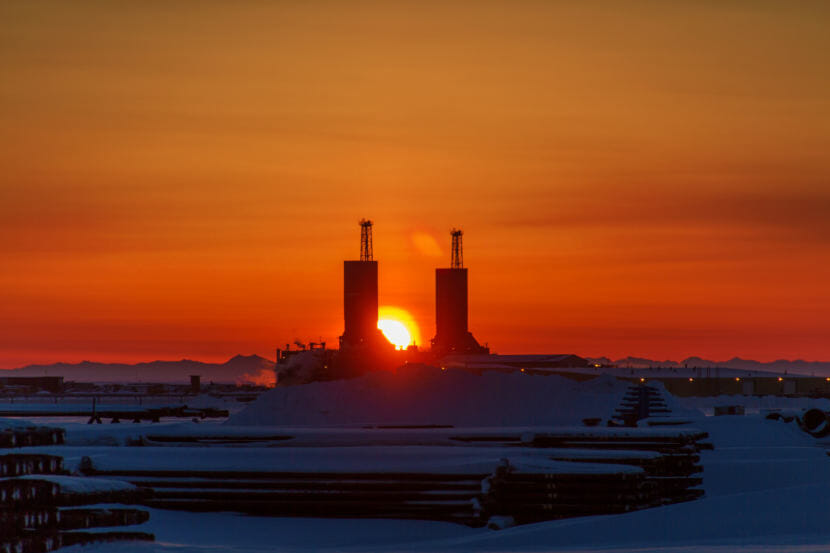
Sunrise on the North Slope behind the two new Parker drilling rigs. (Photo courtesy Kevan Dee)

Over the weekend, attacks on an oil field and processing facility in Saudi Arabia knocked out more than 5% of the world’s daily oil production.

It was the biggest disruption of global oil supply in decades.

Politically, the attacks have generated a lot of momentum. And, briefly, oil prices spiked.

In Alaska, that meant that on Monday, Sept. 16, North Slope crude prices jumped to their highest level in more than two months.

But that jump was short-lived, and the incident hasn’t had a lasting impact on oil prices — or what those prices are predicted to be in the future.
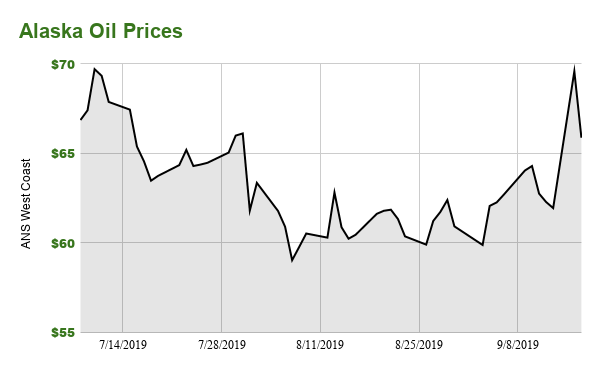
(Graphic by Rashah McChesney/Alaska’s Energy Desk, using data from the Alaska Department of Revenue)

There are a few reasons for that. One is that Saudi Arabia’s energy minister announced on Monday that it is already supplying oil to customers at pre-attack levels. Prince Abdulaziz bin Salman pledged that that country would be back at normal production by the end of the month.

“It was surprising news, and the market reacted thinking there was going to be a lot of supply taken off the market, and it turns out the news wasn’t as bad as feared,” said Alaska Department of Revenue Chief Economist Dan Stickel.

Typically, when oil prices inch up, that’s good for Alaska’s budget. But, a one-day bump in prices isn’t going to do much for Alaska’s bottom line.

“Any short-term volatility isn’t going to have much impact on the budget,” Stickel said. “Right now, prices are below what we had in the latest revenue forecast.”

That revenue forecast is the state’s semi-annual prediction of how much money will be coming in and where it comes from. It’s a big part of how the state develops its fiscal plan. And the price of oil is central to that forecast.

Right now, the Department of Revenue is getting ready to put out its semi-annual forecast. It usually comes out in December.

But some things are going to be different this year.

In the past, the state would bring in oil experts from other parts of the country and the rest of the world. In a closed-door meeting, the outside experts and state economists would come up with an oil price prediction that would drive state spending for the next year.

Stickel said they’re not doing it that way this year: “We are going to look at the futures market as the basis for our price forecast.”

That’s it. No price-forecasting session. No out-of-state experts. Just state employees checking futures and using global oil prices as an indicator of what’s in store for the state.

Stickel said there are a few reasons for the change. A big one is money.
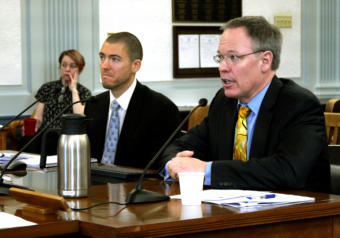
Department of Revenue Commissioner-designee Bruce Tangeman, right, presents the spring revenue forecast to the Senate Finance Committee in Juneau on March 18, 2019. He was accompanied by the department economist Dan Stickel.
Alaska Department of Revenue Chief Economist Dan Stickel, left, with Revenue Commissioner Bruce Tangeman at a Senate Finance Committee meeting in Juneau on March 18, 2019. (Photo by Skip Gray/360 North)

“We’re going to save a lot of time and expense by just using the public forecast source,” Stickel said. Paying the dozens of state employees and outside experts to gather in one place was expensive.

Also, there’s a lot of widely-available information now about global oil markets — and the things that drive prices — that wasn’t available when the state started predicting oil prices.

Stickel said the shift will also help people understand how Alaska is getting its oil price predictions.

“The idea is that it won’t be a group of us just sitting down and deciding on the price forecast. It will have a rather transparent protocol,” he said. “Anyone can say, ‘OK, this is how they grabbed the futures market price.’”

Another factor is that Alaska’s production has declined. The state is putting less oil into the market than it used to.

Stickel said Alaska’s production represents about 0.5% of daily global demand.

It isn’t clear if the change in the way the state forecasts the price of its oil will have a measurable effect on the way the state does business.

Rather, it’s a reflection of Alaska’s diminishing role in the oil markets that it sells into.

“Alaska is now a price taker,” Stickel said.

As opposed to being a price maker. Being a price taker basically means that the state doesn’t produce enough oil to impact prices in the markets that it sells into.

“We used to be a more significant supplier to a smaller market. Now we’re a smaller supplier in a more global market,” he said.
State files felony charges against Baker Hughes after Kenai Peninsula workers were sickened

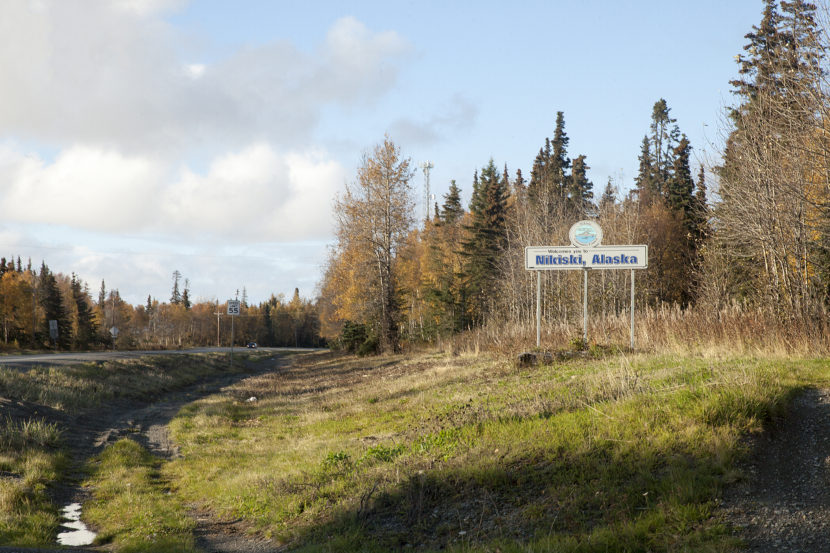
The state of Alaska has filed felony charges against an oil field services company operating near Nikiski. (Photo by Rashah McChesney/Alaska’s Energy Desk)

The state of Alaska has filed felony criminal charges against an oil field services company on the Kenai Peninsula.

An Anchorage grand jury indicted Baker Hughes and John Clyde Willis on Wednesday on 25 felony counts of assault.

The charges come five years after workers on a construction crew for UIC Construction became ill and were treated at a medical facility after working at a Baker Hughes facility near Nikiski.

Workers on that crew attributed their illnesses to exposure to toxic chemical releases. They allege that Baker Hughes, its subsidiaries, and Willis — a manager for a Baker Hughes facility — didn’t respond to their complaints about being exposed to chemicals and didn’t give them the safety information they needed about which chemicals were being used on the job site while they were working.

The state’s district attorney charges that companies, and Willis, recklessly caused injury to Christopher Lovely, Steven Adams, Robert Defoe, Charles VanCuren and Dustin Leavitt by exposing them to toxic gases. That exposure may have caused everything from headaches and respiratory distress to long-term neurological damage, according to the indictment.

A company spokesperson at Baker Hughes sent an email in response to questions about how the company will respond to the indictment and the allegations contained in it.

Stephanie Cathcart wrote that Baker Hughes denies the claims against it and is committed to safety.

If convicted, the company and its subsidiaries face fines of up to $2.5 million for the most serious charges. Willis faces up to 20 years in prison and a fine of up to $250,000 for the most serious charges.

Updated: Coast Guard suspends some Allen Marine tour boats

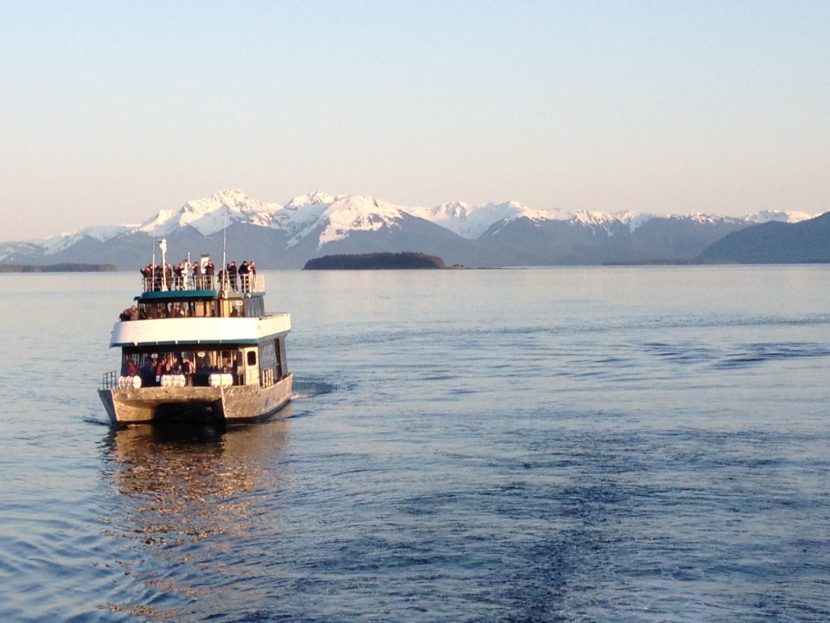
An Allen Marine Tours boat traverses the waters of Southeast Alaska in this 2013 photo. (Photo by Lisa Phu/KTOO)

A wildlife viewing tour operator in Southeast Alaska says they had seven boats taken out of operation on Wednesday after the Coast Guard inspected 10 of their vessels.

Allen Marine Tours operates scenic and wildlife-viewing tours in and around Juneau, Ketchikan and Sitka.

Chief Petty Officer Matthew Schofield, spokesperson for Coast Guard District 17, deferred most questions to Allen Marine. But he did confirm inspectors found multiple issues.

In a press release, the Coast Guard wrote that the violations ranged from “material condition to crew familiarity” that need to be corrected before the boats can sail again. According to the Coast Guard, seven of the boats inspected were in Juneau and three were in Sitka. Of those inspected vessels, the Coast Guard said six in Juneau and one in Sitka were taken out of service.

Schofield said the company is fixing the problems, but couldn’t give a timeline for when the boats can resume tours.

The company sent a statement saying that the Coast Guard found crew training issues. Company spokesperson Zakary Kirkpatrick wrote in an email that the inspections “identified a few items for improvement on select vessels. This resulted in the inability for us to operate scheduled tours aboard those vessels.”

Kirkpatrick wrote that they have always worked with the Coast Guard to ensure compliance and passenger safety and that they’ve safely carried more than 1 million guests on tours of Southeast Alaska.

Kirkpatrick said most of the guests scheduled for tours Wednesday were able to be rebooked on other Allen Marine vessels.

This story has been updated.

Correction: A previous version of this story said that the Coast Guard had suspended operation of 10 Allen Marine Tours boats on Thursday. According to the Coast Guard, they inspected 10 boats but only suspended seven of them on Wednesday.

State ombudsman says Board of Fisheries violated open meetings law

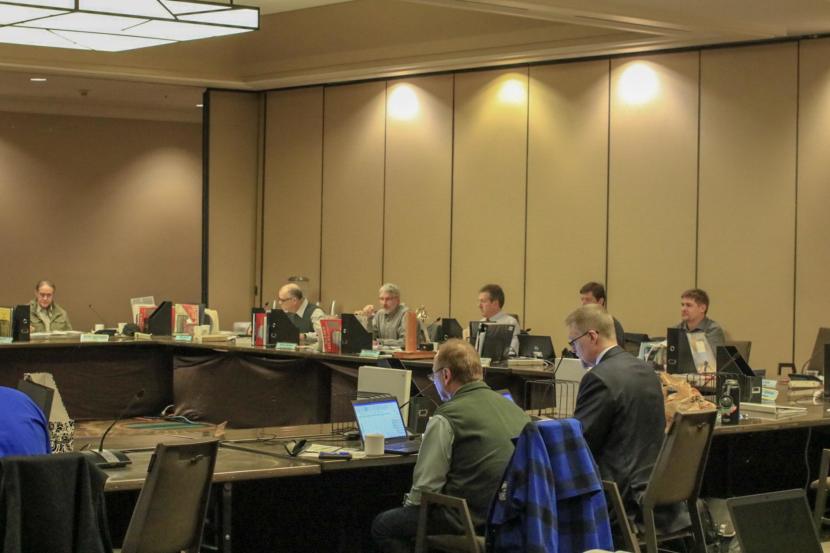
Alaska Board of Fisheries members meet in Anchorage for a work session earlier this year. (Photo by Aaron Bolton, KBBI – Homer)

The Alaska Board of Fisheries violated the state’s open meetings law. That’s according to Alaska’s ombudsman that released a critical report on September 3,  saying the board improperly shifted the location of its Cook Inlet finfish meeting earlier this year with little public notice — the location issue is expected to be revisited again next month.

When the Board of Fish move its Upper Cook Inlet Finfish meeting from Kenai to Anchorage – it took a lot of people by surprise. Kenai Mayor Brian Gabriel was one of them.  Gabriel is also longtime commercial fisherman.

“It wasn’t on the agenda,” he said. “We just happened to get a heads up that they were going to consider that later in the meeting.”

This is a big deal because for nearly two decades, these finfish meetings — which set fishing regulations for commercial, sports and subsistence fishing in Upper Cook Inlet —  have been held in Anchorage.  The issue has long been a point of contention for Cook Inlet fishermen who say that the cost of travelling to Anchorage for the meetings is exorbitant.

Gabriel said fishermen from outside of Anchorage have been asking for the meetings to be moved for years.

“These meetings last for two weeks,” he said.”  “That’s a commitment for folks to go up there and participate.”

Last year, the board decided to rotate the location of the meeting between Anchorage, Kenai Peninsula and Mat-Su.

Gabriel said  he thought the fight was finished after the board voted last year to hold its 2020 meeting on the Kenai Peninsula. But then word came that the board was poised to reconsider at its January meeting in Anchorage. Gabriel and other area officials drove up to speak to board members. But then the message changed again. 

“We were told that they were not going to have the vote that day. Apparently they had some second thoughts about the public notice part of it. So we turned around and came home,” he said.

After they left the board did vote after all. By a single vote it changed the location of the 2020 meeting back to Anchorage. Board of Fish Chair Reed Morisky did not reply to a request for comment Wednesday. But in meeting tape from January, he admitted there had been some confusion in the room.

“So, I take full responsibility for that, there was no intent to mislead,” Morisky said.

State investigators couldn’t account for the last-minute change, either.

“He was not able to tell the investigator what the circumstances were that changed,” said Alaska State Ombudsman Kate Burkhart.

She said she looked into the whole affair following a complaint to her office.

“It really did not follow the spirit of the law, which is that public entities do the public’s work in public,” she said.

The ombudsman advised the board to hold a fresh vote at its October meeting.

Board of Fish Chair Reed Morisky wrote a letter to the ombudsman pledging the rotating meeting location policy will be revisited next month.

But Gabriel  said he doesn’t have a lot of faith the board will change course.

Still, he said he’s grateful the ombudsman stepped in.


Unalaska recovers $2.3M after phishing email scam

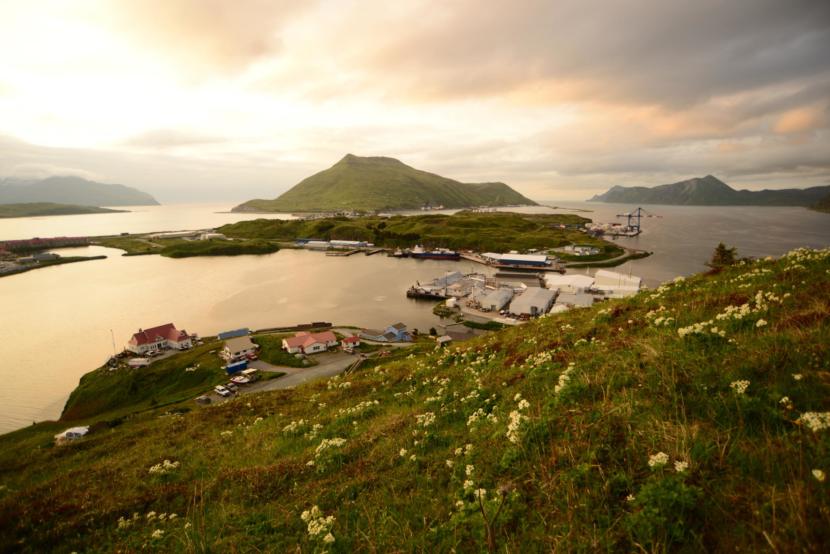
The first cruise ship of the 2019 season is scheduled to arrive in Unalaska on May 6.
The  City of Unalaska recovered much of nearly $4 million taken in a phishing email scam. (Photo by Berett Wilber/KUCB)

More than $2.3 million dollars has been returned to the City of Unalaska, after a nearly two-month federal investigation into a fraudulent financial request.

Between May 15 and July 9, the city paid out $2,985,406.10 to a fraudulent bank account as a result of a phishing email scam.  The sender of the email represented themselves as a known vendor and requested a change in payment method.

City Manager Erin Reinders said as soon as they were made aware of the fraudulent activity in July, city officials acted quickly to notify the Federal Bureau of Investigation (FBI), as well as the city’s attorney and insurance company.

“It was at that point where we recognized that we had been transferring funds that were in response to legitimate invoices from a known vendor into an account that was not the vendor’s account,” said Reinders.

Reinders would not comment on who the legitimate vendor was. But that vendor has since been paid the full amount owed.

Federal officials were able to recover $2,347,544.43 of the nearly $3 million. The remaining $637,861.67 was not recovered, but Reinders said she expects the city’s insurance will cover the remainder of the city funds.

In a statement, FBI special agent Steve Forrest wrote that fraudulent schemes are increasing in frequency and sophistication.

“In the case of Unalaska, we were able to recover funds and prevent any future loss thanks to the timely and thorough response from the city administration,” Forrest wrote. “We are continuing to investigate this case in an effort to identify the perpetrators.”

Unalaska has been involved in at least three federal investigations this year. In addition to the fraud inquiry, investigators are still looking into the Mount Ballyhoo car crash that killed two teenagers in May, as well as the death of a U.S. Coast Guard seaman in January. Last week, another 19-year-old coastguardsman was charged with his murder.

Earthquake shakes Southeast Alaska, no tsunami danger

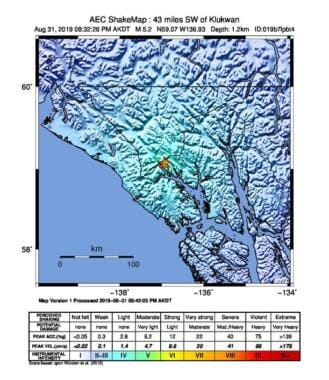
(Graphic courtesy Alaska Earthquake Center)

A 5.0 magnitude earthquake rattled Southeast Alaska residents late Saturday evening.

There is no tsunami danger from this earthquake, according to the Tsunami Warning Center in Palmer.

The earthquake struck just after 8:30 p.m. about 100 miles northwest of Juneau, in a remote corner of Glacier Bay National Park and Preserve, according to the Alaska Earthquake Center.

A 3.8 magnitude earthquake struck nearby two days ago, according to the Alaska Earthquake Center data.

Residents of Juneau, Haines, Skagway and Klukwan reported feeling the quake.

Site notifications
Update notification options
Subscribe to notifications