Rashah McChesney

Daily News Editor

I help the newsroom establish daily news priorities and do hands-on editing to ensure a steady stream of breaking and enterprise news for a local and regional audience.

Court training aims to improve outcomes in child welfare cases

The court system’s case filing and records management system in the clerk’s office of the Dimond Courthouse in Juneau on April 22, 2019. Folders are color-coded by case type: Different stickers correspond to specific judges, and case numbers also color-coded by year. (Photo by Jeremy Hsieh/KTOO)

There are thousands of open child welfare cases in Alaska.

These could be anything from child abuse cases to divorces. The cases are complicated, and they take a lot of people and time — and communication — to resolve.

Dozens of people flew into Juneau in early December for a training program aimed at getting everyone involved in child welfare cases on the same page.

Among them were Bart Meyer and Stacey Wayne. The two started a mediation business together in Sitka about a year ago.

“I think we’re the only couple in the state that offer mediation together,” Wayne said. “Most mediators work independently, but we always work as a team.”

Wayne said that it has been helpful to have two genders in the room when they’re mediating — so that everyone is comfortable that they’re going to be treated fairly. She said those mediation techniques they’ve learned have also worked their way into the couple’s personal lives.

“I thought that I was good at conflict resolution but … I learned a lot of tricks I wished I’d had when I had younger children,” she said. “Now I apply them to our combined four children, much to their dismay. I think they do hear us trying our mediation tactics and call us out on it — but they are useful.”

The core of the couple’s business is working with the state court system to help resolve disputes in legal cases.

They came to Juneau to learn about handling child welfare cases. In Alaska, they’re called “child in need of aid” cases, or CINA cases. There are more than 3,400 of them open in the state right now. When one of these cases gets opened, a lot of people get involved.
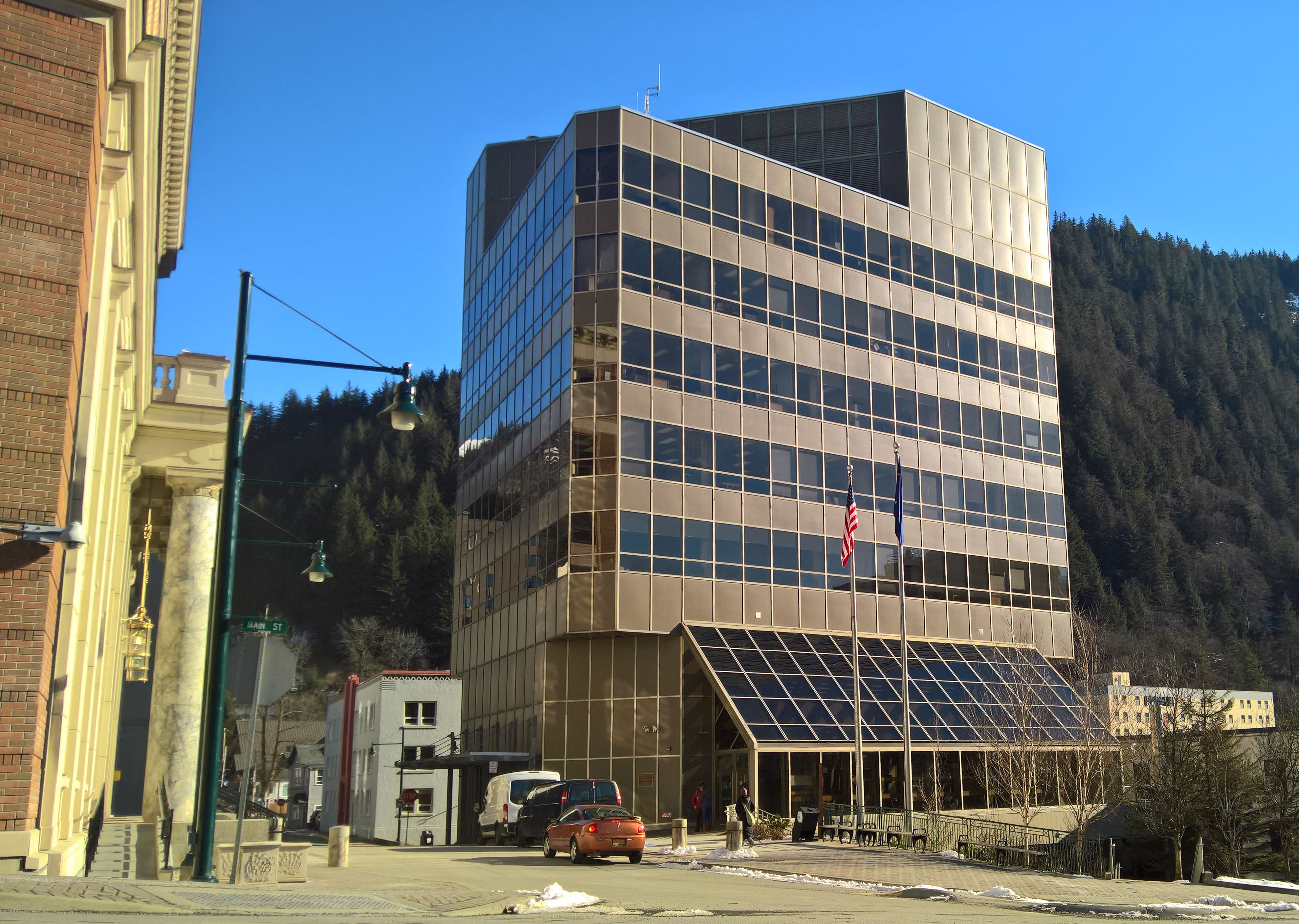
Dimond Courthouse
The Dimond Courthouse in Juneau, where the training program took place. (Photo by Jeremy Hsieh/KTOO)

Barbara Malchick, a former state lawyer, spent six years designing the curriculum for the CINA case training. She’s part of a Court Improvement Program that got a federal grant for the training.

“(CINA cases) are not handled the same way as your typical cases, like a criminal case where you have a prosecutor, a defendant and a defendant’s attorney. In our cases, we have multiple players,” said Malchick. “We have the Office of Children’s Services, represented by an attorney from the attorney general’s office. We have the parents, a mother, a father.”

Each of the parents in a case could have an attorney, and sometimes there are multiple sets of parents. The children are considered legal parties as well. They’re represented by a guardian ad litem — a person appointed specifically to represent the best interests of the child. If the child is Alaska Native or Native American, their tribe becomes a legal party to the case as well.

When you get all of those people in the room — the prosecutor, the defendant, all of the attorneys, the judges, the families — Malchick said it can be difficult to get everyone on the same page. And up until about nine years ago, there wasn’t any training in place for people who were involved in those types of cases in Alaska.

“I think it was pretty obvious from the beginning that, especially new practitioners didn’t have a clue,” she said.

Malchick said the curriculum has evolved to handle issues that come up routinely in cases.

“We have a module called ‘family well-being’ that talks about child development and the impact of abuse and neglect on children,” she said. “We have another full-day module that talks about services and resources, so the kinds of treatment resources that are available to help families to prevent the child abuse and neglect, or to help them get their children back.”

Everyone at the training in Juneau got a crash course in the state and federal laws applying to each case. Then they took a hypothetical child welfare case and ran it from start to finish.

Meyer and Wayne are not lawyers. They don’t give legal advice. Their job is to get everyone into the room together to work out some kind of agreement. Wayne said the training is a good way to meet people face-to-face that they’re often only communicating with via phone or digitally.

“It’s really great to sort of build those relationships. Having that kind of trust and familiarity when you’re trying to work through difficult problems with people is so important,” she said.

Sitka caseworker Krista Perala said that meeting in-person is impactful for her too.

“Normally I’m that looming voice on the phone,” she said. “I’m from Sitka, so we can’t travel every day to, like, a court hearing here in Juneau.”

Perala works for the Sitka Tribe of Alaska. She specializes in the federal law that covers child welfare cases when a Native American or Alaska Native child is involved. That law — the Indian Child Welfare Act — prioritizes a tribe’s jurisdiction and interest in maintaining cultural practices in a child’s life.

Perala said she’s in court nearly every day. But the opportunity to run through a case with everyone involved — to train with everyone — is invaluable.

“You have (the Office of Children’s Services) supervisors, assistant attorney generals, Judge (Amy) Mead is sitting right next to me. You have all of these amazing players that play a huge part in these young children’s lives,” Perala said. “They’re at the same table, learning the same exact thing, and you hear, ‘OK, well (the Office of Children’s Services) has challenges with this. How can we fix that?’ The tribe has challenges with this. How can we fix that?’ And everybody is at the table coming together and collaborating.”

The Sitka Tribe of Alaska has cases all over the state and country, and that means Perala is often working on cases where she’s communicating across cultural divides.

In Juneau, she said the training is another chance to educate people about the cultural practices that are important in an Alaska Native child’s life — and that is a step toward addressing racial disparities in the system.

“If you think about it, the majority of the race that’s within Alaska is Caucasian, and the minority is Alaska Native. But within the child welfare system, the majority race is Alaska Native when the minority is Caucasian.”

Perala said she values the chance to communicate across barriers.

Correction: A previous version of this story misspelled Barbara Malchick’s name.

No politics: Just cookies, fudge and photos at traditional open house

Marty Meyer, Lt. Gov Kevin Meyer, Rose Dunleavy and Gov. Mike Dunleavy chat with each other as they wait to greet visitors who stopped by the Governor’s Mansion for the annual Christmas open house on Tuesday in Juneau. (Photo by Rashah McChesney/KTOO)

Hundreds of people stopped by the Governor’s Mansion in Juneau on Tuesday for the annual Christmas open house.  

Before the doors opened, Gov. Mike Dunleavy talked with reporters for a few minutes. Hdidn’t answer specific questions about the upcoming budget.  

“You’re going to find out tomorrow when we roll out the budget, tomorrow is when we roll out the budget,” he said.

But he said that help may be on the way for the state’s struggling ferry system.

“They’re looking at the possibility of getting some help there with $20 million out of (the Legislative Budget and Audit Committee). So we hopefully will hear something soon on that,” he said. “This situation is being monitored and has been monitored, discussed and we’re looking at coming up with some solutions this year — long-term solutions for the marine highway system.”

Lala Jackson, 2, shakes Gov. Mike Dunleavy’s hand during the annual Christmas open house on Tuesday in Juneau. (Photo by Rashah McChesney/KTOO)

He did answer questions about the trays piled high with cookies for the crowds. According to the governor’s office, there were about 15,000 cookies and 100 pounds of fudge and chocolate candy on hand for visitors. 

“I’m not supposed to say that I tried a cookie like a chocolate chip, but I have and that’s my favorite,” he said.

Hundreds of people stopped by the Governor’s Mansion for the annual Christmas open house on Tuesday in Juneau. (Photo by Rashah McChesney/KTOO)

That set the tone for the evening. There wasn’t a lot of political talk going around. That didn’t surprise Juneau resident Becky Allison.   

“This was about my fourth one I’ve been to. The last one I went to was when Sarah Palin was in office, so its been a few years,” Allison said.

She said she doesn’t remember a lot of political talk then either. 

“She was a controversial person herself, but I didn’t hear anything the whole time, it was a good visit then too,” Allison said.

Dunleavy is expected to release his budget on Dec. 11.

Southeast Alaska fisherman pleads guilty to illegally harvesting $35,000 worth of sea cucumbers

Sea cucumber. (Creative Commons photo by Mary Harrsch)

A Southeast Alaska commercial fisherman has been convicted for his role in illegally harvesting nearly 7,500 pounds of sea cucumbers near Prince of Wales Island.

Jonathan McGraw Jr., of Naukati Bay, pleaded guilty to fishing in closed waters and providing false information on a harvest report. Both are misdemeanors.

In 2018, McGraw and two others were charged with illegally fishing in a scientific preserve near Whale Pass. That area has been closed to fishing since the 1980s.

Alaska Department of Fish and Game biologist Justin Breese wrote in an email that there would definitely be an impact from the illegal harvest. The scientific preserve is designed to give managers some idea of what natural mortality rates among sea cucumber populations look like when they’re not being harvested in a commercial fishery.

“Therefore there would definitely be some impact due to the illegal harvest since it is an extra source of sea cucumber mortality that would then be applied across the entire fishery,” Breese wrote.

Still, the sea cucumber population in Southeast Alaska is doing well, so “teasing out the impact of 4 tons of illegal harvest out of other factors is a difficult problem,” he said.

Charges for the three men came after other divers told Alaska Wildlife Troopers that the men were bringing in large loads of sea cucumbers, but no one was seeing McGraw’s boat — the FV Bottom Time — in the usual fishing areas, according to the Anchorage Daily News.

McGraw was sentenced to a month in jail and fined more than $35,000, the approximate value of the stolen sea cucumbers. He didn’t respond to an attempt to reach him via social media.

He will also lose his commercial fishing privileges and will be on probation for one year.

One of the other two men who were charged, Curtis Looper, was convicted in late 2018 of fishing in closed waters.

In Tlingit land-rights loss, a Native American rights attorney lays out injustice and hope for the future

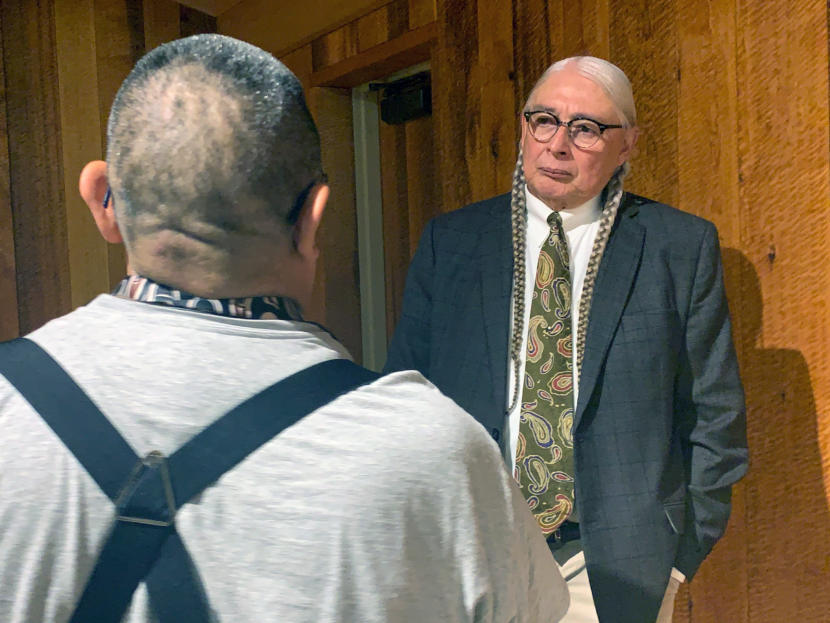
Walter Echo-Hawk talks to a man after giving a speech on the 1955 Tee-Hit-Ton Tlingit loss of a Supreme Court case on November 8, 2019, in Juneau, Alaska. (Photo by Rashah McChesney/Alaska's Energy Desk)
Walter Echo-Hawk talks to a man after giving a speech on the 1955 Tee-Hit-Ton Tlingit loss of a Supreme Court case on Nov. 7, 2019, in Juneau. (Photo by Rashah McChesney/Alaska’s Energy Desk)

Walter Echo-Hawk is, essentially, a walking law library. It makes sense, given that he’s been practicing law since 1973.

He rattles off cases from memory — from the WWII-era Korematsu case that was used to uphold internment of Americans of Japanese descent, to the Dred Scott decision from 1857, when the U.S. Supreme Court held that the Constitution didn’t include citizenship for black people.

Echo-Hawk’s lecture was peppered with legal cases that laid out a framework for his argument that legal system has — at times — prioritized justice, and at other times has been subject to bias and racism.

“Most Americans, in our free and democratic society, tend to equate our legal system with justice. But what is justice? We think we know it when we see it,” Echo-Hawk said. “But by justice, what I mean here is that condition when the law fairly protects widely-held needs and values of all segments of the population.”

But it was the 1955 Supreme Court decision against the Tee-Hit-Ton Tlingit people that he centered his lecture on while speaking to about 60 people in the Shuká Hít clan house at the Sealaska Heritage Institute on Thursday.

Echo-Hawk spent a lot of time talking about justice — what it means and who has access to it. And as an example, he used the Tee-Hit-Ton case that he calls one of the greatest miscarriages of justice in Indian Law.

Essentially, Tlingit land was taken to create the Tongass National Forest. Then, in 1951 the Forest Service offered up 350,000 acres of that land for a timber sale, near Wrangell. That land is home to the Tee-Hit-Ton Tlingit, and they sued.

Echo-Hawk calls it a test case. One that was designed to determine the extent of Tlingit land rights in Alaska at the time.

In this case, the Tlingit said they had aboriginal title to the land.

“They said it’s just as valid as any white man’s ordinary real estate title is,” he said. “In the case, the Tlingits contended that the timber sale was unconstitutional because their property in that vast area could not be taken by the government without their consent, without just compensation as required by the Fifth Amendment.”

But that case didn’t end well for them. In 1955, the Supreme Court ruled that Congress gave them permission to occupy their homelands but not title to it — so they had no basis for a claim that the government owed them money.

Echo-Hawk laid out a few reasons why this happened, including racism and ignorance found in several legal opinions in federal Indian law cases.

“The idea that Indians are racially inferior, that we have inherently inferior characters, that our cultures are inferior and that even our religions are inferior,” he said.

He also said that the 1950s was not a good time in the country to be bringing up these cases for Native American and Alaska Native people.

“This was when the cowboy-and-Indian movies reigned supreme. All Americans thought they were cowpokes riding in the Wild West,” he said.

And federal policy at the time revolved around erasing Alaska Native and American Indian culture.

“Given all of these factors, the Supreme Court can hardly be expected to come down with a favorable decision in this case for the Tlingit,” he said.

Katherine Eldemar has some thoughts on that last point. She’s a lawyer and a judge, and she’s on the board of directors of the Juneau-based Native corporation Goldbelt, Inc. She’s also Tlingit, from Juneau.

She talked to Echo-Hawk after his presentation. She told him that she likes to focus on solutions to systemic problems, especially as it pertains to laws affecting indigenous people in the U.S.

“How do you get the Supreme Court of the United States to rule and administer justice in their ruling? As tribal judges, we saw some pretty challenging Supreme Court cases that really did harm in Indian country,” Eldemar said.

One thing she suggested? Get the judges out of their chambers.

“They need to see where their decisions are being implemented and the outcomes. See the poverty. See the challenges and see how it does not work,” she said.

Echo-Hawk agreed with her. He said the lack of education among the judges and policymakers is probably the biggest single issue facing Indian country today.

But he also said that there’s a different mindset now than there was in 1955 — that this is the dawn of a brand new era, a human rights era.

He points to the United Nations Declaration on the Rights of Indigenous Peoples. It was ratified in the U.S. about a decade ago. And he said that U.N. framework could be used as the basis for legal arguments framing indigenous rights as human rights.

That was an argument that Rosita Worl took to heart. Worl, who is Tlingit, is the president of the Sealaska Heritage Institute. She said Southeast Alaska Native people have appealed to the U.N. before — during a fight for their subsistence rights. And she didn’t really see a legal mechanism for the U.N. to help them at the time.

But now?

“We have this proclamation, and it sets out a framework for justice for Native, indigenous people. And I hadn’t thought about, you know, bringing it to the next step of having our states, having our government — the national government and the state-level government — implement those recommendations. So I’m going to go back and take another look at them,” she said.

Still, she sees echoes of the same arguments used to justify keeping Tlingit people from owning their land in that 1955 Supreme Court case being used in cases facing Southeast Alaska Native people today.

She points to Alaska Native Vietnam Veterans who are newly eligible for land claims. But they can’t select land near their homes in the Tongass National Forest — which she said in an injustice.

Facing a $16M repair, Alaska’s ferry system will pull Malaspina out of service

It was pouring rain when the Malaspina docked in Juneau.
The Malaspina docked in Juneau in 2014. (Photo by Heather Bryant/KTOO)

The ferry Malaspina is being pulled out of service in December, and it’s not clear when it will return.

The 56-year-old Alaska Marine Highway System vessel will be stored in Ketchikan this January for an “unmanned, long-term layup,” according to the Alaska Department of Transportation and Public Facilities.

The ferry was scheduled for an overhaul over the winter, but an inspection showed it needs extensive steel replacement. Repairs are expected to cost about $16 million.

“… This is in excess of the available budget and cannot be completed at this time,” wrote Department of Transportation spokesperson Meadow Bailey in an email.

Bailey wrote that there won’t be any impact to the current sailing schedule. DOT hasn’t made any long-term decisions about the future of the vessel.

Southeast, Southwest Alaska lag in new jobs report. But there are bright spots.

(Photo by Heather Bryant/KTOO)

Gov. Mike Dunleavy took to social media on Monday, sharing news that Alaska’s employment is up — there are about 2,000 more jobs than there were at this time last year. 

Things are looking really great for our economy here in Alaska and we’ll continue to give you some good news as it unfolds, but things are looking really well for the state of Alaska,” Dunleavy said in a video announcement. 

The state’s unemployment rate is at 6.2%.  

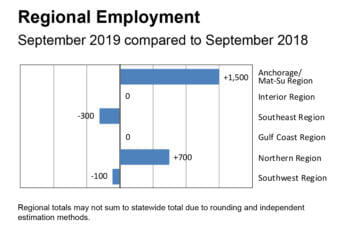
But, the state’s department of labor noted that Alaska lost 400 state jobs in the past year and about a quarter of those were in Southeast Alaska. 

(Graphic courtesy Alaska Department of Labor and Workforce Development, Research and Analysis Section)
(Graphic courtesy of Alaska Department of Labor and Workforce Development, Research and Analysis Section)

“It was obviously hit harder than the state as a whole, just given the concentration of state government jobs that we have in this area, particularly in Juneau,” said state economist Karinne Wiebold.

While most parts of the state saw an uptick in jobs, the Panhandle shed 300 of them. That’s in contrast with the Anchorage and Mat-Su regions which added the most jobs. The fastest growth was in construction and oil and gas.

But it’s not all doom and gloom for Southeast. The visitor industry continues to drive jobs in the private sector. More than a million cruise ship passengers called in Southeast ports this year. That number is expected to climb to 1.4 million next year.

Tourism, particularly cruise tourism has a pretty strong effect in our summer employment in the last two years have been particularly strong with the cruise ship traffic. So that’s a little bit of a bright spot for us,” Wiebold said.

Overall Southeast Alaska’s unemployment rate stands at 4.8 percent. That’s still the lowest jobless rate in Alaska.  


Site notifications
Update notification options
Subscribe to notifications