Rashah McChesney

Daily News Editor

I help the newsroom establish daily news priorities and do hands-on editing to ensure a steady stream of breaking and enterprise news for a local and regional audience.

Hooper Bay School closed after a pipe burst, flooding the building

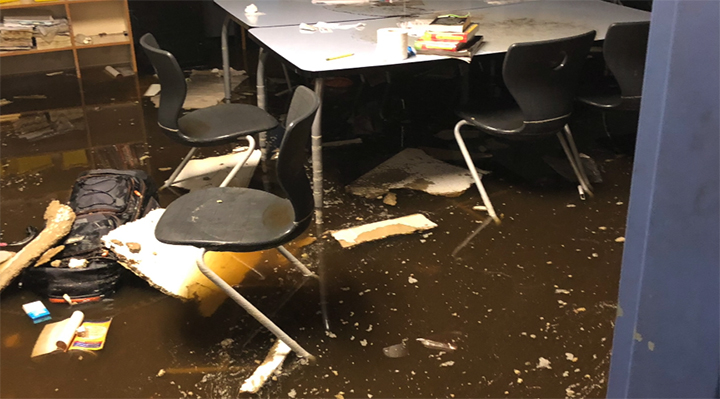
A flooded room inside of the school in Hooper Bay. (Photo courtesy Daniel Cernek)

Update (Feb. 10)Anna Rose MacArthur, KYUK – Bethel

Hooper Bay students returned to school Feb. 3, for the first time since December. A pipe burst in the school during winter break, flooding the building, wreaking havoc and delaying the spring semester. (Read more)

Original story

School is out in the coastal community of Hooper Bay in Western Alaska after extreme cold weather in December caused a pipe to burst and flood the building.

Students were supposed to return on Jan. 5, but Lower Yukon School District officials say that can’t happen until the school has been repaired.

There’s a movie floating on social media that a Hooper Bay resident Daniel Cerneck made. It’s cell phone video and still images shot by people walking through the Hooper Bay School in December.

Several inches of water pour down the stairs. The lights are flickering or fully out in the hallways, chunks of ceiling tiles float along the floor — at one point, a man opens a classroom door and at least a foot of water, books and paper plates stream out.

“We had a significant break in a fire-suppression water line,” said Lower Yukon School District Superintendent Hannibal Anderson.

The damage is extensive, but Anderson said staff are hoping to have the school reopened by the end of January. He said the current plan is to extend school days when class is back in session to make up for the time off.

Right now, the teachers and staff who would normally be working, are not.

Anderson said the teachers will continue to be paid on their normal schedules — they’re salaried. But it could pose a problem for staff who are paid hourly.

So far, Hooper Bay School Principal David Harris said all of the staff — about 20 of them — who could have been out of work have instead taken jobs cleaning up the school.

He said it’s hard work.

“We’re a two-story building, and I have 50-year-old women going up and down these stairs, and I don’t know about what kind of shape you’re in, but I know I get tired just looking at them,” Harris said.

He said it has been a community effort to get the school gutted, fixed and reopened. The school’s cook is making meals during the day.

“Sunday they made a turkey dinner for all the workers. I think today, I think he’s doing moose today. A moose dinner,” Harris said. “I had a lot of Papa Murphy’s pizzas in my freezer, so we were able to feed ‘em Papa Murphy’s, which is always a big hit out here.”

Still, it’s costing the school money to be closed. A basketball tournament that was scheduled in January had to be canceled. That’s how the kids raise money for activities — selling tickets and things from their school store.

“That’s a financial hit that we’re taking. Probably $12,000 to $15,000,” Harris said.

There’s another large basketball tournament coming up: the Bering Sea Classic. Typically the Hooper Bay School hosts eight other schools, or 16 teams-worth of kids in the school building. They’ve rescheduled the event for Feb. 5, but schools set their travel seasons in advance, and Harris said hasn’t been able to confirm that any of the other schools are still coming.

“(I) would love to talk to any coaches in Alaska who would like to send their teams out here. We would love for them to come, to fill out our bracket,” he said, laughing.

And what are all those kids doing while the school is closed? Harris said it’s tough, because school is a big part of their lives.

“In village life, the school is the epicenter. We provide the daily routine of going to school. We provide open gym for the kids to come play ball on the weekends,” he said. “These kids, they don’t have movie theaters, the don’t have bowling alleys, they don’t have shopping malls.”
Despite conflict with Iran, Alaska oil prices are mostly unchanged. Here’s why.

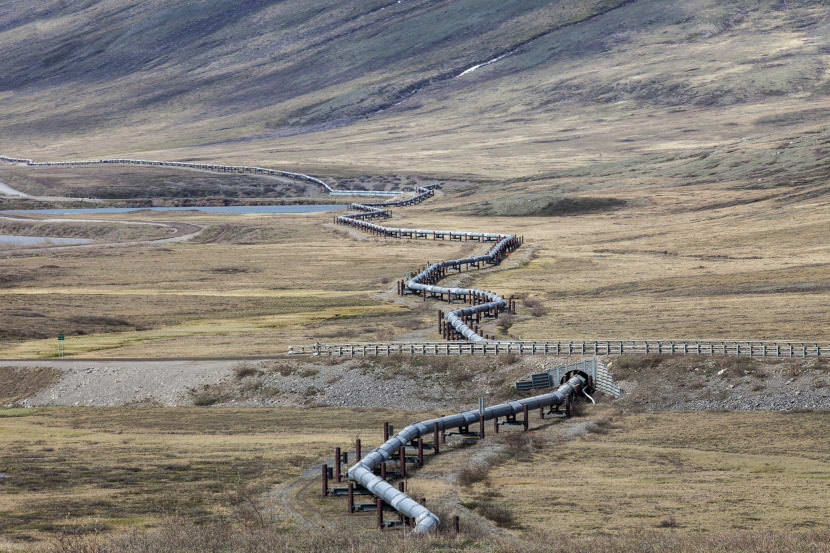
An above-ground section of the Trans-Alaska Pipeline System near the Toolik Lake Research Station in the North Slope Borough. (Photo by Rashah McChesney/Alaska's Energy Desk)
An above-ground section of the Trans-Alaska Pipeline System near the Toolik Field Station in the North Slope Borough. (Photo by Rashah McChesney/Alaska’s Energy Desk)

Oil prices spiked on Jan. 3 after news broke that the U.S. killed Iranian Gen. Qasem Soleimani in a drone strike in Iraq — and again last week, when Iran retaliated by firing missiles at a U.S. military base in Iraq.

But after a short shock in prices, Alaska North Slope crude has settled at a lower price than it was before tensions boiled over.

Analysts say that’s because tension in the Middle East just doesn’t have the same impact on the market for Alaska’s oil that it used to.

Roger Marks is a retired state petroleum economist. He worked for Alaska’s Department of Revenue, watching what was happening politically — and the oil market’s response to it — for 25 years.

“I was there when Iraq invaded Kuwait,” he said. “I was there when the U.S. invaded Iraq, both times.”

At the beginning of his career, disruptions in the Middle East caused a lot of sustained turmoil in the oil market. Marks said during the first Gulf War in the early ’90s, prices jumped up and stayed up for almost a year.

But ask him what oil prices are going to do at any one point, and he’ll laugh.

“You know, nobody knows. Anybody who tells you they know, that’s a sign they don’t know what they’re talking about,” he said.

Oil prices did jump up: Alaska North Slope crude got to nearly $71 on Jan. 7. But the price dropped pretty dramatically the next day. And that, in part, is because the energy market is very different now than it was a decade ago.

Marks points to the attacks on an oil field and processing facility in Saudi Arabia in September that knocked out more than 5% of the world’s daily oil production.

It was the biggest disruption to global oil supply in decades, and Alaska North Slope crude prices jumped to their highest in months — adding nearly $8 — for one day. Then they dropped right back down.

And for Alaska, a one-day spike in oil prices doesn’t really mean much for the state’s bottom line.

But that dynamic — the oil market shrugging off attacks on oil and gas infrastructure in the Middle East — is one that some economists caution is probably not going to last forever.

Richard Nephew is a senior research scholar at the Center on Global Energy Policy at Columbia University. He used to work for the U.S. Department of State, where he was the lead sanctions expert during the negotiations with Iran under former President Barack Obama.

Nephew said there are three reasons the oil market isn’t as reactive to geopolitics in the Middle East as it used to be.

Right now, there’s enough supply that there’s kind of a sense that small, short-term disruptions can be handled.

“There’s enough oil coming from other sources — Alaska being a part of this, but also shale oil and Venezuela and Libya and all those places,” Nephew said. “There is enough oil that’s just floating around that disruptions in any one of those places can be made up by supply in many other places.”

The second reason? Global demand for crude oil isn’t growing like it used to. And third, recent disruptions in supply have been short-lived. After the attack in September, Saudi Arabia brought its oil production back online within a few days.

“Here, you know, you had a spike, and then both Trump and the Iranians said, ‘We’re going to leave the military responses here, so you see things relax,'” he said.

Nephew said he thinks the people driving the oil markets have gotten complacent. They worry about the possibility of a major disruption in supply in the Middle East, but “they’ve kind of internalized this idea of ‘but that probably won’t happen.’”

Nephew said that false confidence is a big problem because, right now, the expectation is that there will be sharp swings in prices and then things will calm down.

But he points out that while Iran may have discounted further military action, there is still the possibility that the country could retaliate. For instance, if Iran were to shut down the Strait of Hormuz that separates it from the Arabian Peninsula — where more than than 20% of the world’s supply of oil comes through — that could cause a major disruption.

“The day that we don’t have things calm down, the day that we do have sustained production losses of 5 million barrels a day or something like that — that’s when you’re going to see a tremendous rise in prices, and it probably will be sustained for a pretty long time,” he said.

To balance Alaska’s budget, prices would have to hit $91 a barrel and stay there, according to the state’s Department of Revenue.

Alaska Supreme Court Justice Craig Stowers to retire

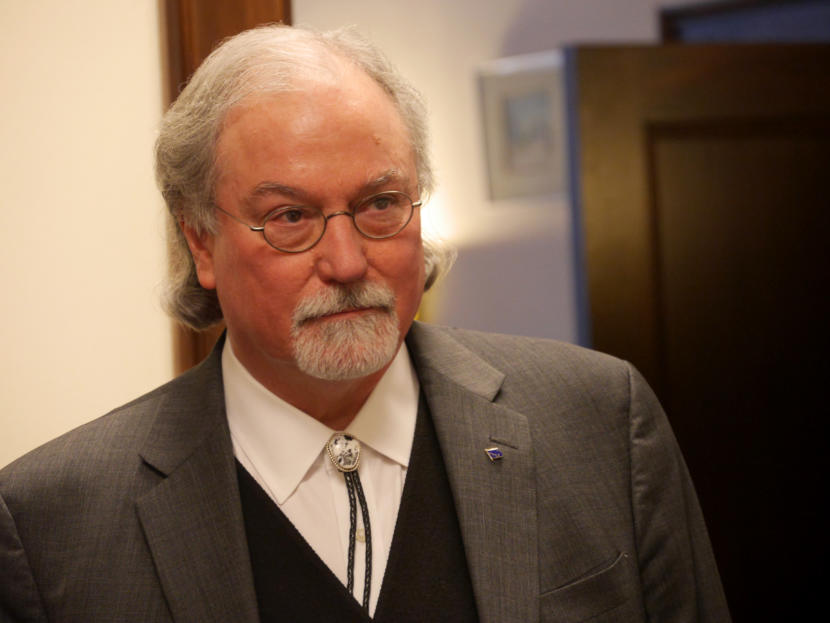
Alaska State Supreme Court Justice Craig Stowers waits outside the House speaker’s office before delivering his State of the Judiciary address to a joint session of the Alaska Legislature on Feb. 7, 2018, in Juneau. (Photo by Skip Gray/360 North)

After more than a decade on the Alaska Supreme Court, Justice Craig Stowers is stepping down. He’s set to retire on June 1.

The Alaska Judicial Council is looking for a replacement. The council put out a call on Jan. 3 saying it would take applications through Feb. 14.

The council screens applications and then sends a list to the governor. It will be some time before a new justice is seated: The judicial council meets in mid-May then will send its recommendations to Gov. Mike Dunleavy.

According to the Alaska Constitution and state law, the governor is supposed to appoint someone within 45 days. Judicial Council Executive Director Susanne DiPietro said that means a new Justice may not be seated until August.

The job pays just over $205,000 a year and is one of five justices on the state Supreme Court.

New vendor awarded $8.5M to service Coast Guard’s failing VHF sites

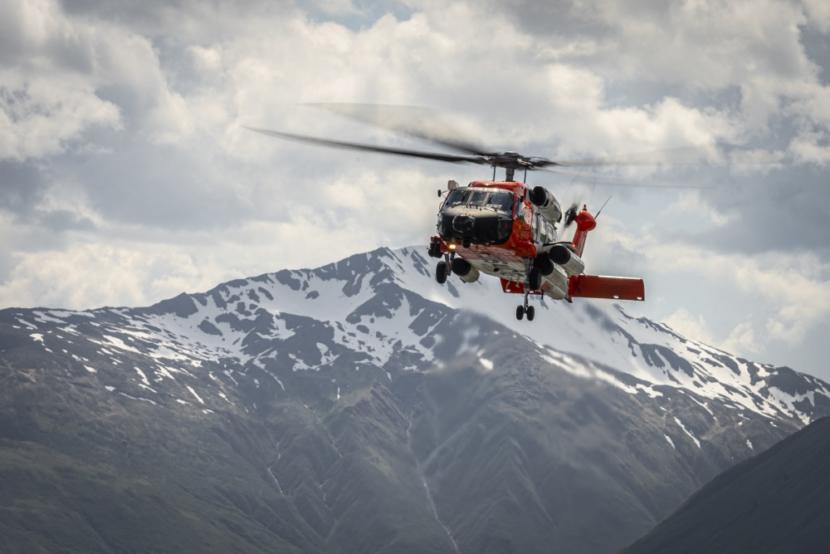
Coast Guard helicopter
An aircrew aboard an MH-60 Jayhawk helicopter makes an approach on their return to Coast Guard Air Station Kodiak, June 5, 2019. (Public domain photo by Petty Officer 1st Class Bradley Pigage/U.S. Coast Guard)

Widespread outages of the Coast Guard’s VHF relay towers persist across Alaska. The federal government has signed a new vendor to begin repairs, but the Coast Guard continues to advise mariners to carry satellite phones and other more sophisticated means of communication as a back up.

For those unfamiliar with marine radios, VHF’s Channel 16 is akin to 911 on the water.

“I don’t know how many people would be that comfortable if suddenly the 911 system went down for months at end, that’s kind of what we have here,” said Ed Page, a retired Coast Guard officer who now runs the Marine Exchange of Alaska.

Marine Exchange offers real-time satellite vessel tracking. But Page says often the simple marine radios are the best things to carry.

Now the Coast Guard’s suggesting that mariners use their cell phones and these SPOT or satellite transponders,” Page said. “But we shouldn’t have to depend on that. Really, the best technology still should be the VHF call on the radio; it’s been around for years.”

Poor VHF coverage isn’t a new issue. Blame Alaska’s geography and weather for that. But this many outages at once is not normal. The Coast Guard doesn’t service its towers. It relies on private contractors to do this work for it.

They have to go to Congress and secure funding and then they usually use defense contractors and it takes many years,” Page said.

In Southeast Alaska, there are 34 relay towers that can beam a distress call from the water to a Coast Guard watchstander.  About a third of those are offline, said Coast Guard Lt. Commander Scott McCann.

So there’s a decent chance that we might not hear any calls for distress on channel 16,” he said.

But he said even if watchstanders don’t hear a call, others nearby might.

“Just because our towers are down, and we might not be able to hear you doesn’t mean that other people’s VHF doesn’t work,” McCann said. “Our towers being down does not affect others. “

Servicing the towers had been the responsibility of Lynxnet, LLC, a Virginia-based subsidiary of NANA Regional Corporation of Kotzebue. But its contract expired last month and it wasn’t renewed.

Silver Mountain Construction, a Palmer-based firm owned by Cook Inlet Region, Inc. also known as CIRI, was recently awarded an $8.5 million contract to take over servicing the sites.

The Coast Guard’s expectation is service will improve over time.

“One of the main things we were looking for when changing over contracts was continuity in support,” McCann said. “We didn’t want to have a gap in support for the radio towers knowing that we have all these issues with them. And that was something that Silver Mountain could provide.”

In recent weeks, much of Prince William Sound has been a dead zone for the Coast Guard’s VHF relay towers. Repair work has been hampered by poor weather. The Coast Guard Cutter Mustang recently stepped up patrols in that region as a precaution.

A week after a fatal police shooting, a community searches for answers

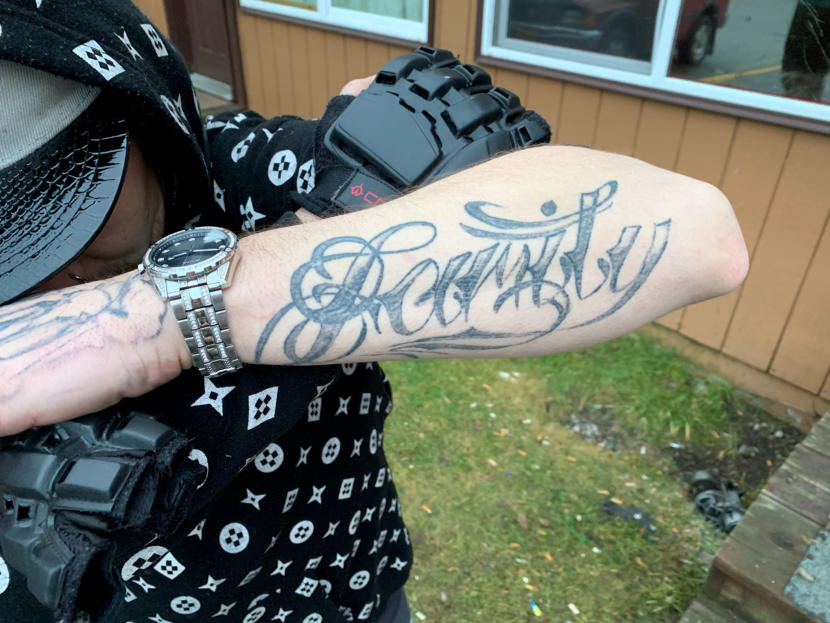
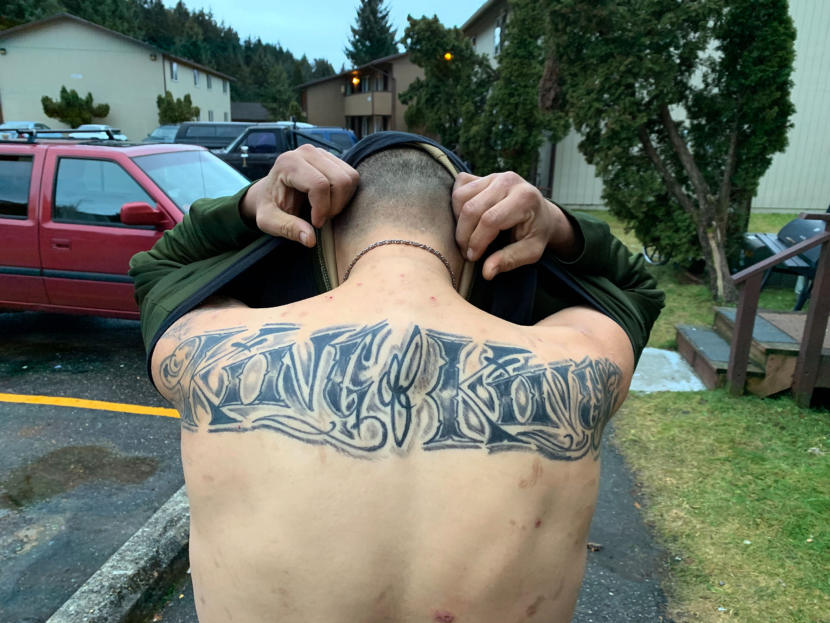
Residents and visitors at the Chinook Apartments complex in the Mendenhall Valley show tattoos they were given by Kelly “Rabbit” Stephens on Sunday, Dec. 29, 2019, in Juneau. Many said they didn’t want to give out their identities for fear of reprisal. Stephens was killed during an early-morning altercation with Juneau Police Officer James Esbenshade. (Photo by Rashah McChesney/KTOO)

On Dec. 28, a Juneau police officer shot and killed a man while responding to a 911 call.

The shooting exposed deep divisions in the community. Some are questioning why the man who was killed provoked police, and others are asking whether it was necessary to use lethal force.

The last time a police officer in Juneau shot and killed someone was in 2007. According to police records, there was a 911 call about a man who was holding a knife to a woman’s throat. When the Juneau police officer got there, the man had a sword. He screamed at the officer and threatened him with it, and the officer eventually shot him in the chest.

Greg Browning was Juneau’s police chief at the time.

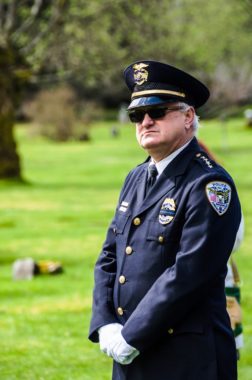
JPD Chief Greg Browning at a Peace Officers Memorial Day observance at Evergreen Cemetery. (Photo by Heather Bryant/KTOO)

“All officer-involved shootings become controversial,” he said. “You know, people think, ‘Well why didn’t the officer shoot the sword out of his hand?'”

In this particular case though, there was an audio recording that, Browning said, made it pretty clear that the officer had done everything he could to avoid using deadly force.

“So I kind of took the unconventional step of just bringing that tape down to the Juneau Empire and letting them have it,” Browning said. “So they could put it out to the public, so they could make their own decision on whether the officer was justified in what he did or not.”

This time around, the Juneau Police Department hasn’t released any footage or audio from the Dec. 28 shooting — they denied a records request seeking access to it.

They also haven’t released the 911 call that prompted Officer James Esbenshade to go to Cinema Drive, where he later shot Juneau resident Kelly Michael Stephens.

But Browning said the community reaction — pushback from some and unwavering support from others — is the same.

“It doesn’t seem to matter how clear-cut the case is, somebody will be skeptical. Which I guess is almost normal,” Browning said. “People have the right to have their opinion about things. But there’s a certain segment of the community that’s a little bit anti-police, and they come out of the woodwork when this happens.”

In 2007, JPD did its own investigation of the shooting and exonerated the officer who did it. This time, they’ve flown in Alaska State Troopers to look into the circumstances around the shooting.

They’ll also be doing the autopsy.

Juneau Police Department spokesperson Erann Kalwara wrote in an email on Dec. 31 that police should get preliminary autopsy results back in about a week. However, the full report — including whether Stephens had any drugs or alcohol in his system when he died — could take up to eight weeks.

There are no plans to drug test the officer who killed him. Kalwara said that would typically happen only if there was a suspicion that the officer was under the influence — which is not the case in this situation.

Browning said the aftermath of a shooting like this one can be hard for an officer — especially because they’re required to go on leave. He said it can be an emotional thing to handle on their own.

“You just have to make sure the officer has good peer support, that he has any professional help he might need,” Browning said.

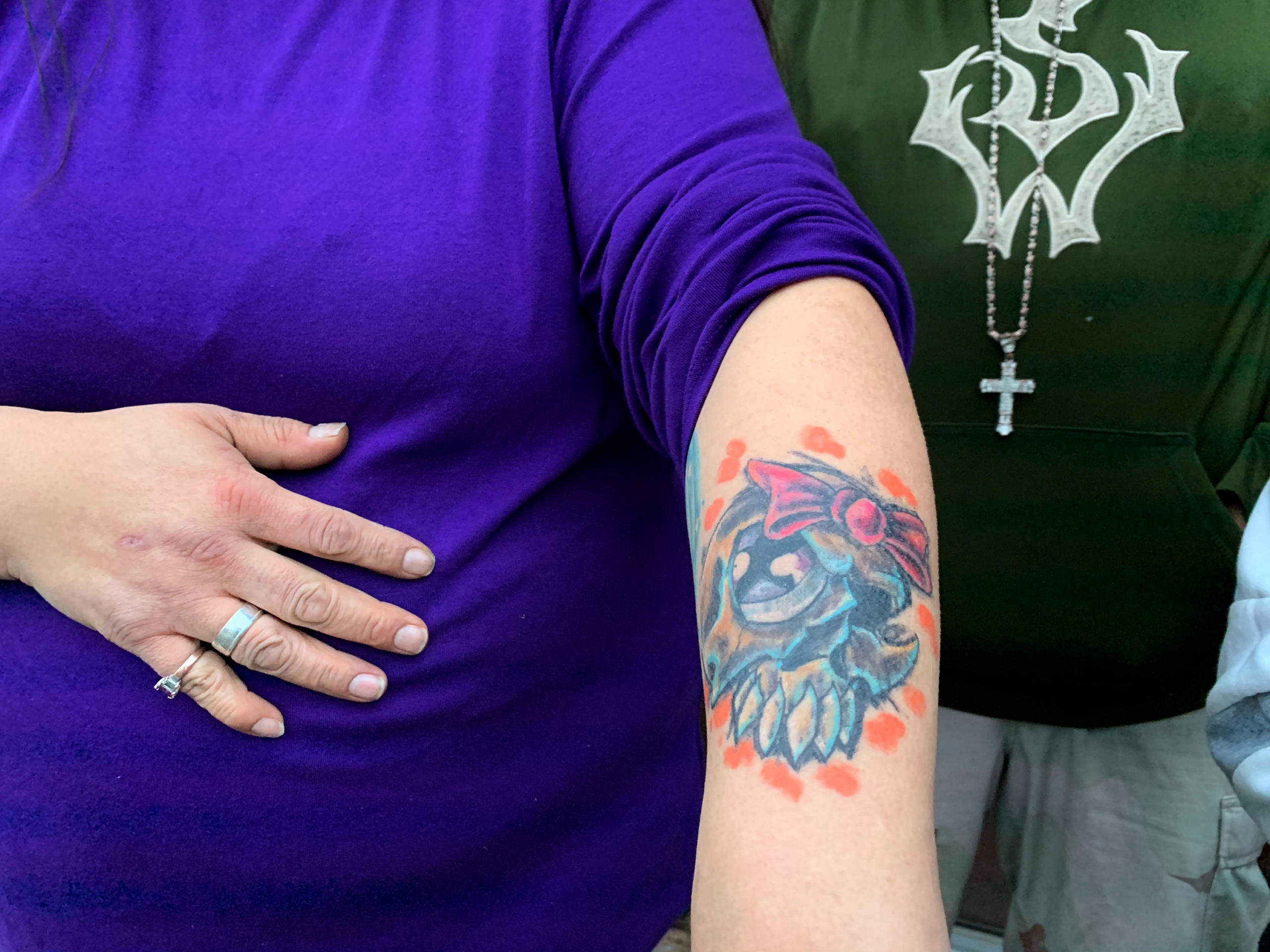
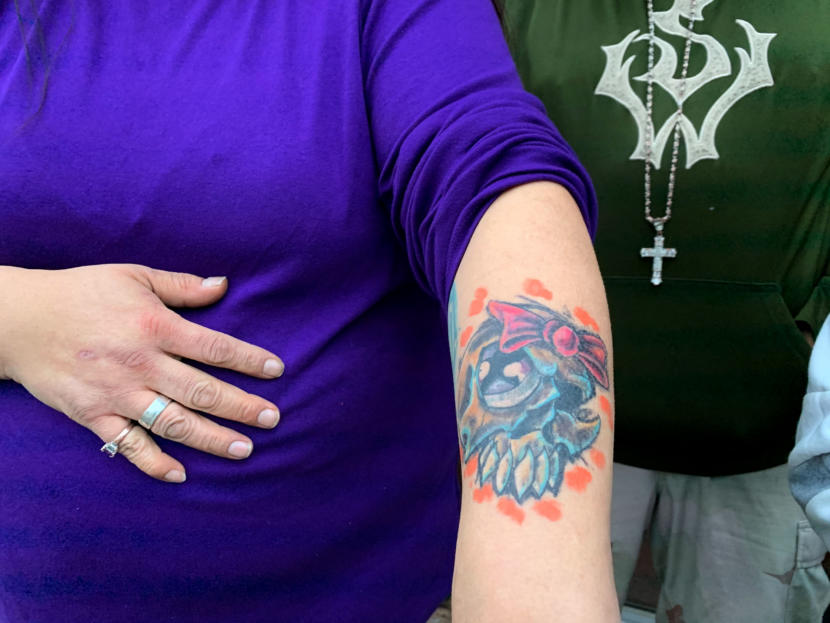
Georgianna Joseph shows her tattoo at the Chinook apartment complex in the Mendenhall Valley on Sunday, Dec. 29, 2019, in Juneau. The tattoo was done by Kelly “Rabbit” Stephens. Stephens was killed during an early-morning altercation with Juneau police. (Photo by Rashah McChesney/KTOO)

As for the man who Esbenshade shot, Kelly Stephens, friends said he was a man who was struggling with balance.

Stephens, 34, was a prolific tattoo artist. He was also a heroin addict who has been in and out of jail over the last few years.

Mario Singh owns Taku Tattoo where Stephens worked on-and-off since 2016. He has some good memories. He said Stephens would crank up the music while he was tattooing — it didn’t matter what kind, just that it was loud.

Singh said Stephens loved art and had an insatiable appetite for tattooing. When he was on his game, he was inspiring to work with.

“He’d tattoo till like 2 a.m.,” Singh said. “It was like, ‘OK man, let’s tone it down to regular hours.’ That’s when he was really motivated and just trying to focus all his energy on that — the guy would work 12 hours on a tattoo.”

But Singh said they got into a frustrating cycle of Stephens letting him down.

“I would try to hold him accountable, and different things would always just kind of fall through,” Singh said. “I ended up having to let him go.”

Stephens moved down south. Then he came back and was clean for a little while. So Singh gave him another chance. And then another.

“Everybody’s worth a second, third, fourth chance,” Singh said. “It just always seems like Kelly’s heart was in the right place. He was just — I think he dealt with a lot of mental anguish, a lot of trauma in his life.”

Singh said he didn’t put a lot of what he knows about Stephens out on social media. In part because, in a town this small, people will pick it up and run with it — use it to further whatever argument they’re going to make.

There are a lot of people in the community talking about this shooting, weighing in on who was right and who was wrong. Singh said there are some things that he wishes everyone would keep in mind.

“He was kind of — not notorious, but I mean, he had gotten into a certain amount of trouble. He was known as a drug addict. Stealing people’s gasoline out of cars. I think there was some footage of him on people’s home cameras and stuff like that. And you know, it’s easy to demonize someone and say, ‘Well you know, he’s just a crackhead.’ But, you know, it’s just a person who’s just dealing with — it wasn’t just a lust for drugs, it was an effort to combat some kind of trauma.”

The last time Singh saw Stephens alive, it was at the shop a few months ago. Stephens had just gotten out of a halfway house and was on an ankle monitor. He was clean, and he wanted to get back to work.

“I was like, ‘Well, me and you used up all our chances. We’re not going to start that back again.’ I still considered him a friend,” Singh said. “I was like, ‘Maybe down the road, who knows?’ He kind of agreed with me, kind of chuckled about it.”

If Singh had known that it was going to be the last time he was going to see Stephens, he said he may have shared a poem called “The Laughing Heart” by Charles Bukowski.

He heard it recently and said it reminds him of Stephens. He thinks it’s because Stephens always tried to come back when life knocked him down. When he knocked himself down.

Juneau police report shooting and killing a man on Cinema Drive

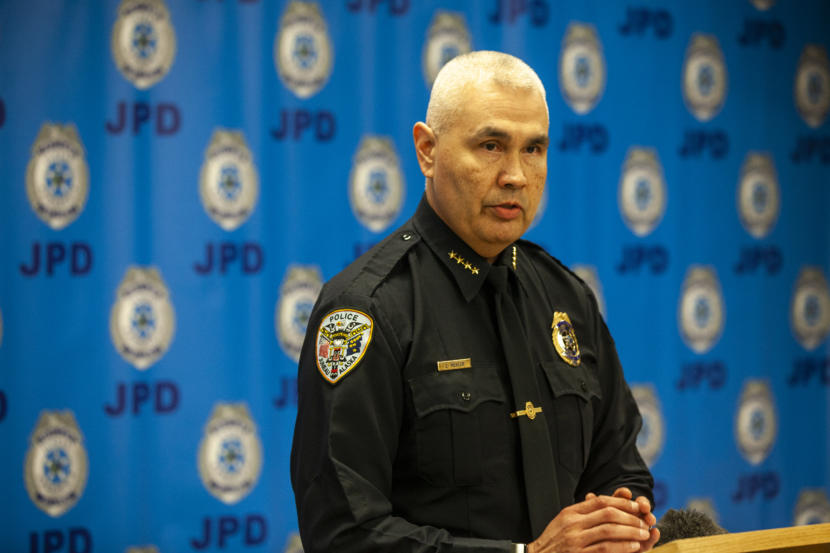
Juneau Police Chief Ed Mercer during a press conference on Sunday, December 29, 2019, at the Juneau Police Department headquarters. A Juneau police officer shot and killed a man early Sunday morning. It is the police department’s first fatal officer-involved shooting since 2007. (Photo by Rashah McChesney/KTOO)

A city police officer shot and killed a Juneau man in the early morning on Dec. 29. 

Kelly Michael Stephens was a 34-year-old tattoo artist whom Juneau police said threatened to kill the officer. Police said he swung a chain at the officer who then fired one shot, hitting Stephens in the stomach.    

During a press conference later that day, City Manager Rorie Watt stood at a podium at the Juneau police station and said it was a tragic day for the community. 

“Obviously a tragedy for the man who lost his life, a tragedy for the officer that felt the need to use his weapon, a tragedy for the community as our sense of security has certainly eroded today,” Watt said.

Residents and visitors at the Chinook apartment complex in the Mendenhall Valley show tattoos they were given by Kelly “Rabbit” Stephens on Sunday, Dec. 29, 2019 in Juneau. Many said they didn’t want their identities known for fear of reprisal. Stephens was killed during an early-morning altercation with Juneau police. (Photo by Rashah McChesney/KTOO)

At the Chinook apartment complex, where the shooting happened, several residents said the same thing. Many stood on their porches Sunday evening, quietly talking while watching their children run along a nearby ditch where bits of bright yellow crime scene tape fluttered in the wind. 

Some shook and cried when they talked about what had happened. 

Many didn’t want to talk on-the-record about Kelly Michael Stephens, better known as Rabbit. 

But, a handful of people — including Georgianna Joseph — did. She and her neighbors rolled up their sleeves, pulled up their shirts and showed off tattoos that Stephens had done. 

Georgianna Joseph shows her tattoo at the Chinook apartment complex in the Mendenhall Valley on Sunday, Dec. 29, 2019 in Juneau, Alaska. The tattoo was done by Kelly “Rabbit” Stephens. Stephens was killed during an early-morning altercation with Juneau Police. (Photo by Rashah McChesney/KTOO)

Joseph’s is a blue and black skull on her forearm with a pink bow on top. She rubbed it while she talked about Stephens. She said he was a good friend. She said that he had been in her apartment on Saturday night. 

“There was no alcohol, no drugs or anything,” she said.

But, Stephens got into a fight with the next door neighbor. Joseph said during the fight, there was a lot of yelling. But, she said, that’s not abnormal in the neighborhood.  She said no one pulled a weapon, and she doesn’t remember hearing a gunshot.

Then, Stephens took off to walk his puppy, headed down Cinema Drive and carrying a dog leash.    

Joseph said “never in a million years,” did she think she’d later watch him lay on the ground, dying from a gunshot wound.

The officer who shot Stephens was responding to a 9-1-1 call. Police said a woman called at 12:28 a.m. saying she heard yelling and a gunshot near Cinema Drive.  

Juneau police haven’t identified the officer who shot Stephens. They said they’ll withhold his identity for at least 24-hours. But, during a press conference on Sunday, Chief Ed Mercer described what he knows of the shooting.

Mercer said when the officer got to the apartment complex and out of his patrol car, he heard yelling. Mercer said the officer saw a man approaching him swinging a chain. 

“The man yelled at the officer that he was going to kill him several times,” Mercer said. “The officer repeatedly gave the man verbal commands to stop.”

When Stephens didn’t stop, Mercer said the officer shot him once in the torso.

It’s not clear exactly what happened after that. 

Mercer said several other JPD officers got the scene. They handcuffed Stephens and called the paramedics. They also picked up the object Stephens had swinging and kept it as evidence.

“The weapon that was recovered was on a rope and at the very end was a chain that appears to be a motorcycle chain with a carabiner attaching it,” Mercer said. “It could look like a leash, but it was a rope with a carabiner and a chain.”

Georgianna Joseph and and other witnesses, including Thomas Austin, said they tried to help Stephens. But, they were kept back by police. They said, no one helped Stephens while he lay on the ground — his puppy, hiding under a nearby police cruiser. 

Mercer said he’s not sure how long it took the paramedics to get there, but he thinks an officer on scene gave Stephens medical attention. 

“We had multiple officers that arrived on scene, so it may not have necessarily been the officer involved in the shooting,” he said.

Stephens was taken to Bartlett Regional Hospital.

Joseph said she went to the hospital to check on him; that’s where she found out he had died.

“We all thought he was OK,” she said.  She paused and shook her head. “They destroyed multiple lives. He was really loved.”

This isn’t the first violent encounter Stephens has had with Juneau police.  In 2018, he was charged with assaulting an officer along with three other charges that were eventually dropped. According to court records, he pleaded guilty to that misdemeanor. 

The officer who shot Stephens has been placed on paid administrative leave, per department policy. Juneau Police spokesperson Erann Kalwara said it’s not clear how long that leave will last. 

Investigators from the Alaska State Troopers are headed to Juneau to help with the investigation. 

Juneau Police officers are equipped with BodyWorn, an audio and video recording system. Mercer said there are also mobile video systems in police cars. 

This is the second police-involved shooting in Juneau this year, but the first fatal one since 2007.

Original story

Juneau police are reporting that an officer shot and killed a man early Sunday (Dec. 29) morning. 

According to a media release, a woman called reporting that someone had fired a gun near a home on Cinema Drive.

A Juneau police officer responded and shot a man who was taken to Bartlett Hospital, but later pronounced dead, according to the release.

The officer has been placed on administrative leave and will not be named for at least 24 hours. Police have also not released the name of the victim. 

A press conference will be held at 4 p.m. on Sunday at the police station in Juneau. 


Correction: A previous version of this story listed Kelly Michael Stephens’ age incorrectly. He is 34.

Site notifications
Update notification options
Subscribe to notifications