I help the newsroom establish daily news priorities and do hands-on editing to ensure a steady stream of breaking and enterprise news for a local and regional audience.
From left to right, outgoing chief of staff Tuckerman Babcock, Gov. Mike Dunleavy and incoming chief of staff Ben Stevens pose for a photo that accompanied the announcement of that Stevens is succeeding Babcock. (Photo courtesy of the governor’s office)
A senior policy advisor for Gov. Mike Dunleavy has retired, effective immediately.
Tuckerman Babcock’s resignation letter went out late Friday afternoon along with a media release with a statement from Dunleavy thanking Babcock for his service.
In the letter, Babcock says he wants to focus on his wife, eight children and nine grandchildren.
Babcock was the chair of the Alaska Republican Party before he was asked to be chief of staff for Dunleavy.
He was a controversial figure before he joined the Dunleavy administration. As Republican party chair, he led a GOP push to unseat Republican legislators who joined a Democratic-led majority caucus in the state House of Representatives. As chief of staff, he maintained a Facebook page where he shared links to conservative media outlets.
And he has drawn criticism from former state workers who named him in lawsuits along with Dunleavy, alleging they were unconstitutionally fired.
The governor’s spokesperson, Matt Shuckerow, said Babcock is traveling and likely unavailable for comment.
In his retirement letter, Babcock says the “ship of Alaska will sail on, and with the experienced mariner Ben Stevens as your Chief of Staff, your administration is in excellent hands.”
Stevens joined the Dunleavy administration in late 2018. He is a former Alaska Senate president who was investigated by the FBI for corruption along with five other state legislators in 2006. He was never charged.
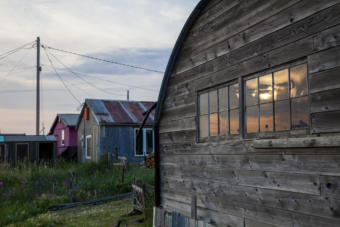
In Unalakleet on July 13, where power costs are set to go up for residents and the city as the local utility prepares to lose funds from the state’s Power Cost Equalization program. (Photo by Rashah McChesney/Alaska’s Energy Desk)
It’s salmon fishing and berry picking season in Unalakleet. It’s also the first month of the new operating budget year for the state.
Right now, when residents get together to swap stories about fishing, salmonberry pie recipes and the unseasonable heat, they are also talking about the impacts of a decades-old accounting quirk that could have far-reaching impacts in rural Alaska.
Most people call it “the sweep.” It’s an automatic transfer of money from dozens of the state’s bank accounts into one big savings account that happens at the end of each fiscal year.
And each year for 28 years, the Alaska Legislature has voted to put all of that money back into the accounts it came from. But this year, that didn’t happen.
Typically, that sweep goes unnoticed. But this year, it’s the talk of the town in Unalakleet, where residents who get their power from the Unalakleet Valley Electric Cooperative are about to get their monthly bill.
“Yeah, it’s pretty much everybody. We have two residents who are off-grid, totally,” said Reese Huhta of the Unalakleet Valley Electric Cooperative.
He said everyone else in town — that’s about 270 homes, 40 businesses and 22 community facilities — will be getting a bill. And along with it, they’ll get a notice that next month’s bills are going to go up — in some cases by thousands of dollars a month.
In Unalakleet, Huhta said homeowners’ bills will go up an average of $80 a month.
“I think we will see more shutoff notices. Some members that work seasonally that don’t have the ability to just go work more overtime or get a second job, that’s not an option. We have a lot of members that are on fixed incomes, and there’s just not a lot of money trees to shake,” he said.
The city’s power bill will go up, too. The rate it pays for everything — from streetlights to getting water for residents to pumping sewage away from homes — will double.
“Annually they’ll spend, in our models, $55,000 to $70,000 more,” Huhta said.
Currently, the city is the electric utility’s largest customer that receives Power Cost Equalization credits.
Huhta said his utility hasn’t gotten a formal notice yet from the state about the fact that there is no money available to reimburse it for power costs. But he said the utility can’t afford to issue billing credits to customers without getting paid back for long.
For now, the utility will bridge the gap from savings.
“So we want our members to at least have the courtesy of 30 days’ (notice). It’s something we would have loved to have had, rather than being notified after the fact,” he said.
The Legislature is still meeting in special session through the beginning of August, and it’s possible there will be some funding for the program. Both the governor’s office and the Legislature included funding for the program in their budgets — but they didn’t agree on where the money should come from.
So for now, Huhta said everything is in limbo.
The sun sits low in the sky on July 13, 2019 in Unalakleet. The local electric utility will send out notices to residents that their power costs are set to go up as it prepares to lose funds from the state’s Power Cost Equalization program. (Photo by Rashah McChesney/Alaska’s Energy Desk)
Clarification: A previous version of this story incorrectly identified the City of Unalakleet as the Unalakleet Valley Electric Cooperative’s largest customer. The city is not the utility’s largest customer, but it is the utility’s largest recipient of Power Cost Equalization credits.
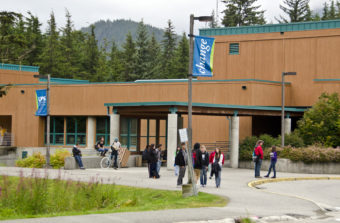
Students gather outside at the University of Alaska Southeast on Tuesday, Sept. 4, 2012. (Photo by Heather Bryant/KTOO)
Notice went out to 12,000 Alaska students on Tuesday afternoon that money for their grants and scholarships isn’t currently available for the next school year.
But it’s not because the funds were vetoed from the budget. The Alaska Commission on Postsecondary Education wrote in the message that funds for the Alaska Performance Scholarship and Alaska Education Grant aren’t currently available and require legislative action to be restored.
The commission is a state corporation tasked with planning for higher education and administering financial aid programs.
Funding for a program that provides money for students from Alaska to attend the University of Washington School of Medicine is also unavailable.
At issue is nearly $350 million in Alaska’s Higher Education Investment Fund. Each year, funds from nearly every state program get swept into a constitutionally-mandated savings account. Typically lawmakers vote to put the money back into the programs it was designated for. But that process requires a supermajority of the Legislature — three-quarters of them — to vote to put the money back. This year, that didn’t happen.
It’s also unusual for the Higher Education Fund to be included in the funding sweep — historically, that hasn’t happened.
According to data from the University of Alaska, nearly 1 in 5 students gets a merit-based Alaska Performance Scholarship. Altogether, the performance scholarships and education funds support more than 5,000 students with more than $15 million in financial aid each year.
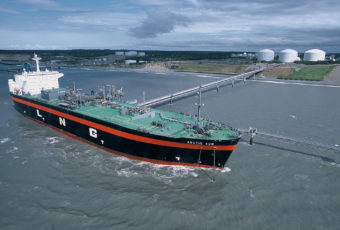
A liquefied natural gas (LNG) tanker fills up at the ConocoPhillips liquid natural gas export facility in Nikiski, Alaska. When it opened in 1969, it was the only facility of its kind in the U.S. to get a license to export its gas to Japan. For more than 40 years, the state has attempted to develop similar projects to bring natural gas from the North Slope to market. None of those projects have broken ground. (Photo courtesy of ConocoPhillips)
The federal agency leading the environmental review of the Alaska LNG project has released a nearly 3,800-page draft report on its potential impacts.
Staff at the Federal Energy Regulatory Commission, or FERC, have been working in tandem with nine other federal agencies, including the Environmental Protection Agency, Army Corps of Engineers, and U.S. Fish and Wildlife Service to develop the report since 2017 when the state’s gasline corporation filed for a permit to build the $43 billion project.
The Alaska Gasline Development Corporation plans to pipe natural gas more than 800 miles from the North Slope to Nikiski, where it would be liquefied and then shipped off to customers.
Staff at the federal agency found that the Alaska LNG project would have significant impacts on permafrost, wetlands and forest, and that it would likely cause problems for the Central Arctic caribou herd. Constructing and operating the project would likely affect six federally-listed species, including Cook Inlet beluga whales and polar bears. They also said the project could negatively affect housing and public services in some areas.
But they also concluded that the project would have a positive impact on state and local economies.
If everything stays on schedule, the federal commission could vote on the Alaska Gasline Development Corporation’s application by June 2020.
If built, it would be one of the largest LNG projects in the world. But along with final federal approval — the state’s project needs customers, investors and financing to be viable.
The federal agency will take public comments on its draft environmental review through Oct. 3. The agency will hold public meetings in Alaska to go over the report, but it has not yet announced the dates or locations.
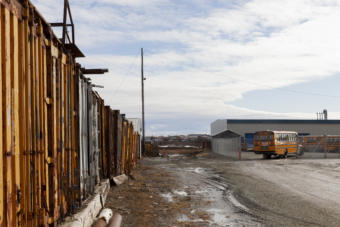
A boy bicycles through town on Wednesday, April 2, in Bethel, Alaska. The Lower Kuskokwim School District, headquartered in Bethel, has shipping containers full of contaminated materials that have been there for years, waiting to be barged out. (Photos by Rashah McChesney/Alaska’s Energy Desk)
There are thousands of open contaminated sites in Alaska. Typically, when one is discovered, it’s up to the landowner — or the person responsible for making the mess — to clean it up. But there are dozens of sites where this process has broken down — where it isn’t clear who owned the property when it was polluted, who caused the pollution and who should pay to clean it up.
It’s especially a problem in rural Alaska, where remote sites can cost millions to remediate.
Lower Kuskokwim School District Maintenance Director Jeff Harris is intimately familiar with the problem — his district has seven open contaminated sites where state regulators have flagged it as either potentially or entirely responsible for cleanup.
On an uncharacteristically warm, dusty spring day at his office in the school district’s Bethel headquarters, he offers an unorthodox tour of some school district property.
So, from the massive cab of one of the district’s beefy Dodge trucks, we go for a bumpy drive along the city’s unpaved roads. Bethel isn’t a big town. It has about 16 total miles of road. But still, it’s surprising to drive down Fifth Avenue and come across a block of brightly-colored shipping containers.
“This is the ugly part of LKSD,” Harris said. “So we’ve got more containers, all the Super Sacks — ” he pauses and turns, pointing across the road. Behind a chain-link fence is a cluster of dilapidated, 10,000-gallon fuel tanks. “And these are the fuel tanks that we removed from villages so we could get rid of them.”
A row of shipping containers full of contamination from a fire sit along Fifth Avenue on Wednesday, April 2, in Bethel, Alaska. The containers have been there for four years, waiting to be shipped out of the community — but the Lower Kuskokwim School District faces several barriers to completing that task.
The Lower Kuskokwim School District is the largest of its kind in Alaska. It’s a Rural Education Attendance Area — think of it as a type of borough created specifically for rural education — spanning 22,000 square miles of tundra and 27 schools. A lot of times, when contaminated junk is removed from one of those village schools — it makes a pit stop at district headquarters in Bethel.
The containers that we’re looking at hold the remnants of a Yup’ik immersion school that burned down in Bethel in 2016.
“It was like, dirt from the fire. So it’s contaminated with broken wood and that kind of stuff,” he said.
There’s another row of shipping containers just like it a few blocks away right outside of the high school. Those have everything from darkroom chemicals to asbestos in them.
Harris said you can’t just take all of this stuff over to the dump. And there aren’t a lot of ways to get out of town. You could fly. Or, as is the case with these containers, take a boat.
A row of shipping containers used to store contaminated material near Bethel High School.
They have to be barged about 50 miles down the Kuskokwim River where it empties into a bay and, eventually, the Bering Sea. From there, it’s thousands of miles to the closest landfill that will take them. It gets expensive.
Three years ago, Harris said he shipped one container of dried biosolids — that’s code for treated sewage — from a village downriver.
That one shipping container, wedged onto a barge and transported from Tuntutuliak to Oregon? It cost $15,000.
Now, facing this long row of containers — the scale of the school district’s problem starts to comes into focus. Each container has to be cataloged — getting contaminants into a landfill can be a tricky proposition. Usually, the landowner wants to know what they’re disposing of before they agree to take it on.
And Bethel — a town of about 6,000 people — doesn’t exactly have the biggest landfill.
“You know if you live in New York City you just take all this stuff in a truck and take it to Staten Island and they’d put it down, drive over it 10 times with the biggest bulldozer in the world. Problem solved. You can’t do that in a landfill here. We can’t really do that in the landfill because landfill is tiny,” Harris said.
Even if the landfill in Bethel could take all of the biosolids the district has to get rid of, it isn’t set up to take other types of contamination, like asbestos or petroleum-contaminated dirt from leaking fuel tanks.
“It’s all supposed to go away, but where do you make it go away to?” he said. “It’s a big problem. Logistically, it’s a big problem.”
Lower Kuskokwim School District Maintenance Director Jeff Harris near a row of shipping containers full of contaminated materials the district needs to ship out of town.
Harris said millions of dollars could go toward getting rid of all of the school district’s contaminated waste.
Most of the sites that state regulators say the school district is responsible for cleaning up are former schools that the federal Bureau of Indian Affairs, or BIA, operated before turning them over to the state’s Department of Education and Early Development decades ago.
They aren’t used as schools anymore. But they are contaminated. Usually it’s the old tank farms, leaching petroleum contaminants into the surrounding soil. They’re rotting in small villages — in some cases, near drinking water wells — or eroding into rivers or just a few feet away from buildings where children are going to school.
The village Harris mentioned, Tuntutuliak, has a bigger problem than just one shipping container of sewage. One of the sites that the state flagged as a high priority is a BIA school that was built in the late 1950s.
It’s a short flight downriver from Bethel to the small village. The Yup’ik native village is in the middle of the tundra — so that means scattered lakes and wetlands. Many of the buildings and homes in the village sit along an elevated wooden boardwalk. It’s something of a four-wheeler superhighway when school lets out.
Mark Olick races out on one to meet the plane. Then we go for a ride through town. First to the new school. Then to a collection of abandoned buildings sitting between homes along the river.
Mark Olick, Tuntutuliak school maintenance man.
Olick has lived in the village for 48 years. He points to the rotting wood where steps used to lead from the boardwalk to the front entrance. He remembers walking up those steps when he went to first grade in 1979. He remembers when the river wasn’t lapping at the edge of the boardwalk.
“That bank was 200 yards away,” he said, pointing to an eroding river bank that’s maybe 50 feet from the buildings.
He doesn’t remember why they closed the old school. He thinks maybe the village outgrew it. He also doesn’t remember anyone ever telling him that the area is contaminated.
There are no signs or fencing up. Just a pile of empty, rusting fuel tanks nearby that smell faintly of the thousands of gallons of fuel they used to hold.
Old heating fuel tanks sit near an abandoned former Bureau of Indian Affairs school in Tuntutuliak.
He offers a ride over to Tuntutuliak Tribal Council President Henry Lupie’s house.
Lupie meets us on the boardwalk outside of his home and offers up his toasty living room as a good place to talk.
“You want a cup of coffee?” he says, grinning.
Lupie has a long memory, so over several bitter black cups, Lupie recounts decades of history around the old school — the 35-year struggle the village has had over the school.
Like Olick, Lupie has lived in this village his entire life, though he left for a few years to go to boarding school in Oregon. He taught in the old BIA school and remembers when it was closed in the 1980s.
The community still used it though. When the wood came in for a new church, they stored it in the old school to keep it dry. Even now, Lupie says, the community put plywood up to try and keep people out of them.
“But still, kids get into abandoned buildings. That’s pretty natural I guess.” He laughs.
Tuntutuliak Tribal Council President Henry Lupie talks about the village’s efforts to get a contaminated site remediated.
At first, they thought they could reuse the old buildings. But when it became clear that the site was contaminated, Lupie says the village tried to get it cleaned up.
“The problem at first was, we couldn’t identify who was responsible,” he said. “We thought it was BIA at first, when we contacted BIA, they said they transferred it to the state, and the state said they didn’t have any responsibility because it was an old BIA site.”
So the buildings just sit there, rotting. Sinking into the marshy land along the Quinak River.
State records show a tangle of people from the federal and state government, village corporation and the Lower Kuskokwim School District weighing in on what should be done with the school for the last 41 years.
And at least three times, people have come out to the village to do environmental assessments of the old property. They’ve found evidence of fuel spills and contamination. Arsenic and chromium. There’s asbestos in the buildings.
More than a decade ago, the site was added to the state’s contaminated sites database. But no state or federal agency took responsibility for cleaning it up.
To understand how a contaminated site in a village like Tuntutuliak might get lost in the shuffle, it’s helpful to understand the scale of the contamination problem statewide.
“We have about 2,300 active contaminated sites. So at any given time we can be we can be trying to make decisions on a site that’s anywhere in the state,” said Eric Breitenberger. He’s an environmental program manager at the Department of Environmental Conservation.
He’s been working for the state, specifically with pollution, for nearly 20 years.
He lays out what’s supposed to happen when a site lands in the state’s contaminated sites database. State environmental regulators become detectives of a sort. They try to find out everything they can about the area: Who’s living near it? How do they use it? Who owned it? Who’s responsible for the contamination — the person who’s supposed to pay to clean it up?
And how dangerous is that site to the people living there? Answering that question involves a very complicated, kind of depressing flowchart. There are all of these branches — if/then questions involving the soil, air and groundwater. Does it affect the food? Each site gets an exposure ranking. It’s essentially a snapshot of how dangerous it is for the community around it.
Ideally, a responsible party is found. They pay to figure out the extent of the damage to the site. They tell the state how they’re going to clean it up. They clean it up — and the site gets closed.
But there are contaminated sites in Alaska that have been open for 10, 20, 30 years. How could that happen?
“Yeah, that’s an awkward question. And we spend a lot of time working with sites like that,” he said. “There are a lot of sites in our database that have been there for a really long time. Part of the reason for that … I’ll kind of use an analogy: It’s the picking of the low-hanging fruit.”
In the case of Tuntutuliak, regulators just haven’t been able to pin down who should pay to clean it up.
Children play after school in Tuntutuliak. Village residents have been living alongside a contaminated former Bureau of Indian Affairs school for decades.
The Lower Kuskokwim School District operated the school, but the state’s Department of Education and Early Development technically owns the land. The fuel releases, at least some of them, happened while the Bureau of Indian Affairs was in control of the buildings. Each has been flagged as potentially responsible for helping to pay for cleanup.
But those negotiations haven’t happened. In part because there hasn’t been much — if any — response from BIA.
Breitenberger — and other contaminated site managers — say that’s pretty common. BIA has been reluctant to engage with the state on sites it may eventually be responsible for cleaning up.
A big part of the holdup with a lot of legacy contaminated sites is that the responsible party is supposed to pay for everything. In the case of Tuntutuliak, it’s going to be expensive.
A few years ago, the state’s Department of Education got another environmental assessment done — adding up all of the costs of tearing down the buildings, digging up contaminated soil and barging everything out. It estimated more than $900,000 to clean it up.
All of this back and forth, and no action? Back in Tuntutuliak, Lupie says it feels like the village is not a priority for the state and federal agencies tasked with environmental oversight. And that feels hypocritical.
“Our village corporation has tank farms, and if there’s an oil spill, it would be our responsibility to clean it up. We’d be faced with penalties,” he said. “What I can’t understand is, you know, for the federal government — BIA is part of the federal government — and they are imposed with the same laws and regulation that we’re expected to follow … I keep wondering, why doesn’t it apply to themselves? You know, it’s supposed to work the same way.”
A row of shipping containers used to store contaminated material near Bethel High School.
And in the end, there’s been a workaround in Tuntutuliak. One that doesn’t require the school district, or the state, or the federal Bureau of Indian Affairs, to claim responsibility for the contamination.
The school district applied for a grant from the state’s Department of Education to expand the new school in Tuntutuliak. Part of that money will go toward cleaning up the old contaminated one — which, by the way, is scheduled to be demolished by 2021.
A full 13 years since it landed in the state’s contaminated sites database.
Rep. Bryce Edgmon, I-Dillingham, speaks to members of the Alaska House of Representatives immediately after being elected speaker of the House for the 31st Legislature in Juneau on Feb. 14, 2019. (Photo by Skip Gray/360 North)
At the Alaska Legislature this week, there’s a lot of talk about something called “the sweep.”
This is a term used to describe an accounting quirk with the state’s money that’s happened every year for the last 20 years. And it goes something like this: On the night of June 30 — that’s the end of the state’s fiscal year — a lot of money moves around at the last minute.
“That sweep occurs at one second before midnight, and the reverse sweep occurs one second after midnight, or as close as possible to that,” said Division of Legislative Finance Director David Teal.
Legislative Finance Director David Teal gives a presentation to the House Finance Committee, Feb. 22, 2016. (Photo by Skip Gray/360 North)
That sweep drains all of the money out of several state accounts — including the general fund — and puts it all in a savings account called the Constitutional Budget Reserve. This is a constitutional mandate, and it can’t be avoided.
Typically, on July 1, the money goes back into those state accounts, and state agencies continue to use it to pay the bills.
“So theoretically, if the reverse sweep occurs, nobody knows the difference. All the money is exactly where it was when you went to bed,” Teal said.
But while the sweep is constitutionally mandated, that reverse sweep is not. It’s up to lawmakers to put that money back. In order for this process to go smoothly, a supermajority of the Legislature — three-quarters of them — have to vote to put that money back into the accounts it came from.
But this year, some key things have changed.
For one, Gov. Mike Dunleavy’s administration wants to get rid of a lot of those state accounts. The accounts are earmarked for everything from the compensation for crime victims, to debt retirement, to the Alaska Marine Highway System.
Dunleavy didn’t include a reverse sweep in his budget. So what happens if the Legislature fails to get that supermajority? All of that money stays in the Constitutional Budget Reserve — out of reach of the state departments who would normally use it.
One other potential change is what the sweep includes. Right now, there are exemptions for money in state corporations, like the Alaska Industrial Development and Export Authority and the Alaska Gasline Development Corporation. But there are also two big accounts that haven’t been included in the sweep in the past. One is an endowment for higher education that pays for college student grants and scholarships, and the other is the Power Cost Equalization fund, or PCE. That one is used to offset the cost of energy in rural Alaska.
“The common belief here in the Legislature, and certainly amongst those who are closest to the issue and rural legislators, is that the governor intends to take all of the money out of that account and to sweep it into the budget reserve and essentially do away with the PCE endowment,” said House Majority Leader Bryce Edgmon. He’s an independent rural legislator from Dillingham.
Edgmon said he remembers a time when rural legislators fought every year to get funds earmarked to offset high power costs in their districts. The PCE endowment — which has swelled to about $1 billion — largely took that political fight off the table. But now, with the prospect of it being included in the sweep this year, that means the funds could be spent on other things.
So far, there has been just one year where legislators didn’t muster the votes to push the reverse sweep through. Teal said generally the funds that are being swept can replenish themselves.
To put it in household budget terms, it’s like someone coming in and taking all of the cash in your checking account on June 30.
“Meanwhile, you’re scrambling to cover bills and you know you may have to borrow from your sister or do whatever it takes to pay your bills. But it’s true that, in a month or two, you’re probably going to have the money and be able to cover things,” he said.
But in the case of Power Cost Equalization, it doesn’t work like that. Teal said it only earns money on the interest from its balance. That means that if the money is swept out and the Legislature can’t muster the votes to put it back, it could disappear completely.
Close
Update notification options
Subscribe to notifications
Subscribe
Get notifications about news related to the topics you care about. You can unsubscribe anytime.