Rashah McChesney

Daily News Editor

I help the newsroom establish daily news priorities and do hands-on editing to ensure a steady stream of breaking and enterprise news for a local and regional audience.

The state’s new budget director is a well-known fiscal hawk

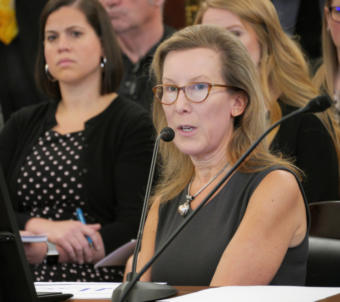
Donna Arduin, director of the Office of Management and Budget, gives a presentation to the Senate Finance Committee, Jan. 23, 2019. (Photo by Skip Gray/@360 North)

The state’s new budget director, Donna Arduin, is putting together a proposal for next year’s budget.

She laid out some of her methods for the Senate Finance Committee on Tuesday.

That budget probably won’t come out for another three weeks. But it’s likely to be controversial, as it’s expected to make deep cuts to address the $1.6 billion hole in the state’s budget.

Arduin is a veteran state budget hawk who has worked on cutting spending for governors in several other states.

She said her office is not going to continue to squeeze budgets and try to maintain the same level of services.

“Our proposals are all policy-driven. And as I said, rather than asking agencies to do more with less, we’re asking them to do less with less in many instances,” she said.

She echoed Gov. Mike Dunleavy’s message to lawmakers that the state’s spending must meet its income.

One of her first moves as budget director was to reorganize the state’s budget staff. Now, instead of each commissioner of each state agency having their own budget team, those budget teams have been relocated to her office and answer to her.

She said her office has been working with departments to help them prioritize their programs.

“In some cases, finding things that, really, agencies are doing now that aren’t part of their core missions, or even fit within their primary business processes,” Arduin said.

She said her department is also looking at options for outsourcing state services, eliminating non-essential programs and asking Alaskans to pay for more services.

Sitka Republican and finance committee co-chair Bert Stedman said he thinks the public should see the process that goes into building the budget, “because the budget itself might take the air out of most of the rooms it’s dropped into.”

The budget is expected out on Feb. 13.

Watch the latest legislative coverage from Gavel Alaska:

Newscast – Wednesday, Jan. 23, 2019

In this newscast:

  • A proposed merger between the parent company of Juneau’s power utility and a Canadian power company is dead,
  • The state’s new budget director, Donna Arduin, is putting together a proposal for next year’s budget. It drops Feb. 13,
  • Gov. Mike Dunleavy declared war on crime during his State of the State, on Thursday he proposed three bills to that end,
  • Federal furloughed employees in Juneau are having a hard time paying the bills and taking heat online from people who don’t understand.

Revenue commissioner outlines a new direction for Alaska’s gas pipeline project

Sen. Cathy Giessel, R-Anchorage, and Sen. Mike Dunleavy, R-Wasill, listen to Alaska Gasline Development Corporation President Keith Meyer, aduring a Senate Finance meeting focusing oncorporation's budget on Tuesday, February 14, 2017, in Juneau, Alaska. (Photo by Rashah McChesney/Alaska's Energy Desk)
Sen. Cathy Giessel, R-Anchorage, and former Sen. Mike Dunleavy, R-Wasilla, listen to former Alaska Gasline Development Corporation President Keith Meyer, during a Senate Finance meeting focusing on corporation’s budget on February 14, 2017, in Juneau. (Photo by Rashah McChesney/Alaska’s Energy Desk)

Alaska’s natural gas pipeline export project is headed in a new direction.

And that direction looks a lot like a previous version of the project: one that was led by the oil companies on the North Slope.

The state corporation in charge of developing a natural gas pipeline project has new board members, they’ve installed a new president — and they have new direction from Gov. Mike Dunleavy’s administration.

That direction is similar to the one the Alaska LNG project was following before former Gov. Bill Walker took office. One that was led by the “big three” oil producers in the state: BP, ConocoPhillips and ExxonMobil.

New Department of Revenue Commissioner Bruce Tangeman laid out some of the philosophy of the Dunleavy administration at an event for the Alaska Support Industry Alliance in Anchorage on Friday.

Right now, he said they’re in fact-finding mode.

That is, the new administration wants to get more information about exactly where the project is in the process of getting permitted and built.

“Is the project economic, and is there a way for us to share the risk in this project?” Tangeman said. “There’s a lot of, well, there hasn’t been a lot of information publicly on the project for the last couple of years.”

Once they get that information, Tangeman said it needs to go back to the Legislature.

To accomplish that, the state is going back to a stage-gate approach. That’s a style of project management that divides projects into stages, each one separated by a decision on whether to move forward.

“That’s the process that we had been using prior to the Walker administration,” he said. “There’s no secret to it, there’s no science. It’s merely — this is how big projects that companies like Exxon, BP and Conoco, this is the process that they have used and continue to use to build projects around the world.”

Tangeman said the Alaska LNG project moved away from that phased process when former Gov. Walker took over and installed Keith Meyer at the helm of the gasline development corporation.

The pipeline project was a key issue for Walker, who said the oil producers had too much control over it. In 2016, the oil producers stepped away from the project, saying it didn’t make economic sense at the time.

Meyer and Walker championed a state-led project and pushed for an accelerated schedule to get it permitted and built in time to meet what Meyer said would be a global surge in demand for natural gas.

“After a certain amount of time, there was discussion of FID, final investment decision, and breaking ground and hiring 10,000 people. Well under the previous stage-gate approach, we probably would have gone through a couple more stage-gates before we would even be talking about that,” Tangeman said. “It just seemed like it was too good to be true.”

A final investment decision is essentially when the project gets a final go-ahead and starts planning for shovels in the ground. And for the last few years, the message from the gasline corporation has been that the state is aiming to get that by next year.

“Yeah, 2020 for an FID was not realistic,” he said.

The project will now be driven by economics — does it make financial sense for the state to get it built right now? — instead of a schedule, Tangeman said.

Another problem for the Dunleavy administration is the current structure of the project — that is, that it’s state-led and there are currently no partners. Tangeman said that means the state is taking on all of the risk.

“State government is not exactly set up to build $50 billion projects,” he said.

The gasline corporation is negotiating with three potential partners in China who could buy the gas or put money into the project. Tangeman said he doesn’t think the changes at the Alaska Gasline Development Corporation will scare them off.

“Our customers, potential customers, you know if China is a potential customer down the road — they understand what this governor is doing,” he said.

Tangeman said the Dunleavy administration would like to see its former oil and gas industry partners — that’s BP, ConocoPhillips and ExxonMobil — come back to the project, though it’s not clear if they will.

Newscast – Tuesday, January 22, 2019

In this newscast:

  • House Republican Representative Dave Talerico fell one vote short of being elected the speaker of the Alaska House
  • Unalaska’s city council is considering contributing money to an Alaska Municipal League project that would help municipalities figure out how to collect sales tax on online purchases
  • University of Alaska Anchorage teaching students are unsure about their futures
  • In Bethel, Alaska Natives who adhere to the Russian Orthodox tradition commemorate Theophany
  • Gov. Mike Dunleavy’s administration is changing state Department of Corrections policies that some say have helped people succeed when they’re released from prison
December jobs report shows modest growth in Alaska’s oil and gas industry

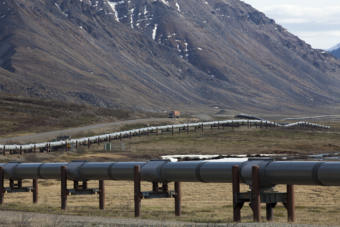
A truck drives up the Dalton Highway near the Toolik Field Station on June 9, 2017, in the North Slope Borough. (Photo by Rashah McChesney/Alaska's Energy Desk)
A truck drives up the Dalton Highway near the Toolik Field Station on June 9, 2017, in the North Slope Borough. (Photo by Rashah McChesney/Alaska’s Energy Desk)

Alaska has been in a recession for the better part of three years, and the state’s unemployment rate is the highest in the nation right now at 6.3 percent. Many sectors of the economy have been shedding jobs, but there are some signs that the losses are slowing.

The state’s Department of Labor and Workforce Development released its December employment numbers on Friday. 

They show that some sectors of the economy are still losing jobs. But state economist Neal Fried said some sectors — like the oil and gas industry — are recovering.  

One is the negatives have, generally speaking, gotten considerably smaller, especially in negatives like oil and gas, which was a big, big loser. Those losses got a lot smaller and actually oil and gas employment turned positive in December over the year,” Fried said.

Turning positive means that in December 2018, there were more people employed in the oil and gas industry than there were in December 2017. So far, that means the Department of Labor’s forecast that jobs in the oil and gas industry would grow modestly this year is right on track. Oil industry jobs have been in a free fall since they peaked in 2015. New jobs in the oil and gas industry generally lead to more jobs in other sectors of the economy, like construction. 

Those jobs come with a caveat though: If oil prices tank again — and stay down — that could slow down work in the oil patch.

Still, Fried said that the work that’s projected to be done this year is probably not going to be affected.

I mean, most of those projects and the activity is probably in place unless something really dramatic happened with price,” Fried said. “You know a lot of our oil industry activity is more project-based. You know if you get started you’re probably going to finish it.”

That sentiment was echoed by ConocoPhillips Alaska President Joe Marushack.

“We really have to plan our program out at least six months, eight months, nine months into the future. So we’re in the middle of what we call our ice road season, or our heavy drilling season, exploration season right now. That’ll be done in the next four or five months. So no, I wouldn’t say oil prices, whether they go up or down, will impact the 2019 program much, if anything at all,” Marushack said.

ConocoPhillips spokesperson Meredith Kenny said the company expects to need about 800 contractors during the 2019 construction and exploration season. She wrote in an email that it could mean jobs for more than 1,000 people during the company’s peak winter activity because “some of the jobs are alternating jobs — for example 4 weeks on, two weeks off with more than on person required for one position.”


Site notifications
Update notification options
Subscribe to notifications