Rashah McChesney

Daily News Editor

I help the newsroom establish daily news priorities and do hands-on editing to ensure a steady stream of breaking and enterprise news for a local and regional audience.

Winter fuel costs could spike nationwide. Here’s why Alaska is different.

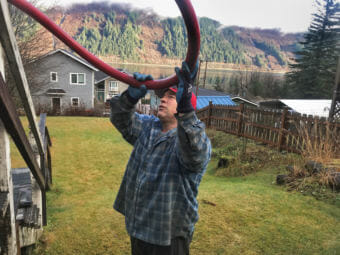
Phil Isaak, of Ike's Fuel finishes topping off a heating oil tank on November 15, 2018, in Juneau, Alaska. Isaak says costs in Alaska don't really match up well with heating fuel costs in the rest of the country. (Photo by Rashah McChesney/Alaska's Energy Desk)
Phil Isaak, of Ike’s Fuel finishes topping off a heating oil tank on Nov. 15, 2018, in Juneau, Alaska. Isaak said costs in Alaska don’t really match up well with heating fuel costs in the rest of the country. (Photo by Rashah McChesney/Alaska’s Energy Desk)

Back in October the U.S. Energy Information Administration put out a report on winter heating fuels. The federal administration forecasts that U.S. households will spend more to heat their homes this winter. Especially in the places that use heating oil as their main source of warmth.

But trends in the Lower 48 don’t necessarily hold true in Alaska.

It’s warm in Juneau right now. Not a lot of snow or ice on the ground. That means things are kind of slow-going over at Ike’s Fuel.  So Phil Isaak had time to talk about his family’s heating fuel business and what he thought of the predictions.

Isaak’s family has been delivering heating oil around Juneau since 1966 when his father started the business — he joked that they could have delivered milk instead.

The Energy Information Administration forecasted higher costs to heat homes this winter.  And people who heat their homes primarily with oil could be hit the hardest, with up to a 20 percent jump.  Only about 30 percent of homes in Alaska use oil as their main source of heat.  Those homes are concentrated in rural areas, Fairbanks and here in Southeast.

What to do when costs go up? Isaak has some advice for Alaskans.

The first thing he said is to budget for the cold years.

“Other ways, you know, tell people, ‘Wear an extra sweater and keep your heat at 65,'” he said. Then he grinned. “If I was really ruthless, I’d say, ‘Well they need to open their windows and turn their heat up to 90 and run their hot water all day,’ but that would not benefit anybody but us.”

That prediction of higher costs for winter heating fuels is based on higher prices and higher consumption of the fuel. All of that could drive winter heating costs up to their highest in four years.

But Isaak isn’t really buying that. For one, he said Alaska is different than the rest of country. In Juneau, for instance, Ike’s Fuel gets a fuel barge every three weeks. That means prices are varied, but they are largely insulated from daily changes.

Other rural parts of the state are similar.  A lot of off-the-road-system communities rely on bulk fuel purchases, so the prices are locked in for months at a time.

Isaak isn’t the only one who says Alaska is different from the rest of the country.

Anchorage economist Steve Colt co-authored a 2009 study on the impact of fuel costs in rural Alaska.

He said there are two factors that drive how much homes are going to pay to heat with fuel — the first is the price of the fuel. The second is how much the house is going to use.

“So if it’s 20 percent warmer, you’re going to pay 20 percent less and if the price is 20 percent higher, you’re going to pay 20 percent more. They contribute equally to your bill,” he said.

Colt said when it comes to heating costs, Alaska is so different from the rest of the country that it almost has its own energy market.

“In many parts of Alaska, the prices are already so high that something that would push up the price of heating oil by 20 percent in New Jersey is probably not going to push it up by 20 percent in Alaska, in rural Alaska. ”

Putting price aside, that other factor that determines heating cost — how much fuel a house is going to use — is largely determined by temperature.  And that’s largely determined by Mother Nature. Right now, it’s not super cold here.

It’s not just Juneau that doesn’t have any snow on the ground: The whole state is getting warmer.

The latest National Climate Assessment came out last week, and its chapter on Alaska calls the state one of the fastest-warming places on Earth.

And winter is warming faster than any other season.  According to the report, the coldest days of the year here are supposed to increase by more than 12 degrees by mid-century.

That could mean lower heating bills all around.

Both major candidates for Alaska governor want higher PFDs. What would it cost?

Republican Mike Dunleavy, left, and Democrat Mark Begich are the two main candidates for governor.
Republican Mike Dunleavy, left, and Democrat Mark Begich are the two main candidates for governor. (Photos by Rashah McChesney/Alaska’s Energy Desk)

Three weeks ago, Alaskan voters had the option to pick between gubernatorial candidates who want to cap the Permanent Fund Dividend and those who don’t.

Now, the two front-runners — former state Sen. Mike Dunleavy, R-Wasilla, and former U.S. Sen. Mark Begich, D-Alaska, both want to raise PFDs.

They don’t agree on much, but both the Republican and Democratic front-runners in Alaska’s governor’s race have a few things in common when it comes to the Permanent Fund and the dividend checks that Alaskans get every year.

They’ve both proposed raising the amount of the PFD. They both support putting the PFD program in the state’s constitution. And they both say they want to ask voters if — and how — the PFD program should be changed.

But, that’s where the similarities end.

Last year, lawmakers adopted a plan that used money from the Permanent Fund to pay for state government and dividends. But those dividend checks have been in flux since Gov. Bill Walker and state legislators started capping them in 2016.

Dunleavy has said throughout his campaign that he wants to undo all that.  He said he wants to pay full dividends under the formula the state has been using since 1982. That would have been a roughly $2,900 PFD this year.

“The Permanent Fund and the Permanent Fund Dividend worked well for decades,” Dunleavy said during a recent debate at Anchorage’s CBS-affiliate KTVA. “Nobody ever complained about whether the Permanent Fund dividend was $700 one year, or $900 one year or $1,000 or $600. The people of Alaska had no issue of that. The people of Alaska got upset, Joe, when politicians stuck their fingers in that process without any consultation or any vote on the part of the people of Alaska.”

Dunleavy said he wants to pay Alaskans back for the three years of capped dividends. Add all that up, and it comes out to about $3,500 per person.   

Meanwhile, Begich said he’d go along with the idea of drawing on Permanent Fund earnings to fund state government. But, he doesn’t want lawmakers to decide how much the PFD will be each year. Instead, he wants to take a percent of the Permanent Fund’s market value every year and divide it. Half would go toward funding dividends and the other half towards education.

“I want it to go to education where it is constitutionally protected, so every year educators around the state, families and parents and others and kids know their education is going to be funded and make sure teachers aren’t given pink slips every year and the threat of being laid off,” he said.

His proposal would bump up the dividend amount too. It would have resulted in $2,100 checks this year.

Both candidates have said they could streamline government to help pay for their proposals. In the past, Dunleavy has proposed cuts to Medicaid. He’s also said the state could save money by not filling some open positions. But he didn’t get into specifics on what he would cut — and his campaign would not make him available for an interview and did not answer emailed questions.

During a recent interview in Juneau, Begich didn’t get into detail on which parts of state government he would cut either. He said it depends on the price of oil and how big the state’s deficit ended up being. But somewhere in that mix, he said the state will need new revenue.

That’s code for taxes.

“I can tell you it won’t be a wage tax and it will not be a gas tax. Gas tax hurts rural Alaska and is a regressive tax on the poor. A wage tax only affects people who are working,” Begich said. “But, whatever form that we come up with for a revenue stream, may it be income tax, sales tax, corporate or a combination, we do have to go after this $2 billion of wages we pay to workers who don’t live here.”

During a recent debate in Fairbanks, Dunleavy said he does not support new taxes.

But higher dividends have a direct impact on the state’s budget. Legislative finance director David Teal said higher dividends now mean higher deficits. 

A deficit is not necessarily a problem. At least, Teal said, it’s not a problem when the state has billions in savings to cover the shortfall.

“There was a time when we could have had no oil revenue whatsoever and coasted for three years, which, in any other state was amazing — it’s amazing here too,” Teal said.

But Alaska has been chewing through savings to cover billion-dollar budget gaps for three years now and it just doesn’t have that kind of money in savings anymore.  

So, how does the PFD factor into the state’s budget problems?   

Well, the Permanent Fund Dividends are paid out of one big account that the Legislature hasn’t drained. That’s the earnings reserve account of the Permanent Fund.

At last count, it had more than $18 billion in it. Currently, the legislature has a plan in place to draw money from that account — based on the total value of the Permanent Fund. That money would be used to fund dividends and state government — but that means that a higher dividend leaves less money to cover the gap between what the state spends and what it makes. So the higher the dividend, the higher the deficit. 

Still, one that both candidates could suggest to pay for their higher PFD proposals is draw billions from that earnings reserve account. Teal said there’s enough money to cover either proposal. They could draw several billion dollars out of that account and spend that money on state government or education or send it directly to Alaskans.

Teal said technically the earnings reserve could handle that right now.

“It becomes a problem only if we have big losses in the stock market. And we have if we have another 2008-2009 type of year, that can vanish very quickly.”

There’s one other, slower type of loss: Any money that gets pulled from that account reduces future dividends because it reduces the value of the fund — so there’s less money, to earn money, to pay them. 

But, while Alaska’s next governor might want to change the PFD — it’s the Legislature that will have to decide to do it.


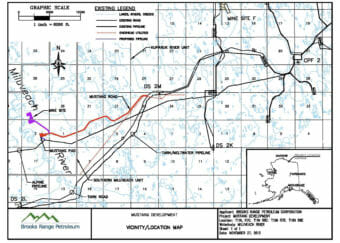
What’s so special about the Mustang Field?

Graphic courtesy Alaska Department of Natural Resources
(Graphic courtesy Alaska Department of Natural Resources)

The Mustang Field is pretty unremarkable —  in that it looks like the rest of the North Slope. Flat tundra stretches as far as the eye can see — and on top, all the signs of the oil industry.  There’s a long gravel road, a big pad and some equipment.  

What is remarkable about this field is the type of investment it has gotten in the past decade. Specifically, about $95 million dollars in state or state-backed loans.

But, this is not a story about a field that doesn’t have any oil.  This field is nestled between two very productive ConocoPhillips units. One — Kuparuk —  is the second largest oilfield in North America. Mustang is estimated to hold more than 25 million barrels of oil.

Instead of being operated by one of the major players on the North Slope, it is run by a small, 13-year-old, independent oil company — Brooks Range Petroleum Corporation.  

The company plans to hire a few hundred people this winter to put in a small, quick production facility and start producing in early 2019. Its president and CEO Bart Armfield said oil is coming soon.

But it has taken the better part of a decade to get to this point. There is a long paper trail at the Department of Natural Resources showing years of work delays.

Ask Armfield about the company’s plans and those delays and he has a quick answer.

“What happened to the whole industry? Oil prices fell from $120 plus to $30 a barrel,” Armfield said.

It’s a refrain Alaskans have been hearing for three years. In 2014, oil prices started to fall and it wrecked the state’s budget. Financing projects in the oil patch got trickier too.

Armfield’s not blaming all of the project’s delays on low oil prices — there were some technical problems too.  But he said that crash put Brooks Range Petroleum in a holding pattern. 

But now, oil prices have rebounded somewhat and the Mustang Field could be well on its way to paying off some of its bills next year.  There are a lot of outstanding bills and untangling who exactly is responsible for paying what back, is not easy.  

For starters, Brooks Range Petroleum operates the Mustang Field project — but it does not fully own it.

Just who owns which part is a web of companies and subsidiaries and right in the middle is AIDEA, the Alaska Industrial Development and Export Authority. It’s the state corporation that finances in-state projects. 

When AIDEA bought into the Mustang field in 2013 — it tried something different. Instead of just investing or loaning money to the field – AIDEA formed a corporation. That AIDEA-owned corporation built the road and pad leading out to the Mustang field.

AIDEA did it again a year later. It formed another corporation to build an oil processing facility. Altogether, the state corporation put about $72 million into developing and maintaining the Mustang Field. 

But, by 2015 there was still no oil coming out of it — that means no money coming in to recoup AIDEA’s investment. Oil prices were in a free-fall. That’s when the Department of Revenue stepped in, specifically the state treasury, and floated one of those state-owned corporations a $22.5 million line of credit.  Think of it as a bridge loan, something to keep the Mustang Field afloat until things got better.

Because that company was 96% owned by AIDEA, what happened was basically one part of the state loaned money to another part of the state.  Also, the collateral for that loan was oil tax credits that the state’s tax division owes to the corporation.

That’s convoluted, but basically it means that the state and a state-owned corporation carry almost $95 million worth of debt and nearly all of the risk of default on that debt for the Mustang Field.

This was — and still is — unusual. The Mustang field is the only one to get a loan like that from the treasury.  In fact, the treasury made the loan out of a portion of the state’s general fund, then changed its rules several months later to say that it was OK to invest state money in that type of loan. 

Right now, there isn’t a lot of documentation that explains why that loan was made.  Over at the Department of Revenue, Deputy Commissioner’s Mike Barnhill has been trying to sort it out.  

Barnhill wasn’t in that position when his department made the loan. When he started in January, he says staff flagged it for him. because it was due to be paid in July.

He pulled the file and there isn’t a lot of information in it about the origins of the loan. 

“I have, I believe, reviewed all of the files within the Department of Revenue.  There’s a pending public records request for emails, that I don’t have access to. So it may be that those emails reveal the genesis of the idea,” Barnhill said.

That public records request came from Jeff Landfield, a blogger who runs the site Alaska Landmine.  Landfield said he doesn’t understand why the state would make a loan to bail a state-backed company out.  

“So, I started digging into it and trying to figure out what happened,” Landfield said. “The more I dug into it the more I realized it was like… I think ‘fishy’ is a good term, you know?”

Landfield works in the oilfield support industry and said he considers it blatant favoritism. He wants to know why that loan wasn’t offered to any other companies when oil prices were down and the industry was suffering.

“If you’re involved with AIDEA and you’re in a project, you’ll get a bailout,” Landfield said. “Where all the other companies who have a lot more money who stand to lose more — who don’t have the ‘in’ with somebody in the government or the state, you know one of the company’s I talked to said where’s our f– bailout?”

Landfield’s request for those emails is making its way through the state’s Department of Law.

Senator Bert Stedman, R-Sitka,  also wants to know why that loan was made. He’s launched a legislative audit. 

That audit might take a while, but Stedman said that’s ok.

“I don’t think it’s as time-sensitive to get it out because the program is no longer in existence.  Don’t misinterpret that as slow-rolling going out of the auditing department, that’s not the case.  But it’s not… the house isn’t on fire.”

Stedman says it can’t be changed now, but he thinks Alaskans should know how their money was spent.  

“I don’t think we need to make excuses, you know, why this project was done. It was done,” Stedman said. “Now we just need to, you know, clarify. You know what was done and and what kind of policy direction we’re going in and clean up the mess. You know all of the players are changed. So, it’s not a hanging party you know it’s just .. sort it out and go on.”

That loan still hasn’t been paid back, and it’s not clear when that’s going to happen.  

The Department of Revenue asked AIDEA to take over the loan — but that hasn’t happened.  For now, Barnhill said there’s a deal in the works to extend the payment deadline.  But, that’s complicated too. 

The current deal goes something like this: the tax division of the Department of Revenue owes the AIDEA-owned company about $20 million in tax credits. But, that money is currently tied up in court. When that court case gets resolved and those funds get released, the Department of Revenue will hang onto the money and pay itself back.  Or, the loan could be extended until December of 2020 — whichever happens first. 

It’s not just the treasury that wants out from under its loan to the Mustang Field.  The AIDEA board voted to sell its ownership interest too.

That leaves ownership and operation to a handful of companies and Brooks Range.

Brooks Range CEO Bart Armfield is okay with that. He said that Brooks Range has a clear path to getting its oil out of the ground and is well on its way to making some money so it can pay its bills.

Protesters at Murkowski’s Alaska offices ask her to torpedo Trump’s Supreme Court pick

After a tense day of confirmation hearings on Supreme Court nominee Judge Brett Kavanaugh, Meredith Trainor was having trouble sleeping.

“I was so upset about the way the Kavanaugh hearing went. I was really upset about the way the senators on the judiciary committee treated Christine Blasey Ford and it felt really important to do something here in Juneau,” she said.

Psychology professor Christine Blasey Ford has accused Kavanaugh of sexually assaulting her when the two were teenagers.

Afterwards Trainor, a Juneau resident, logged onto Facebook and created an event asking the community to meet her outside of U.S. Sen. Lisa Murkowski’s office on Friday. She wanted to rally in support of Blasey Ford and oppose fast-tracking Kavanaugh’s nomination to the U.S. Supreme Court.

Then, she said, she went to bed. 

By noon on Friday, people were streaming into the narrow parking lot of Murkowski’s office with signs, bells and drums. Eventually, more than 130 people showed up.

Trainor said she’s not surprised by the turnout.  

Dozens signed a banner outside of U.S. Sen. Lisa Murkowski's office during rally against U.S. Supreme Court nominee Brett Kavanaugh on Friday in Juneau.
Dozens signed a banner outside of U.S. Sen. Lisa Murkowski’s office during rally against U.S. Supreme Court nominee Brett Kavanaugh on Friday in Juneau. (Photo by Rashah McChesney/Alaska’s Energy Desk)

“You know we have a senator who happens to be in a very powerful position within the current congressional leadership and Sen. Murkowski, in addition to being well positioned to weigh in and to potentially change the direction of what happens in the future with the Supreme Court — I think her being a woman is very significant,” she said.

Right around the same time, 900 miles away, another crowd gathered at Murkowski’s office in Anchorage.

There, about 150 people had a similar message.

“She’s the only Republican I’ve ever voted for, and I think she’s in a very difficult position and we are hoping and praying that she does the right thing,” said Kim O’Brien.

She feels it would be a betrayal if Murkowski votes for Kavanaugh.

“She’s a swing vote, and we want to swing her in the right direction. The direction of morality. And, respect for women and the American public,” O’Brien said.

There were demonstrations in other parts of the state as well.

In Petersburg in Southeast Alaska, a protest organized late this morning had about 25 people by noon. Petersburg has about 3,000 residents. 

In Fairbanks, the Daily News-Miner reports that about 40 people gathered outside of Murkowski’s office. 

Meanwhile, in Washington D.C. Murkowski joined Arizona Sen. Jeff Flake in calling for an delay of the confirmation vote. Senate Republicans have agreed to a one week delay and President Donald Trump has called for an additional FBI investigation into Kavanaugh.

Abbey Collins, Orin Pearson and the Fairbanks Daily News-Miner contributed to this story. 

Permanent Fund managers to look for in-state investment opportunities

The Alaska Permanent Fund Corp.'s exterior sign, March 14, 2016. (Photo by Skip Gray/360 North)
The Alaska Permanent Fund Corp.’s exterior sign. (Photo by Skip Gray/360 North)

Alaska’s Permanent Fund Corporation has a new mandate to increase the amount of the Permanent Fund that is invested in the state.

The fund’s Board of Trustees adopted the new policy Thursday during a meeting in Anchorage.

It sets a goal of increasing the amount of the Permanent Fund assets invested in-state to at least 5 percent in five years.    
Permanent Fund CEO Angela Rodell told the board what that would look like in dollars.

“…By 2023, at least $2.4 billion of the fund — if the fund stays flat — would be invested in state,” she said.

To qualify as an in-state investment, it would be handled by an investment manager who isn’t employed by the Permanent Fund Corporation. That manager would either need to have an office in Alaska and an Alaska-based employee managing its assets. Or, it could also be direct investment into a project in the state.     

In addition to the new policy, the board also directed the Permanent Fund Corporation to put $200 million into a program that would use Alaska-based investment managers.  

After one year, Feds examine how DOT takeover of environmental reviews is working

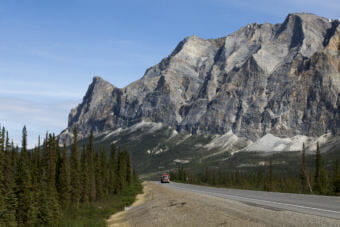
A truck makes its way south on the Dalton Highway near Coldfoot, Alaska. (Photo by Rashah McChesney/Alaska's Energy Desk)
A truck makes its way south on the Dalton Highway near Coldfoot, Alaska. (Photo by Rashah McChesney/Alaska’s Energy Desk)

For the first time, the state’s Department of Transportation and Public Facilities is in the driver’s seat when it comes to navigating the legal environmental requirements that come along with big transportation projects.

The state doesn’t have a dedicated fund for state highway projects. So, something like 90% of the projects in the state get federal money. That means that when the state wants to work on a highway — build a new one, widen an old one — there’s usually some kind of federal environmental review.  

Typically that review falls under the National Environmental Policy Act (NEPA), which requires federal agencies to consider the impact that any decision they make might have on the environment.

In the past, the Federal Highway Administration handled that review. But an Obama-era law gave states the option to take control of some of that process. Last year, Alaska joined 6 states that have taken the feds up on that offer.

There’s evidence that the states that have taken over this work are saving a lot of time in the permitting process.

In early September, the Federal Highway Administration put out the results of its first audit of how Alaska’s Department of Transportation is handling the new responsibilities.

There are few areas that could be improved, like one instance where the state should have held a public hearing, but didn’t. And there are questions about having enough staff and allocating the time and money they need for training.

But there are other areas where federal auditors say the state is doing well. Like, bringing in legal help early-on in the process.

With this new power comes new responsibility — namely legal liability. It means it can be sued in federal court.  

The state added a new attorney in the Department of Law — specifically to make sure that projects are legally defensible. The state’s Department of Transportation and Public Facilities added four other positions to cope with the new responsibilities too.

The Federal Highway Administration is taking comments on the audit until October 5.

Site notifications
Update notification options
Subscribe to notifications