Rashah McChesney

Daily News Editor

I help the newsroom establish daily news priorities and do hands-on editing to ensure a steady stream of breaking and enterprise news for a local and regional audience.
Cyber-security firm says Alaska was targeted by Chinese cyber spies

Tiananmen Square at night on May 24, 2018, in Beijing, China. A cyber-security firm is reporting that Alaska was targeted by hackers using computers in China before and after a trade mission in May.  (Photo by Rashah McChesney/Alaska’s Energy Desk)

A cyber-security firm is reporting that Alaska was targeted by hackers using computers in China.

The company, Recorded Future, documents repeated attempts to connect to several networks in Alaska before and after the state sent a trade delegation to China in May.

According to the report, the scanning activity spiked when Gov. Bill Walker announced the visit to China in March and again just after the delegation left the country.

The data shows that Alaska Communications Systems Group, or ACS, and Alaska Power and Telephone Company were targeted in addition to the state’s Department of Natural Resources.  

There’s evidence that the scanning came from internet connections registered to Tsinghua University in Beijing.

Walker’s administration is pushing back against the report.  

Press Secretary Austin Baird said there was web traffic targeting the state but no hack actually happened.

“The state of Alaska like most state governments, like most businesses, like most companies that do business online or do business internationally, there’s routinely anonymous activity on the perimeter networks that amounts to someone checking if the door is locked,” Baird said.

Baird said the state does not believe that China was the original source of the scanning activity.

He said the state contacted law enforcement as a precautionary measure but doesn’t plan to do any further investigation into the source of the web traffic.


The mysterious case of Alaska’s strange sockeye salmon returns this year

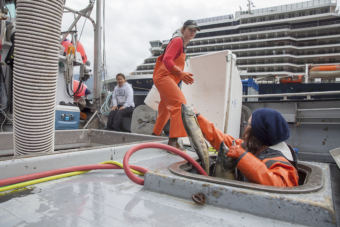
Ava Daugherty, of Juneau, grabs a salmon from Sara Gering, of Juneau, as the two work to offload more than several thousand pounds of salmon from the fishing tender San Juan on July 19, 2018, in Juneau. Behind them, San Juan captain Bonny Millard, looks on. Millard said it has been an unusual season for sockeye salmon that she is picking up from commercial fishermen in Southeast Alaska. (Photo by Rashah McChesney/Alaska’s Energy Desk)

There’s something unusual going on with the sockeye salmon runs returning to Alaska this year. In some places — like Bristol Bay — the runs are strong. In others, like the Copper River or the Kenai River they’re unexpectedly weak. In some places, there are sockeye that are unusually small. In others, sockeye of a certain age appear to be missing entirely.

It’s a mystery.

In Southeast Alaska, one of the first Alaska Department of Fish and Game staffers to notice an unusual trend was Iris Frank, a regional data coordinator and fisheries technician. 

Frank’s lab is on the first floor of fish and game’s Douglas Island office that looks like it hasn’t changed much in the 32 years since she got there.

Frank has been looking at blown-up images of sockeye salmon scales for decades.  She pops one onto the machine and dials it into focus to show that salmon scales have ridges, called circuli.  They look a lot like fingerprints. 

Circuli carry a lot of information about what a salmon has been doing since it hatched.

“So if you think about a fish being out say, in a lake in the summertime, it’s warmer there. There’s more feed around. So these circuli are probably going to be bigger and more widely spaced apart,” she said.

Then, during the winter months, the ridges compress together. Group those two sets of ridges together, Franks says she can usually get a pretty good idea of how old a salmon is from reading the scales.

She gets about 40,000 of these salmon scales in a year and she’s an expert at reading them. In the last few years — she’s noticed that on some fish — those lines are getting closer and closer together. Frank is quick to point out that she is not a fisheries scientist, but that could mean the fish aren’t growing as fast, or as big as they normally do.

She said she hasn’t seen anything like it before, in the decades that she’s been reading scales.

“This is just, you know, the hairs on the back of your neck standing up going ‘well that’s really odd,'” she said.

Frank doesn’t know why it’s happening, or what it means. But it’s a clue.

And, it’s part of a pretty big mystery. Elsewhere in the state, fish and game scientists are scratching their heads over smaller sockeye, sockeye trickling into rivers and lakes where they normally come back strong or whole age groups of sockeye that appear to be missing. Several said they’re wondering what is happening to the sockeye once they leave Alaska’s freshwater and head out into the ocean.

Out at the Alaska Fisheries Science Center in Auke Bay, there’s a team of National Oceanic and Atmospheric Administration scientists who specialize in researching fish at sea.

Among them is Ed Farley. He’s a program manager for the Ecosystem Monitoring and Assessment Program. There, researchers focus on Alaska’s large marine ecosystems like the Gulf of Alaska and the Bering and Chukchi Seas.

Farley said he was not surprised to see inconsistent returns of sockeye salmon to Alaska this year, and he has a pretty good idea of what could be happening — though he’s reluctant to call it a smoking gun.

One big clue is the blob. That’s the warmer-than-normal water that moved into the North Pacific about four years ago. It stayed unusually hot through 2016 in the Gulf of Alaska shelf — some 4 to 6 degrees higher than normal. Farley said that shelf is where young sockeye salmon from Alaska go to eat once they venture out from their home rivers. Generally they move onto the shelf and move counter-clockwise foraging for food before they wind up in the North Pacific Ocean. 

That heat has a big impact on salmon and other cold-water species.

“That’s going to increase their metabolic rate, so they’re going to have to find more food,” Farley said.

But something else happened in the Gulf of Alaska during that time period too.

Farley said a team of researchers did surveys on the food web during those hot years and found that some of the key food for young sockeye salmon was missing.

Some things like copepods — that’s a high-fat bug that sockeye eat, basically eggs with legs — just weren’t around in the same volume as they had been.

“So you kind of a get a double whammy,” Farley said. “You know they’re having to eat more because their metabolic processes are speeding up. But there’s less prey. And so this is impacting their growth rate at this time, this period of summer, when they’re supposed to grow and get this fat store.”

Farley said that could have caused a lot of young sockeye salmon to die during their first summer at sea.

Another factor, Farley said, is pink salmon. There’s some evidence that they compete with sockeye for food in the North Pacific. But Farley is quick to point out that the role  pink salmon play in sockeye salmon deaths is still in question.  

Farley also works with the North Pacific Anadromous Fish Commission which has scientists from several countries including Russia, Japan and the United States. Farley said some researchers on that commission have looked at sockeye salmon scales and calculated growth rates of the salmon during different life history stages. They’ve found a pattern of growth that shows sockeye salmon aren’t growing as fast in years when there are a lot of pink salmon in the same place.

But when it comes to the sockeye salmon returns this year, Farley is less focused on what’s happening in the North Pacific and more on the Gulf of Alaska. He suspects that some of the sockeye salmon returning to Alaska this year went out into the ocean at a time when they needed more food to survive and it just wasn’t there.

And those banner Bristol Bay sockeye salmon returns this year? Farley said those same warm ocean conditions might be the culprits there as well.

Warm water may have decimated the food web in the Gulf of Alaska — but there’s evidence that it made the Bering Sea more fertile.  Farley says that’s where Bristol Bay sockeye rear, so they were much better off than their Gulf of Alaska relatives.

As trade war escalates, Alaska gasline corporation and Gov. Bill Walker minimize threat to state’s LNG project

Alaska Gov. Bill Walker listens to a speech during a meeting with Sinopec on Friday, May 25, 2018, in Beijing, China. Sinopec is one of three potential partners the state is courting with its liquefied natural gas export project.  (Photo by Rashah McChesney/Alaska’s Energy Desk)

Alaska’s Gasline development Corporation and Gov. Bill Walker’s administration are minimizing the potential impact of a tariff on the state’s liquefied natural gas export project.

China — the project’s largest potential customer and investor — is threatening to impose a 25 percent penalty on imports of LNG.

Gene Therriault is the government liaison for the state gasline corporation. He wrote in an email that the corporation believes the trade dispute will be resolved before Alaska exports LNG to China.

“The Alaska LNG project represents a multigenerational project that matches China’s 100 years of natural gas demand with Alaska’s 100 years of supply on the North Slope. As a result, Alaska LNG will continue to present a win-win opportunity for both countries,” Therriault wrote.

The LNG tariff is the latest escalation in a tit-for-tat trade dispute between the U.S. and China. The move ostensibly threatens the financial viability of the Alaska LNG project.  A 25 percent penalty would make Alaska’s gas significantly more expensive for Chinese customers.

It’s not the first time a tariff has threatened the project. The Trump administration levied a tariff on Chinese steel imports. That could impact the state’s ability to find steel for the project’s 800-mile long pipeline.

Gov. Bill Walker’s office also emailed a written statement calling the trade tensions “short term.”

According to a media release, Walker’s administration will “continue to work with the Trump Administration to ensure that Chinese and U.S. officials strike a fair compromise so that Alaska’s natural gas reaches the market.”

China’s ministry of commerce announced the LNG penalty as part of a $60 billion package of tariffs. If carried out, it levels penalties on thousands of U.S. goods from beef to lumber to auto parts.

AK: There and back again, one man’s journey from China to Alaska

John Tichotsky, economist, and Yingdi Wang, Alaska trade representative to China, on a walk through town on May 29, 2018, in Shanghai, China. Both accompanied Alaska Gov. Bill Walker on a trade mission to the country. (Photo by Rashah McChesney/Alaska’s Energy Desk)

Alaska’s does $1 billion dollars worth of trade with China every year — it’s the state’s largest trading partner.  But, it took a lot of work to break into that market.  One man, Yingdi Wang, has been at it for decades.

When Alaska Gov. Bill Walker decided to take 50 people on a trade mission to China — the logistics were complicated. But, when the bulk of the delegation landed at the airport in Beijing on the first day, Yingdi Wang was waiting there.

Wang is a small, impeccably dressed man. And he is really good at logistics. He’s a natural-born fixer. On this trip, that means a steady-stream of rapid Mandarin to the bus driver, to staff at the airport and hotels, answering questions, solving problems, even Tracking down a tailor so half the delegation can get new suits.

He’s up with the group first thing in the morning, and out late. On these long bus trips he usually puts his sunglasses on, crosses his arms and takes a nap.  During a bus trip in Shanghai, with about a dozen people who are interested in selling what Alaska has to offer into China — Wang sits in the front seat, watching the horizon. He’s thinking about how much the city has changed since the first time he visited in 1991.

“Well, there was no highway. There was no high-rises … like, this road we’re on? It’s just a big, big, big change,” he said.

From that seat, nearly 30 skyscrapers are in view.

“Hundreds, hundreds you know,” he said.

It’s a sea of people.

Wang was born in 1954 in Beijing, about 10 minutes from Tiananmen Square. 

Crowds of people walk around Tiananmen Square at night on Thursday, May 24, 2018, in Beijing, China. (Photo by Rashah McChesney/Alaska’s Energy Desk)

“That was my childhood. I grew up there,” he said. “Oh, you know summertime we just went to Tiananmen Square, we slept in the square there, you know.”

It was a chaotic time. The cultural revolution started in 1966.  China’s communist leader, Mao Zedong,  shut down the nation’s schools for a time.  Wang says, his education just kind of stalled.

“We just doing the revolution, you know? Even [when] we go to school, we don’t study, you know, we just play,” he said. “Teacher afraid to teach; student just doesn’t want to study.”

When he was 16, Wang was sent to a work camp. He worked as a welder, a boiler-maker and in a big chemical factory outside of Beijing for about 15 years.

By the early 1980s, he was 30 years old and he wanted more.  He wanted to finish college. But, he said he wasn’t allowed to do that in China.

“Well at that time in China — my age — cannot go to college you know.  I’m 30 years old.” he said.  “It’s just, the system not allow me to go to university to study.”

So, he decided to come to America.  But, it took awhile.  

A close friend, John Sturgeon (yes, that John Sturgeon), said that process was not easy.

“And I can’t remember the exact number of times but he told me, I think over a hundred times [he] went to the American embassy and applied for a visa. And they were extremely hard to get in those days because they figure people come over here and they wouldn’t leave. And think like a hundred and twentieth time,  he told me that he went up and put his visa application down. He said the guy looked at him, he said ‘son, you’re going to keep on coming aren’t you?’ And he says ‘yes.’ and he says ‘OK, approved,'” Sturgeon said. ” And that’s how he came to America.”

Wang ended up in Alaska.

Sturgeon said he met Wang for the first time in Anchorage. 

“I had a friend that I was working with called up and said he had some college student that was looking to make some extra money if I needed him my lawn cut,” Sturgeon said. “I says,’yeah.’ I really didn’t. But I was trying to do him a favor and so I said ‘OK.’ So, that person turned out to be Yingdi.”

Sturgeon said he liked Wang immediately.

“‘He’s real personable. He’s really outgoing and kind of always got a smile on his face,” Sturgeon said. “But he was, you know, trying to work his way through college.  He got a scholarship that wasn’t enough to pay for everything, so he had taken kind of odd jobs wherever he could get them to live on.”

Before long, they were working together.  First, in the timber industry at Koncor Forest Products, a company set up by four Alaska Native corporations. Wang’s first job was scanning log tags by hand before they were shipped off; sometimes that meant 20,000 tags per ship.

“Yingdi would come in after hours and scan those tags ’til, you know, late in the evening and sometimes early in the morning,” Sturgeon said.

He said he watched Wang blossom from a new immigrant with terrible English skills into a savvy business person pretty quickly.

With Wang’s help, Koncor Forest Products opened one of the first headquarters in China for an Alaska company. Wang ran the company’s bureau from his apartment in Beijing. 

Sturgeon and Wang don’t work at Koncor together anymore, but they’ve started their own businesses together since then.  In a country that values reputation, Sturgeon said Wang has built a good one. 

“Still to this day we don’t have to put down deposits to the factories when we buy something because they trusted Yingdi,” Sturgeon said.

About 15 years ago, Wang took those private-sector skills into the public sector and started working for the state.  

When someone from the Governor’s office or the Department of Commerce wants to do business in China, they call Wang.

 “So, he is the ultimate fix it man for the state of Alaska,” said Alaska Gasline Development Corporation economic adviser John Tichotsky.

John Tichotsky and Yingdi Wang flip through photos during a port tour on May 29, 2018, in China. (Photo by Rashah McChesney/Alaska’s Energy Desk)

He said Wang is completely at ease negotiating with high-level government officials, then chatting casually with cab-drivers or negotiating in a market. 

“He’s like a genie in the bottle. You get to tell them your wish, and everything from a suit to a meeting with a minister … he could probably pull it off,” Tichotsky said.

And, he knows Alaska. Tichotsky said Wang has a talent for stepping in at these crucial points in meetings to make sure everyone is on the same page.

“There are some real cultural specificities and Yingdi’s just good at pointing out to people what they should do — how they should react — without being condescending or making you feel like you’re awkward,” Tichotsky said. 

But, that’s all changing now.  

Back on that bus in Shanghai, Wang said he’s getting close to retirement age.  He’s 64.

This summer, he’s leaving behind that apartment in Beijing and settling in the U.S. for good.  

Feds ask Alaska LNG to hire contractor to help with project permitting

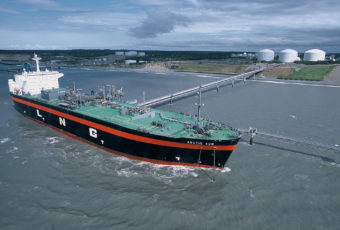
An LNG tanker fills up at the ConocoPhillips liquid natural gas export facility in Nikiski, Alaska. When it opened in 1969, it was the only facility of its kind in the U.S. to get a license to export its gas to Japan. For more than forty years, the state has attempted to develop similar projects to bring natural gas from the North Slope to market, none of those projects have broken ground. (Photo courtesy of ConocoPhillips)
An LNG tanker fills up at the ConocoPhillips liquid natural gas export facility in Nikiski, Alaska.  A state-led LNG export project would ship gas from the North Slope to a nearby facility, before exporting it to countries in Asia. The state’s gasline corporation is currently seeking a private contractor to help it move through the federal permitting process. (Photo courtesy of ConocoPhillips)

Alaska’s gasline corporation is planning to hire a private contractor to help it through the federal permitting process.

The move comes after the Federal Energy Regulatory Commission (FERC) sent a letter to the state, asking for help.  FERC is the lead agency doing the environmental and engineering review of the Alaska LNG project.

“And in this case it is for the fire protection review,” said Alaska Gasline Development Corporation Senior Vice President Frank Richards. “That’s essentially examining the engineering plans and drawings that we’ve provided to them to make sure that they’re in compliance with code and good engineering practices.”

He says there’s a staffing shortage at the federal commission and they’re looking to outsource some of project review they usually do in-house.

Last week, Bloomberg News reported a backlog of permit reviews at the federal commission, citing potential delays of  12 – 18 months.

But, Richards said he met with staff from the federal commission after the state received the letter and they didn’t say there would be any delays in the schedule for permitting Alaska’s project.

“I received no indication from FERC that that schedule is going to be slipped,” Richards said.

Currently, Alaska’s gasline project is on an 18-month timeline to get through the environmental review — that schedule would see a final environmental review of the project by late 2019.

Editor’s note: The headline for this story was changed to reflect that the Federal Energy Regulatory Commission asked the Alaska Gasline Development Corporation to hire a contractor.

Legislators quiz Alaska LNG project managers on progress

An LNG tanker fills up at the ConocoPhillips liquid natural gas export facility in Nikiski, Alaska. When it opened in 1969, it was the only facility of its kind in the U.S. to get a license to export its gas to Japan. For more than forty years, the state has attempted to develop similar projects to bring natural gas from the North Slope to market, none of those projects have broken ground. (Photo courtesy of ConocoPhillips)
An LNG tanker fills up at the ConocoPhillips liquid natural gas export facility in Nikiski, Alaska. When it opened in 1969, it was the only facility of its kind in the U.S. to get a license to export its gas to Japan.  The planned Alaska LNG project would site a liquefaction terminal for North Slope natural gas nearby. (Photo courtesy of ConocoPhillips)

Lawmakers got a progress report on the Alaska LNG project from the state’s gasline development corporation on Wednesday in Anchorage.

It is a busy year for the Alaska Gasline Development Corporation, or AGDC. It is trying to land agreements with Chinese companies to buy the state’s gas. At the same time, the corporation is working through an exhaustive federal environmental review and negotiations with North Slope companies to sell their gas into the pipeline. 

Before the meeting on Wednesday,  Sen. Cathy Giessel, R-Anchorage, sent the corporation a bulleted list of the information and questions that she wanted answered. 

She asked for everything from a list contractors the corporation is using and how much money it’s compensating board members for travel to certain types of state employees moonlighting for the corporation as well.

On that last one, Giessel said she is concerned about the influence of partisan politics on the project.

“When we created AGDC, we were very careful to make sure that AGDC was a separate entity that would not be influenced by politics. In other words, governors that come and go,” Giessel said. “Here is the governor’s deputy chief of staff on a list documented by AGDC as working for a AGDC. It’s concerning.”

She’s not the only legislator who said that they were concerned about political influence on the LNG export project.

The Alaska LNG project has been a key issue for current Gov. Bill Walker and it’s an election year.  

When asked about Giessel’s letter, Anchorage Democrat Geran Tarr said she wants the legislature to have oversight but thinks it’s important not to micromanage what the state corporation is doing.

“It just seems that you know people who are politically aligned to the governor are more willing to trust what they’re doing moving forward and people who are not politically aligned with the governor are not trusting,” she said.

Tarr said she is concerned that the politics are getting in the way of lawmakers being able to accurately gauge the Alaska LNG export project’s feasibility based on its merit — rather than their own political alignments.  

Putting aside the politics —  a lot of lawmakers had questions about how the project would be financed and what the state could be obligated to pay for.

They heard presentations from the Department of Natural Resources and the Department of Revenue as well.

Senator Bert Stedman, R-Sitka, asked the Department of Revenue about its analysis of how the state is going to pay for its portion of construction on the project.

“When you have cost overruns of 10, 20, 30 billion possibly — which is not out of the realm of possibilities. How are you going to factor in the state exposure of capital calls in particular if we draw on the Permanent Fund or something I never really thought about and not too excited about grandma’s pension pool to to do to deal.”

Lawmakers also asked about tariffs and the trade war with China.

Frank Richards, the senior vice president of the gasline corporation says– so far — the project seems to have escaped major impact from the steel tariffs. And, China hasn’t retaliated with a tariff on LNG imports.  

“China wants clean efficient natural gas, Alaska has it, U.S. wants to produce it and export it. So we feel that are in a good position as a project as Alaska to not hopefully be impacted by that,” he said.

Lawmakers were on a tight timeline to get the meeting finished, so several will be submitting questions in writing to the corporation.

Project organizers are on a tight timeline too. Their deadline for signing commercial agreements with potential Chinese investment partners and buyers is in December.

Site notifications
Update notification options
Subscribe to notifications