I help the newsroom establish daily news priorities and do hands-on editing to ensure a steady stream of breaking and enterprise news for a local and regional audience.
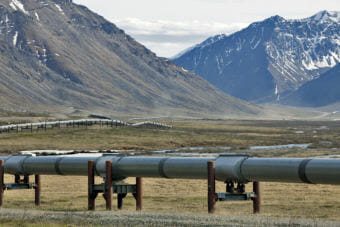
The Trans-Alaska Pipeline runs alongside the Dalton Highway near the Toolik Field Station on June 9, 2017, in the North Slope Borough. (Photo by Rashah McChesney/Alaska’s Energy Desk)
Add to that, the legislature’s decision to tap into the Permanent Fund’s earnings to pay the bills and the state is suddenly a lot closer to a balanced budget.
“I saw one day where the Alaska oil price got slightly over $80 a barrel, but we’ve been in the high $70s for the last couple of weeks,” said Ken Alper, director of the tax division at Alaska’s Department of Revenue.
Each time the price per barrel of oil climbs up, Alper has basically the same message.
“It’s good for Alaska’s economy to have higher oil prices, there’s no question about that,” he said.
But, prices have to get higher — and stay higher — to have a lasting impact on the state’s budget.
“Should the current prices hold, we will have our first balanced budget in several years for fiscal year ’19,” Alper said.
Alper calls that number the break-even point for the state’s budget. That’s the point when the state starts bringing in enough revenue from oil to pay all the bills. Up until 2018, that break-even price was a lot higher, at more than $90 per-barrel.
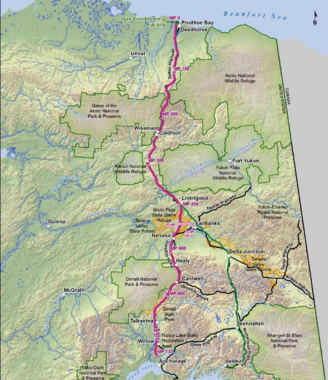
The current route planned for the Alaska Standalone Pipeline — an in-state natural gas pipeline designed to bring gas from the North Slope to Alaska communities. (Map courtesy of the Alaska Gasline Development Corporation)
Alaska is one step closer to getting an in-state natural gas pipeline; though it’s not clear if the project will ever be built.
The U.S. Army Corps of Engineers announced Friday that it had released the final supplement for its environmental review of the Alaska Stand Alone Pipeline project. The final permit in that process should be released sometime in the next three months.
The in-state pipeline project has taken a backseat to the massive Alaska LNG export project.
Both projects would pipe gas several hundred miles from the North Slope to market, but the standalone pipeline is designed for in-state use, while the Alaska LNG project is designed to sell that gas to Asian markets.
Staff at the Alaska Gasline Development Corporation have repeatedly said that they are focused on building the larger project. Frank Richards is the senior vice president for both projects at the state’s gasline corporation. He said the in-state pipeline project is basically on hold, now that it has the permits it needs.
“It’s truly the backup plan,” Richards said. “It means we will have the permits and authorization to construct, should the need arise.”
Even though the in-state pipeline project is on hold, Richards said it can still help the state develop the Alaska LNG project. The pipeline projects are similar enough that federal regulators could use work done on one to guide permitting for the other.
Also, Richards said there is about $11 million left over from developing the in-state project that can now be used to fund the export project.
Responders from Alaska Department of Environmental Conservation, the federal Environmental Protection Agency, the North Slope Borough and BP Exploration Alaska have been established to respond to natural gas and crude oil discharge near Prudhoe Bay. (Photo courtesy EPA)
Companies drilling oil and gas wells in Alaska will now have to dig deep enough to avoid problems stemming from thawing permafrost.
Alaska’s Oil and Gas Conservation Commission announced a regulation change on June 19 that requires companies to set surface casings for wells below the base of the permafrost.
The surface casing is basically a pipe that protects the well from outside contaminants and keeps the sides of the well from caving in.
The change in regulation comes after a BP well failed last year, and leaked oil and gas on the North Slope. The company blamed the spill on a piece of the casing that buckled after thawing permafrost put uneven pressure on it.
Cathy Foerster sits on the conservation commission. She said BP has already shut-in the wells that have the flawed design. So, she doesn’t think companies operating in Alaska will have to spend any money to comply with the new regulations.
“Nobody is going to do anything differently than they’re already doing it,” Foerster said. The regulation change was put in there for the new guys. When you come up here, if you’re going to drill a well, you have to drill it this way. The people who have been up here have learned that and they’re doing it. But, welcome to Alaska. Set it below the permafrost. ”
The new regulation will go into effect on July 18.
John Sturgeon discusses his U.S. Supreme Court case with the Alaska Senate Resources Committee on Feb. 17, 2016. Sturgeon is the plaintiff in in Sturgeon v. Frost, a case involving a dispute over federal control over navigable waters. (Photo by Skip Gray/360 North)
The U.S. Supreme Court has agreed to hear an Alaska water rights case for the second time.
On Monday, the court agreed to review Alaska hunter John Sturgeon’s case. That case grew from a 2007 incident when National Park Service rangers confronted Sturgeon and said he couldn’t operate his hovercraft in the Yukon-Charley Rivers National Preserve.
The issue at the core of the Sturgeon case is a fight over control of rivers in Alaska. Specifically, who has the authority to regulate state navigable waters within conservation units in the state.

Those conservation units are things like national parks and preserves, wildlife refuges, wilderness areas and wild and scenic rivers.
Gov. Bill Walker talks strategy with one of his economic advisors, John Tichotsky, on Thursday, May 24, 2018, in Beijing, China. Walker’s administration is leading a 10-day trade mission to China with the hopes of increasing Alaska’s exports to the state. (Photo by Rashah McChesney/Alaska’s Energy Desk)
Alaska’s trade delegation to China is headed home. The trip, called Opportunity Alaska, put several companies selling Alaska’s goods and services in front of Chinese investors and consumers.
Gov. Walker and state gasline corporation head Keith Meyer also pushed for support for the $45 billion Alaska LNG project.
Rashah McChesney from Alaska’s Energy Desk travelled with the delegation and has this update on the last leg of the trip.
Interview highlights:
Shanghai is a beautiful city, but it is full of smog. Several members of the delegation have said that this is proof that China needs cleaner fuel, like Alaska’s LNG export project.
There hasn’t been any real news on that front, but the group did meet with Sinopec and Bank of China — both are very large potential funders and partners of the project.
And what happened in those meetings?
There’s this sort of ceremonial meeting that I’ve seen several times on this trip. The governor and his aides sit one side of the room, and whomever he’s meeting — and his aides — sit on the other. They face off and the two greet each other through interpreters and have these long discussions. They introduce their entourages, talk about the purpose of the visit, etc.
The Bank of China hosted a reception for the delegation — that’s the state-owned bank that could help finance the $45 billion pipeline project.
Walker and the delegation also met with Sinopec, the giant state-owned oil and gas company that could be a partner. And the president said that he looked forward to continuing to study the feasibility of the project with Alaska.
Then he said this: “After some of the work we did, in terms of assessment and evaluation in technology, economics and in terms of the resources of Sinopec — I think there’s a lot more work for us to be done than originally imagined.”
The Governor has always been so optimistic about the gasline. Is he saying this trip has changed that?
I have not yet had the chance to talk to the governor about what he thinks of those comments, but I don’t think so. He and and several other members of the trade delegation say they are optimistic that this is the best time for the project to get built.
And apart from the gasline, what else is going on?
Well, there has been a lot of progress with the tourism companies that came here. China has a rapidly growing middle class and they’re spending a lot more on outdoor tourism than they used to which makes Alaska an attractive destination. There has been a surge in the number of Chinese visitors to Alaska in recent years.
There was also an agreement signed with Alaska Pacific University — working toward a partnership that would allow the Chinese Nordic Team to train at APU and vice versa — allowing Alaska’s team to prepare for the 2022 Winter Olympics, which China is hosting.
I’m told a delegation from China will be in Alaska next month to look at the facilities; they’ll head up to Alyeska Ski Resort in Girdwood as well. This a big deal for both APU and Alyeska and could lead to an influx in students and tourists.
Rashah McChesney is in China May 19 – 30, traveling with Gov. Bill Walker and the Opportunity Alaska: China Trade Mission. She’s filing stories for Alaska’s Energy Desk, Alaska Public Media and NPR.
Gov. Bill Walker meets with Vice Premier Liu He in Beijing on Monday, May 21, 2018. (Photo courtesy Alaska Governor’s Office)
CHENGDU — Alaska Gov. Bill Walker along with state gasline corporation head Keith Meyer met with Chinese Vice Premier Liu He in Beijing early Monday morning.
Chinese Vice Premier Liu He left Washington D.C., over the weekend where he led a delegation working to avert a trade war with the United States.
The result? Both sides announced on Saturday that they would stop slapping each other with tariffs and that China would buy more goods and services from the U.S.
Alaska Gov. Bill Walker met with He early Monday morning just hours after the China’s top economic adviser returned to Beijing. Walker touted the timing of his arrival in Beijing.
“We were absolutely first in line, I mean it was impeccable timing on our part,” Walker said. “We just happened to be there on the morning after, I mean he returned two hours after our flight got into Beijing, from Washington.”
China is Alaska’s largest trading partner. Walker hopes the state can play a pivotal role in reducing tensions over the trade deficit between the U.S. and China.
That trade deficit is massive. Last year, the U.S. bought $375 billion more in goods and services than it sold to China.
Both countries agreed to increases in U.S. agriculture and energy exports to China.
Meanwhile, Walker is leading a 10-day trade mission with a delegation of Alaska companies peddling everything from seafood and the $45 billion AK LNG export project, to organic baby food, specialty teas and minerals.
As he ran between meetings with Chinese officials in Chengdu on Tuesday, Walker said Alaska is just one piece of a large geopolitical puzzle — but it’s a role he is willing to play.
“I just am happy with the result,” he said. “I don’t care what piece I am, I’m just happy with the result.”
Close
Update notification options
Subscribe to notifications
Subscribe
Get notifications about news related to the topics you care about. You can unsubscribe anytime.