Rashah McChesney

Daily News Editor

I help the newsroom establish daily news priorities and do hands-on editing to ensure a steady stream of breaking and enterprise news for a local and regional audience.
Walker’s bills to swap oil tax credit debt for bond debt making progress

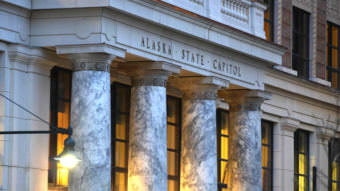
Alaska State Capitol, Feb. 7th, 2017. (Photo by Skip Gray/360 North)
Alaska State Capitol in February. The Legislature is considering a proposal that have the state borrow money to pay back nearly $1 billion in cash credit debt it owes to oil and gas companies. (Photo by Skip Gray/360 North)

Currently, Alaska owes nearly $900 million to companies in the form of oil tax credits. A bill that would have the state issue bonds to pay those companies is on the move in the legislature.

Gov. Bill Walker introduced companion bills in the House and Senate this session. Each lays out of a plan for the state to issue bonds to quickly pay down the debt it owes to oil and gas companies.

The House Resources committee voted Tuesday morning to pass its version of the bill along to the next committee.  But, the committee’s co-chair Rep. Geran Tarr, D-Anchorage, said she doesn’t support it.

She said the state would be swapping one type of interest-free debt for another that could have less favorable repayment terms. If the state issues bonds and then fails to make payments, that could affect its credit rating.

“It means that we would have to prioritize it over other important state needs like public safety, if there were such a time as everything falls out from under us. So that’s difficult for me,” Tarr said.

Pat Galvin, Chief Operating Officer of Great Bear Petroleum Operating, LLC., on March 22, 2017 in Juneau. (Photo by Rashah McChesney/Alaska’s Energy Desk)

The state’s tax credit bill stems from a program that was designed to encourage companies to explore and develop new oil fields in the state.  The state used to pay off the balance of the credits each year,  but as oil prices sank the Walker administration pulled back and made minimum payments on what the state owes.   

For three years, oil and gas companies — and some banks — have repeatedly told lawmakers that the unpaid credits are hurting development in Alaska.

Pat Galvin, Chief Commercial Officer of Great Bear Petroleum, said the unpaid credits harmed companies’ ability to get financing for exploration and development. 

Great Bear has exploration wells on the North Slope that are on hold. 

“The funding is held up because of the uncertainty over these tax credit payments,” Galvin said.

A companion Senate bill has moved into the Senate Finance committee as well.  From there, the bills must move to the House and Senate floors to be voted on.

After pushback, public comment period on Pebble Mine extended

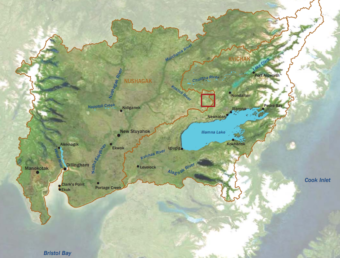
Map of the Bristol Bay region. The Pebble Deposit location is indicated by the red box. (Photo courtesy U.S. EPA)

A public comment period on the environmental impact of the proposed Pebble Mine has been extended.

The U.S. Army Corps of Engineers announced on April 6 that it would add two months to its initial scoping period. Public comments during that scoping process help the Corps decide what to focus on during the environmental review of the project.

The Corps had initially scheduled a 30-day scoping period that would have ended in April. Now, people will have until June 29 to weigh in.

Alaska Department of Natural Resources Commissioner Andy Mack and Senator Lisa Murkowski wrote to the Corps asking for more time. Both said the federal review process needs to include longer public comment periods given the scope of the massive mining project.  

Murkowski also asked the Corps to reach out to Alaska Native Corporations and expand its outreach to rural communities in the Nushagak River watershed who are likely to be impacted by the mine.

The mine would be located near some of the richest salmon fisheries in the world.

Walker asks legislature to divert funds from studying ANWR into public safety

A still from the ANWR video released by the White House (Image courtesy YouTube)
A still from the ANWR video released by the White House. (Image courtesy YouTube)

Gov. Bill Walker is asking the state legislature to take $10 million he originally wanted to spend exploring for signs of oil in the Arctic National Wildlife Refuge — and put it toward other things.

Walker sent a letter to the co-chairs of the House and Senate Finance committees on April 2, asking them to redirect more than $8.3 million toward a statewide 911 system. Walker originally allocated the funds for seismic exploratory work, in the budget he released in December.

He also wants to split $1.5 million between the Department of Revenue and the Department of Natural Resources to do legal and financial work on the Alaska LNG project.
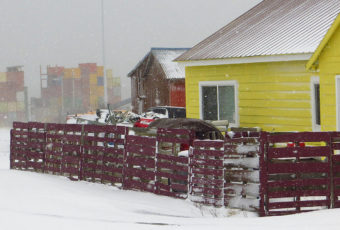
Congress opened the Refuge to development in December, but there is not a lot of data about how much oil is actually in it.

In the letter, Walker says the funds are not needed for seismic exploration in the Refuge right now.

Both the House and the Senate will have to approve the budget before the money can be spent.

State wants to stop billing homeowners for tech support after spills

Boom
In 2014, A NORTECH crew works on a Gastineau Channel beach to clean up heating oil spilled from a vandalized tank at the Prospector Hotel. The state helps homeowners with heating oil spills too, at a cost. A new bill in front of the legislature would allow the Alaska Department of Environmental Conservation to provide tech support for residential spills, without charge. (Photo by Matt Miller/KTOO)

When a home heating oil tank leaks, costs can add up quickly.  

Depending on the size of the spill, everything from hiring contractors to buying cleanup supplies and even calling the state to report the spill — gets billed.

Alaska’s lawmakers are considering a bill to help with those costs.

In 2010, Fabienne Peter-Contesse’s family found a cork-sized hole in the bottom of their underground heating oil tank in Juneau.

Peter-Contesse told a House Resources committee last month that as soon as they discovered the leak, the family immediately called the state’s Department of Environmental Conservation for help.

A spill expert came out, gave them some advice on what to do and the family started the cleanup.

“So we went out, spent a lot of money on a lot of boom,” Peter-Contesse said. “A lot of absorbent pads … sloshing through our property. Disposing of the free product and pads, etc. in an environmentally responsible way.”

It wasn’t cheap.

“We’ve spent tens of thousands of dollars on this effort. Cleanup, hiring the contractor. We’ve spent several thousand dollars on soil testing. And, none of this is covered by homeowners insurance,” Peter-Contesse said. “So that is all out of pocket.”

Peter-Contesse said that DEC’s staff has been a great resource for technical support and answering questions.

But then, in 2017, the family got their first bill from the state.

“And as you can imagine, the blood pressure shot through the roof,” she said.

They didn’t want to keep paying that bill — in addition to all of the other other ones — so, the family stopped talking to state spill response staff.

State Spill Prevention and Response Director Kristin Ryan said, that’s a common response.

“We have had several situations where a homeowner is talking to us, everything is going well. Then, several weeks later they get our bill — which is an automated process — and all of the sudden, they don’t return our phone calls. They won’t let us on their property. They don’t want to talk to us, because they don’t want another bill,” Ryan said.

Right now, staff at the Department of Environmental Conservation are required by law to recover their costs when they consult on spills. On average, getting technical support from employees in the state’s Division of Spill Prevention and Response can cost between $100-$150 an hour.
But, Ryan said, she doesn’t think that when the statutes were written — lawmakers were considering individual homeowners and heating oil leaks.

“They were thinking about Exxon. They were thinking about BP. They were thinking about big companies that are making money off of oil. And they didn’t think the state should have any expenses associated with that industry,” Ryan said.

Right now, there are about 150 homes that have heating oil spills that the state is consulting on.

The bill is pretty narrowly defined to cover just spills from equipment or fuel that is used solely to provide space heat or electric power for residential homes.

It wouldn’t take away any of the cleanup costs — which is typically the bulk of the cost in a situation where heating oil is spilled. But, it would allow the state to provide, essentially free “tech support” when something does go wrong.

Ryan says spill response experts do everything from help homeowners draft bids for contractors to show them where to buy supplies to cleanup the spills themselves.  

“Or go out with a meter that helps them see if the vapors are strong enough in the house that perhaps they should move or leave while they’re doing cleanup, things that are — to us — are really important to do,” Ryan said. “We’d like to do it without burdening them with a bill.”

If the bill passes, Ryan’s department estimates that it’ll lose about $60,000 a year in revenue. 

Ryan said she’s confident the state can absorb that cost — especially if it entices homeowners into reporting spills and getting help to clean them up.

Clarification: In an earlier version of this story, the photo caption didn’t specify when the Prospector Hotel spill happened. The caption has been clarified to note that it was a 2014 spill, not 2018. 

State puts out list of companies that got $75 million in cashable tax credits last year

Armstrong1_Harball
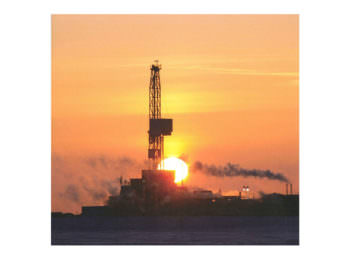
A rig in the Pikka unit, where oil companies Armstrong Oil & Gas and Repsol say they’ve found 1.2 billion barrels of oil. (Photo courtesy Armstrong Oil & Gas)

The state has released the list of companies it reimbursed for oil and gas exploration and development work last year.

These cash-for-credits recipients used to be kept confidential, but a law passed in 2016 now requires that the state report them.
According to the Department of Revenue, the state spent just over $75 million last year, paying down a debt it owes under the now-defunct program.

The total debt has ballooned up to about $900 million this year. The state is making minimum payments on that debt — it’s not scheduled to pay them off fully until about 2025.

A company doing work on the North Slope, Repsol, got the highest payment, at nearly $18 million.

Despite getting payments totaling about $28 million, several companies like BlueCrest Energy, Caelus and Great Bear Petroleum have slowed or halted work in the state. Company leadership has consistently cited slow reimbursement from the state under the program as a reason for the delays.

Walker hopeful plan to pay off oil tax credit debt with bonds will pass this session

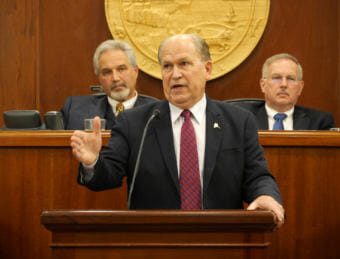
Independent Gov. Bill Walker addresses the Alaska Legislature on Jan. 18, 2018, in the Alaska State Capitol in Juneau. Senate President Pete Kelly, R-Fairbanks, and House Speaker Bryce Edgmon, D-Dillingham, are seated at the dais behind him. It was Walker's fourth State of the State Address. (Photo by Skip Gray/360 North)
Independent Gov. Bill Walker addresses the Alaska Legislature on Jan. 18, 2018, in the Alaska State Capitol in Juneau. Senate President Pete Kelly, R-Fairbanks, and House Speaker Bryce Edgmon, D-Dillingham, are seated at the dais behind him. It was Walker’s fourth State of the State Address. (Photo by Skip Gray/360 North)

A proposal to issue bonds to pay off about $900 million in tax credit debt to oil and gas companies hasn’t gained much traction in the Legislature.

Gov. Bill Walker included it in his budget in December.

Since then, the bill has had no hearings in the House and just one in mid-February in the Senate. Walker said Tuesday that he’s still hopeful that it will make it through this session.

“Well, I actually have heard some fairly positive things about that from various legislators, once they understand it,” Walker said. “I think there was some confusion initially and so we spent some time with them and so I think there’s some interest in that.”

Most of the credits are owed under a now-defunct cashable credit program that was designed to entice new companies to explore and produce oil and gas in the state.

The bill would allow companies to opt into a program that would pay credits now, but at a discount. The cost of borrowing the bonds would be built in to the discounted rate, so the state won’t lose money. 

Sen. Natasha Von Imhof, R-Anchorage, said there are some things that make the bill attractive. 

Right now, the state makes a minimum payment on the balance it owes. Last year it was about $73 million, this year it jumped to over $200 million.

“That wildly variable payment, it’s hard to predict and hard to budget for. A bond will create, theoretically a locked in payment,” she said.

Pat Galvin is the chief operating officer at Great Bear Petroleum, a private oil exploration company. 

“The worst thing for the state is if the companies that did this work basically fall apart and go bankrupt and disappear, then you won’t get other companies willing to come up because they’ll just see a bunch of dead companies lying around,” Galvin said.

Galvin said the outstanding credit debt has already done a lot of damage to the state’s reputation. But, he sees this proposal as one that could help fix that problem.

Site notifications
Update notification options
Subscribe to notifications