Rashah McChesney

Daily News Editor

I help the newsroom establish daily news priorities and do hands-on editing to ensure a steady stream of breaking and enterprise news for a local and regional audience.
No environmental impact from 22,000-gallon heating oil spill in Savoonga

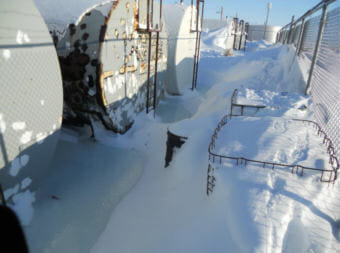
Several tanks stand in pools of heating oil that was spilled during a tank transfer at the Savoonga Native Store in Savoonga, Alaska. (Photo courtesy/Savoonga Native Store)
Several tanks stand in pools of heating oil that spilled during a tank transfer at the Savoonga Native Store in Savoonga. (Photo courtesy Savoonga Native Store)

Alaska’s spill response division is reporting a 22,000 gallon heating oil spill in a village on St. Lawrence Island in the Bering Sea.

The Savoonga Native Store reported the spill on Wednesday morning. According to an Alaska Department of Environmental Conservation report, the spill happened while someone was transferring fuel from one storage tank to another.

Tom DeRuyter works for the Alaska Department of Environmental Conservation.

He said no one from DEC has made it out to the site yet, but the spill reportedly happened inside of a lined container, surrounded by a chain-link fence and barbed wire.

“So the environmental impacts to this are nonexistent at this point, we’re very fortunate it’s in secondary containment,” DeRuyter said.

DeRuyter said cleanup efforts are relatively simple, but will be hampered by deep snow drifts in and around the area. At this point, he said, the state’s biggest concern is worker safety during cleanup as the heating oil is toxic.

He said the state has an inspector on the way who should be in the community by Friday.

Lawmakers might have more control over the Permanent Fund than they think

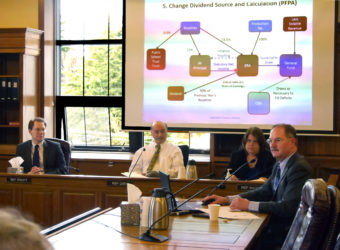
Legislative Finance Director David Teal testifies before the Senate Finance Committee on April 3, 2017. (Photo by Skip Gray/360 North)
Legislative Finance Director David Teal testifies before the Senate Finance Committee on April 3, 2017, in Juneau. (Photo by Skip Gray/360 North)

There’s an old brown church, with a steeple on top, just across the street from the state Capitol. But it isn’t a church anymore. Now it’s where the director of the legislative finance division, David Teal, works.

Unless you’ve been living under a rock, you know that Alaska’s budget is a mess. After three years of fighting it off, the legislature seems to have finally agreed to tap into the state’s Permanent Fund.

Breaking into the state’s biggest piggy bank carries a lot of political and financial risk. But, it turns out that maybe lawmakers have more control over the outcome than they thought.

Alaska Permanent Fund Corporation sign, March 14, 2016.
Alaska Permanent Fund Corporation sign at headquarters, March 14, 2016, in Juneau. (Photo by Skip Gray/360 North)

Alaska’s Permanent Fund, at last count, is worth about $66 billion. 

It’s basically made up of two parts — there’s the corpus, or main account, worth nearly $50 billion. It’s protected by the constitution, so lawmakers can put money in it but they can’t take money out of it.

The second part is called the Earnings Reserve.  This is the account that holds the earnings — the money the Permanent Fund makes on its investments. And it can be spent.  It’s worth more than $16 billion.

When legislators talk about spending the Permanent Fund, they mean the Earnings Reserve.

Teal says the Earnings Reserve is fundamentally different than other reserves the state has used to pay its bills. 

“It can vanish without being spent,” he said.

There’s volatility in that account because of the way that it’s invested.  Sometimes that’s a good thing: those investments have doubled the size of the fund in the last decade, adding billions to that piggy bank.  

But, big risks can also bring big losses.  In early February, there was a stock market slide and the fund lost 4 percent of its value. That’s nearly $3 billion dollars.  

Losing value isn’t the same as losing money.   The market goes up and down on a daily basis a lot of those losses can be regained quickly. But if something catastrophic happens and those losses were to stick? Teal said the Earnings Reserve can lose a lot of real money, real fast. 

But, it can be hard for lawmakers to plan for true losses because, in the entire history of the Permanent Fund there has been just one year where its investments lost more than they made.  That was 2009.

Remember that global recession? It triggered some of the worst years the U.S. stock market has ever had.

In Alaska, Teal says, the Earnings Reserve — that’s the one lawmakers want to use now — was drained. 

“There was some concern right up until the final month of the fiscal year that there was no money for dividends,” he said.

That’s right, the Earnings Reserve is the account that pays Permanent Fund Dividends every year too.  

So, back when that financial crash took a big bite out of the Permanent Fund and its managers were faced with the prospect of losses in both accounts, they chose to protect the main one.

Managers transferred money into it from the Earnings Reserve to keep that main account from taking a loss.  

“Based on standard accounting practices in place in 2009,” wrote Permanent Fund Corporation spokersperson Paulyn Swanson in an email.

Ten years later, the state’s in a recession again.  But some things are different.

This time, there’s  enough cash in the Earnings Reserve to pay dividends, but the politics have changed. Now, the governor, along with the legislature, has been capping PFDs.  

This leaves millions in that Earnings Reserve for lawmakers to potentially spend. They haven’t yet, but it is hugely controversial.

One senator said it’s illegal, and so he sued. That case made it all the way to the state Supreme Court last year.

It’s pretty widely known as “The Wielechowski Decision.” 

Sen. Bill Wielechowski (D-Anchorage) on the Senate Floor during debate about CSSB 26 (fin) on March 15th, 2017. (Photo by Skip Gray/360 North)

But, when you talk to Sen. Bill Wielechowski, D-Anchorage, it’s clear that it’s not a decision that he would have made.

“Well the lawsuit stemmed from my belief, my firm belief after reviewing the case law and the statutes, and the legislative history, and the constitutional history — that that the governor did not have the right to go and veto the dividend,” Wielechowski said. “Unfortunately it didn’t turn out the way we had hoped.”

Wielechowski lost that case.  

Not only that, but the court’s ruling had a much broader meaning. 

That’s because the crux of Wielechowski’s case was that sometimes money automatically flows out of the Earnings Reserve account and it doesn’t require the legislature’s appropriation.

The state argued that everything that comes out of that account has to be officially approved by the legislature.

“And so we had this knock down drag out battle over whether or not it was a dedicated fund, what the legislature intended in 1976, what the voters intended in 1976, what the legislature intended when they created the Permanent Fund dividend program in 1982 … and so the court sided with the state,” Wielechowski said.

Remember back in 2009 when the Permanent Fund lost more money than it made?  Well, its managers didn’t ask permission to use that earnings account as a buffer; they just did it. And if that crash were to happen again? They couldn’t do it that way again because Wielechowski lost that case.  

But that was not immediately clear from the ruling. At least not to the Permanent Fund Corporation’s legal counsel, Teal or even Wielechowski.

“That wasn’t something that we focused on,” Wielechowski said.

He was focused on dividends. Most people were.  He says, the secondary impact is a big deal.  

He sees it as a power shift from the Permanent Fund’s managers to the legislature. 

If lawmakers start relying on the Earnings Reserve to pay the bills, Wielechowski doesn’t trust that they’ll transfer money out of it to protect an account they can’t touch.

But David Teal sees it differently. He says now that losses are spread out between both accounts, running out of cash to spend from that Earnings Reserve is less likely. And maybe that’s a good thing if the state is going to rely on it to pay bills.

State gets timeline for federal environmental review of Alaska LNG project

This illustration shows what a liquefaction plant could look like. (Image courtesy Alaska LNG)


Update at 4:25 p.m.

The federal agency responsible for studying the environmental impact of the Alaska LNG project has released a timeline for completing its review.

The Federal Energy Regulatory Commission announced on Tuesday that it plans to release a draft of the final Environmental Impact Statement in a year. If they stick to that schedule, they could authorize the project as early as March of 2020.

The state was hoping to get through that permitting process and begin construction next year.

But, Alaska Gasline Development Corporation President Keith Meyer said the corporation can still bring the project online by 2025.

“We’re just happy that it’s a schedule that we can work with, we can live with and that does not adversely impact the project,” he said.  “So we’re pretty excited about it. Today was a big day for us here.”

But not everyone is as excited about an environmental review with such a quick turnaround.

Erin Whalen is a senior associate attorney with Earthjustice, a non-profit, environmental law organization.  She said the environmental review timeline needs to be scaled to the project.  

“This is a huge project,” she said. “It’s going to affect tons of communities across Alaska and input, getting input from communities in Alaska takes time. Any community it takes time, but in Alaska in particular it’s tricky to ensure that people have been fully heard on a project.”

Whalen said it’s not just community input that matters either.

“Then you’re talking about not just communities but … climate change and not just a handful of species but potentially hundreds of species across this giant swathe of land,” she said. “So it’s an ambitious timeline.”

At least one community is already weighing-in with the federal commission on Tuesday. 

Valdez Mayor Ruth Knight sent the federal commission a letter asking for further study of the wetlands impact of the project. 

The federal commission has already ordered the state corporation to study Valdez and the Matanuska-Susitna borough as potential alternative sites for the mega-project.

The state corporation is still looking for customers for Alaska’s gas and for partners to help finance the $45 billion project.


Original story: 

The federal agency responsible for studying the environmental impact of the Alaska LNG project has released a timeline for completing that review.

The Federal Energy Regulatory Commission announced on Tuesday, March 13, that it planned to release a draft of the final Environmental Impact Statement in about a year.

If the federal commission sticks to that schedule, they could authorize the project as early as March of 2020.

The state was hoping to get through that permitting process by 2019 and begin construction.

Still, Alaska Gasline Development Corporation President Keith Meyer said in a press release that the schedule will keep the gas export project on track to come online by 2025.

The state corporation is still looking for customers for Alaska’s gas and partners to help finance the $45 billion project.


Walker seeks to deepen trade ties with China

Alaska Gov. Bill Walker watches Alaska Gasline Development Corporation President Keith Meyer talk to reporters during a press conference on March 5, 2018, in Anchorage, Alaska. (Photo by Victoria Petersen/Alaska Public Media)

Alaska exported more than $1.3 billion worth of goods to China last year. The country is the top consumer of Alaska’s goods.  

During a press conference in Anchorage on Monday, Gov. Bill Walker said he wants to increase those trade ties. Walker hosted the Chinese President Xi Jinping, in Alaska last year. 

Walker also detailed a new trade mission he called Opportunity Alaska: China Trade Mission.  There are still some details to work out, he said, like who is going.  

“We anticipate that this being predominantly private sector folks that will be paying their own way to participate in that,” Walker said.

The governor’s office is taking applications until early April from Alaska companies that want to travel with the state’s delegation. In addition to the cost of airfare, hotels and meals, there is a  a $3,000 fee to take part in the mission, according to a media release from Walker’s office. 

Alaska’s Gasline Development Corporation (AGDC)  is also seeking to partner with China.  The state is working to develop a massive liquefied natural gas export project and hopes to partner with an investment bank, sovereign wealth fund and a China-owned oil company. Walker and AGDC head Keith Meyer said they don’t expect looming steel and aluminum import tariffs will derail the pipeline, even though the 800-mile pipeline project is expected to use thousands of tons of steel.

Meyer said he does not expect the tariffs to add much cost to the $45 billion project.

“The heart of the issue is trade and that is where I think, really, Alaska stands tall as  being really an export powerhouse to the United States. And, if we get this Alaska trade rolling then I don’t think there’s need for that kind of tough trade talk,” Meyer said.

During the conference, state officials also highlighted a new scholarship program for Alaska students to study abroad in China. And they spoke of increasing tourism and the Ted Stevens Anchorage International Airport seeking to add more flights to China.

Federal regulators push for more information on Alaska’s gasline project

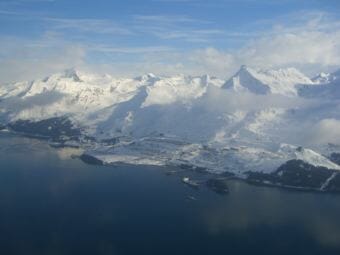
The Federal Energy Regulatory Commission has directed the Alaska Gasline Development Corporation to study the City of Valdez, shown here from the sky, as an optional route for the state's $45 billion gasline export project. (Photo by Total Heliski)
The Federal Energy Regulatory Commission has directed the Alaska Gasline Development Corporation to study the City of Valdez, shown here from the sky, as an optional route for the state’s $45 billion gasline export project. (Photo by Total Heliski)

Last week, the state’s gasline corporation got a letter from the federal agency leading the permitting process for the AlaskaLNG project.

The Federal Energy Regulatory Commission says the state agency isn’t answering a lot of its questions. Regulators wrote that the state hasn’t sent information that is crucial for analyzing the $43 billion project.

Rashah McChesney from Alaska’s Energy Desk covers the state’s gasline project. She spoke with Alaska Public Media’s Lori Townsend.

Can you tell me more about this letter? What was in it?

The Alaska Gasline Development Corporation has been waiting for a response from the Federal Energy Regulatory Commission since January. That’s when the state corporation announced that it had finished responding to hundreds of questions that the federal agency had asked.

I spoke to gasline corporation head Keith Meyer last month and he described the 6-foot high stacks of documents. They’re just shy of 100,000 pages that they’ve turned over to the feds about this project.

He was hoping that they’d get a response with a schedule in it – something that would lay out how long it would take for the federal agency to do an environmental review of the project and issue a draft of the permit.

But, that is not what happened.  Instead, the federal commission just came back to the state with more questions.

And, it didn’t just come back with more questions.  Federal regulators wrote that the state has answered some questions by saying that it wouldn’t provide the information because the studies aren’t required by the state or other agencies at this point. If the state keeps responding this way, regulators says it will delay the timeline for getting that environmental review.

To that end, the regulatory commission sent along a 170-page letter with all of these questions that they say need more adequate responses. They’ve given the state 20 days to respond.

It seems like a lot of information to compile and get sent off in 20 days. What’s on that list of this requirement?

The gasline development corporation told me that they plan on getting ahold of federal regulators in early March, or at least by early March and sending them a schedule of how long it’s going to take them to answer all of these questions.

A lot of them are going to require really detailed analysis and more field work and things that either haven’t been done yet or are going to take a lot of man-hours to complete.

What kind of questions is the regulatory commission asking?  

These are really specific data requests — Everything from plans the state project has to avoid wildlife and monitor the health of marine mammals to what kind of grass the project will use to revegetate certain areas.

The federal agency wants to see a plan for monitoring permafrost and erosion along the pipeline. It wants to know the exact location of ice roads and bridges that will be built during construction.

They want to see details on how roads will be moved and which private wells that are located near the project will be monitored for contamination. They want a lot of this information that people who are going to be affected by the project need have a chance to weigh-in on the permit.

The federal schedule for getting through an environmental review is packed with public comment periods and other federal agencies weighing-in on certain aspects of design and construction.

There are some bigger questions too. The Matanuska-Susitna Borough and Valdez have weighed in on the state’s project as well, and they’re not happy…

Beyond these hyper-specific details about how and where and what impacts construction are going to have in Alaska, the federal agency says the state hasn’t done enough studying of alternate routes for the pipeline and port at the end of it.

The Matanuska-Susitna Borough contacted the federal agency in January and argued that its Port Mackenzie site hadn’t been adequately vetted. In fact, the borough argued that its port was eliminated because the Alaska LNG project had mistakenly studied the wrong site.

Borough officials say that ending the pipeline at their port could save billions because the pipeline would be about 50 miles shorter.

And Valdez is fighting to get the project moved too. A group there has been arguing that the pipeline should be rerouted and that Valdez should be the terminal and port. They weighed in with the federal agency least year. They said moving the pipeline could provide natural gas along the Richardson Highway and save hundreds of millions of dollars.

Now, federal regulators are specifically directing the state to study these two sites as alternatives.  And this could be a big problem for the state’s timeline. Keith Meyer told me last month that the state inherited this route when it took over the project in 2016. But, it could take years of additional studying to figuring out if these routes are feasible. He says the current route is the one that has to happen in order for the project to get built in time.

What does he mean by that? In time for what?

There’s this window when global natural gas demand is projected to skyrocket. The idea is to bring the state’s gasline project online in time to export to Asia to meet that demand.  

Right now, the state is on a tight schedule to get these federal permits – Meyer says he wants it done by the end of this year. 10 months. The state wants to start construction in 2019.

They’re trying to build a facility on the North Slope, an 800-mile long pipeline, a massive plant in Southcentral Alaska. And these data requests mean that the state has to spend more time and money doing fieldwork and analysis and it could affect the project timeline.  

And there’s also this ripple effect. Because, at the same time they’ve got to get all commercial agreements in place – negotiate with the North Slope producers to sell the gas, negotiate with equity partners to help pay for building the $45 billion project, negotiate with potential buyers of the gas. There are just a lot of moving pieces that have to fit together for this project to make it to the finish line.

Have you heard from the state corporation in response to this letter? What are they saying?

Their message is largely hopeful. I spoke with Jesse Carlstrom, he’s a communications manager at the corporation. He says they’re confident that the federal commission will have the information it needs to prepare that environmental impact statement this year.  

And like I said, they will respond by earlier March but even if they get that draft permit issued by the end of the year, there’s still at least a 45 day public comment period that has to happen at the end of issuing that draft permit and sometimes it’s even longer for large-scale projects.

So, there’s definitely not a lot of room for error and a lot of potential delays that are popping up this year.

To get good credit, Alaska’s fishing towns may have to factor in climate change

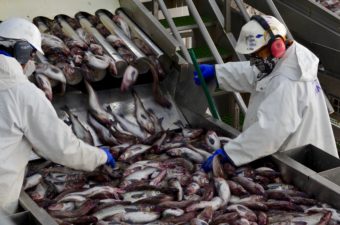
Fishing trawlers lined up in Dutch Harbor, on Sep. 24, 2013, in Unalaska, Alaska.(Photo courtesy/James Brooks)
Fishing trawlers lined up in Dutch Harbor, on Sep. 24, 2013, in Unalaska, Alaska. (Creative Commons photo by James Brooks)

Late last year one of the world’s largest credit rating agencies announced that climate change would have an economic impact on the U.S.

Moody’s suggested that climate risks could become credit risks for some U.S. states.

Even though Alaska is warming nearly twice as fast as the rest of the U.S., its credit rating doesn’t seem to be in danger. But take a closer look at some of the state’s coastal communities and the story changes, especially when Alaska’s fishing towns consider adding climate risks to their balance sheets.

Frank Kelty is the mayor of the Unalaska, a tiny town is on an island sandwiched between the Bering Sea and the Gulf of Alaska, near some of the richest fishing grounds in the world.

Kelty has been there for 45 years, and lately, he’s seen a lot of changes.

“We’ve had a huge increase in humpback whales coming right into the inner harbor by the road system. Just hundreds of them hanging around,” he said.

People have been pulling off of the road to watch what he calls the “whale show.”

“Traditionally, the whales would be out in the pass and we’d hardly ever see them in town. But now they’re coming into the inner harbor,” Kelty said. “They must be feeding on something. I don’t know if it’s krill or salmon smolt, or what … maybe their cycle’s off too. I don’t know.”

Some of the other changes in the Bering Sea aren’t as entertaining.

“Two years ago we missed our herring season because the herring had already moved into the area and left when the fishery opened in July,” Kelty said.

In Unalaska, fishing is a primary driver of the economy. When the fish don’t show up, Kelty said the city starts to lose money.

“It’s our only industry in this area,” he said. “And the trickle-down effect you get for jobs throughout the community, be it the clinic, city workers, State of Alaska workers that work for fish and game and maintain the airport, things like that, it’s all driven by the health and well being of the seafood industry.”

It’s really not surprising that some of Alaska’s communities rely on one industry to keep them afloat. The whole state has traditionally relied on oil to pay for almost everything.

The state’s treasurer and debt manager, Deven Mitchell, said even though Alaska is at the forefront of visible effects of climate change these things really aren’t a risk to the state’s credit.

But, the state isn’t the only entity that needs a credit rating. Sometimes, cities need them too. Valdez and Kodiak have had them in the past. The rating helps determine how cheaply a community can borrow money to finance things like big infrastructure projects.

In Alaska’s coastal fishing communities, climate change is a very real, if not somewhat unpredictable, threat to the economy.

Like, there has been this massive decline in the population of cod in the Gulf of Alaska. That’s a big money fish in places like Kodiak. Commercial fishermen land millions of pounds in Alaska each year. This year, the amount they’re allowed to catch has been cut by 80 percent.

Mitchell says that’s where he sees the most economic risk for communities in Alaska.

“Is it…just a normal cycle in the fishery? Or is it something that you know, this ocean acidification issue, or warming, the blob, whatever is going to create a permanent situation?” Mitchell said. “Is there an alternative fishery that might develop as a result of that? From, you know, tuna moving in or something that’s a warmer water fish that the people in Kodiak are going to be able to rely on? Or is it, you know, the end of a community’s economy?”

This is something that fisheries scientists have been trying to get a grasp on in Alaska. Beyond asking what will happen to fish, what will happen to fishermen and the fishing communities that rely on them?

Stephen Kasperski is an economist with the National Oceanic and Atmospheric Administration. He said researchers are trying to model the impact on fishermen as the fleets move around to keep up with the fish.

He said they build these economic models with information they have on fishing revenues by vessel, where vessels deliver and where fishermen are catching.

Kasperski said the researchers take that catch data and then model where the fishing fleet might end up.

“And then, you know, tying that back to where do we think the economic impacts are happening? Saying, for this change in fisheries landings in these given communities, how much does that mean for fisheries support business? For processors? For people who support that industry, and kind of get a sense of the total economic impact from those changes,” he said.

When considering economic impact to the city, Mayor Kelty brings up pollock. Unalaska is the top fishing port in the country and the vast majority of that volume comes from pollock that fishermen bring in from the Bering Sea.

Every year, those fishermen come to Unalaska and spend millions of dollars on fuel and groceries.  There’s this whole industry built around what happens to the pollock they catch. Some of it comes into the port and goes into these huge multi-million dollar processing facilities. That means jobs and property taxes for the city.

But there’s evidence that pollock are sensitive to sea temperatures. Kelty said there’s this concern that with warmer water, they could move farther offshore.

It’s going to have a major impact to our shoreside facilities because of the distance the catcher vessels have to run and cause a major problem for the products that we produce in this town,” he said.

Members of Kasperski’s team have modeled the economic impacts of climate change on pollock in the Bering Sea.

They’re expecting a drop in pollock catch in the region through the next half a century. Their modeling showed economic losses that, while relatively small percentage-wise, could add up to billions of dollars.

But, there are other factors. Like, if there are fewer pollock — will the price go up? What happens if fuel prices spike? Kasperski says all of these studies have caveats. It’s hard predict what fish or fishermen are going to do in response to a changing marine ecosystem.

He also says there’s no conclusive evidence that any fleet in Alaska is going to need to move — leaving a community high and dry anytime soon.

“Nothing has come up that clear,” he said. “I think the mayor is right. That these are big boats that are capable of doing that, especially the pollock fleet. Whether or not we get more fish processing farther north — that’s kind of an open question depending on, you know, if it makes sense to open a bigger plant in Nome if the species are closer there.”

Back In Unalaska, Kelty said it’s not really a pressing concern for the city’s bottom line right now.

“We just did a $40 million bond for upgrades to our main port facility,” he said, “and we were able to get the bonds, so at this time I don’t think we’re worried about our credit rating.”

Site notifications
Update notification options
Subscribe to notifications