Rashah McChesney

Daily News Editor

I help the newsroom establish daily news priorities and do hands-on editing to ensure a steady stream of breaking and enterprise news for a local and regional audience.
Unique payment plan for companies who owe TAPS settlement money

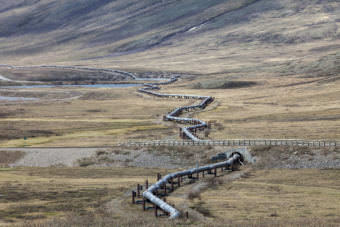
An above-ground section of the Trans-Alaska Pipeline System near the Toolik Lake Research Station in the North Slope Borough. (Photo by Rashah McChesney/Alaska's Energy Desk)
An above-ground section of the Trans-Alaska Pipeline System near the Toolik Lake Research Station in the North Slope Borough. (Photo by Rashah McChesney/Alaska’s Energy Desk)

On Dec. 14, lawyers for the State of Alaska announced that they’d reached a massive multi-million dollar settlement centering on the Trans-Alaska Pipeline.

Under the proposed settlement, the state expects to collect about $165 million in back taxes, primarily from the major oil companies operating on the North Slope.

But, a new state law allows those companies to pay that debt with tax credits, meaning the state might not see any of that money. At least, not in cash.

The fight over rates has been going on for nearly a decade.

The Trans-Alaska pipeline is essentially a toll road for oil from the North Slope and the state contends that the companies that own the pipeline — including BP, ConocoPhillips and ExxonMobil — charged too high of a toll.

That means the state has been losing out on money. Essentially, the cost of shipping is subtracted from the taxable value of oil. The lower the value of the oil, the less companies pay in taxes and royalties to the state.

John Ptacin handles pipeline rate-making cases for the state’s Department of Law. He said, by 2015 there were dozens of open rate cases.

“Because of how the litigation unfolded, every time between 2009 and 2015 that any carrier filed for a new rate case the state and the independent shippers filed protests at both FERC [Federal Energy Regulatory Commision] and the Regulatory Commission of Alaska,” he said.

Ptacin said once regulators determined that the rate costs had been too high, there was a lot to sort out between the owners of the pipeline, the shippers and the state.

“So that’s what we’ve been doing for the last two years is trying to see if we could work through all of the rates from 2009-2015 on file,” he said.

And they did finally sort it out. The state and the companies agreed to settle open cases with both federal and state regulatory authorities. They came up with a new kind of rate calculation that they’ll use through 2021. That should, in theory, keep disputes over rates down.

But, part of that settlement is that the state is owed about $165 million in back taxes from companies that paid to ship oil down the Trans-Alaska Pipeline.

In the past, that money would have been paid directly to the state. But that’s changed. Now, the state’s Department of Revenue is estimating that it won’t see the bulk of that settlement.  At least not directly.  

Instead, the the major oil companies on the North Slope are expected to buy tax credits the state owes to other companies and use them to pay their old tax bills.

Right now, the state owes nearly $1 billion to small, independent oil and gas companies under defunct cash-for-credits scheme that the legislature ended last year.  And lawmakers tucked a provision into the law that ended that program that allows companies to buy cash credits and use them against past tax bills.

“Because of that, we believe companies are going to purchase, major producers are going to purchase about $100 million worth of these tax credits that are in the hands of the smaller companies,” said Department of Revenue Tax Division Director Ken Alper.

He said the major companies are probably going to get a pretty good deal out of it because there are more sellers than there are buyers. 

That means that the major North Slope producers are not going to pay full price for those credits. But, they’ll be able to redeem them for their full value to the state.

“From the point of view of the company getting that money, they’re just happy to cash out. They want to be able to get their cash and get away, the question is, how much are they willing to accept to do that?” said Alper. “From the point of view of the people purchasing the credits, the major producers, if they pay 80 cents or 90 cents on the dollar, they get all 100 cents to offset their taxes when they use the certificate.”

Alper said the state isn’t expecting any of this to happen until next year.

But, there’s still a lot to sort out before it could happen.

For one, the settlement still has to be approved by the Regulatory Commission of Alaska and the Federal Energy Regulatory Commission. Ptacin said that could take up to six months.

State approves ExxonMobil’s expansion plan for Point Thomson, ending months-long fight

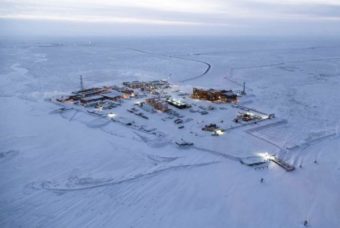
Point Thomson is approximately 60 miles east of Prudhoe Bay. (Photo courtesy Exxon)
Point Thomson is approximately 60 miles east of Prudhoe Bay. (Photo courtesy ExxonMobil)

Gov. Bill Walker’s administration has approved a plan to possibly expand a massive gas field east of Prudhoe Bay.

The Point Thomson gas field currently produces a diesel-like fluid. But it’s sitting on a giant natural gas reserve that is a crucial part of the state-led gasline project.

In a press release, Walker says the Point Thomson field expansion adds momentum to the state’s Alaska LNG project.

But, it has been a struggle to get the field developed. The state’s fight with the field’s operator, ExxonMobil stretched out into a years-long legal battle that was settled in 2012. That settlement laid out a legal plan for developing the field.  

After the field came online last year, Exxon released a plan that included upping natural gas production from the field and potentially arranging to pipe it to Prudhoe Bay if the state’s gasline project had not been approved by 2019.  

The state rejected that plan in August, saying that the company was not doing enough to prove that it would actually expand the field.

After months of negotiation, the state released the new plan on December 22. It includes more details on what ExxonMobil will do over the next two years to expand the field. The company says it will negotiate a commercial agreement send gas to Prudhoe Bay, some 60 miles away. It will also engineer and design wells and other infrastructure that’s needed to expand the field.

The company released a statement saying that it wants to develop Point Thomson through a major gas sale. But, absent being able to sell it to the state-led LNG mega-project, the company is exploring the idea of selling it to Prudhoe Bay instead.

ExxonMobil operates the project. BP and ConocoPhillips also have ownership stakes in the field.

State’s latest water quality report has bad news for popular Kenai River

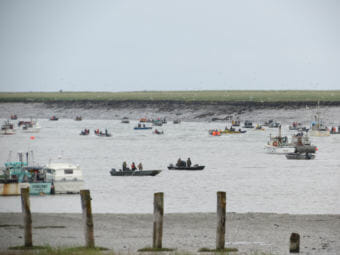
A number of fishing boats crowded near the mouth of the Kenai River on July 15, 2012 in Kenai, Alaska. A portion of the river, upstream of this one, has been flagged by the state for violating water quality standards for turbidity. (Photo courtesy Brian Henderson)

The state’s Department of Environmental Conservation is calling for comments on its newest water quality report.

The report is part of the federal Clean Water Act program that requires each state to develop plans to fix water bodies that have been polluted.  

A new one is supposed to be published every two years, but the state hasn’t put one out for five. Each time the state puts out one of these lists, there’s good news and there’s bad news.

If there were a popularity contest for rivers in Alaska, judging by the thousands of people who visit the Kenai River every year — it would win.

Anglers zip around in motorboats, looking for the perfect fishing holes. They wriggle into their waders and cast from the shoreline. Or, they just stand in the river mouth holding these long-poled nets, shoulder-to-shoulder by the hundreds. 

This year, Alaska’s Department of Environmental Conservation put out a new Integrated Water Quality Monitoring and Assessment Report. It’s a federally mandated list of all of the rivers, lakes and water bodies in the state that have been polluted — and how things have progressed in cleaning them up.  

“It really is, you know, it’s the report card on the health of Alaska’s water,” said Environmental Program Specialist Drew Grant. He’s been supervising the collection and release of the data in these reports for decades.

On this year’s report card, the Kenai River is getting a failing grade. The state is recommending that it be put on a list of polluted waterways.  Sometimes, when the state flags a river as polluted, it’s because of oil or trash or industrial pollution. But, in the case of the Kenai, it’s likely the effect of too many people using it too often. 

Jack Sinclair is the executive director of the Kenai Watershed Forum.  As part of the study that got the river listed, he sat at one spot on the river for 12 hours, counting boats.  

“It was 2000 boats that passed. That’s not the number of boats that were on the river, but that’s how many passes happened along that stretch,” Sinclair said.

Each of those 2,000 passes kicks up a cloud in the water. That’s exactly what the state says is wrong on about 7.5 miles of the Kenai River.  It doesn’t meet the state’s water quality standards for turbidity.

Turbidity is a measurement of the cloudiness. The simplest way to think of it is like smog in the water. And, a smoggy river is not good for anything living in it.  And, it’s not good for people — for drinking, swimming or fishing.

The Kenai isn’t the only river in the state having this problem. This year’s report adds the Little Susitna River in the Mat-Su borough to the impaired list, for the same turbidity problem. The Little Su also has a problem with petroleum pollution. The state is also proposing the addition of Lake Lucille in the Mat-Su borough for elevated levels of lead and zinc. 

Once a river is listed as impaired, it kicks off a process at the state and federal levels that require the water be cleaned, or in this case cleared.

“It is a year’s (long) process,” said Division of Water Section Manager Cindy Guilder.  “Some of that is driven by ‘how difficult is the problem to solve?’ and what’s the commitment by the community.”

There are three levels of pollution standards. The first, and easiest to violate is whether there’s enough pollution to make the water unsafe for people to drink. The second is recreation — is the water safe to be in, clear enough to fish in? The last, and hardest to violate, is the standard for the safety of wildlife and fish.

The Kenai River violates drinking water and recreational standards. But should a popular sportfishing river be required to meet drinking water standards?

Ricky Gease, executive director of the Kenai River Sportfishing Association, doesn’t think it should.  Gease’s association is a non-profit group that advocates for sport and personal use fishermen in the state. 

“Not too many people for a thirst of clear water would hunker down to the Kenai any place along that section and grab a glass of water to drink,” he said, “It’s all cloudy. It’s silty. It probably wouldn’t be very good for you.”

While he doesn’t agree with the state’s standards — Gease has several ideas for things that can be done to lower the turbidity on the river. Most all of them involve reducing boat traffic.

Right now, fishing guides get their own special times on the river to take clients fishing. That means a lot of boat traffic hits the river at the same time.

“They call it a shotgun start,” Gease said. “Maybe doing away with that, getting some other regulations for guide hours so everybody’s not starting at exactly the same time.”

Or, he says, get people out of their boats and let them fish from shore.

State environmental scientists like this. They like it when the who use the river come up with ways to change their habits, for the health of the river.

The state’s report is still in draft form, which means some things could change. The state is taking public comments until January 29.  

Permanent Fund Corporation to study ethical and sustainable investing

Fixed Income Portfolio Manager Maria (Masha) Skuratovskaya studies her screens at the Alaska Permanent Fund Corp., March 14, 2016. (Photo by Skip Gray/360 North)

The Alaska Permanent Fund Corporation has about $5 billion invested in fossil fuels. That includes stock in companies like Halliburton, Exxon, BP and Tesoro.

A coalition of groups, including the Alaska Climate Action Network and Oasis Earth, wants that to change. On Dec. 11, during a Board of Trustees meeting in Anchorage, they petitioned the Permanent Fund’s board to drop all its fossil fuel holdings.

Rick Steiner, of Oasis Earth, has been pressuring the Corporation and the state for 25 years to drop those investments.

And for the first time, the Corporation’s Board of Trustees has requested a meeting to talk about the sustainability and ethical impacts of its investments.

“I was elated. I mean, in a way it took me a minute to really process that,” Steiner said.

He said he hopes it’s the first step toward a screening process for investments that could cause social or environmental harm.

Steiner has also requested that the Permanent Fund Corporation provide a history of the performance of its fossil fuels holdings. He said that data would likely show that they are not profitable anymore. 

“Socially responsible investing has proven itself to be more lucrative, more popular. And some of these other negative investments — such as fossil fuels, nuclear weapons, corrupt company activities throughout the world — which the Alaska fund is still invested in — they’re a drain on a total portfolio, not an asset,” he said.

The Permanent Fund Corporation responded to him on Friday, saying it couldn’t track that performance data. 

No one at the Permanent Fund, or its board, was available to talk about the petition. But, the Corporation sent a written statement saying that it was too soon to know the framework for its socially responsible investment session.

Walker wants to borrow money to pay $900 million in oil tax credits

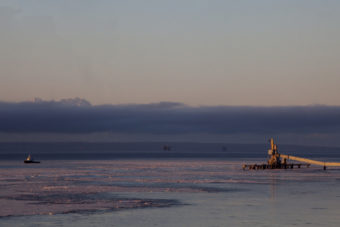
Cook Inlet oil platforms are visible from shore near Kenai, Alaska. Many smaller and independent oil and gas companies did work that is eligible for reimbursement through a now-defunct cash-for-credits program in Alaska. In his budget for next year,  Gov. Bill Walker proposes paying all of the nearly $900 million in unpaid credits by issuing bonds.  (Photo by Rashah McChesney/Alaska’s Energy Desk)

Gov. Bill Walker released the state budget on December 15. Tucked in there is a proposal to pay off nearly $900 million in tax credits owed to oil companies.

Currently, the state is making minimum payments on those cashable oil and gas tax credits. It’s not scheduled to pay them off fully until 2025.

Walker and the Department of Revenue are proposing to speed up that process.

“What we’re proposing is to find a way to pay them all off in the very near term, using bonds,” said Department of Revenue Tax Division Director Ken Alper.

The details of the proposal are not fully fleshed out, but essentially the state would offer oil and gas companies the opportunity to get reimbursed for credits by 2019,  at a discount.

That discounted rate could be somewhere between 90 to 94 cents for every dollar owed.  

“We don’t want to lose money on the deal and that’s where the discount rate comes in,” Alper said. “It’s going to cost us money to issue these bonds and borrow this money. We want the amount of discount we get from industry to at least pay the state’s cost and risk associated with the state borrowing money.”

Before the deal can move forward, the Legislature has to vote to allow the state to negotiate the deals and sell the bonds.

And a deal might be attractive to companies — not just because they get their money sooner. Right now, their options are to wait for the state to pay these cash credits off, or sell them to one of the major producers in the state.

But, it’s a buyer’s market.  

“The problem is, the major producers don’t have that much demand,” Alper said. “Because, the price of oil is lower, they don’t have as much tax obligation as they used to. To the extent that they’re willing to purchase them, they’re going to pay a pretty steep discount.”

Alper says the most important goal is to free the state of that $900 million debt and increase the industry’s confidence that the state will pay what it owes.

Credit rating agency sees a ‘clear path,’ as Alaska tries to balance its budget

An Alaska Permanent Fund Corp. sign in the office in Juneau, March 14, 2016. (Photo by Skip Gray/360 North)
An Alaska Permanent Fund Corp. sign in the office in Juneau. (Photo by Skip Gray/360 North)

Up until 2016, Alaska had the highest credit rating Moody’s Investment Service had to offer.

But, global oil prices crashed, and Alaska’s budget followed suit. In less than a year and a half, Alaska went from one of Moody’s highest rated states, to one of its lowest.   

Credit rating agencies, like Moodys,  look at the $2.5 billion hole in the state’s budget, the energy-dependent economy, and how heavily the government leaned on savings to balance the budget — which all looks bad. But, recently, Moody’s changed their outlook.

A few months ago,  Alaska’s professional number-crunchers went out on a mission. 

“We met with all of the credit rating agencies and tried to help them kind of understand what’s happening in Alaska the assets that are available,”Department of Revenue Commissioner Sheldon Fisher said.

A few weeks later, Moody’s updated Alaska’s credit rating. In late November, Moodys changed its outlook on Alaska from negative, to stable.

For the state, and some cities in it — that’s good news.

“It means that we actually spend less,” Fisher said. “If they were to have downgraded us it would have cost us more to have borrowed money in the future.”

But, what happened? Why did Moody’s analysts change their opinions? Oil prices are still pretty low. The state is still spending more than it makes. And, it hasn’t gotten an income or sales tax or any other way to bring a bunch of new money in.

Dan Seymour is a bond analyst for Moodys and he’s the lead analyst for Alaska. He said the state’s credit rating is still really good.

“The AA3 rating is an extremely high rating,” Seymour said.

It’s the fourth out of the 21 on the scale.

“[That] indicates virtually zero risk of defaults on the bonds by the entity that has borrowed the money, which is to say that Alaska is rated higher than the vast majority of borrowers,” Seymour said.

But, most states have great credit. And, when you compare Alaska to other states, it has one of the worst credit ratings.

Seymour said, when energy prices crashed it hurt a lot of other states like West Virginia and Oklahoma and New Mexico. Each of these states relies pretty heavily on energy related fees or taxes to fund their budgets.

“I don’t think any other state compares to Alaska in its lack of economic diversity or its budgetary reliance on revenue from a single industry,” Seymour said.

But, it’s not all bad news. Seymour said Alaska been spending billions more than the state brings in. But, when the earnings from the Permanent Fund are factored  in — that’s the money the fund makes from investments — the budget hole, the gap between what the state spends and what it makes, disappears. 

Because, while Alaska’s struggled to balance its budget, the Permanent Fund has been doing well. It’s up to more than $62 billion.

“Five years ago or so it was more like $40 billion dollars,” Seymour said. “So because of the continued deposits into the fund and the strong performance of the fund it’s gotten big enough that there’s now a clear path to that fund generating enough income for the state to live on.”

To be clear, Seymour said, it isn’t that Moody’s just realized that Alaska has this earnings reserve account and that changed its outlook. There have been other signs of progress. In the last couple of years, the state has cut its budget and oil prices have gone up.  

But, spending money from the Permanent Fund Earnings Reserve isn’t exactly easy.  The Legislature has never used money from that account this way, to cover government operations.  

But, there’s nothing in state law barring the Legislature from using it, and the Governor has proposed to do just that.  But, some people see that as endangering Alaskans dividends — the money comes from the same account.  That’s a giant political hurdle to overcome.  

There’s some evidence that it could happen, though. Last year, both the House and Senate passed bills that would have tapped into those reserves. And, the government has capped dividends for the last two years.

That Legislative history is one of the things, Fisher said, that helped build the state’s case to the credit rating agencies.

Seymour said there’s another issue putting pressure on legislators to use the earnings reserve account. The state has been relying on savings for three years to balance its budget. And, it’s running out of other savings accounts to tap into. The $13.8 billion earnings reserve is the next logical place to go.

“If the Legislature wants to keep spending money it’s going to have to find it somewhere in the earnings account of the Permanent Fund is the most likely source for that,” Seymour said.

Spending from that earnings reserve account is still tapping into savings to balance the budget. And, both Seymour and Fisher said there’s always the chance that something could go wrong. Like, the stock market could crash and the Permanent Fund accounts could lose a lot of money in a short period of time.

But, Seymour says, Moody’s doesn’t think the Permanent Funds investments are always going to make money. Rather, that some years it will make money and some years it will lose money and that it will average out and be able to plug the hole in the state’s budget. 

Clarification: This story has been updated to qualify that the Legislature has set aside money otherwise bound for the Permanent Fund Earnings Reserve to fund some limited government operations: the Permanent Fund Corp. the Department of Revenue’s Dividend Division. Additionally, money from the dividend appropriation is used to fund programs in the Department of Corrections and the Department of Administration. The state has never used Permanent Fund earnings to supplement the general fund.

Site notifications
Update notification options
Subscribe to notifications