Rashah McChesney

Daily News Editor

I help the newsroom establish daily news priorities and do hands-on editing to ensure a steady stream of breaking and enterprise news for a local and regional audience.
Alongside Trump in China, Alaska gets a new deal on its LNG

Alaska Gasline Development Corporation President Keith Meyer, Alaska Gov. Bill Walker and Department of Natural Resources Commissioner Andy Mack discuss meetings with potential buyers of Alaska’s LNG during a press conference on Friday Sept. 30, 2016 in Anchorage, Alaska. (Photo by Rashah McChesney)
Alaska Gasline Development Corporation President Keith Meyer, Alaska Gov. Bill Walker and Department of Natural Resources Commissioner Andy Mack discuss meetings with potential buyers of Alaska’s LNG during a news conference Friday Sept. 30, 2016, in Anchorage, Alaska. (Photo by Rashah McChesney/Alaska’s Energy Desk)


Update: 11:30 p.m.

Alaska will stay in the lead and continue writing the checks on its gasline megaproject.

But, Alaska Gov. Bill Walker and state gasline corporation head Keith Meyer say they are encouraged by a deal they inked in Beijing.

As President Donald Trump and Chinese President Xi Jinping (She-Jingpain) looked on, Alaska’s trade delegation signed an agreement with a China-owned oil company giant Sinopec,  one of the country’s banks and a sovereign wealth fund.

In a late night phone call with reporters on Wednesday, Meyer said the state has been trying to woo companies in China for months, “We’ve been through the courtship, we are now engaged.”

Details of the agreement are sparse but the deal links Alaska’s gas pipeline project to three China-owned entities as potential buyers, lenders and investors in the project.

Anchorage Democrat Rep. Geran Tarr says the deal is a positive step — but, she’s not sure it’s enough to convince the legislature to funnel more money into the gasline corporation.

“I think at this point the feeling in the legislature is the remaining $70-80 million is what AGDC has to work with to get to a decision point,” she said.

Tarr said Alaska’s corporation will update the legislature in May of 2018 with a go or no-go decision by next December.  

A substantive deal on the state-run gasline project could be a game-changer for Alaska’s struggling oil-based economy. The pipeline would cost between $45 billion and $65 billion to build. Its construction would temporarily add thousands of jobs to the state’s economy.

In its current form, the more than 800-mile-long pipeline would connect the Arctic and Pacific oceans and pipe natural gas from Prudhoe Bay on the North Slope to the Kenai Peninsula, south of Anchorage, before loading it onto tankers and shipping it to Asian buyers.

Kerry-Anne Shanks, head of Asia gas and LNG research at Wood MacKenzie, an energy research and consulting group, wrote in an email that the Alaska LNG project is at an early stage of development.

“Wood Mackenzie classifies it as speculative, which means the commercial structure and marketing plan are not yet clear. It is likely to take a few years before the project is ready for FID (Final Investment decision). LNG projects generally take at least 4 years to construct from project sanction,” Shanks wrote.

Hugo Brennan, an Asia analyst for Verisk Maplecroft, wrote in an email that the deal is politically expedient.

“Its non-binding nature gives Sinopec the flexibility to quietly back away from the deal down the line. Beijing is mindful of the need to maintain varied commodity import routes,” Brennan wrote.


Original story

Alaska Gov. Bill Walker and state gasline corporation head Keith Meyer inked a deal in China today as U.S. President Donald Trump and Chinese President Xi Jinping looked on.

Details of the agreement are sparse but the deal links Alaska’s liquid natural gas pipeline project to three Chinese entities, including the state-owned oil company Sinopec, one of the country’s banks and a sovereign wealth fund.

Alaska’s gasline corporation says the agreement involves working cooperatively on LNG marketing, financing, and investment in Alaska LNG However, no one from the corporation returned an email seeking more information on the type of deal that was signed.

Walker and Meyer are expected to give a closed-door briefing on the deal to Alaska’s legislators.

A substantive deal on the state-run gasline project could be a game-changer for Alaska’s struggling oil-based economy. The pipeline would cost between $45 billion and $65 billion to build. Its construction would temporarily add thousands of jobs to the state’s economy.

In its current form, the more than 800-mile-long pipeline would connect the Arctic and Pacific oceans and pipe natural gas from Prudhoe Bay on the North Slope to the Kenai Peninsula, south of Anchorage, before loading it onto tankers and shipping it to Asian buyers.


Editor’s note: This is a breaking news story that will be updated periodically. A previous version of this story listed five Chinese entities signing a deal to explore Alaska’s LNG project, it is three. China Petrochemical Corporation, or Sinopec, China Capital Corporation and the Bank of China.  Additionally, the story incorrectly described the form the natural gas from Prudhoe Bay would be in, as it is shipped down the pipeline.  It would not be converted to LNG until it reached the Kenai Peninsula. 

State economist says global spike in oil price not likely to affect forecast

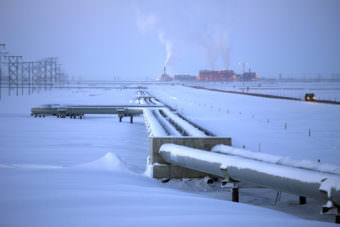
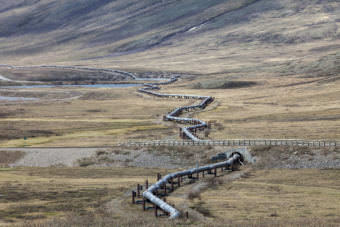
An above-ground section of the Trans-Alaska Pipeline System near the Toolik Lake Research Station in the North Slope Borough. (Photo by Rashah McChesney/Alaska's Energy Desk)
An above-ground section of the Trans-Alaska Pipeline System near the Toolik Lake Research Station in the North Slope Borough. State economists say the jump in oil prices isn’t likely to prompt a boost in production in Alaska.  (Photo by Rashah McChesney/Alaska’s Energy Desk)

Global demand for oil is up, and prices have surged to their highest level since 2015.

In Alaska, North Slope crude rose to more than $63 a barrel by Monday.

At the Department of Revenue, Chief Economist Dan Stickel said they’re pulling together data for the state’s annual oil price forecast. It’s due out in December.  While they’re watching the jump in oil prices, they’re not ready to change their long term forecast just yet.

“Short term price movements, they’re interesting, but if you’re looking at the impact on investment and production, you really have to look at more of the long term,” Stickel said.

In the long term, the state isn’t expecting oil prices to rally much higher, for much longer.

In late October, the Department of Revenue put out a preview of that forecast. And, state economists predicted that oil prices will average about $54 per barrel next year.

The price of oil is often volatile. Especially when global supply and demand don’t line up.  Stickel said Alaska has generally been along for the ride when those dramatic shifts happen.

“That’s a lot of what we’ve been looking at is just this idea that, you know we had a few years of an under supplied market with oil prices up over $100, then we had a few years of an oversupplied market when prices went down to the $30’s and below,” he said.

In the last year or so, Stickel said supply and demand have roughly balanced out. But even when there’s more demand than supply, it doesn’t typically have an immediate effect on the production of Alaska’s oil

Stickel said that’s because Alaska isn’t a ‘swing’ producer. Oil production projects in the state take a long time to explore and develop and bring on line.

“And they produce for a very long time. When a project in Alaska happens, it’s a very long term investment and it’s a long term production,” Stickel said.

So, when global demand for oil is higher than supply, Alaska’s not likely to step in and bring production up quickly, to meet that need.

“You look at the shale oil down south and you can make a decision to drill a well and you can have that well producing a few months later,” he said.

So, for now, Stickel said the state is sticking with its forecast. Adjusting for inflation, they’re predicting that oil prices will stabilize in the $55-$60 per barrel range for the next five years.

The price increase helps the state’s bottom line. But, for the budget to be balanced – even with all of the budget cuts that have happened – oil prices would have to be much higher.

“You’d need [Alaska North Slope] prices to be up in the $90 per barrel range or higher. And I don’t think we’re anywhere near going back to those levels so, we still have a hole to fill.”


Gov. Walker, Meyer headed to China with Trump

Alaska Gasline Development Corporation President Keith Meyer, Alaska Gov. Bill Walker and Department of Natural Resources Commissioner Andy Mack discuss meetings with potential buyers of Alaska’s LNG during a press conference on Friday Sept. 30, 2016 in Anchorage, Alaska. (Photo by Rashah McChesney)
Alaska Gasline Development Corporation President Keith Meyer, Alaska Gov. Bill Walker and Department of Natural Resources Commissioner Andy Mack discuss meetings with potential buyers of Alaska’s LNG during a press conference on Friday Sept. 30, 2016 in Anchorage. Meyer and Walker area headed to China with President Donald Trump, where they plan to tout the state’s gasline megaproject.  (Photo by Rashah McChesney)

President Donald Trump is headed to China next week.  Alaska’s Governor and the man tasked with landing a deal to build the state’s ambitious gas pipeline project will be there.

Gov. Bill Walker and Keith Meyer will be in Beijing with the president, as part of a larger group of corporate leaders and members of the private sector.

Walker wouldn’t say if he planned to announce any deals with potential partners for Alaska’s $45 billion LNG project. 
“You know, it’s too soon to say. I will actually be in China a couple of days before the president arrives into China, into Beijing. So we’ll see what happens in these final few days,” Walker said.

But he said his goal for the trip is to make a deal.

He also had no details on meetings scheduled with potential customers. Alaska Gasline Development Corporation spokesperson Rosetta Alcantra says she has not doesn’t have any information about meetings or Meyer’s travel arrangements.

Walker said he sees this trip as the most significant opportunity Alaska will have to engage with the market on the project.  He said it aligns with the Trump administration’s goals of working with China on trade and energy policy.

“It’s a good fit for a number of reasons,” Walker said.”One is, it’s about a $10 billion dollar a year offset on the balance of trade issue and also what it does on the air quality, air emissions, natural gas vs. some of the other fuels that they use in those areas.”

Walker will fly with President Trump to Hawaii on Friday for a meeting with four other governors on Pacific issues. Then, he’ll head to Beijing on Saturday.


Editor’s note: This story has been updated to include a response from the Alaska Gasline Development Corporation on corporation president Keith Meyer’s schedule. 


After BP leak report, state calls for review of all North Slope wells

Responders from Alaska Department of Environmental Conservation (ADEC), U. S. Environmental Protection Agency (U.S. EPA), the North Slope Borough, and BP Exploration Alaska (BPXA) has been established to respond to natural gas and crude oil discharge near Prudhoe Bay, Alaska. (Photo courtesy U.S. EPA)

State regulators are calling for a review of thousands of oil wells on the North Slope by the end of this year.

The Alaska Oil and Gas Conservation Commission is ordering all wells on the North Slope that have a similar design to a BP well that failed this spring, to be shut in immediately and reported to the state.

The emergency order comes after BP blamed an April oil spill and gas leak on a piece of a well casing that buckled under pressure from thawing permafrost.  

The company later shut in five other producing wells that had a similar design.

But, Cathy Foerster, who sits on the commission, said the company kept the results of its investigation largely quiet. 

“When BP was in here last week we asked them if they had shared the information with all of their operators and they said they had only shared it with their co-owners,” she said.

She said she was disappointed by the company’s decision.

It isn’t clear how many wells on the North Slope have a similar design. But, Foerster said she was confident that engineers for each company could complete the review process before the end of the year.

She said BP’s flawed Prudhoe Bay well was older and she doesn’t think newer fields on the North Slope will have similarly designed wells.

“I don’t think many modern wells were drilled that way, but I don’t know,” she said.  “We’re doing this just to make sure.”

She said operators will not have to shut in the flawed wells permanently – they can pay to have them fixed.

Foerster said the permafrost around the wells is not thawing because of climate change; rather she blames it on the heat from the oil and gas and other fluids being pumped from thousands of feet underground to the frozen surface.


Oil production is up, and DNR expects it to keep climbing

BPfacility_Harball
Pipelines lead to one of BP’s facilities on the North Slope. (Photo courtesy BP)

Lawmakers got some good news in Juneau on Tuesday, as the state’s Department of Natural Resources unveiled the fall production forecast.

Oil production is up. And they expect it rise again next year.

It was a difficult year for the North Slope in 2016.  After the drop in oil prices, operators cut 44 percent of their spending. They let drilling rigs go idle and laid off hundreds of workers.  

At Alaska’s Division of Oil and Gas, Ed King said they were surprised when they started putting together this year’s production forecast.

“When we read the news of rigs getting laid down and kind of this global contraction of the industry, we kind of expected that to manifest itself in reduced production,” he said. “So, yeah, it is a little bit surprising to see how much they’ve been able to do in this low price environment.”

For the year, King said production was up about 3 million barrels, and the state is predicting that it’s going to be up next year too.
King said a big part of that prediction is coming from the companies.

“You know, last year they told us, the Prudhoe Bay operator (BP) at least, they told us that they were expecting to be able to hold production relatively flat and we were a little bit skeptical and this year they told us the same thing – now we have a tendency to want to believe them a little bit more,” King said.

And, this isn’t new oil. At least, it’s not coming from new fields.

ConocoPhillips brought another portion of its Colville River oil field online and that increased production. But the increases mostly came from places like Prudhoe Bay.

King said the oil companies trimmed operations, cut costs and found ways to squeeze oil out of old fields.  

“A lot of it is just facility optimization and just management of the resources and that’s really something that they weren’t paying as much attention to, I think when they were out there trying to find new places to drill and new oil – now they’re focused more on the assets that they do have and getting the most out of them,” he said.

In some places, like ConocoPhillips’ Kuparuk River Oil Field – operators drilled new wells.  In others, like the Oooguruk offshore oil field in the Beaufort Sea, Caelus Energy has been fracking.

And Hilcorp took over operation of three fields, Endicott, Milne Point and North Star.  The company’s business model is to find ways to get new oil out of old fields. 

But, it’s not all good news. Alaska’s Department of Revenue also put out a forecast today.  This one, an early look at oil prices.  Analysts are saying that oil prices won’t increase as quickly as previously thought.

They predict oil won’t climb to $75 per barrel until 2027, and they attribute most of that increase to inflation.  


State appeals controversial ballot initiative decision to Supreme Court

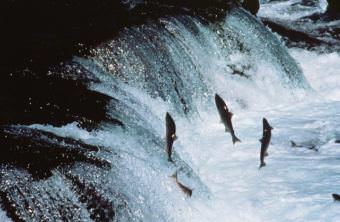
Adult sockeye salmon encounter a waterfall on their way up-river to spawn. (Photo by Marvina Munch/ U.S. Fish and Wildlife Service)

State attorneys are appealing a judge’s decision to allow a controversial ballot initiative to move forward.  

The Department of Law filed a notice of appeal on Friday, asking the Supreme Court to reverse the lower court’s opinion.

In a media release, State Attorney General Jahna Lindemuth said the question of whether the ballot initiative is unconstitutional should be answered by the Supreme Court.

The initiative would go on the 2018 ballot, and would ask voters to strengthen the state’s permitting requirements for projects that could interfere with salmon streams.  

Essentially the initiative would establish two tracks of development permits — one for small projects, another for large ones. Developers would have to prove that the projects wouldn’t damage salmon habitat.

Last month, Lt. Gov. Byron Mallott rejected the initiative, saying it would force the state legislature to protect salmon over other types of resource development, like mining.

The state’s argument is that the Legislature should have the power to allocate state assets among competing uses, like salmon and mining or dam development.

The state argues that the initiative is too broad and could halt development of roads, pipelines and the proposed Pebble Mine.

The group behind the ballot initiative — Stand for Salmon — says the initiative isn’t designed to prohibit development. They argue that it would just strengthen the permitting process.

Site notifications
Update notification options
Subscribe to notifications