Rashah McChesney

Daily News Editor

I help the newsroom establish daily news priorities and do hands-on editing to ensure a steady stream of breaking and enterprise news for a local and regional audience.
On Alaska day, lawmakers and staff met on oil and gas taxes

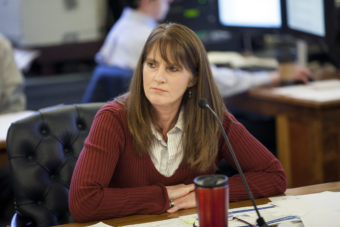
Anchorage Democratic Rep. Geran Tarr, co-chair of the House Resources committee, gestures during a House floor session earlier this year in Juneau.
Anchorage Democratic Rep. Geran Tarr, co-chair of the House Resources committee, gestures during a House floor session earlier this year in Juneau.  (Photo by Rashah McChesney/Alaska’s Energy Desk)

Wednesday was Alaska Day, a state holiday, but some lawmakers and their staff meting for an all-day crash course on oil taxes.

It’s somewhat of a habit for Alaska’s Legislature to wade into a fight over the state’s oil and gas tax system. There have been seven major changes to the tax system over the last 12 years. And each time, the issue has been bitterly divisive.

Lawmakers are gearing up to go at it again in January.  But first, members of the House and Senate are trying to make sure everyone is speaking the same language.

Anchorage Democratic Rep. Geran Tarr led the oil and gas tax working group. Her office helped coordinate the meeting.  

“The point is, the more everybody is on the same page, the more productive the conversations can be,” Tarr said.

To that end, they planned to hear from consultants and an advisory board made up of members of the industry, analysts and state regulators.

And the meeting was public — sort of.

It wasn’t easily accessible. There was no way to call in. The legislative information office, or LIO, was closed for the state holiday. So the meeting wasn’t streamed like others are during the legislative session.  

And while the LIO technically serves at the pleasure of the Legislature and could be opened for a meeting, a spokesperson for the office said it would be uncommon to do that outside the regular legislative session.  

Instead, they held the meeting at the BP Energy Center.

A staff member from Anchorage Republican Sen. Cathy Giessel’s office said about 40 legislative staffers registered to attend.

There was a webinar, but lawmakers didn’t share how to register. The meetings were recorded and will be made available for viewing at a later date.

Tarr said she didn’t think anyone would mind if members of the general public showed up, but the meeting wasn’t geared toward them.

State corporation sets December deadline to find customers for Alaska’s gas

Sen. Natasha Von Imhof, R-Anchorage, questions representatives from the Alaska Gasline Development Corporation during a Senate Finance meeting focusing on the corporation's budget on Tuesday, February 14, 2017, in Juneau, Alaska. (Photo by Rashah McChesney/Alaska's Energy Desk)
Sen. Natasha Von Imhof, R-Anchorage, questions representatives from the Alaska Gasline Development Corporation during a Senate Finance meeting focusing on the corporation’s budget on Tuesday, February 14, 2017, in Juneau. (Photo by Rashah McChesney/Alaska’s Energy Desk)

The Alaska Gasline Development Corporation has another deadline looming.

Board Chairman Dave Cruz told lawmakers in Anchorage on Monday that the corporation’s board is operating under a December 31, 2017 deadline to find a customer for Alaska’s natural gas.

It has been 10 months since the state took the lead on the mega-project that would transport natural gas from Prudhoe Bay to Cook Inlet, then ship it to buyers in Asia. 

Alaska Gasline Development Corporation President Keith Meyer, Alaska Gov. Bill Walker and Department of Natural Resources Commissioner Andy Mack discuss meetings with potential buyers of Alaska’s LNG during a press conference on Friday Sept. 30, 2016 in Anchorage, Alaska. (Photo by Rashah McChesney)
Alaska Gasline Development Corporation President Keith Meyer, Alaska Gov. Bill Walker and Department of Natural Resources Commissioner Andy Mack discuss meetings with potential buyers of Alaska’s LNG during a press conference on Friday Sept. 30, 2016 in Anchorage. (Photo by Rashah McChesney)

Members of finance and resources committee in both the state House and Senate met to hear a quarterly report on the progress of the project.  Corporation President Keith Meyer was not at the meeting, Cruz said he is in Asia marketing the state’s gas.

So, Cruz started the meeting. And he began by asking lawmakers to consider the impact that their discussions with members of the media can have on the corporation’s efforts to market the project.

“The world is watching us. This is not just some little project in Alaska that the world doesn’t know about,” Cruz said.  “And every local news story that is picked up by our industry and world press it places a great challenge on our team when they have to first defend the project against the negative comments before being able to sell it on its merits.”

For the next hour, lawmakers peppered Cruz and other members of the corporation’s executive board with questions about project finances, employee turnover and how much money the state expects to make on its share of the project.
Sen. Natasha Von Imhof, R-Anchorage, and Sen. Anna MacKinnon, R-Eagle River, both accused employees of evading questions on the project’s finances.

Von Imhof said she met with employees at the corporation last week and they “danced around her questions,” on how fast the corporation is burning through the roughly $102 million it has budgeted to spend on building a gasline project. She said she spent the weekend digging through documents and determined that it has about $70 million left to spend.  

That is a fraction of the roughly $45 billion needed for the project to be built.  Richards said the corporation is currently spending about $3 million a month, though the board has authorized it to spend more than $6 million monthly. 

Lawmakers also asked about deadlines.  Last year, Gov. Bill Walker gave the project until September, 2017 to generate enough activity to justify continuing to spend millions on the project.

The state corporation held an open-season asking potential customers and investors to show formal interest. And while it did not result in any firm commitments, Walker said he is encouraged by how well the state has engaged with potential buyers .

But, he stopped short of saying the state should put more money into the project.  

When lawmakers asked Corporation Senior Vice President Frank Richards if the corporation plans to come to the legislature for more money during the next session — he said it all depends on whether it finds a customer.


Editor’s note: A previous version of this story,  mistakenly attributed the  Alaska Gasline Development Corporation’s self-imposed deadline for finding a customer.  Board Chairman Dave Cruz shared that internal deadline with lawmakers.  


Seeking investment, Alaska goes open source with oil & gas data

ArmstrongPikka
An Armstrong rig in the Pikka Unit on the North Slope. The State of Alaska is releasing data it has collected from companies under a tax credit program that requires companies turn over seismic information and well data to the state in order to get the credit. After a waiting period, the state sells it to the public.  (Photo courtesy Armstrong Oil and Gas)

Somewhere in Anchorage, the state is hiding four giant suitcases, filled with top-secret pictures of the ground. 

The Deputy Commissioner of the Department of Natural Resources, Mark Wiggin, said they weigh about 150 pounds a piece.

“…And in there are stacked these blocks. These seven to eight terabyte-per-block basically floppy drives,” Wiggin said.

Add them all up and those drives hold about 300 terabytes of valuable information from seismic testing and exploratory wells — essentially a map of what lies beneath the surface of Alaska.

It’s just one of the data sets the state has slowly been collecting from oil and gas companies since 2003. That’s when it launched a tax credit program that required companies to turn over that data if they wanted to redeem the credit.

Alaska’s Oil and Gas division is releasing valuable oil exploration data from leases on the North Slope and Cook Inlet. 

As part of a tax program created in 2003, companies could claim a credit in exchange for turning over seismic information and exploratory well data.

The state agreed to hold onto the data for ten years. Now, they’re going public with it — for a fee.

So far, the state has collected at least 50 of these data sets stretching all the way from the North Slope to Cook Inlet. The information is key to developing theories about geological formations — theories like where oil might be located.

And they are expensive to produce. Companies spend millions of dollars buying leases, transporting equipment to explore and drill, hiring specialized imaging companies to scour remote fields, hoping to strike it big.

The information is valuable and it’s the state’s responsibility to keep it confidential when companies turn it over in exchange for those credits. 

They don’t deliver it in armored trucks, but Wiggin said that’s not too far off-base.

For years, when companies wanted to bring in well log data from the field, they had to fly it from far-flung places, back into Anchorage. Wiggin knows, because it was his job when he worked for Arco as a test engineer.

“In essence, I would bring it in and you’d basically nearly have it handcuffed to you, as you brought it into town,” he said. “I think we might have overdone the secrecy at times… I didn’t wear handcuffs. But, we indeed did not send them in with just anybody.”

Under this program, the state released its first two data sets in 2016.  One set included a 3-D seismic survey from the North Slope that covered a huge chunk of ground near Prudhoe Bay. And the state saw a burst of activity, requests from university researchers, companies, and contractors.

And even getting the data that is open to the public is still vaguely super-spy-ish. Acting Deputy Commissioner of the Department of Natural Resources Steve Masterman says they ask people to provide a brand new hard drive, still in the wrapper. 

“So we know it’s never been touched by a computer, so we know that it’s clean,” he said. “We will load on the data and send it back to them.”

Wiggin said there’s already a company using that data to decide where it’s going to drill.

It’s an independent newcomer to the state, Alliance Exploration. The Nevada-based company bought its first leases from the state in December.

“We released it and they are working diligently to drill a well based on that seismic data this coming winter,” Wiggin said.

And that is a best-case scenario for the state, he said. “They were able to access inexpensive seismic data and develop prospects of their own that would lead to exploration and surely, hopefully development.

Using this kind of oil field data to attract new investment to the state is an uncommon idea. At least in the U.S.

Wiggin said he doesn’t know of any other states that do it. But a few other countries — like Norway and Mexico — do release seismic data. 

This fall, the state plans to release a second batch of data. Some of it is seismic data that covers areas of the National Petroleum Reserve – Alaska. Some of it is well data from a Cook Inlet field that BlueCrest Energy is currently exploring.

And, along with that second release of data is a new set of fees. They’ll charge $300 a square mile for 3-D seismic data, plus another $1.50 per gigabyte.

That means that getting copies of the data in those four suitcases could cost hundreds of thousands of dollars. Though, Masterman said there is an option to cherry pick parts of a data set, to avoid running up costs.

Wiggin said the DNR needs to recoup some of the state’s costs for  archiving and maintaining the huge amounts of information that companies generate when they’re exploring.

Editor’s note: Mark Wiggin is a member of the Alaska Public Media Board of Directors. 


As the state’s gasline corporation hopes for investment interest, lawmakers look for answers

Alaska Gasline Development Corporation President Keith Meyer, Alaska Gov. Bill Walker and Department of Natural Resources Commissioner Andy Mack discuss meetings with potential buyers of Alaska’s LNG during a press conference on Friday Sept. 30, 2016 in Anchorage, Alaska. (Photo by Rashah McChesney)
Alaska Gasline Development Corporation President Keith Meyer, Alaska Gov. Bill Walker and Department of Natural Resources Commissioner Andy Mack discuss meetings with potential buyers of Alaska’s LNG during a press conference on Sept. 30, 2016, in Anchorage. (Photo by Rashah McChesney/Alaska’s Energy Desk)

For the last two months the state’s gasline corporation has asked potential customers and investors in the state-led project to formally show interest in the massive pipeline project, without being bound by a contract.  

It’s called an open season, and it has been a chance for the state to get an idea of just how much the global market wants Alaska’s gas.

And while the state corporation and the governor are optimistic, some lawmakers aren’t sure there has been enough interest to continue pouring state money into the $45 billion project.

Last year, Gov. Bill Walker told a reporter at the Alaska Dispatch News that he would give the state-run LNG pipeline project a year to find its footing and a market for the state’s North Slope gas reserves.

And it has been a busy year. Walker said, once the state started meeting with other countries, without a company as an intermediary, things really heated up.

“I think it really started with a meeting with President Xi, President of China, when he came to Alaska, expressed his interest in LNG to China,” he said.

Walker and members of Alaska’s Gasline Development Corporation have zipped back and forth to Washington D.C. and Singapore and Korea. They opened an office in Tokyo. And Walker said, he’s encouraged by what he’s hearing.

“Never in my wildest dreams would I have thought we would have this kind of market engagement,” Walker said. “And again it’s the first time we’ve really engaged market to market. We’ve always done it through somebody else, a producer or someone who has a competing project elsewhere in the world. And now we’re doing it sort of sovereign to sovereign and I think it’s been very, very, very successful.”

But, he stopped short of saying whether he thinks the state corporation should go to the legislature for more funding this year.

“We’ll look and see if that’s warranted or not,” he said.  “It’s probably too soon to say on that.”

Right now, the corporation has as spending plan of just over $100 million dollars that will see its funds depleted in about a year.

As Walker’s soft deadline approaches, the state corporation tasked with finding customers and investors to build the mega-project said it has gotten some good news.  

Last week, it reported signing confidentiality agreements across six different markets.

The federal government said the project qualifies for a program that streamlines the permitting process. The corporation also got an opinion from the IRS that said it’s likely to be tax-exempt.

And the corporation signed a memorandum of understanding, or MOU, with a Korean gas corporation. It’s basically an agreement that the two corporations could work together as the project develops.

Still, the project is a tough sell to lawmakers who control where the state’s money goes.

Some, like Sen. Kevin Meyer, R-Anchorage, say it’s not clear if any of the steps the corporation or the governor have taken are going to make the project cheaper or more attractive to investors.

“That’s kind of the big unknown is what does that apply to and how much does that apply to,” Meyer said. “I know the governor kind of a made a big thing about it but, you know, he also made a big thing about this MOU’s which are basically meaningless.”

So far, the state and its former oil company partners have spent more than half a billion dollars studying the project, trying to figure out if it’s feasible.

“We want to be excited and positive and optimistic about the project but yet we also want to be real and objective because it’s, it’s a big project and it has already cost a lot of money that we don’t have,” Meyer said.

Last year, both the House and Senate mulled proposals to strip millions from the state corporation’s budget.

Meyer said lawmakers just don’t have enough information to know if the state can afford to keep pushing the project forward.

And on the other side of the aisle, Rep. Geran Tarr, D-Anchorage, agrees.  

Tarr said she thinks that patience is wearing thin in the legislature, in part because of the state’s multi-billion dollar budget deficit.

As lawmakers cut funds for education, power in rural areas, and student scholarships, Tarr said it can be hard to justify spending millions of dollars on a project that they can’t be sure will even be built.

“Can we afford to do it right now while we’re still trying to fix our other major financial problems? And, is now the right time given the market conditions? We know that that resource is not going to go anywhere. It’s going to be there. And I fully believe it will be developed … it’s a matter of the timing,” Tarr said.

The corporation is supposed to give a progress report to the legislature in September.  And Tarr said she thinks that meeting will be full of detailed questions about just who is interested in Alaska’s gas and just how much money the state will be expected to pay to develop the project.

She said she hopes they’ll get some answers.


For now, Hurricane Harvey not expected to impact Alaska’s oil and gas

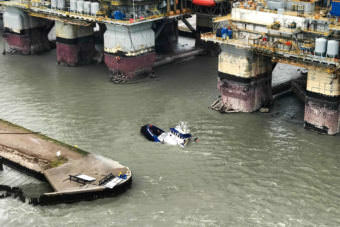
Coast Guardsmen rescue 15 people in distress aboard three vessels after Hurricane Harvey made landfall near Aug. 26, 2017, near Port Aransas, Texas. (Photo courtesy Coast Guard Air Station Corpus Christi)

Hurricane — now Tropical Storm — Harvey has caused nearly 100 oil and gas production platforms in the Gulf of Mexico to temporarily shut down.  

Since the storm came ashore last Friday, oil production in the region has dropped by more than 300,000 barrels per day, according to data from the Bureau of Safety and Environmental Enforcement.

According to agency estimates, about 22 percent of the oil production and 26 percent of the natural gas production in the Gulf of Mexico has been shut down.

But that drop in production doesn’t necessarily translate to a higher demand for Alaska’s oil, because globally the oil market is oversupplied. 

“There’s a lot of ability for the market to absorb a temporary shut-in of some production here or there,” said Chief Economist for the Alaska Department of Revenue  Dan Stickel.

Additionally, Alaska’s oil doesn’t compete with Gulf Coast oil. Stickel said they’re essentially going into two different markets.  

“Alaska’s oil is all going to the West Coast and competing with international crude,” Stickel said.

As long as production isn’t stalled long-term from the hurricane, Stickel said it’s not likely that oil prices are going to jump significantly.

Alaskans aren’t likely to see an increase in the price of gasoline at the pump either.  

Goldman Sachs estimates that the hurricane has taken about 3 million barrels a day of the nation’s refining capacity offline.  But, Stickel says that Alaska gets most of its gas from West Coast refineries.

If Gulf Coast refineries stay offline for an extended period of time, gas prices in Alaska could be impacted. When Hurricane Katrina hit New Orleans in 2005, prices at the pump spiked all over Alaska. That storm left crucial oil pipelines and refineries in the Gulf Coast region unable to operate for weeks.   

“We’re not really expecting that type of impact from this particular hurricane,” Stickel said.

State works to interpret its newest oil tax credit overhaul

Ken Alper, Director of the Tax Division at the Department of Revenue, gives an overview of a bill to the House Resources Committee on Feb. 3, 2016, in Juneau. (Photo by Skip Gray/360 North)

A group of oil industry representatives, tax experts, lawmakers and state employees met on August 22, to start the process of decoding a controversial new oil and gas tax credit law.

It took just over five months for the Alaska legislature to settle on the key components of the latest oil and gas tax revision; it’s going to take several more for the state’s Department of Revenue to finish regulations interpreting the new law — House Bill 111.

And those interpretations can cost companies, or the state, millions.

One big step in in this process is figuring out how — and when — the state’s cashable tax credit program will end. Lawmakers drew the line at July 1, 2017. Any work that happens after that date, that is eligible for a state tax credit, is supposed to be awarded under a new system.

“So, for those credits that are tied to a specific set of expenses, like an exploration credit, that’s easy to do,” said Department of Revenue Tax Division Director Ken Alper. “And we’re able to say, this invoice is from before July 1 and this one is after.”

But some tax credits don’t work that way, like a net operating loss credit, which a company can take when it spends more than it makes on a project.  That loss typically is calculated annually.

“It’s very difficult to break that up and say what portion of the loss comes from what month,” Alper said.

Alper said there is a workaround this year. Companies will be allowed to calculate net operating loss tax credits for the entire year’s work. Then, half of that credit will be eligible for cash, and the other half will fall under the new law.


People who testified asked for clarification on other parts of the bill, including a “ring-fencing” provision that changes how fields owned by the same company are separated for tax credits, and a section that allows companies to apply tax credits to what they owe from previous years.

Most of the provisions of the new bill go into effect on Jan. 1, 2018.  John Larsen, audit master for the state’s tax division, said the Department of Revenue plans to have the regulations out by then.

The tax division is taking comments until August 29. There will be  a set of draft regulations out and another round of public comment  in October.

Site notifications
Update notification options
Subscribe to notifications