I help the newsroom establish daily news priorities and do hands-on editing to ensure a steady stream of breaking and enterprise news for a local and regional audience.

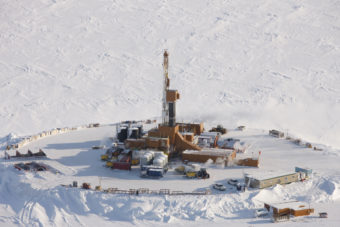
Caelus Energy’s Smith Bay rig. Caelus CEO Jim Musselman says tax credits are needed to help develop the find. (Image courtesy Caelus Energy)
After five months of back and forth, the legislature may be close to compromising on changes to the state’s oil and gas tax credit system.
Lawmakers in the House and Senate seem to agree that the state needs to overhaul a system that has it paying cash for tax credits to oil companies. It will owe nearly $700 million by the end of the year.
But a bill to change that system — House Bill 111 — has been tinkered with by both houses and neither has budged.
The House version of the bill was designed to cut oil tax credits, and force companies to pay a minimum tax. Critics called it a significant tax increase.
The Senate version of the bill scaled back that bill — refusing to substantively hike taxes on the oil industry.
And so far, the two bodies have been at an impasse. Since June 22, the bill has been the only thing on the agenda for the current special session. But most lawmakers left town and there have been no public meetings on the legislation for the last two weeks.
Rep. Geran Tarr, D-Anchorage, said the House is proposing a compromise to the Senate.
“We’re proposing to eliminate the cash credits,” she said. “That is what the governor, the Senate and the House all agree on. What we don’t agree on is what comes after that. What new incentive or deduction would be in place.”
In exchange for dropping a comprehensive reform this year, Tarr said the House wants a special committee to meet throughout the summer and fall and come back for the next legislative session with a compromise bill.
It’s not clear what the Senate will do with that proposal.
Lawmakers will have to come back to Juneau to hold a session on the bill, and that’s not likely to happen right away. Rena Miller, the Senate’s communications director, said they probably won’t be back until Wednesday at the earliest. That’s three days before the special session is scheduled to end.
Fixed Income Portfolio Manager Maria Skuratovskaya studies her screens at the Alaska Permanent Fund Corp., on March 14, 2016, in Juneau. Employees who manage the fund were among the 18,000 who got layoff notices on Thursday. If lawmakers don’t come to an agreement on the budget within the next 30-days, the government will shut down. (Photo by Skip Gray/360 North)
For the third straight year, state employees are being warned about a looming government shutdown and the potential for mass layoffs.
Lawmakers in Juneau appear to be at an impasse on the budget. They’re halfway through a 30-day special session and are cutting it close to their deadline to negotiate a budget for the state.
If they don’t have it figured out before July 1, thousands of state employees will be laid off and state business will grind to a halt.
Gov. Bill Walker’s administration sent out 18,000 notices on Thursday, warning state employees that they could be laid off if lawmakers don’t come to a compromise.
Kate Sheehan, who heads the state’s division of personnel and labor relations, said there are critical positions that the state can’t function without, so some people are still going to have to go to work.
“But the decision as to who will actually report to work if there is a shutdown has not yet been made,” Sheehan said.
It’s the third straight year that state employees have been faced with the prospect of temporarily losing their jobs.

In 2015, the state sent notices to some employees that they could be laid off. The legislature had a budget plan, but it wasn’t fully funded.
Then, in 2016, the state printed thousands of letters, but didn’t send them after lawmakers reached a compromise.
“So, like I said, it’s a little bit unprecedented where we are now, without having a budget at all,” Sheehan said.
And because there’s never been a shutdown in Alaska, Sheehan said her department is getting a legal opinion on who can come back to work and who can’t.
Among the thousands of state employees who got notices today, is the team of people who manage the state’s Permanent Fund Corporation.
The fund has been at the center of the budget debate this year. Lawmakers have been trying to figure out how to fill a $2.5 billion hole in next year’s budget that opened after oil prices crashed.
“There doesn’t seem to be any debate about whether or not the Permanent Fund should be used,” said Permanent Fund Corporation CEO Angela Rodell. “It’s more about how much of the Permanent Fund should be used.”
Rodell said the funds investments could be automated.
“… in other words, you just put on the money and let the computer decide the asset allocation, and there’s a standard passive index fund,” she said.
But that could have a real impact on how much money it brings in. Rodell said employees at the corporation have added an additional $4.1 billion to what the fund has brought in over the last five years.
“So I am hopeful and I am confident that the legislature will reach an agreement prior to July 1, but I do, I do worry,” she said. “I do worry about what the potential cost of inaction or slow action yields.”
Walker put out a statement on Thursday saying that mass layoffs could affect both the public and private sectors of the economy as people who process everything from fishing permits to driver’s licenses and record home sales would be forced to stop working.
Walker said lawmakers in the House and the Senate have asked for one more day to reach a solution.
In 2015 layoff letters went out in June, but the budget was passed, preventing a government shutdown. (Photo by Elizabeth Jenkins/KTOO)
The Governor’s office and the Department of Administration are warning of a potential government shutdown.
The office sent emails today to state employees explaining the situation.
Lawmakers have not yet passed a budget for the 2018 fiscal year, which starts in just over a month on July 1. The legislature is still meeting in special session, grappling with a multi-billion dollar budget deficit.
If lawmakers don’t reach a compromise before then, a government shutdown would start on July 1.
A Department of Administration spokesperson says it will send close to 18,000 notices on Thursday, unless the legislature passes a budget, giving state employees a month to prepare for potential layoffs.
That figure doesn’t include the university system, legislature and courts, who must notify their own employees.
Sen. Cathy Giessel, R-Anchorage, and Sen. Mike Dunleavy, R-Wasilla, listen to Alaska Gasline Development Corporation President Keith Meyer, during a Senate Finance meeting focusing on the corporation’s budget on February 14, in Juneau. (Photo by Rashah McChesney/Alaska’s Energy Desk)
The head of Alaska’s Gasline Development Corporation (AGDC) is in China this week, working to attract buyers and woo investors into supporting a state-run LNG export project. Meanwhile, political support in Alaska for the ambitious project is waning.
The budget isn’t done yet, but if the Senate’s cut stands the state corporation tasked with building Alaska’s massive liquid natural gas pipeline will be tackling the $45 billion project with only $45 million in the bank.

Alaska Gasline Development Corporation President Keith Meyer, Gov. Bill Walker and Department of Natural Resources Commissioner Andy Mack discuss meetings with potential buyers of Alaska’s LNG during a press conference on Sept. 30, 2016 in Anchorage. (Photo by Rashah McChesney)
Last week, the Senate moved to divert money set aside for the gas pipeline and instead use it to hire more state troopers and prosecutors and fund road maintenance.
AGDC spokesperson Rosetta Alcantra says the cut could send a mixed message to potential investors.
“You know, there’s a lot of positive movement out there and from the perspective of potential customers, I don’t think that helps the message,” she said.
Alcantra said if the cut stands, the corporation will have to prioritize how it spends it money as it pursues the federal permitting, customers and financing it needs to build the project.
She said it would be difficult to prioritize any one thing over the other.
“You can’t move forward without a (Federal Energy Regulatory Commission) license. You can’t move forward without a commercial interest either,” Alcantra said. “I can’t say one is more important over the other. I think they’re complementary and need to be operated on a parallel path,” she said.
The Alaska LNG project would connect two oceans and pipe natural gas from Prudhoe Bay to the Kenai Peninsula, then ship it to buyers in the Asia Pacific.
But there has been bipartisan doubt about the project since the state took the lead in late 2016.
Lawmakers grilled the corporation about its budget this session, questioning the wisdom of an Iditarod sponsorship and its decision to open offices in Tokyo and Houston.
Between the two lawmakers who created the state corporation — one launched an audit of it in December and the other, Rep. Mike Chenault, R-Nikiski, said he understands the legislature’s frustration with the corporation and the project.
Rep. Mike Chenault, R- Nikiski, talks to reporters during a House Minority press availability on April 13. (Photo by Skip Gray/360 North)
“I know the people in my community, a number of them are frustrated because they’ve been told this stuff is happening and in all reality it’s not … We’re not checking things off the list in order to move forward,” he said. “The list just keeps getting bigger.”
Chenault said he supports an LNG project, but he says the corporation has to prove that it makes good economic sense for the state to continue to invest millions in developing the project.
“Maybe they’re huckeldy-buck and everything is going hunky dory but that’s not the vibes that I get from talking to people around and people in the industry.”
Chenault says he’s heard a lot of confusion and complaints from constituents in his Kenai Peninsula District and hometown of Nikiski. The unincorporated town sits at the end of the proposed pipeline. Residents have seen several hundred acres carved out of the middle of the town to be potentially used as a site for a liquefaction plant.
Kenai Peninsula Borough Mayor Mike Navarre sent a letter to the corporation earlier this week criticizing its assertion that it will take just two years to make it through the federal permitting process and start construction on the project. He says the corporation could be building up false hope for property owners, contractors and job seekers in the communities that would be impacted by the project.
The House and the Senate will have a conference committee on the budget. If the cut stands, Gov. Bill Walker could still veto it.
Grace Jang, the governor’s spokesperson, says he won’t comment on the pending cut until it reaches his desk.
Senate President Pete Kelly, R-Fairbanks, talks to reporters at a Senate Majority press availability, April 13, 2017. Sens. Peter Micciche, R- Soldotna and Anna Mackinnon, R-Anchorage, seated next to him also participated. (Photo by Skip Gray/360 North)
With the end of session looming, Alaska’s Senate passed its version of an oil tax credit reform bill on Monday.
Both bodies agree that the state needs to stop paying cash for oil credits — it’s a system that will leave the state owing nearly $700 million to oil companies by the end of the year.
Now the bill will head back to the House to see if its members will accept the Senate’s changes.
Technically, the session ends on Wednesday and while lawmakers could vote to extend it by 10 days, it will take two-thirds of the members from both bodies voting to do so.
Gov. Bill Walker could call legislators into a special session to resolve this issue. Walker spokesperson Grace Jang says it’s too soon to say if he will.
Editor’s note: This story has been edited to reflect the accurate percentage of legislative member votes required to extend the session.
Members of the unincorporated Kenai Peninsula community of Nikiski are weighing their options after the Alaska Gasline Development Corporation filed for federal permitting of a massive LNG project, raising the possibility of using eminent domain to get the land it needs for the project to go forward. (Photo by Rashah McChesney)
The rumor mill in the Kenai Peninsula community of Nikiski is up and running again after the Alaska Gasline Development Corporation (AGDC) mailed letters to landowners last week. The letter laid out details of the state-run corporation’s application for federal permitting, the environmental review process and where people could weigh-in on the whole thing. It also raised the possibility of the project using eminent domain to get the rest of the property it would need to build the project.
The corporation took control of the estimated $45 billion mega-project last year. And it has been negotiating for control of the land needed to build a pipeline from the North Slope to Cook Inlet, and a plant and dock in Nikiski.
“I think it’s a psychological tactic,” said Steve Bush, who works as a contract negotiator for some landowners in Nikiski who could sell their property to the LNG project.
Bush said the letters — and the prospect of eminent domain — got people’s attention. He’s heard from clients who want to know if they’re going to lose their land.
“It scares people around here,” Bush said.
But not everyone in town is worried about the specter of losing their property.
Mike O’Toole and his family own nearly 40 acres of land in Nikiski in an industrial area where the pipeline’s liquefaction plant would need to be built. He said that when ExxonMobil, BP and ConocoPhillips were heading up the gasline project, the partners’ property management firm made an offer on his land.
“I studied the offer and I studied my relocation costs and it didn’t work out for me. So I stayed,” he said.
But since the state took over the project in 2016, O’Toole hadn’t heard any updates. That is, until last week when he got the letter. He wasn’t surprised to see the state talking about using eminent domain to get some of the remaining land it needs to move the project forward.
“I think that there’s people that fear eminent domain, but I think the fear is of the unknown,” O’Toole said.
He said he’s had a good experience with the LNG project so far and trusts that the negotiation process will be fair. He thinks the project has been forthright with people up to this point.
“They could have come in here, bought a whole bunch of property and then announced the project and everybody could have gone ‘what just happened here?’”
The Kenai Peninsula Borough got a letter as well. It owns land in Nikiski that would be needed for the final project. The borough’s Chief of Staff, Larry Persily, said he started getting calls from landowners after the letters went out last week. But, he’s told them not to worry too much about it.
“AGDC has no money to acquire land. They don’t have any customers, any financing. So, yes. If the project went ahead, at some point in life, they may need to use eminent domain if there is a holdout that blocks the entire thing. But, as I told one person, go ahead and remodel your bathroom and enjoy it in the meantime and worry about the schedule for the project at some other time.”
And at the Alaska Gasline Development Corporation, officials say that they don’t currently have any plans to go through the eminent domain process. Currently, they’re negotiating with the state’s former oil-company partners for control of the 630 acres of land the project already bought in Nikiski. They’ll need about 300 more acres for the project to go forward.
Corporation president Keith Meyer said that typically projects can come to an agreement with the landowner without having to resort to eminent domain.
Close
Update notification options
Subscribe to notifications
Subscribe
Get notifications about news related to the topics you care about. You can unsubscribe anytime.