Rashah McChesney

Daily News Editor

I help the newsroom establish daily news priorities and do hands-on editing to ensure a steady stream of breaking and enterprise news for a local and regional audience.
Divisions deepen as lawmakers tinker with Alaska’s oil tax credits

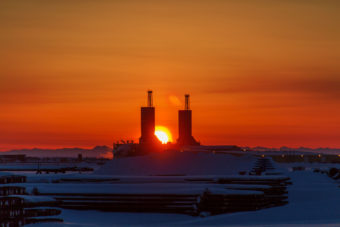
North Slope Drill Rigs at sunrise
The sun rises on the North Slope between drill rigs, Nov. 6, 2012. (Creative Commons photo by Kevan Dee)

Lawmakers in Juneau are still tinkering with the state’s oil tax credit system.

Ranking members of both the Senate and the House seem to agree that the state needs to break free of a system that will leave it owing nearly $700 million in cash payments to oil companies by the end of the year. But Senate Republicans have completely rewritten the House’s version of a reform bill.

So far this session lawmakers in the majority parties in both the House and the Senate seem to agree that the state oil tax credit system needs a change, but exactly what will change is unclear.

A Democrat-led House bill that kicked off this year’s fight over oil tax credits passed into the Senate last month, and the  Republican-led Senate has crafted a version that looks a lot different.

“I would say the Senate version of the bill is unrecognizable from the House bill, it’s that different,” said Anchorage Democrat Geran Tarr.

Her House resources committee led the charge to push an oil tax credit reform bill through this session. When it passed, primarily along caucus lines in the House, it was designed to cut oil tax credits, a key part of her caucus’s plan to balance the state’s budget.

The House’s bill cut credits that went to legacy fields like Prudhoe Bay. It doesn’t allow companies to dip below the state’s 4 percent minimum tax. And, it axed a credit that companies could trade to the state for millions in cash payments.  

It would have raised North Slope oil taxes by up to $100 million per year in the next few years, according to the Department of Revenue.

Industry is calling it a significant tax increase. And that bill landed with a thud in a Republican-led Senate that has agreed that some reform needs to happen but seems largely uninterested in substantively hiking taxes on the industry.  

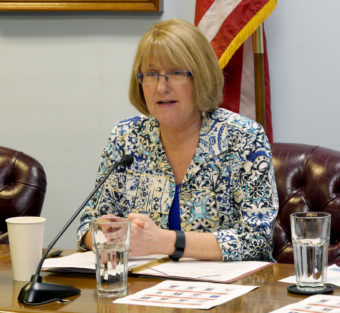
There lawmakers have crafted a bill that narrows the focus of the bill. Cathy Giessel’s Senate resources committee wrote the Senate bill.

“In fact, you could argue that they’re the same issues that the House also has consensus with the Senate on…and the governor. That primary issue is the cashable credits simply have to be repealed,” Giessel said. ” We can’t afford them.”

Under the cash credit program the state owes companies about $700 million in unpaid credits now and that could balloon up to $1 billion next year.

Giessel said the Senate version of the bill also hardens the state’s minimum tax, but it allows companies producing new oil to take credits that would dip them below that minimum.

The Senate version of the bill will have to go back to the House for a concurrence vote and it will likely run into opposition there. Tarr said, in it’s current form, it’s too generous. 

“This is not a version of the bill that will be supported by a majority in the House,” she said.

Both the Senate and House versions of the bill have drawn criticism from oil and gas producers and an industry trade association, who have repeatedly asked lawmakers not to raise taxes during a low oil price environment. They’ve also warned of further layoffs and delays in developing projects.

In public testimony,  some Alaskans have echoed those arguments.

For some, like Alex Vaughan, the impact of low oil prices and budget cuts have already hit and  they’ve hit hard. He told a Senate Finance committee that he is leaving the state. 

“A year ago, I was working for Caelus Energy and they shut down the rig, which subsequently meant that I lost the job,” Vaughan said. “And likely within the next month, I’ll be headed to Texas, which is horrible.”

Vaughan said his sister has been laid off from work in the industry as well. He was among the majority of people who told that finance committee they want to see a stable tax structure that would encourage growth in the oil and gas industry.

The bill has a long way to go. The Senate finance committee has hearings scheduled to take it up every day for the rest of the week. If its version of the bill passes through the Senate, it will go back to the House. If it doesn’t pass there, the two bodies will have to form a committee to negotiate on it together.

Senate committee grills state over inaccurate oil production forecast

Sen. Anna MacKinnon, R-Anchorage, speaks during a Senate Majority Press Availability on April 3, 2017. (Photo by Skip Gray/360 North)
Sen. Anna MacKinnon, R-Anchorage, speaks during a Senate Majority Press Availability on April 3, 2017.  MacKinnon is the chair of the Senate Finance committee. (Photo by Skip Gray/360 North)

Alaska’s Department of Revenue faced criticism during a Senate Finance Committee meeting on Friday after it put out its spring forecast. It predicts an unprecedented 12 percent drop in oil production next year.
That prediction came from the state’s Department of Natural Resources, which took over the task of predicting oil production last year. The state used to use an outside consultant.

While the Department of Revenue issues a revenue forecast in the fall and spring, the Department of Natural Resources (DNR) only issues one forecast for oil production. They won’t update that forecast again for several months.

And if their initial fall prediction is wrong, it can skew the spring forecast. And that’s what DNR’s Ed King says happened this year.

“So the numbers you’re looking at this year for [fiscal year 20]18 on this particular forecast are…stale,” King said. “They have not been updated. Just to say, on the record, [it’s] very clear the department does not anticipate a 12 percent decline over the next year.”

That didn’t sit well with lawmakers who use the spring forecast — and projections of revenue that will come in to the state from oil production — to justify their proposals for state’s budget.  Among other proposals, lawmakers are considering an income tax this session, to help fill the state’s budget gap.

Eagle River Republican Senator Anna MacKinnon says her finance committee needs better modeling.

“Production will play a huge role,” MacKinnon said. “It makes a huge economic difference in the picture that is being painted for Alaskans as we go forward with at least one legislative body in pursuit of taxing individual Alaskans.”

King told members of the Senate finance committee that Department of Natural Resources staff are trying to do more with less.

“I guess the parting comment I would make is that, with reduced budgets and the reduced resources and the task of producing this forecast without any additional resources is a fairly heavy lift for us to absorb and we can’t necessarily do that every single month while new data comes in,” King said. “We are doing the best we can.”

Prices per barrel of oil are projected to increase slightly to $54 per barrel in the 2018 fiscal year.

And another bright spot in the revenue forecast is that the state expects to have about $200 million more in general fund revenue this fiscal year than it originally projected. And another $208 million more next year.

Bill would make it easier to pass on information about contaminated sites in Alaska

Contaminated snow-covered tundra on April 29, 2014, from a BP Exploration Alaska spill in Prudoe Bay, Alaska. (Photo courtesy Alaska Department of Environmental Conservation)

From leaking pipelines and polluted aquifers, to broken septic tanks and abandoned military equipment, there are more than 2,200 open cases of contaminated sites in Alaska. A new bill that that is making its way through the state House, would require full disclosure of contamination on the deed of a property before it can be sold.
They’re called environmental covenants and Alaska is one of just seven states that doesn’t have laws on the books that make sure contamination is fully disclosed at the time of a property sale.

Kristin Ryan, the spill response director for the Alaska Department of Environmental Conservation has the perfect example of what can happen without environmental covenants: When a gas station in Anchorage closed and the owners pulled their tanks out of the ground, they found that fuel had leaked into the dirt around the foundation of a building on the property. The only way to clean up the dirt, was to remove the foundation of the building.

“So we agreed, and this is very common, we agreed to allow the responsible party to leave the dirt in place,” Ryan said.

The state put a restriction on the property that said if the foundation was ever removed, the dirt would have to be cleaned up. But, then the site was sold several times. And two years ago another person bought the property. 

Ryan says the new owner “took the building down, was unaware of the restriction, spread the dirt everywhere and built a Subway restaurant.”

Now, the owner of the restaurant has to deal with clean-up on the property. A covenant could have changed that. 

There are disclosure laws in Alaska already, but Ryan says that they aren’t always followed. There’s even an online database where the state keeps detailed logs of the types of contamination and cleanup efforts.

“So the information is out there for people, but who goes and looks at our database when they’re buying property? I mean, it’s not common,” Ryan said. “We talk to realtors and remind them to do that, and title companies and mortgage lenders, but it still isn’t a guarantee that that information is communicated.”

The new law would allow the state to put a covenant right on the deed of the property.

Republican Senate Majority leader Peter Micciche is carrying the bill this session. It’s gotten broad bipartisan support so far, though Micciche says the title puts some people off at first.

“Some people in this building get concerned anytime they see the word environmental in something,” he said. “It takes a few minutes to explain the value. That, in this case, it’s good for everyone.”

So far, opposition to the bill has come primarily from the Department of Defense. The Air Force regional environmental office wrote to Micciche, saying it couldn’t comply with the new law. There are federal laws that don’t allow covenants to be placed on federal land.

Micciche says he was expecting to hear from the federal government.

“We feel they should be held at the same standard,” Micciche said. “And we think it’s important and as you can imagine in this building a note from the feds in opposition to a bill is not always a bad thing. And I don’t say that lightly, it just happens to be the case.”

Other states that have enacted similar bills have found a way around the federal laws. Colorado put an environmental restriction clause in its environmental covenants bill. And Ryan says that it’s a critical addition to Alaska’s bill because most of the state’s open contaminated sites are on federal property.  

The bill sailed through its first House committee on Tuesday and is headed into another.

“The only roadblock that I see is time. I know of no opposition. It was 19-1 in the Senate. I expect it to be probably 40-zip in the house. It’s a good bill,” Micciche said.

It looks as though lawmakers will likely extend their stay in Juneau past their Sunday deadline. The environmental covenants bill has a hearing scheduled for Monday, after the conclusion of the 90-day regular session.

Oil tax credit bill on its way to the Senate, with ultimatum from the House

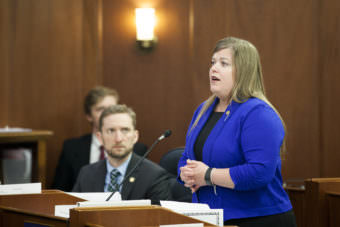
Rep. Geran Tarr, D-Anchorage, during a debate on the state House floor over an oil tax credit overhaul bill on Monday in Juneau. Tarr spoke in favor of the bill. (Photo by Rashah McChesney/Alaska’s Energy Desk)

After hours of debate on the state House floor, an oil tax credit bill is on its way to the Senate.

House Bill 111 passed, primarily along caucus lines. Proponents said that it will stabilize the state’s tax regime and get Alaska a larger share of the profits from its oil.

Opponents said they were rushed in reviewing the latest version of the bill.  And, they say that increasing taxes on oil industry when prices are down will drive away the industry Alaska relies on for most of its money.

Alaska is one step closer to getting another oil tax credit overhaul. Representatives in the State House voted to send a contentious bill over to the Senate.
Facing stiff opposition to a tax hike from Senate Republicans, the House Finance committee that put out the latest version of the bill tied it to a Senate-approved permanent fund bill. They added language that said the permanent fund bill will only pass in the House if the House’s version of the oil tax credit bill passes in the Senate.

The latest oil tax credit overhaul drew a lot of criticism from opponents in the House who said that it goes beyond fixing a cash-for-credit system that many said the state cannot afford.

Wasilla Republican Delena Johnson and many of her colleagues in the House minority said they did not have enough time to look over the newest version of the bill. It was put out on Friday.

“To take on this bill without understanding the consequence. Having it sneaked in at the last minute, having less than 12 hours to put in amendments, it just doesn’t make good sense,” she said.

In its current form, the bill drops a program that offered tax credits that can be transferred to other companies or exchanged for cash for work done on the North Slope. The state’s delayed payments on those tax credits has resulted in a tab that will reach about $900 million this year. 

Rep. Chris Birch, R-Anchorage, argues during a debate on the state House floor over an oil tax credit overhaul bill on Monday, April 10, 2017, in Juneau, Alaska. Birch spoke against the bill. (Photo by Rashah McChesney/Alaska's Energy Desk)
Rep. Chris Birch, R-Anchorage, argues during a debate on the state House floor over an oil tax credit overhaul bill on Monday in Juneau. Birch spoke against the bill. (Photo by Rashah McChesney/Alaska’s Energy Desk)

That’s a provision that lawmakers on both sides of the aisle agree with. Especially since there have been large discoveries on the North Slope that could leave the state on the hook for billions in credit liabilities before it makes any taxes or royalties from those developments. 

Proponents of the bill said that it’s a better idea to reform the tax credit system to into something the state can actually afford, rather than continue along with credits that the state has to delay paying.

In the new bill, companies would be expected to carry their losses until they are producing oil and owe a tax liability to the state — then they could use those losses to offset those taxes.

A new addition to the bill cuts off a per-barrel credit given for oil production. But, it also drops the base tax rate for the North Slope by 10 percent.

If the oil industry investment in the state stays the same, and oil prices don’t change dramatically, the Department of Revenue forecasts that the new oil tax credit system would raise oil income to the state for at least the next decade.  According to its projections, the state could bring in $130 million more in revenue by 2019 all the way up to $475 million more by 2027.

But there are a lot of caveats to that projection, and the bill isn’t assured to pass in its current form.

Opponents and industry representatives have repeatedly argued that the state changes its oil tax credit regime too often.

Alaska’s Revenue commissioner Randall Hoffbeck said the political infighting and instability in the state’s oil tax credit system go hand-in-hand.

“As long as you’ve got a state that’s 50/50 split and a legislature that’s 50/50 split on whether the current tax structure is an appropriate tax structure, there will always be a large amount of uncertainty in the underlying tax structure,” he said. “What we need to do is get to a tax structure that enough people say ‘That is good enough. We’re going to leave it alone and we’re going to leave it alone for a long time.'”

Hoffbeck said having a predictable tax system is more important than the actual amount of tax revenue the state brings in.

Opponents also question the idea of raising taxes on the industry at a time when oil prices are low. The oil and gas industry has shed thousands of jobs since record high employment in 2015. And it’s projected to lose another 1,500 this year.

Fairbanks Republican Steve Thompson said a tax hike will cause more people to lose their jobs.

“The oil companies have said they’re going to be laying down drill rigs if this is what we’re going to end up doing because we will not be profitable,” Thompson said.

But many in the Democrat-led majority caucus said that industry will not walk away from Alaska citing other states and countries with higher tax rates and the state’s high-quality oil.

Fairbanks Democrat David Guttenberg said Alaskans should look at what the multinational oil companies say about Alaska in their shareholder meetings. He says Prudhoe Bay will remain an attractive place to invest.

“Part of what they have successfully conveyed to this legislature, which has always bothered me, is that their shareholders are more important than our people,” Guttenberg said.

Guttenberg and 20 other legislators in the House are betting that the industry can handle the pressure. But, there isn’t a lot of time left in the regular session for the Senate to decide what it’s going to do. Next Sunday is the 90-day session deadline, but without a fiscal plan for the state or resolution on oil tax credits, lawmakers will likely continue to meet.

KTOO’s Andrew Kitchenman contributed to this story. 


Hilcorp shuts down third pipeline in Cook Inlet

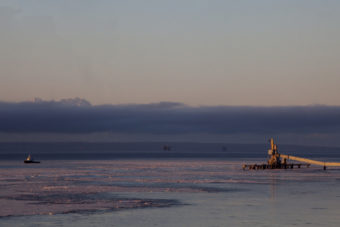
Cook Inlet oil platforms are visible from shore near Kenai, Alaska. The dominant oil and gas producer in Cook Inlet has struggled with aging infrastructure and reported three pipeline failures this year. (Photo by Rashah McChesney/Alaska’s Energy Desk)

The federal agency charged with regulating pipelines and hazardous materials is looking into another natural gas leak on a Hilcorp platform in Cook Inlet. 

Patricia Klinger, a spokesperson for the the Pipeline and Hazardous Materials Safety Administration, wrote in an email that the agency is aware of the leak and investigating it.

It is the third report this year of equipment failure on Hilcorp-owned infrastructure in the inlet, including another ongoing gas leak and an oil leak

In an emailed statement, company spokesperson Lori Nelson said Hilcorp started an audit of its pipelines in the region in response to its other gas leak. During an inspection, the company discovered that a pipeline on its Steelhead Platform was measuring more gas leaving the platform than what was arriving on shore.

Nelson calls this a “metering discrepancy,” but she says the company took the line out of service on April 1, as a precaution. Nelson wrote that the company flew over the area several times, but did not find evidence of a gas leak.

The company was also responding to an oil leak from its nearby Anna platform on April 1 and has shut down two other oil platforms in Cook Inlet to deal with a natural gas leak that has been visibly bubbling to the surface of Cook Inlet since February.  Icy and winter weather conditions have complicated repair of both lines.

The line from the Steelhead platform has been emptied of natural gas and filled with seawater since April 3.

The state agencies involved in the other spills in Cook Inlet acknowledged that they are aware of the situation on the Steelhead Platform, but would not comment on record about the situation.

Lois Epstein is an engineer and the Arctic Program Director for the Wilderness Society.  She joined calls from other environmental groups in Cook Inlet for an audit of Hilcorp’s aging infrastructure.

“They are very open about their business plan, which is to take over old fields and make them profitable for the company,” Epstein said. “We need to see whether they’re cutting corners. We need to ask a lot of hard questions about their operations.”

She says the company should not be allowed to expand its operations in Alaska without addressing concerns about its safety record.

In Tyonek, celebration as a coal mining company backs down

Many in Tyonek, a village on the western shore of Cook Inlet, are celebrating after the Chuitna coal mine proposal was shelved by PacRim Coal. (Photo Courtesy The Salmon Project/Ash Adams)

Residents of the tiny Cook Inlet village of Tyonek are celebrating after news that a company attempting to develop a massive coal mine near their village, has shelved the project.

PacRim Coal has been pursuing the Chuitna Coal Project for more than a decade, but the company has been fighting with environmental groups, members of the Tyonek native village and a regulatory process that required permits from several state and federal agencies.

Last week, the company told state and federal regulatory agencies that it would no longer pursue permitting on the project.

Janelle Baker got a text at 7:50 a.m. Monday morning, with news that has spread like wildfire through her home village of Tyonek.

“Well, I yelled in joy. Saying ‘yes’ that they finally stopped,” Baker said.

They are PacRim Coal mining company. Baker and many other residents of the village have been fighting a proposed coal mine built on the Chuitna River, about 45 miles southwest of Anchorage and less than 10 miles from her village.

Last week, the company told state and federal regulators that it is shelving the project and won’t move forward with the permit process. State officials said the company told them it was looking for a funding partner, and couldn’t find one.

And the news percolated through the village over the weekend.

Arthur Standifer is the president of Tyonek’s native council.  He said he called at least 20 people to share the news. 

“What it means for us is our fish will continue to be here for future generations, also our wildlife, like the bears and the moose and the other animals will be secure and they’ll be here. They’ll have a safe place to be,” Standifer said.

The Chuitna coal mine has been in development for decades. The project got its final environmental approval from the Environmental Protection Agency back in 1990, but coal prices crashed and it didn’t move forward. 

Chuitna Coal Mine. (Graphic Courtesy DNR)

The project was rekindled in 2006, but it has faced both a long and complex regulatory permitting process through state and federal agencies.  And it faced stiff opposition from tribal members and environmental groups.

But, while the company has shelved the project, a move many in Tyonek consider a win, that doesn’t mean it’s dead.  

“If PacRim or another company got access to the leases, it’s possible for them to restart the project,” said Russell Kirkham, who manages the state’s coal regulatory program. “If that was to happen fairly quickly, they could possibly start fairly close to where they are now in terms of the process.”

And, it’s not uncommon for there to be a long lead time in developing projects like this.

Kyle Moselle, a large mine project manager for the Alaska Department of Natural Resources, said that it’s always surprising when a company backs away from a permitting process because it costs a lot of money to make it through.

“Mining of any sort, whether it’s surface mining like a coal project like Chuitna, or load mining …there’s no guarantees and it’s a rigorous review process.”

Back in Tyonek, Arthur Standifer said villagers are cautiously optimistic about PacRim’s decision.

“At this point in time, it’s just a victory for us,” he said. “But we’ll keep an ear to the ground and see what’s going to happen.”

Moselle said he hopes people understand the context and the timeline for a project like PacRim’s and that the state is ready to review any proposal like it that would develop the state’s resources.


Site notifications
Update notification options
Subscribe to notifications