Rashah McChesney

Daily News Editor

I help the newsroom establish daily news priorities and do hands-on editing to ensure a steady stream of breaking and enterprise news for a local and regional audience.

Industry pushes back against proposed changes to state’s oil tax system

SAE Exploration Chairman and CEO Jeff Hastings answers questions Wednesday after his testimony before the House Resources Committee in Juneau. (Photo by Rashah McChesney/Alaska’s Energy Desk)

As lawmakers in Juneau consider changes to the state’s oil tax credit system, they’re facing stiff opposition from oil companies.

Several industry representatives testified before lawmakers this week. They are calling the changes proposed in House Bill 111 a tax increase. They also say it could affect their investment decisions.

Rich Ruggiero, a legislative oil and gas consultant, told lawmakers that the state’s current tax regime isn’t flexible enough to deal with the changing industry.

But industry representatives told lawmakers that proposing this bill — when oil prices are low — is akin to kicking them when they’re down.

“Nine of the 11 policy sections of the bill would increase cost and or taxes on the industry at a time when oil prices are still in this lower-for-longer range,” said Kara Moriarty, president and CEO of the Alaska Oil and Gas Association. “In fact, some companies are even still losing money in Alaska today.”

The bill scales back North Slope credits and raises the state’s 4 percent minimum tax.

HB 111 contains several provisions lawmakers considered during last year’s oil tax credit debate:

  • It reduces credits companies can earn per-barrel to $5, when prices are below $110.
  • It cuts credits companies can take when they’re operating at a loss, from 35 percent to 15 percent.
  • It also kicks companies off of the net operating loss tax credit program when they’re producing more than 15,000 barrels of oil per day.

Exxon Mobil tax counsel Dan Seckers told lawmakers Friday that he was troubled to see the state consider eliminating the net operating loss credits.

“That just means you’re losing money,” Seckers said. “I know people like to call the loss credits subsidies to the companies. I’m sorry, I just can’t wrap my head around that concept.”

Smaller companies, like Great Bear Petroleum, say the net operating loss credits are there to level the playing field between new entrants into the industry and legacy producers.

The vice president of commercial ventures for BP Alaska, Damian Bilbao, told lawmakers the new bill would discourage companies from extending the lives of legacy fields such as Prudhoe Bay and Kuparuk. And that it would not encourage independent companies to explore.

Industry representatives also said they want stability.

Several mentioned the state has changed its tax policy six times in the past decade.

House Resources Committee co-chair Geran Tarr, D-Anchorage, pointed out that some of those changes were proposed by the industry.

“We do want to get to a place where we’re not revisiting this every year, and I wish that would have been last year and not this year,” she said.

The House Resources committee has scheduled public testimony on the bill for March 1.

Walker peddles pipeline project to President Trump

Chief Oil & Gas Advisor John Hendrix, Alaska Gasline Development Corporation President Keith Meyer, Alaska Gov. Bill Walker and Department of Natural Resources Commissioner Andy Mack gave a press conference on Friday Sept. 30, 2016 to discuss their meetings with potential Asian markets for Alaska's LNG in Anchorage, Alaska. (Photo by Rashah McChesney)
Chief Oil & Gas Advisor John Hendrix, Alaska Gasline Development Corporation President Keith Meyer, Alaska Gov. Bill Walker and Department of Natural Resources Commissioner Andy Mack at a news conference on Sept. 30, 2016, discussing their meetings with potential Asian markets for Alaska’s LNG in Anchorage. (Photo by Rashah McChesney/Alaska’s Energy Desk)

Throughout his presidential campaign, Donald Trump pledged to increase the nation’s infrastructure spending.

After Trump was elected, Alaska Gov. Bill Walker sent the new president an infrastructure wishlist from the state.

At the top of that list is the state-led $45 billion gasline project.

Gov. Bill Walker sent a letter congratulating Donald Trump for his election win and reminding the president-elect about his campaign promise to increase infrastructure spending.  

“I assume other governors are doing the same thing as far as getting our foot in the door, so to speak,” he said.

donald trump Feb 10 2011
Donald Trump speaking at CPAC 2011 in Washington, D.C. (Creative Commons photo by Gage Skidmore)

Walker sent a similar letter to Trump’s Interior Secretary-pick Ryan Zinke. And another to the National Governor’s Association, after it asked for a list of shovel-ready projects to hand over to the president’s transition team.  

It just makes good economic sense to get the project in front of the new administration, Walker said.

“Well, it’s the largest one. If the president is looking for large projects to sort of jump start the economy and those kinds of things, we started with the largest one. And the one that helps the U.S. on the balance of payments, creates the most jobs,” he said.

Even with presidential support, the project faces significant hurdles.

Not the least of which is the Legislature, which holds the state’s purse strings. They’ve been tightening them each year.

Anchorage Sen. Cathy Giessel, R-Anchorage, said she probably would have asked the new president for a different kind of infrastructure project. 

“I’m kind of big on roads myself, and there’s several that would  allow us to access mineral resources as well,” Giessel said. “Of course we know that (Walker) believes the LNG project will cover the shortfall in our budget and provide a huge amount of revenue for the state going forward. I think that’s kind of an overstatement.”

Giessel, who chairs the Senate Resources committee, acts as a de facto liaison between the body and the state’s gasline development corporation — attending all of its board meetings, bringing its representatives before lawmakers.

She was one of two legislators who launched an audit of the corporation, calling for an investigation of what it’s done with the $600 million given to it by the state over the past several years.

But, despite questions she has about the state’s ability to lead the massive project, Giessel said she understands why Walker would choose to bring the gasline to the president’s attention. 

Sen. Cathy Giessel, R-Anchorage, and Sen. Mike Dunleavy, R-Wasill, listen to Alaska Gasline Development Corporation President Keith Meyer, aduring a Senate Finance meeting focusing oncorporation's budget on Tuesday, February 14, 2017, in Juneau, Alaska. (Photo by Rashah McChesney/Alaska's Energy Desk)
Sen. Cathy Giessel, R-Anchorage and Sen. Mike Dunleavy, R-Wasilla listen to Alaska Gasline Development Corporation President Keith Meyer during a Senate Finance meeting focusing on the corporation’s budget on February 14, 2017, in Juneau. (Photo by Rashah McChesney/Alaska’s Energy Desk)

“The federal government has been very supportive of our gasline project all along. FERC has been very interested in it and even President Obama has been incredibly supportive,”  she said. “I’m not sure what else a president could do. They can’t really override these regulatory processes.”

Walker agrees.

He said he’s not really asking the new administration to do anything specific when it comes to the state’s gasline ambitions.  It’s up to the market to decide if the project will go forward, he said.

Vivek Chandra, a petroleum economist and founder of Texas LNG, said the market just isn’t there for projects as big as Alaska’s.

Chandra, a geophysicist, worked for Arco in Alaska in the mid-1990s on an LNG project. Today, his company in Texas is targeting the same markets in Asia that Alaska is going after — though on a much smaller scale.

“I spend an awful lot of my time taking to the market and understanding what the market wants,” he said. “That’s one of the reasons I’m incredibly skeptical of what’s going on in Alaska.”

He said, regulatory hurdles aside, Alaska’s biggest problem is that its project is just too big.

“The state and everybody else should realize that, in a commodity world, the buyers no longer want to sign very large scale, long-term contracts, because they think there are going to be lots of suppliers, and the lowest prices wins,” he said.

Markets aside, the state has other hurdles to jump over.

For one, it  hasn’t yet taken over a Department of Energy license that would allow it to export natural gas to Asia.

Plus, it hasn’t gotten control of the land it needs to build the most expensive part of the project — the natural gas liquefaction plant on the Kenai Peninsula.

Despite the hurdles, Kenai Peninsula Borough Mayor Mike Navarre said he agrees with Walker that the gasline would be critically important for the state if it were built.

Navarre said he still hears from borough residents about the project, but the excitement has faded.

“You know, I think the general sense is that people support the project, but recognize that the momentum has slowed considerably,” Navarre said.

Still, Navarre said he supports Walker’s effort to bring national attention to the state’s dreams of a gasline. He said it would be “irresponsible for the governor not to pursue every opportunity out there.”

New bill from House lawmaker would hike minimum tax on oil industry

Rep. Les Gara, D-Anchorage
Rep. Les Gara, D-Anchorage, during discussions about the state operating budget shortly before the House Finance Committee passed it, March 9, 2016. (Photo by Skip Gray/360 North)

A state House lawmaker has released another bill proposing changes to the state’s oil and gas tax credit regime. Anchorage Democrat Les Gara debuted his bill, called the “Fair Share for Alaska’s Oil Act,” on Wednesday.

Among the changes proposed in the bill is an increase in the state’s current minimum tax, from 4 percent up to 10 percent, as oil prices rise.

“We can’t afford to run a state when Prudhoe Bay is only paying a 4 percent tax; that’s tiny. So, as prices go up and companies get more profitable we say the tax should go up fairly,” Gara said.

Other members of the House Majority coalition released another bill last week that would also make major changes to the current oil tax credit structure. Gara said his bill is intended to supplement that one.

“They’re focusing mostly on tax credits and we’ve all decided that we should throw out the best ideas that we have and then see which ones we can get support for and pass,” he said.

Representatives from the oil and gas industry have repeatedly told lawmakers this session that they want the tax structure to remain stable. Gara says he’s aiming for an equitable split of profits from oil production in his bill, but thinks there will be push-back from the industry.

“I think industry has its duty to protect its shareholders and I have a duty to protect my voters, who are my shareholders,” he said.  “They’re going to say a penny in taxes will drive them off the edge.”

The bill hasn’t yet been scheduled for committee hearings.

Lawmakers grill Alaska’s gasline corporation on its budget

Sen. Cathy Giessel, R-Anchorage, and Sen. Mike Dunleavy, R-Wasill, listen to Alaska Gasline Development Corporation President Keith Meyer, aduring a Senate Finance meeting focusing oncorporation's budget on Tuesday, February 14, 2017, in Juneau, Alaska. (Photo by Rashah McChesney/Alaska's Energy Desk)
Sen. Cathy Giessel, R-Anchorage, and Sen. Mike Dunleavy, R-Wasilla, listen to Alaska Gasline Development Corporation President Keith Meyer, during a Senate Finance meeting focusing on the corporation’s budget on Tuesday in Juneau. (Photo by Rashah McChesney/Alaska’s Energy Desk)

The state corporation (Alaska Gasline Development Corporation, or AGDC) charged with taking the lead on the massive Alaska liquid natural gas project is again having its finances questioned.  On Tuesday, members of the Senate Finance committee pressed the corporation’s president Keith Meyer for detailed information about his budget.

The corporation has been tasked with managing two different gas pipeline projects and the legislature appropriated millions into two separate funds for those projects.  Meyer has asked for legislative approval to shift millions between those two accounts.

Anchorage Republican Sen. Anna MacKinnon says the corporation has not been transparent about how the money has been spent, so far. 

“What we’ve been trying to understand is whether you’ve been cross-pollinating those funds and we haven’t had access to any of the records to actually audit how you’ve handled those funds,” MacKinnon said.

The agency has about $102 million between the two funds. But as the state takes over the mega-project, lawmakers have questioned how the corporation will pay for the additional millions of dollars it could take to finish an application to the Federal Regulatory Commission, or FERC, and to buy the land its needs for a plant on the Kenai Peninsula. 

Sen. Natasha Von Imhof, R-Anchorage, questions representatives from the Alaska Gasline Development Corporation during a Senate Finance meeting focusing on the corporation's budget on Tuesday, February 14, 2017, in Juneau, Alaska. (Photo by Rashah McChesney/Alaska's Energy Desk)
Sen. Natasha Von Imhof, R-Anchorage, questions representatives from the Alaska Gasline Development Corporation during a Senate Finance meeting focusing on the corporation’s budget on Tuesday, February 14, 2017, in Juneau, Alaska. (Photo by Rashah McChesney/Alaska’s Energy Desk)

MacKinnon and other members of the committee quizzed Meyer over the costs of the corporation’s satellite offices in Houston and Tokyo. Anchorage Republican Natasha Von Imhof asked about a $50,000 sponsorship of the Iditarod.  

“And, how is sponsoring the Iditarod ceremonial start going to help you reach your goals of securing a buyer in Asia, obtaining a tax exempt status and applying for FERC?” Von Imhof asked.

Meyer says the Iditarod sponsorship coincides with a summit the corporation is hosting that will bring potential customers to the state to see sites where the gas line could be constructed.

“The attendees pay to attend. There are sponsors, we’ve got some very nice sponsors. We’re not done with sponsorships yet actually; they’re still coming in. AGDC is funding some of this as well and depending on how many sponsors, that amount may change,” Meyer said.

Going forward, Meyer told the finance committee that the corporation would be more transparent, including sending regular updates to lawmakers who sign confidentiality agreements.

He also says the corporation isn’t planning to ask the legislature for any more money this year.

MacKinnon told Meyer that lawmakers needed more from the corporation.

“Mr. Meyer, I want you to know that there are people that I represent that are asking us to kill the project. That are requesting information and that they believe that it is not in the best interests of the state to move forward,” she said.

An ongoing audit of the corporation isn’t expected to be finished until well after the legislature gavels out, but MacKinnon says she’ll have the corporation in front of her committee again this session.

Renewed fight, but old arguments for lawmakers wanting to open ANWR for drilling

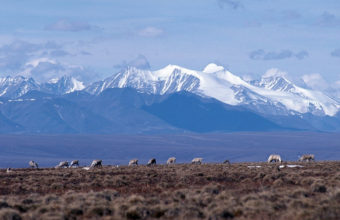
Caribou graze on the coastal plain of the Arctic National Wildlife Refuge, with the Brooks Range as a backdrop. (USFWS)

Over the past 25 years, Alaska’s Legislature has passed nearly a dozen resolutions asking Congress to allow drilling in the coastal plain of the Arctic National Wildlife Refuge.  But this year, something is different. There’s been more push back and public testimony opposed to passing an ANWR resolution.

When Donetta Tritt talks about her hometown of Arctic Village, she talks about caribou.

“When I was little, I didn’t know that caribou was called caribou,” Tritt said. “I called it meat. And so I’d be like, look mom, meat!  I’d see, like, a caribou running on the mountain and I’d be like ‘meat’!”

Arctic Village sits on the edge of the Arctic National Wildlife Refuge (ANWR), in the Brooks Range. Just 152 people lived there in 2010.

Tritt, who lives in Fairbanks now, flew to Juneau to represent her Neetsai Gwich’in people and talk about the importance of the Porcupine caribou herd.

She’s protesting a resolution that has become somewhat of a habit for the Legislature to pass, a call on Congress to open up the refuge to drilling. 

ANWR-USGS
Alaska’s congressional delegation this week renewed their effort to allow development in the Arctic National Wildlife Refuge. (image courtesy U.S. Geological Survey)

The Arctic coastal plain of ANWR is an important calving and birthing ground for the Porcupine herd, and Tritt said that drilling in the refuge could have serious ramifications for the lives of people in Arctic Village and the Gwich’in as a whole.

But not everyone in her district feels that way.  The Kotzebue Democrat who introduced the resolution, Rep. Dean Westlake, is chairman of the House’s Arctic committee. His district covers the North Slope and includes the refuge.  And he doesn’t dispute that the environmental concerns of some of his constituents are important.  

But, he said, his district desperately needs an economic boost. And he’s looking toward an industry that has provided that boost to the North Slope and surrounding villages for decades.

“When I was a young man, I worked on the North Slope like a lot of young people did to go pursue a dream. The money is there,” Westlake said.

Westlake said he depends on the land for food and honors the environment, but he believes that responsible development is key to the health of the region.

These are not new arguments for and against opening the refuge to drilling. They’re arguments that have played out in legislative hearings for decades at the state level, though not usually at this scale.

Princess Johnson, from Fairbanks, has been following these resolutions for a long time, but this year, she decided to visit Juneau in person.

“Typically, this is a resolution that gets passed every year in our state Legislature,” she said.

When she’s showed up to testify before, there have only been a handful of people there. “A couple of people that are for that, a couple people that are speaking out against it, and we know that it’s just standard,” she said.

Johnson said the political environment has become extreme in the last year and it has motivated her and activists like her to be louder about their concerns.

This is the first time she’s traveled to Juneau to talk to legislators. She’s used to skipping state politics altogether and going straight to Washington D.C. to get an audience with federal politicians.

The state’s resolution, while largely ceremonial, could also carry more weight this year with the state’s delegation in D.C. Alaska’s U.S. senators Lisa Murkowski and Dan Sullivan introduced a bill in January to open up a portion of the refuge for drilling, and on the House side, Alaska Representative Don Young introduced a similar bill.

And with the new presidential administration, and a Republican-led Congress, these bills may have a better chance at gaining traction.

It’s an uphill battle for Tritt, Johnson and dozens of people who testified before the two state House committees that have heard the resolution so far. Both committees heard an overwhelming amount of testimony against the resolution, then quickly passed them through.  

Even lawmakers who support environmental arguments against opening ANWR won’t vote against it.

“The folks, particularly in this room who testified about their concerns,  I don’t view them as wrong,” said Rep. Andy Josephson, D-Anchorage. “They have a long view, and I have real concerns that, that long view is shortening. That is, I’m worried about my planet. They make some very good arguments and they’re among the finest Alaskans I’ve met. Having said that … my state needs revenue.”

And with arguments like that, it’s likely that the resolution will continue its path to sail smoothly through the Legislature for the 12th time.

Latest oil tax credit bill off to a rough start in state House

Rep. Chris Birch, R-Anchorage, argues over the debut of an oil tax credit bill, during a floor session of the state House, on Wednesday, February 8, 2017, in Juneau, Alaska. (Photo by Rashah McChesney/Alaska’s Energy Desk)

Last session, the fight over oil tax credits was one of the biggest questions lawmakers sought to answer.  And while they did manage to pass a bill, it focused on Cook Inlet. Now, many lawmakers are saying it’s time to look at the North Slope.  

The message from the oil industry has been clear. Keep the tax structure stable, and help with new development — because it will pay off in the long run. But on Wednesday,  lawmakers on a House Resources committee introduced a bill that makes deep cuts to the subsidies the state gives to the oil and gas industry. And, for a few minutes, the state House floor started to sound a lot like Britain’s House of Commons. 

The chaos erupted after members of the House resources committee released their much anticipated bill proposing another round of oil tax credit reforms. Or, at least, five members of the committee did. Four of them, members of the House minority Republican party, say they were never consulted.

“You know we sit through a lot of meetings, Mr. Speaker, and at no time was this brought before us. As a matter of fact it was actually presented to the media, and if consensus was achieved it was done in a secret meeting,” said Rep. Chris Birch, R-Anchorage.  “Typically, In my experience as a committee member, I would be given the opportunity to review the bill before it would be shared with the press.”

For at least half an hour, members of the House minority and majority caucuses argued over whose names should be on the bill, how it should be introduced, decorum in debating motions and just about everything that can be fought over besides the content of the bill. And, that debate is likely going to continue because, in its current form, the bill packs a punch.  

The proposed bill cuts net operating loss credits from 35% to 15% and limits the ability of companies to earn those credits if they’re producing more than 15,000 barrels of oil per day.   

Rep. George Rauscher, R-Wasilla, during a floor session of the state House, on Wednesday, February 8, 2017, in Juneau, Alaska. (Photo by Rashah McChesney/Alaska’s Energy Desk)

This is a big deal for some smaller oil companies.

Caelus Energy Senior Vice President Pat Foley told the House Resources committee last week that its Nuna Project on the North Slope has lost value since it was sanctioned under the state’s current oil tax regime. Lawmakers fought bitterly over changes to that regime last year.

And Foley says the changes hurt Caelus’ bottom line.

“For Caelus that project is now worth, to us, $0.62 on the dollar. We’re still okay. It’s still a project that can survive,” Foley said. “But we can’t stand too much more erosion at all.”

The bill also eliminates the state’s credit repurchasing program in 2018. That program has gotten a lot of attention in the last two years because Gov. Bill Walker has delayed millions in payments the state already owes to companies under that program.

The bill also raises the state’s minimum tax from four percent to five percent. And it hardens “the floor,” which refers to the credits that companies can take that allow them dip below the state’s four percent minimum tax rate.

Anchorage Democrat Geran Tarr, who chairs the House resources committee says the bill isn’t in its final form. 

Rep. Geran Tarr, D-Anchorage, co-chair of the House Resources committee, gestures during a debate over the way her committee debuted an oil tax credit bill, during a floor session of the state House, on Wednesday, February 8, 2017, in Juneau, Alaska. (Photo by Rashah McChesney/Alaska’s Energy Desk)

“We consider this just a starting point,” Tarr said during a press conference after the floor debate. “For anyone who’s followed oil and gas issues over the last few years, you know that many, many hearings is generally several dozen hearings. So, I anticipate that will be what happens this year as well — that we will have ample opportunity for industry, for concerned Alaskans, to hear from the administration.”

In its current form, the House bill could be on a collision course with the Senate. And members of the House who say the industry needs stability right now, not more pressure from the state.

Anchorage Republican Cathy Giessel, who chairs the Senate resources committee said recent announcements of major new finds on the North Slope are a sign that the current tax structure is working.

And she says she’s not interested in having another marathon fight over oil subsidies. It’s a fight she says lawmakers have been having constantly since they started adjusting the tax credits in 2014 and tweaked them again in 2016.

“So, my concern with further changes is this is further instability for our state,” she said.

But, while she doesn’t want to rock the boat too hard, Giessel acknowledges that the state is in a recession. And says lawmakers may need to reconsider the way tax credits are paid, so the state isn’t paying cash up front for industry investment.

But if the debate over how the bill was introduced is any indication, the debate over what the bill does, could be deafening.

Site notifications
Update notification options
Subscribe to notifications