Rashah McChesney

Daily News Editor

I help the newsroom establish daily news priorities and do hands-on editing to ensure a steady stream of breaking and enterprise news for a local and regional audience.
Legislature considers new contract to sell royalty oil

conocopipeline_Harball
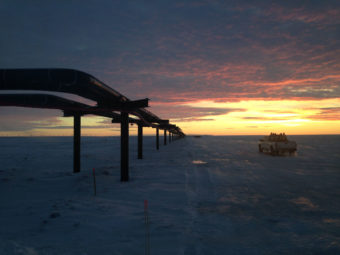
Pipelines stretch toward the horizon on NPR-A land leased by ConocoPhillips. The company announced it’s found 300 million barrels of recoverable oil nearby. (Photo by Elizabeth Harball/Alaska’s Energy Desk)

The state gets the bulk of its royalties from oil produced on the North Slope in the form of oil rather than in payments from the producers.

This week, lawmakers are considering a contract to sell some of that royalty oil to the  Alaska-owned refinery and fuel marketing company Petro Star.

Jim Shine, commercial manager for the Division of Oil and Gas at the state’s Department of Natural Resources, said the state makes more money if it receives its oil “in kind” — or in oil — rather than “in value” — meaning in cash.

“When the state elects its royalty oil in value, the producer ships the oil and sells it alongside their own production, on the state’s behalf,” Shine said.

That means the state has to pay what it costs to move that oil from Valdez to the West Coast. On average, that’s about $3.50 per barrel.

So, for the last 38 years, the state has kept its royalty oil and sold it. Usually, the state sells to in-state buyers, dodging that transportation cost. Currently, the state is in a five-year contract with Tesoro.  It sells between 20,000-25,000 barrels per day to the company.

By contrast, Petro Star — a subsidiary of the Arctic Slope Regional Corporation — will be able to draw 18,800-23,000 barrels per day this year.  That number will drop over the next five years based on state estimates of lower flow in the Trans-Alaska Pipeline.

“In the past, the state has had maybe a little bit more comfort in our royalty shares over a longer period of time. For instance, we’ve had 10 year contracts for royalty sales before,” Shine said.

But as volume in the Trans-Alaska Pipeline drops, so does certainty in the amount of oil the state will have to sell.

These kinds of contracts do carry some risk. If Tesoro or Petro Star were to default on paying for the oil or taking it from the producers on the North Slope, the state could be left with thousands of barrels of unsold oil. Currently, the state has a $46 million bond from Petro Star to cover the costs of the company defaulting on payment – or the state having to re-sell the oil.

This year, the state expects to get 50,000-55,000 barrels per day of royalty oil from North Slope production.

North Slope oil companies ask lawmakers for stable tax laws

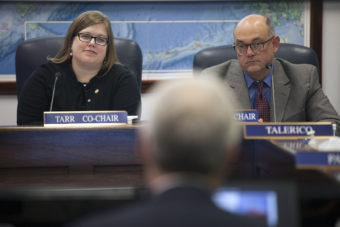
Rep. Geran Tarr and Rep. Andy Josephson, Anchorage Democrats and co-chairs of the House Resources Committee hear testimony from oil and gas industry representatives on Wednesday Feb. 1, 2017 in Juneau. (Photo by Rashah McChesney/Alaska’s Energy Desk)

A state House committee heard testimony Wednesday afternoon from the big three North Slope oil producers. ConocoPhillips, ExxonMobil, and BP representatives gave several members of the House Resources Committee their perspectives on how the state’s oil tax structure is working.

Alaska’s current tax regime on the North Slope essentially takes 35 percent of the profit a company earns on a barrel of oil, but tax credits reduce the amount companies actually have to pay. 

While each company represents different finds in different areas of the North Slope with different profit margins, they had a similar message:

“The need for Alaska to maintain a competitive fiscal regime that encourages critical, ongoing and long term investment is by far one of the most important issues you face. We know it’s going to be tough for you and the entire legislature to deal with this issue,” said ExxonMobil Tax Counsel Dan Seckers.

Dan Seckers, Tax Counsel for ExxonMobil, testifies before a House Resources committee on Wednesday Feb. 1, 2017 in Juneau, Alaska. (Photo by Rashah McChesney)

Seckers and others told lawmakers that its current tax regime, the More Alaska Production Act (MAPA) is working.

“Has MAPA made Alaska’s investment climate more competitive? Has it resulted in more simple, predictable production taxes? Has it been working as legislators had hoped? Has it lived up to its name? We believe, at ExxonMobil the answer to each and every one of those questions is yes,” Seckers said.

The committee heard three hours of testimony.

Lawmakers are gearing up for a tough session as they negotiate how the state will fill its multi-billion dollar budget hole. How the oil and gas industry should help fill that hole is a particularly complicated question.

Kara Moriarty, President of the Alaska Oil and Gas Association, told the committee that the tax credits are working to generate new development and investment. But she also reminded lawmakers that the state has changed its tax policies six times in the last decade. 

“How can we remain competitive when the state has constantly changing tax policies?” Moriarty asked.

The industry representatives repeatedly told the state that they want a stable tax regime.

The committee will also hear presentations from some of the state’s smaller oil companies as House lawmakers work toward introducing a bill that could again tweak the state’s tax structure.

From the bush to Congress, Willie Hensley straddles rural and urban divide in Alaska


(Left) Now-Lt. Gov Byron Mallot, Willie Hensley and Roy Huhndorf testify before Congress. (Photo courtesy Willie Hensley)

One afternoon in the mid-1970s, journalist John McPhee and an influential Alaska Native politician Willie Hensley took off from  Anchorage in a de Havilland Otter and flew deep into the Alaska range, looking for a new state capitol.

Later, in his book “Coming into the Country,” McPhee introduced the rest of the nation to one of the most prominent, young Alaska Native leaders in the state. Hensley was instrumental in forcing the state and the federal government to settle land claims with its 60,000 Alaska Native residents.

William Hensley has a long memory.  Dates, names, places, votes: History just seems to spill out of him. In his Anchorage garage, stacks of old framed photos, posters and political paraphernalia lean against a set of shelves.

Reed Stoops and Willie Hensley wait in the control room at KTOO before a forum on John McPhee's book, "Coming into the Country," on Tuesday, Jan. 24, 2017, in Juneau, Alaska. (Photo by Rashah McChesney/Alaska's Energy Desk)
Reed Stoops and Willie Hensley wait in the control room at KTOO before a forum on John McPhee’s book, “Coming into the Country,” on Tuesday, Jan. 24, 2017, in Juneau, Alaska. (Photo by Rashah McChesney/Alaska’s Energy Desk)

On a recent Wednesday, he lifted one out from his first term in the state legislature. He was 25 years old.

“Let’s see, Mike Bradner is here somewhere. Here’s Don Young. We sat next to each other,” Hensley said.

The list goes on.

“There’s Mike Bradner over there, he’s still around. Tom Fink, who was the mayor of Anchorage, he’s still around, still alive,” he said.

Alaska’s modern history is very short. And, among the people who helped to shape the state, Hensley stands out.

From a semi-nomadic, traditional subsistence Inupiaq childhood to lobbying in the halls of Washington, D.C., Hensley straddled the enormous divide between rural and urban Alaska.

He was instrumental in lobbying for the Alaska Native Claims Settlement Act: A deal that journalist John McPhee in his book calls more significant than the statehood act.  It changed the status and the structure of native societies in the state and paved the way for the Trans-Alaska Pipeline.

But Hensley didn’t start, or stop there.

He was born William Iggiagruk Hensley in 1941 in Kotzebue. Iggiagruk is his grandfather’s name.

“That G with a dot is a guh, not a g. Like my name Iggiagruk, the g with two dots. Oddly enough, in our language, iggiak is your throat. Iggik, is a mountain. Iggiagruk, is a small mountain. That’s my name,” he said.

At 15, Hensley was flown to a boarding school in pre-Civil Rights Era Tennessee. Before long, he was in college in Fairbanks and then George Washington University in the District of Columbia.

When he was 25, he was elected to the Alaska  House of Representatives. He wasn’t the first Alaska Native lawmaker, but one of just a handful and definitely the youngest. 

Barry Jackson, a member of the land claims task force, and Willie Hensley, chair of the task force, announcing that the task force had given former Gov. Walter Hickel recommendations on land claims issues in 1969. (Photo courtesy Willie Hensley)

In 1974, Alaskans voted to move the state capitol out of Juneau, and the Lieutenant Governor asked Hensley to head the Capital Site Selection Committee.

The nine-member committee flew all over Alaska, trying to find a hundred square miles of land, near a mass transit artery, on state land, or cheap-for-the-state land, and far enough away from Anchorage and Fairbanks to satisfy voters.

It was a committee assignment Hensley says no politician in their right mind would accept.  But he did, though he had some reservations.

“You know, we were basically a failing state until we got that first $900 million dollars in 1969. And we still had tons and tons of things that needed to be built: housing, schools, water and sewers, you know ports, airports. All these things that communities needed and I just didn’t think spending several billion dollars for a new capitol was the right thing to do,” he said.

That’s when Hensley met John McPhee, whom he had never heard of. And, he assumed McPhee needed a history lesson.  

“I was trying to help. You know,  I’ve sort of always felt this need to try to explain Alaska to people who didn’t know anything,” Hensley said. “And, I sort of felt the same way about him, so I was going on and on.”

And Hensley, who often can’t resist arching his eyebrows and dropping a dad-joke or two — couldn’t resist poking fun at the process to McPhee.  

“For instance, we were flying along and there was this little creek down below, we had maps and stuff you know and it was called, Bulchitna,” he said. “And I said ‘huh, that’s a beautiful name for a new Capital. Bullchitna.”

Early on, Hensley said he had written McPhee off as just another white guy.

“I just knew back then that there were very few people that were non-native that had any concept of what our lives were out there. Also, who had just a limited comprehension of the space that our people had occupied for literally thousands of years,” he said.

So, what did Hensley think of McPhee’s book?

“Oh I kind of enjoyed the book actually. His was an honest portrayal, I think, and so that’s why I liked it,” he said.

“Coming into the Country” gave outsiders a glimpse into the rapidly changing landscape of Alaska Native leadership and society. When the state was split into twelve regions, each with its own native corporation, they had to split a billion dollars and 40 million acres of land. They were suddenly and collectively rich.

In the book McPhee borrows the term “Brooks Brothers native.” He uses it to describe a class of native person who has seen a much wider segment of the world than their forebearers and most of their contemporaries. He describes Alaska Airlines jets half-full of natives zipping around the state on business, investing in each other’s regions, building corporate empires. 

John McPhee and Willie Hensley in a newspaper clipping from 1980 when the two were awarded honorary doctorates from the University of Alaska. (Photo courtesy/Willie Hensley)

And Hensley says, that was accurate.

“Yeah, there’s lots of stories about individuals who all the sudden started carrying around briefcases,” Hensley said. “That was not our world, right. And sometimes all they had was smoked salmon in there and maybe a sandwich, you know.”

Hensley retired in 2008.  He says he’s left politics behind. Now, he’s focused on connecting Alaska’s native people to their culture. And, teaching. He says every generation worries if the next one has what it takes to point the state in the right direction. And he thinks the lessons of the past — his past — may offer some clues.

State gasline corporation quietly opens office in Tokyo

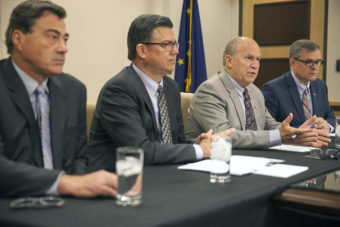
Chief Oil & Gas Advisor John Hendrix, Alaska Gasline Development Corporation President Keith Meyer, Alaska Gov. Bill Walker and Department of Natural Resources Commissioner Andy Mack gave a press conference on Friday Sept. 30, 2016 to discuss their meetings with potential Asian markets for Alaska's LNG in Anchorage, Alaska. (Photo by Rashah McChesney)
Chief Oil & Gas Advisor John Hendrix, Alaska Gasline Development Corporation President Keith Meyer, Alaska Gov. Bill Walker and Department of Natural Resources Commissioner Andy Mack gave a news conference on Friday Sept. 30, 2016, to discuss their meetings with potential Asian markets for Alaska’s LNG in Anchorage, Alaska. (Photo by Rashah McChesney/Alaska’s Energy Desk)

Updated | 5:20 p.m.

Last weekend, the Alaska Gasline Development Corporation announced that it had opened a new office in Japan. But, it only made the announcement in Japan. Now, one lawmaker is questioning how the agency is spending its money, and why.

The Alaska Gasline Development Corporation (AGDC) hired Nick Shiratori. He’s a former employee of Mitsubishi-subsidiary Diamond Gas Shipping and he’s been marketing the oil and gas industry since 1979. But, they didn’t announce the new office or Shiratori’s appointment in Alaska.  

Grace Jang is a spokesperson for Gov. Bill Walker’s office.

“Let me start off by saying, this is not a new office,” Jang said. “The state of Alaska, for 36 years, has had a representative in Japan.”

She said that the Governor’s office has paid for a consultant in Japan for decades.

What has changed is that the $130,000 budgeted through June for Shiratori’s position and his $5,300 per month Tokyo office space will be paid for by the Alaska Gasline Development Corporation.

Corporation spokesperson Rosetta Alcantra said Shiratori will be doing a mix of marketing and communication for the corporation.

“Mr. Shiratori has over 37 years of experience in the oil and gas industry. Certainly that comes with a large network of folks that he has contact with and so we’re hoping that he can help provide that connection for us,” Alcantra said. 

The AGDC is tasked with managing Alaska’s gasline projects. Among them, is the massive Alaska LNG project that’s expected to cost $45-65 billion to build.  It would include an 800-mile pipeline to bring natural gas from the North Slope to Cook Inlet where it could be compressed into a liquid form and shipped to buyers.

But, the corporation hasn’t yet taken control of the project and is still negotiating with its former partners —  BP, ConocoPhillips and Exxon — over a federal export permit and control of the land needed to build the project.

Lawmakers had mixed responses to news of the office in Japan.  Rep. David Guttenberg, D-Fairbanks, said he sees it  as an asset to the state.

“I certainly think in the international markets where our products play, you have to have a presence,” he said.

The Fairbanks Democrat said the state has had offices and consultants in Asian countries for decades and that they play important roles in marketing natural resources.

But Sen. Cathy Giessel, R-Anchorage, said she thinks the corporation is misspending the money the legislature appropriated to it.

“We have no information about this Japanese office,” she said. “At the same time we’re here in Juneau, wondering how we’re going to balance the budget, considering taxing citizens, reducing education funding, dealing with healthcare costs. And $100 million is sitting in the treasury of the AGDC and we don’t know what it’s being used for. So there is huge, there is huge concern.” 

Giessel also said the corporation was not transparent in its decision to open the new office. She chairs the Senate Resources committee and says she attends most of the corporation’s board meetings.

Unlike the board’s much-publicized decision to open a satellite office in Houston last year, the Tokyo office didn’t get any public attention.

Representatives from the gasline corporation are due in front of Giessel’s committee next week. She said there will be plenty of questions about how it spends its money.

Original story | 11 a.m. Thursday

The state gasline corporation has opened a satellite office in Tokyo.

State officials and the Alaska Gasline Development Corporation have been working to market the state’s natural gas reserves to Asian markets.

Masatoshi Nick Shiratori confirmed by phone late Wednesday evening that he is running the new office in Japan.

Shiratori previously worked at Mitsubishi subsidiary Diamond Gas Shipping before he joined the state’s gasline team.

A spokesperson for the corporation confirmed this morning that the office is open. But, they have not yet announced it publicly.

Alaska’s gasline corporation is tasked with managing the massive Alaska LNG project that is expected to cost $45 billion to $65 billion to build. It’s still negotiating with ExxonMobil, BP and ConocoPhillips to take over the project.

In its current form, the LNG project would include an 800-mile pipeline to bring natural gas from the North Slope to Cook Inlet.

Writer John McPhee was at ease in a canoe, Brad Snow was at ease with him

Brad Snow in a canoe looking very relaxed and free, living along the Yukon River in Alaska. Snow appeared in John McPhee’s 1977 book “Coming into the Country.” (Photo courtesy Brad Snow and Lilly Allen/UAF Project Jukebox)

Brad Snow was 26 years old when he left Anchorage to start a life with his girlfriend, Lilly Allen, near the Yukon River. The couple is featured in John McPhee’s book “Coming into the Country,” published 40 years ago.

Snow and Allen built a log cabin on the Nation River, a tributary to the Yukon. But in 1976, the Bureau of Land Management told them they were trespassing and forced them off the land.

After he met McPhee, Snow offered to take him by canoe from Eagle to Circle, a trip that took four days. Snow says it didn’t take long for him to warm up to the writer.

Job losses in nearly every sector expected for 2017

State and local government workers receive similar compensation to priv-ate-sector workers, according to an Institute of Social and Economic Research report. State Office Building. Aug. 5, 2016.(Photo by Andrew Kitchenman/KTOO)
Like most other sectors of the economy, state jobs are in decline. Alaska Department of Labor and Workforce Development economists predict a shrinking economy in 2017 as the state struggles to recover from low oil prices and a loss of billions in revenue from the oil and gas industry.  (Photo by Andrew Kitchenman/KTOO)

Thousands of Alaskans lost their jobs in 2016, and in the forecast for 2017, it doesn’t look like the economy is going to stop shrinking anytime soon.

Oil prices, the foundation of the state’s economy, have rebounded slightly but not enough to balance the state’s budget. A new state economic forecast predicts layoffs and job losses in nearly every sector of the economy.

State economists say cuts in the oil and gas industry, construction and the public sector have been so deep they’re causing job losses in nearly every other sector of the economy.

Alaska’s Department of Labor and Workforce Development economists say the state’s economy is in decline, and, for the first time in decades, the state is going to have to fund the majority of its budget with something other than oil revenue.

That said, oil industry losses, the catalyst for the state’s rapidly shrinking economy, are expected to slow. According to the state’s employment forecast for 2017, the oil industry is expected to shed 1,400 jobs this year: about half of what it lost last year. 

(Graphic Courtesy Alaska's Department of Labor and Workforce Development)
Oil workforce drops from 2015 high. (Graphic Courtesy Alaska’s Department of Labor and Workforce Development)

While oil prices are the main driver for the economy, state economist Caroline Schultz says they’re relatively easy to predict. The big unknown now is political.

“Legislative decisions and budget decisions made by the legislature and the governor, I mean, we don’t have as good of a read on how that’s going to pan out as we do on oil prices,” Schultz said.

Whatever the legislature decides to do this year probably won’t solve all of the state’s budget problems but could go a long way toward boosting consumer confidence and encouraging new business, Schultz wrote in her analysis.

Sectors of the economy like arts and entertainment and recreation will see big losses in 2017 as people spend less money. And, while a good tourist season will help with that loss, this year could be rough on restaurants and bars.

The financial services are also expected to take a hit as real estate and demand for financing slows.

Also, the public sector will be thinned again. At least 1,300 jobs were cut in 2016. Governor Bill Walker introduced a budget in mid-December that calls for another 400 state jobs to be cut by December of 2017. 

The 2016 numbers are preliminary, the 2017 are forecasted. (Graphic Courtesy Alaska's Department of Labor and Workforce Development)
Government job losses in Alaska. 2016 numbers are preliminary; 2017 are forecasted. (Graphic Courtesy Alaska’s Department of Labor and Workforce Development)

There are some bright spots.

The healthcare industry is expected to keep adding jobs as the state’s population ages. In fact, it’s the only industry forecasted to grow, adding 500 new jobs this year.

Military spending is up with nearly $550 million in new hangars, buildings and construction contracts between Eielson and Fort Wainwright bases in Fairbanks. 

In Anchorage and Southeast Alaska the tourism industry could get a boost from large numbers of out-of-state travelers. Cruise ship bookings are up. 

Schultz says there weren’t a lot of surprises when they were crunching the numbers for the 2017 forecast.  

“We’re kind of past the hard part where we had to predict when the rough times were going to start,” she said. “So now we can definitely in retrospect identify that they really started in 2016.”

The new excitement, she says, is to predict when the state starts to come out of this slump. But that likely won’t happen in 2017.

Site notifications
Update notification options
Subscribe to notifications