Rashah McChesney

Daily News Editor

I help the newsroom establish daily news priorities and do hands-on editing to ensure a steady stream of breaking and enterprise news for a local and regional audience.
State monitoring spill at Tesoro pipeline facility near Cook Inlet

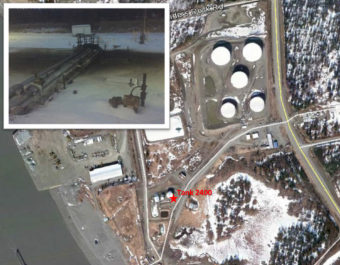
The spill location and photo of the leak on Dec. 18, 2016 in Nikiski, Alaska. (Graphic courtesy Tesoro)

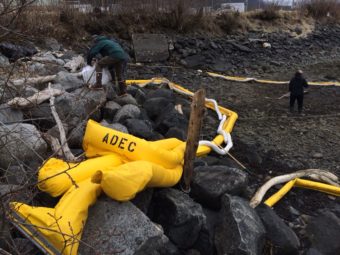
Workers at a Tesoro facility on the Kenai Peninsula are cleaning up contaminated soil and snow after more than 120 gallons of oily water spilled out of a pipeline near Cook Inlet. The company notified the state of the spill at its Kenai Pipeline Facility on Dec. 18.

Jade Gamble, who works in spill response with the Alaska Department of Environmental Conservation, has been doing site visits ever since.

“The spill was contained very quickly,” she said. “They were on-site when it happened and they were able to deploy some absorbent boom around the spill so that it did not spread any further.”

She says the cleanup has been slow.  They’re using hand axes and jackhammers to chip away at the frozen soil. The company will process the contaminated snow and water onsite, while the soil will be burned. Workers also drained and shut down the pipe.

Gamble says it isn’t yet clear exactly how the spill happened.

“They’ve discovered two holes in the line,” she said. “But we don’t know if there’s any others, like I say because some of it’s subsurface.”

The company is cleaning up what has been contaminated and exploring the buried parts of the line to make sure there are no other leaks. In an emailed statement, Tesoro says there have been no injuries or impacts on local wildlife. Gamble says the spill hasn’t reached Cook Inlet.

According to DEC data, there have been at least five spills over 50 gallons at that facility in the last 17 years.


Former tax division director weighs in on Prudhoe Bay oil tax case

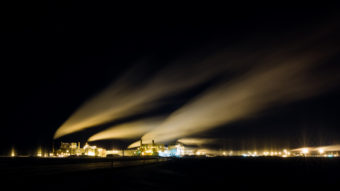
Prudhoe Bay at night on Jan. 28, 2013.
Prudhoe Bay at night on Jan. 28, 2013. (Creative Commons photo by jweston_40)

Last week, Alaska’s Supreme Court issued an opinion on a Prudhoe Bay tax law case that has been open for 10 years.

Alaska’s Energy Desk reporter Rashah McChesney sat down with the former Department of Revenue tax division head Dan Dickinson.

Dickinson’s decision to change the way the oil and gas division interpreted its production tax calculations led to a challenge and ultimately a lawsuit between state and Chevron, ConocoPhillips, ExxonMobil and Forest Oil.

Interview transcript:

McChesney: We’re here today to talk about an ELF. But not the kind of ELF you typically hear about this time of year. This ELF is an economic limit factor. And it was a key part of the way the state calculated production tax rates in the Prudhoe Bay oil field from the 1970s to the mid-2000s. The Department of Revenue’s interpretation of that ELF led to the Prudhoe Bay producers’ lawsuit that went all the way up to the Supreme Court.

Dickinson: So it was, really, it was a procedural question of how we came to that decision, and how we adopted it.

McChesney: The foundation of this lawsuit was that the Department of Revenue had two different tax rates in Prudhoe Bay. You had these big fields that were taxed at one rate and then these smaller, satellite fields that were still technically in Prudhoe Bay, but they were taxed at another rate because, in theory, those fields required the same kind of infrastructure to operate but had fewer economies of scale. So the state taxed them at a lower rate to keep them profitable?

Dickinson: What the state did is, it created a formula — a very complex formula. And what the effect of that formula was, is it made the taxes on very large fields higher and the taxes on smaller fields, very much lower. Size became very important.

McChesney: The state formula ended up kind of incentivizing the development of these smaller, satellite fields that were taxed at a lower rate. Do you remember the difference in tax rate? I’m recalling something like 15% on the larger fields and 0.5% on the smaller fields.

Dickinson: That’s on average. But yes, the smaller fields could very easily be driven to zero and some of them were slightly above zero.

McChesney: So, producers and field operators started prioritizing oil that came from these satellite fields over oil that came from the big ones. But, it wasn’t just so that they could pay that lower rate. It was also because newer wells tended to produce more oil and less of the gas and water and sand that comes out of older wells.

But, no matter which field the oil was coming from — old or new– the producers were the same. Companies were developing new, satellite fields and asking for them to be taxed separately from the old, larger fields. What were the discussions at the Department of Revenue at the time?

Dickinson: The focus on the tax has always been…there’s a tension between two aspects of it. One of it is the state obviously wants to get the money from the tax. On the other hand, they clearly recognize that a poor tax regime will inhibit the kind of growth and the investment that it wants.

McChesney: At some point, the Department of Revenue decides to change the way it’s interpreting the tax law and informs the companies that it’s going to combine most of those smaller satellite fields into the larger fields for calculating production taxes.

Dickinson: The effect of that would have been the tax on Prudhoe Bay, on the main field, would have gone down just a hair. But the tax on all the other remaining fields would have gone up considerably. It would have increased taxes by more than $100 million a year. I know that.

McChesney: Okay, so the Department of Revenue issues this decision and it’s estimated to increase taxes by $100 million a year. But then the next year, the legislature decides to toss out the ELF system and put something else in place, and then it decides to do it retroactively. So there’s like a four or five month period there where they were taxed under one system and then it switches to a new system. All told, this new interpretation of the ELF was in place for about a year, year and a half?

Dickinson: Yes.

McChesney: So the oil companies pay that $100 million dollars in production taxes. Then they sue. It has taken a decade for them to exhaust their legal remedies. Now, the state isn’t on the hook for paying the money back. So, what’s your takeaway from this whole process and the final resolution of the lawsuit?

Dickinson: It would be nice if the statutes were nice and clear, the legislature set out exactly what they wanted and said it in such a way that it actually made sense when you actually had to deal with tax. That’s just not what happens in the real world. People sitting in Juneau come up with a very conceptual idea and, you know, applying it to actual returns and companies is a difficult task. I think it generally gives a clearer line as to when the department can act when it can’t.

McChesney: The supreme court issued its final ruling on Dec. 16.

Timeline extended for state takeover of Alaska LNG project

Alaska Gasline Development Corporation President Keith Meyer, Alaska Gov. Bill Walker and Department of Natural Resources Commissioner Andy Mack discuss meetings with potential buyers of Alaska’s LNG during a press conference on Friday Sept. 30, 2016 in Anchorage, Alaska. (Photo by Rashah McChesney)
Alaska Gasline Development Corporation President Keith Meyer, Alaska Gov. Bill Walker and Department of Natural Resources Commissioner Andy Mack discuss meetings with potential buyers of Alaska’s LNG during a press conference on Sept. 30, 2016, in Anchorage. (Photo by Rashah McChesney/Alaska’s Energy Desk)

The Alaska Gasline Development Corporation is still trying to broker a deal to take over the Alaska LNG project, but it will not happen by its self-imposed end-of-the-year deadline.

This is the second deadline the project has missed in its timeline for taking over the massive $45 billion-plus Alaska LNG project.

The state has been working toward a takeover since BP, ConocoPhillips and ExxonMobil balked at pursuing the project after prices for oil and liquefied natural gas fell worldwide.

Corporation President Keith Meyer told board members on Wednesday that the transition agreements have taken months to finish. He says there are four things that need to be done to take over the project.

So far, AGDC has gotten the rights to all of the information developed by the project so far. It has also sent notice to the Federal Energy Regulatory Commission that it will go through the permitting process alone.

But that still leaves the question of what will happen to a big chunk of land on the Kenai Peninsula. The project bought 630 acres to house a natural gas liquefaction plant at the end of the pipeline.

Additionally, the corporation has not yet taken over a Department of Energy license that would allow the state to export LNG to non-free trade agreement countries.

Meyer told the board the negotiations on those points were still in progress, but agreements would not happen until next year.

Revenue department forecasts jump in oil prices, drop in production

rm_state-rev-2
A crowd walks across a map of Alaska at the Alaska State Library, Archives & Museum on Dec. 19, 2016, in Juneau. The state released its revenue sources book, which will help lawmakers and Gov. Bill Walker work out a budget for the upcoming year.  (Photo by Rashah McChesney/Alaska’s Energy Desk)

When it comes to the state’s bottom line, the tax division’s revenue sources book predicts a patchwork of good and bad news for the state.

The good? Oil prices are forecast to go up.

The bad? The money coming in from oil revenue is nowhere near enough to close the state’s budget gap and production on the North Slope is forecast to go down.

Have a lawmaker, the governor or maybe someone in Alaska’s oil and gas industry on your holiday gift list this year? They’d probably love a good crystal ball: one that might give them a glimpse of the future price of oil, or how much the state is going to produce next year, and maybe a look at the end of the legislative session to find out what’s going to happen with all of those tax proposals floating around.

Unfortunately, no such soothsayer exists. And they’ll probably have to rely on the state’s Department of Revenue.

Earlier this week, analysts released their semi-annual revenue sources book. It’s a snapshot of the state’s financial health.  It has current and historical income information. And, for the analyst on your list, it also has predictions for the price of oil for the next few years: How much the state is going to produce, what kind of money the state expects to have available to spend, and this year a whole chapter on the potential impacts of an income or sales tax.

And, while it’s no crystal ball. It can help with the economic forecast.

First, the good news: Oil prices are predicted to go up. During this fiscal year, they’ll average $46.81 a barrel. And that’s expected to go up to $54 per barrel next year.

State tax division director Ken Alper said that price jump is going to help the state.

“A good rule of thumb for Alaska at the range of prices we’re at right now is every dollar in the price of oil is worth about $30 million,” he said. 

Tax Director Ken Alper
Tax Director Ken Alper with the Department of Revenue speaking on oil tax credits to state lawmakers this February. Alper would like to spend less time talking about oil this legislative session. (Photo by Skip Gray/360 North)

So, a $10 jump in the price of oil means that, over the course of the next year, the state should get about $300 million in additional revenue.  

But that’s not nearly enough to cover the state’s $3 billion budget deficit.

“It’s substantial. No one should ever scoff at $300 million,” he said. “But that’s not balancing the budget.”

One other consequence of that slight jump in oil prices? The state’s going from a price that’s below the oil industry’s break-even point, to above it. That price is around $45 a barrel.

That break-even point is very important for the state.  When oil prices fall below it, the major producers on the North Slope start losing money.  And they can turn those operating losses into credits that can be used to offset taxes they owe to the state.

They’re still required to pay a minimum tax. But, then if it carries into the next year, the companies are able to use those credits to offset even that minimum tax.

“So we were seeing production tax revenues approaching zero for the next several years because of the very low prices we were seeing now,” Alper said. 

So, as oil prices inch upward, the state’s tax revenue picture starts to look at little better.

“That phenomenon falls off a little bit, and we now are starting to see a couple hundred million dollars in production tax revenues in the near future. Not the billions that we had in the past when prices were higher, but at least not zero,” he said.

Now, the bad news. There are still significant challenges ahead for the state.

Oil production is forecast to go down.  Prices aren’t forecast to get above $88 in the next decade.

And, the legislature is gearing up for a fight over oil tax credits, broad-based taxes and just how to solve the state’s budget crisis.

And no amount of prognosticating can tell how policymakers will resolve those arguments.  

State corporation working to takeover Alaska LNG project to be audited

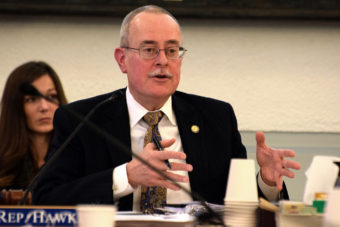
Rep. Mike Hawker, Chair of the Legislative Budget & Audit Committee, on Feb. 12, 2015. (Photo by Skip Gray/360 North)
Rep. Mike Hawker, chair of the Legislative Budget & Audit Committee, on Feb. 12, 2015. Hawker and fellow Anchorage Republican Cathy Giessel asked the committee to audit the Alaska Gasline Development Corp., which Hawker helped form.  (Photo by Skip Gray/360 North)

Update | 2:16p.m. Thursday

The Friday AGDC board meeting, which would have discussed the audit, has been canceled and the company has not been rescheduled.

Original story | Wednesday

The state corporation charged with taking over the massive Alaska LNG project is going to have its finances scrutinized. The legislators who called for the investigation say they want to know what the corporation has done with the $600 million given to it by the state over the last several years.

Outgoing House Rep. Mike Hawker and Sen. Cathy Giessel asked the Legislative Budget & Audit Committee to look into the Alaska Gasline Development Corporation’s finances. The two Anchorage Republicans say they’ve had a hard time getting immediate answers to questions they have about the how the corporation is doing business.

Sen. Cathy Giessel, R-Anchorage, addresses the Alaska Senate in favor of passing House Bill 11, an act that would make certain criminal records unavailable on the internet, Jan. 27, 2016. (Photo by Skip Gray/360 North)
Sen. Cathy Giessel, R-Anchorage, speaks in January. (Photo by Skip Gray/360 North)

“It has been somewhat elusive,” Giessel said. “We see, of course, the cumulative number. But not where the expenditures have happened,”

Hawker and Giessel also asked that the auditor look into whether the corporation’s board of directors had approved significant spending decisions and contracts for senior executive employees and consultants. Keith Meyer, the corporation’s president, is the highest paid state employee. He draws an annual salary of $550,000 with an optional bonus of up to $200,000.

Giessel says, it isn’t clear how the corporation decided on compensation.

“And so again, just due diligence on how these expenditures are being made and who is stepping up with the authority to make them,” she said.

Rep. Hawker told the Legislative Budget & Audit committee that he has a vested interest in how the corporation is run. He wrote the legislation that created it in 2009, with former House Speaker Mike Chenault.

It isn’t clear when the audit will be finished. But Giessel says it likely won’t happen before the end of the next legislative session, in April.

“Typically this type of an audit can take, you know, 6 – 8 months,” she said.

AGDC president Keith Meyer (photo courtesy AGDC).

She says the audit is partially motivated by the huge amount of risk in the state’s decision to take over the largest private construction project in North America.

The Alaska Gasline Development Corporation’s board will meet Friday to discuss the audit.

State moves to update its petroleum spill guidelines

Boom
A crew works on a Gastineau Channel beach on Thursday to clean up heating oil spilled from a vandalized tank at the Prospector Hotel in 2014 in Juneau.  (Photo by Matt Miller/KTOO)

 Alaska’s petroleum-based economy means there are many opportunities for toxic petroleum-based spills.

At least 80 percent of the contaminated sites that the state’s Department of Environmental Conservation deals with, have petroleum products in them.

Now, the Department is making moves to update the decades-old protocols it uses when petrochemicals leak into the soil and water.

In late November, about 30 people gathered in a conference room at the Alaska Department of Environmental Conservation’s Juneau headquarters. They were the first to hear about the Department’s plans to update its regulations for cleaning up petroleum spills.

Sally Schlichting who handles policy and regulation for contaminated sites for the DEC, ran the meeting. She said the overhaul is overdue.

“The last time we looked at petroleum specifically was in 1999. So it’s been quite a long time. It’s been about 17 years,” she said.

The regulations she oversees cover spills all along the pipeline route from oilfields to gas stations to home heating oil tanks.

Schlichting said her department wants to update the cleanup levels to reflect more current science on the toxicity of petroleum.

Petroleum cleanup is complex. Things like jet fuel, heating oil and gasoline are made up of hundreds of compounds and calculating risks to human health is tricky. And Schlichting said, in the decades since the levels were last tweaked, they’ve discovered some oversights.

“For example, in our groundwater, our cleanup levels, in the past, had not accounted for the risks to children from consuming and being in contact with that groundwater that’s contaminated,” Schlichting said.

So the department is holding a series of scoping meetings. They’ve reached out to consulting companies,  state agencies from around the country, the oil industry.  They’re taking comments through mid-January. Then they’ll go back to the drawing board.

At least one environmental consultant in Palmer plans to weigh-in.

Ralph Hulbert said he has clashed with DEC in the past because  the complex calculations they require for petroleum cleanup in soil and groundwater don’t factor in what it would take to respond to a spill.

“They do not like to consider the risks of these responses and what you have to do to clean it up,” Hulbert said. 

Hulbert said some of the cleanup methods cause risks that are worse than what a spill could ever have caused.

He also thinks the state doesn’t do enough to ensure that cleanup costs are reasonable for homeowners and companies who’ve had spills.

Schlichting said DEC gets a lot of comments that their cleanup levels aren’t scientifically based.  During the Juneau meeting, people said they were concerned that more complex approaches to cleanup would be prohibitively expensive.

Whatever the department decides to do, it could take awhile.

After the scoping process ends, the department will spend time researching the input they’ve gotten. Then they’ll either develop draft regulations and go out for public comment or hold a few workshops.

“We’re looking at a year, maybe even two years,” she said.

And while it’s not clear what the new regulations will look like, Schlichting said it’s likely that the cleanup levels for some things, like diesel and gasoline, will probably become more stringent.

Site notifications
Update notification options
Subscribe to notifications