
Rashah McChesney

Daily News Editor

I help the newsroom establish daily news priorities and do hands-on editing to ensure a steady stream of breaking and enterprise news for a local and regional audience.
Blood lines: Sealaska studies Alaska Native descendant dilemma

Jeremiah James learns to sew marine mammal furs at a workshop sponsored by the Sealaska Heritage Institute. (Photo courtesy Kathy Dye/Sealaska Heritage Institute)

What makes a person Alaska Native?

In some places, a regulatory definition — known as blood quantum — has superseded cultural ones.  

And a new study by the Sealaska Heritage Institute in Juneau tackles how that regulatory definition applies to marine mammal hunters.

According to the federal government, Nathan Soboleff is one-eighth Tlingit and one-eighth Haida descent. He said he’s got some Norwegian and Russian mixed in there too. He identifies most strongly with his Tlingit roots.

“My father’s and grandfather’s people have been here since time immemorial and my mother’s side of the family has been here seven or eight generations as Norwegian fishermen. Juneau is my lifelong home,” Soboleff said. 

Nathan’s family name is well-known in Juneau. The Sealaska Heritage Institute building is named after his grandfather, Tlingit elder Walter Soboleff.  His great-uncle Vincent Soboleff is a Russian-American photographer who documented Tlingit life at the turn of the last century.

“There aren’t a lot of Soboleffs in Juneau but we have left a bit of a mark,” he said.

Soboleff also has deep ties to his culture. He’s on the board of directors for the Kootznoowoo village corporation for Angoon. And he’s an outspoken advocate of the importance of cultural heritage.

But, in the lineage math used for certifying degree of Indian blood, Soboleff has a one-fourth blood quantum.

That amount is calculated by the federal government, using ancestors with Indian blood who were enrolled in federally recognized Indian tribes or whose names appeared on the rolls of federally recognized tribes.

That means he’s got just enough of a blood quantum to qualify as a descendant shareholder of the Sealaska corporation.  Of the regional corporations that enroll descendants, all but one — Calista — require a minimum blood quantum.

It also means that, as a subsistence hunter in Southeast Alaska, he can harvest sea otters, harbor seals and Steller sea lions.

Those animals are protected under the Marine Mammal Protection Act, but Alaska Natives who live in coastal areas are exempt and allowed to hunt them for food and clothing or to make handicrafts to sell. 

But that right isn’t afforded to all Alaska Natives. They have to have a blood quantum of a quarter or more.

Soboleff can hunt, but he married a non-Native woman.  And his kids?

“My children are less than that,” he said.

Soboleff’s daughter and sons can watch him hunt and harvest, prepare the carcasses for food or ceremony — but they can’t drive the boat or help him haul the dead animals on board. They can’t help him sew the hides or prepare seal oil.

He said using the blood quantum interpretation as a requirement for harvest has limited his ability to teach his children their cultural heritage.

“If you take that interpretation and move forward in time just a couple of years, you’re really preventing future descendants of the culture of learning their ways,” he said.

And Soboleff’s family isn’t alone.

According to the Sealaska Heritage Institute’s study, the number of Alaska Natives who meet the one-fourth blood quantum threshold is dropping.

In the last decade, nearly 20,000 Alaska Natives enrolled with the Bureau of Indian Affairs had less than that one-fourth blood quantum, according to the agency.

The heaviest hit are communities in the Gulf of Alaska where nearly 60 percent of newly enrolled Alaska Natives don’t meet the threshold.

And, beyond the loss of subsistence hunting privileges, Soboleff said the blood quantum restriction is creating divisions within the Alaska Native community.

“It creates a class of Native peoples. It separates them,” he said. “It specifically breaks them into two groups, those who can hunt, harvest and use those marine mammals and those who cannot.”

Through personal interviews, the study found that most Alaska Natives would like to see the blood quantum criteria changed. It lays out several ways that could happen. 

It includes changing the blood quantum threshold to one-eighth. Though, the same eligibility issue could pop up again in a few decades. Tribal enrollment could be used, but some tribes require a minimum blood quantum.

Rosita Worl is the president of the Sealaska Heritage Institute and an anthropologist who helped guide the research in the study.

“I heard grandfathers talking about how they couldn’t take their grandsons out hunting. I heard other grandfathers talk about being able to take one child out who had the one-quarter blood quantum, but not another who did not meet the eligibility requirements,” she said.

She presented the results of the study at the Alaska Federation of Natives conference in Fairbanks in October.

It’s not the first time the issue has been discussed at the conference. In 2010, the Koniag regional corporation proposed changing the definition of Alaska Native to include lineal descendants with less than one-fourth blood quantum.

But, Worl said it was controversial.

“We didn’t know how many new members that would be,” she said. “Are we talking about a whole new population of 30,000 hunters coming into hunt? You know we just had absolutely no idea.”

Now that the new study makes that data available, she said the next step is for tribal entities to take the research back to their regions and decide if, and how, they might want to change the hunting requirements.

Once they’ve got consensus, they’ll have to take their request to Congress.


Editor’s note: This story has been updated to show that the Sealaska Heritage Institute building was named after Walter Soboleff. 

In Alaska, energy policy is key issue for some voters

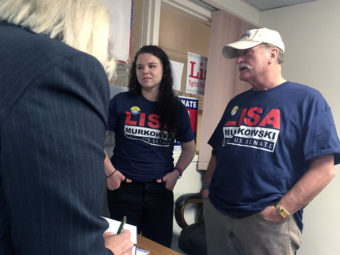
Don Kubley chats with guests during a meet-and-greet with U.S. Senate candidate Lisa Murkowski on Oct. 17, 2016 in Juneau, Alaska. Kubley is supporting Donald Trump for president and says energy policy and Alaska's future weighed heavily on the decision. (Photo by Rashah McChesney/Alaska's Energy Desk)
Don Kubley chats with guests during a meet-and-greet with U.S. Senate candidate Lisa Murkowski on Oct. 17,  in Juneau. Kubley is supporting Donald Trump for President and says energy policy and Alaska’s future weighed heavily in that decision. (Photo by Rashah McChesney/Alaska’s Energy Desk)

Alaska’s energy future, and it’s economic one are inseparably linked.  

But which presidential candidate can best help the state navigate that future? That depends on who you ask.

Don Kubley was an energetic host at a recent Republican meet-and-greet in Juneau.

He’s offers me, and everyone else who shows up, some of his homemade moose stew.

Republican Lisa Murkowski, the U.S. Senate candidate Kubley is stumping for on this night isn’t backing Trump. But Kubley is and that’s because of one issue, energy.

“Totally, number one, no other issue. Help us. Build our economy back. Bring us jobs. Bring us investment. Cut down regulations. Cut down on government. Encourage private investment and businesses to grow. Cause we’re in a deep, deep hole right now,” he said. 

Kubley is a fourth generation Alaskan, born and raised in Ketchikan. He says he worked on the Trans-Alaska Pipeline to get through college. Then he was chief of staff for Lt. Gov. Terry Miller. Now, he’s a lobbyist who sells portable shelters popularized by a doomsday prepping show on National Geographic.

And for him, just one candidate fits the energy-friendly bill.

“Donald Trump. Less regulation. (He) support(s) and encourage resource development and energy development,” Kubley said. 

Trump’s America First energy policy advocates for energy independence. He wants more drilling and fewer environmental protections. He’s in favor of coal production, oil and gas exploration and wants to tap into federal land. He’s for developing some renewable sources, but not at the expense of other forms of energy.

And for Kubley, that kind of rhetoric is powerful.

But for others, the path forward isn’t through deregulation and fossil fuels.

Ceal Smith is the administrator for a Facebook group called Alaska Climate & Energy and part of a new climate caucus founded by members of the state’s Democratic Party.  

She moved to Alaska four years ago from Arizona.  

Smith says energy tops her list when she’s considering presidential candidates.

“I would say this is absolutely the overriding concern. Yeah, I think climate is an issue that we cannot afford to ignore and energy is inextricably tied to climate issues,” she said.

Hillary Clinton’s energy plan would reduce greenhouse gas emissions by up to 30 percent in the next ten years. She says she’ll extend pollution and efficiency standards and launch a $60 billion clean energy challenge She also plans to cut tax subsidies to oil and gas companies.

Originally, Smith campaigned for Bernie Sanders. But now, she said she’ll vote for Clinton.

Smith said Clinton isn’t perfect- she sees the Democratic nominee as too closely tied with the fossil fuel industry. But, she says Trump’s statement on climate change being a hoax and his willingness to deregulate the oil and gas industry are too alarming to ignore.

“We’re looking at trying to push a lot of the Bernie Sanders platform on energy and climate with the current democratic candidate Hillary Clinton and also locally within the Democratic ballot candidates here in Alaska,” Smith said.

As for Alaska’s financial future, Smith said she thinks demand for renewable energy is going to rise quickly. And she sees that as a path forward for the state.

And, while it’s not clear who will take over the Oval Office, one thing is — energy, economy and the environment will continue to dominate state politics.  

Q&A: Polar architect designs for extreme environments and climate change

A renowned contemporary architect is touring Alaska this week.

Hugh Broughton spoke at the Alaska Design Forum in Anchorage and will lecture in Juneau before giving the keynote address at the American Institute of Architects’ Polar Futures forum in Fairbanks on Friday.

He’s considered one of the world’s leading designers of research facilities in Polar regions.

Broughton and his UK-based team of architects just finished the space-age Halley VI for the British Antarctic Survey.
It was a challenging project. The ultramodern modular series of buildings sit atop the Brunt Ice Shelf which moves about 1,300 feet a year.

Broughton’s team designed a facility that can be relocated inland, climb above the area’s rising snow levels and minimizes environmental impact.

Now, he’s on a whirlwind tour of Alaska. He sat down to talk about the demands of building in some of the harshest climates on Earth and how those demands have changed with the climate.


Q: How long have you and your firm been doing this kind of work?

So we started in 2005 when the British Antarctic Survey organized a competition to find a designer for their Halley VI Antarctic Research Station. Actually at that point the largest building we had designed as a practice, was a 1,600 square foot building for Girl Guides in the center of London. But, I never let on about that until after we’d finished the Antarctic Research Station.

Q: What made you guys decide to jump into — I mean that’s an extreme project — what made you think, I can do this?

I have just always loved the natural world. And I thought to myself, well I probably don’t stand much of a chance winning but it had the promise of some fantastic photographs of penguins and ice and I just thought, I’ll go along just for those.

Q: Can you talk about the technical hurdles of building in polar and Arctic regions?

Each situation is quite particular. As it happens the British base is in a very dynamic location. Because it’s on what’s called a floating ice shelf which is where the ice has flowed off the main continent of Antarctica and is actually supported on in this case the Weddell Sea underneath.

And the ice is moving at quite some speed, it’s around 1,500 foot per annum. It was even faster. The ice is around 500 feet thick and every now and then it breaks off as a giant iceberg.

Of course, after that, it’s very cold. I guess you wouldn’t necessarily think it that cold here but it’s at least -50. It’s very windy. There’s winds in excess of 150 miles an hour. And every winter the sea ice freezes to up to 600 miles out from the coast of the Antarctic so it’s very isolated as well.

Q: How has climate change influenced your designs?

I think one of the things I’ve learned about the process of working on designs for polar research stations is issues related to global warming are incredibly complex and rely on changes to do with weather systems, sea currents and so on.

So interestingly, for example in the east Antarctic, you might see temperatures fairly stable and in some cases getting colder. Whereas in the west Antarctic and the Antarctic Peninsula temperatures are rising at a scary rate.

Unfortunately, you then go to the Spanish base. And you can see there when we were digging for example the foundations. Remember we’re in Antarctica here, but no permafrost. 

Similarly we find in the water production for that Spanish base that you’re having to be much more diverse in the ways in which you can get water for the residents. And I think it’s particularly in areas like water production that small communities in cold and remote places are going to see significant change taking place.


Broughton said his team is interested in building in extreme environments all over the world. He says many of the sustainable design principals they’ve used in polar facilities can be applied in other smaller communities or in urban areas.

Anchorage fuel company settles with EPA for Clean Air Act violations

An air pollution control device at the Shoreside Petroleum Inc., faciliy in Seward, Alaska. The device is a flare that burns gasoline vapors. (Photo courtesy of the Environmental Protection Agency)
An air pollution control device at the Shoreside Petroleum Inc. facility in Seward. The device is a flare that burns gasoline vapors. (Photo courtesy Environmental Protection Agency)

An Anchorage-based fuel service company violated federal clean air standards for more than a decade. The Environmental Protection Agency announced a fine against Shoreside Petroleum Inc. on Monday. 

Shoreside Petroleum was leaking gasoline vapor from its fuel terminals into the air around Seward and Cordova.

The company operates marine terminals throughout Southcentral Alaska where it receives, stores and then ships fuel to customers. And, according to the EPA, the company wasn’t checking for gasoline vapor leaks, loaded fuel into substandard trucks and didn’t have the necessary equipment in place to control emissions.

“If you’ve ever put gasoline in your car and you smell gasoline fumes, that’s the fumes coming from Shoreside’s operations,” said EPA Air Quality Inspector John Pavitt.  He handled the agency’s case in Alaska against Shoreside. 

Those distinctive fumes don’t just smell bad, they can be hazardous. Pavitt said they contain chemicals that are known to cause cancer, respiratory problems and cardiovascular disease.

The EPA announced $89,000 in fines for the company. But that fine amount could have been much higher. 

Pavitt said if the EPA had discovered the violations, the result could have been hundreds of thousands of dollars in fines.

But Shoreside took advantage of a new self-audit program with the EPA that allows companies to self-report violations. That lowers the amount of penalties that they have to pay.

In 2014, the company reported violations dating back to 2005. 

No one from the company returned phone calls seeking comment.

After Shoreside reported the violations, it had to buy testing equipment and report the results to the EPA. It also had to pay to install pollution controls and check for leaks. It also had to install new roofs inside its holding tanks.  It spent more than $400,000 to bring the two locations up to code.

The EPA estimates those new controls reduced the company’s pollution emissions by nearly 30 tons a year in Seward and 9 tons a year in Cordova.

“According to the information they gave us, they handle more than 5 million gallons a year of product. And so 30 tons is a small amount of what they’re handling,” Pavitt said.

According to the terms of the settlement, Shoreside Petroleum doesn’t have to admit to or deny that it committed the violations. It must pay the fine within 30 days.

For the first time, Pick.Click.Give. donations take a dip

The Permanent Fund Dividend website prominently features the Pick. Click. Give. program. (Photo by Jeremy Hsieh/KTOO)

It has been a difficult year for nonprofits. The state’s budget is shrinking. Alaskans’ wallets are emptying.

And, for the first time since Alaskans began donating in 2009, the Alaska Community Foundation’s Pick.Click.Give. program saw a drop in donations.

The program allows Alaskans to donate a portion of their annual oil-wealth payments to hundreds of nonprofits statewide.

The people who donated a portion of their Permanent Fund Dividend checks this year were generous. On average, they gave $108 per person, a record high since the program was created by lawmakers in 2008.

But that generosity didn’t make up for the drop in the number of people who decided to donate.

“This was the first year that the program saw a decrease from the year before,” said Jason Grenn, manager of the Alaska Community Foundation’s Pick.Click.Give. program. He’s also an independent candidate for statehouse, challenging Republican Rep. Liz Vazquez for her seat.

Each year, when Alaskans sign up for their PFDs, they have an option to donate $25 or more to hundreds of nonprofit organizations across the state.

And, by most accounts, the program has been successful. Alaskans have given millions to organizations like Catholic Social Services, public media, food banks and Planned Parenthood. This year, nearly $3.2 million was donated to more than 640 nonprofits.

But, that’s down $136,000 from last year.

“I think this year we saw less people giving who maybe realized, ‘Hey, I’m going to maybe need my PFD this year,’” Grenn said.

And, there’s a chance it could get worse for the program, and the nonprofits that depend on it for revenue.

When Alaskans decided to give this year, they didn’t know that Gov. Bill Walker was going to veto half of their dividend checks.

Grenn said that means they could be even less likely to donate next year. He said the Pick.Click.Give. program will emphasize the importance of helping nonprofits, knowing that people might be hesitant to give.

Nikiski residents in limbo after LNG land grab

Bill Warren, in the home on land he says he was negotiating to sell to the Alaska LNG project on Sept. 25, 2016 in Nikiski, Alaska. Warren, and others in Nikiski, say they are unsure what will happen to their land as the project transitions to state control. (Photo by Rashah McChesney/Alaska’s Energy Desk)
Bill Warren says he was negotiating to sell a the home and land to the Alaska LNG project on Sept. 25, 2016, in Nikiski. Warren, and others in Nikiski, said they are unsure what will happen to their land as the project transitions to state control. (Photo by Rashah McChesney/Alaska’s Energy Desk)

Over the last two years, the Alaska LNG project bought about 630 acres of land in Nikiski, on the Kenai Peninsula. That’s where the state and its partners hoped to build a giant natural gas liquefaction plant — and several homes were razed.

But now, the project’s future is uncertain — and so is the fate of that land. Those left behind in Nikiski aren’t sure what the community will look going forward.

Bill Warren’s house at the end of a long gravel driveway, tucked into the trees near a bend on the Kenai Spur highway. It’s easy to miss. The driveway just south of his is on land owned by the Alaska LNG Project LLC. The lot is  vacant and papered with no trespassing signs.

There used to be a house there.

“They tore it down. I built it and my mother lived in it,” Warren said. 

Warren is one of the holdouts in this neighborhood.

They’re among the many residents of this small, unincorporated community whose properties but up against land owned by the Alaska LNG project. But, for whatever reason, they refused to sell. 

Since 2014, the state’s three oil company partners in the Alaska LNG project — ExxonMobil, BP and ConocoPhillips — bought nearly 150 parcels of land in Nikiski.

The area could eventually house a massive plant where North Slope natural gas would be processed and then exported.

This illustration shows what a liquefaction plant could look like. (Image courtesy Alaska LNG)
This illustration shows what a liquefaction plant, like the one planned for the potential Alaska LNG project site in Nikiski, could look like. (Image courtesy Alaska LNG)

But, for now, all of that’s on hold.

On some of the land, the companies tore down the houses. It’s not clear when — or if — the promised project will replace them.

Warren is not happy.

“Well, they ruined us. I always call us a village,” Warren said. “We were a bona fide village here with people and businesses and they just cut a swath through here. Cut 600 acres out, tore the houses down and left us and I don’t like it.”

Warren has been in Nikiski since the 1969, and he’s no stranger to industrial development.

Just to the north of his home, the ConocoPhillips and Agrium docks jut out into the inlet. There’s a tank farm nearby. Helicopters regularly hug the shoreline and fly along the bluff in front of his property.

He shows off a cabin he built using money from Exxon — paid to him in exchange for putting a road through a thicket of his trees.

“We’ve been working on it all summer. It’s a nice little, cute little place,” he said, pointing at the small cabin perched on the edge of his bluff. 

There are no trees blocking his panorama of the Cook Inlet.

Just a mind-boggling expanse of sky and water.

The Redoubt volcano looms on the horizon — and, of course, there are the offshore platforms.

Warren’s a welder. He helped build a lot of the infrastructure in Nikiski.  

And all that infrastructure is one reason the Alaska LNG partners chose Nikiski as the end of the line for North Slope natural gas.

The Nikiski industrial area has four major petrochemical-processing facilities and is one of the largest existing industrial complexes in Alaska. 

With low oil and gas prices challenging the economics of the megaproject, ExxonMobil, BP and ConocoPhillips announced that they wouldn’t invest in the next stage of the project.

Now, the workers on the Kenai Peninsula taking soil samples and testing the water are gone, and the project has shut down its land purchase office. The state has taken over the project, but details on the transition are hard to come by.  

Warren said he got a letter in September from Paragon Properties, the company handling land purchases for the project. It said they were suspending negotiations.

And that leaves people like him in limbo.

“It’s left us where we don’t really own our property. I mean, we do legally. But our plans, our hopes, our dreams  we can act on because it’s all on hold,” he said. 

Those 630 acres in Nikiski are a linchpin of the state’s plans to take over the project.

If the state wants to move forward with permitting the project, then it must prove to the Department of Energy and the Federal Energy Regulatory Commission that it has access to that land.

“You have to show that you have control of the land — either through ownership of the land, a long term lease on the land or the option to buy the land. Because, without land, just like without a pipeline, without gas, without financing, you don’t have a project. And, the agencies are not going to accept a hypothetical project unless you can show that you have control of that land,” said Larry Persily, Kenai Peninsula Borough oil and gas adviser. 

Persily said the federal government doesn’t care how the state works out a deal with the companies that currently own the land — buying it or signing a long-term lease — just that it does.

The state hasn’t released any details about how it’s going to do that.

It’s not clear whether the Alaska Gasline Development Corporation, which is heading up the state’s effort, has the money to buy nearly $30 million worth of land.

The corporation wouldn’t make anyone available to talk about its plans.

In a written statement, spokeswoman Rosetta Alcantra said it is currently negotiating with the producers.

The lack of information has left residents frustrated.

House Speaker Mike Chenault, R-Kenai, whose district includes Nikiski, said the flurry of land buying in the area raised expectations in the community — expectations that now may not be met.  

House Speaker Mike Chenault stepped down from the dais Sunday, April 13, 2014, to speak out against minimum wage ballot organizer Ed Flanagan's holding of a dollar symbol sign in committee, and the perception of corruption it could have implied. (Photo by Skip Gray/Gavel Alaska)
House Speaker Mike Chenault gives testimony on April 13, 2014 in Juneau. (Photo by Skip Gray/Gavel Alaska)

“I’ve tried to explain to folks, they can go buy 600 acres of land. It’s $20 million or whatever. That’s nothing compared to a $65 billion project,” Chenault said.

For Warren, that hope has given away to frustration.

He tends to get worked up when he thinks about the future.

He’s become a well-known fixture on the local morning talk-radio circuit, calling in to complain about what the project has done to the community.

“I’m fearless. What the hell can they do to me? I’m 75 years old and they can’t withdraw me from work or anything and I pay my taxes, so they gotta listen,” he said. “Imagine cutting a swathe through Anchorage like that.”

If the Alaska LNG project does go forward, then it will need another 200 acres to piece together the site for its Nikiski plant.


Editor’s note: A previous version of this story incorrectly referred to a agency, it is the Federal Energy Regulatory Commission. 

Site notifications
Update notification options
Subscribe to notifications