Rashah McChesney

Daily News Editor

I help the newsroom establish daily news priorities and do hands-on editing to ensure a steady stream of breaking and enterprise news for a local and regional audience.
Workers hopeful as Agrium takes steps to reopen its Kenai Peninsula plant

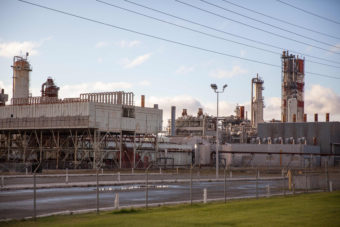
The sun sets over Agrium’s currently dormant fertilizer plant on Sept. 29, 2016 in Nikiski, Alaska. The company is working to get the permits it would need from the state were it to reopen the facility. (Photo by Rashah McChesney/Alaska's Energy Desk)
The sun sets over Agrium’s currently dormant fertilizer plant on Sept. 29, 2016, in Nikiski. The company is working to get the permits it would need from the state were it to reopen the facility. (Photo by Rashah McChesney/Alaska’s Energy Desk)

The Agrium natural gas-to-fertilizer plant in Nikiski has been taking steps to reopen. If it does, then it could add hundreds of high-paying jobs to the struggling Kenai Peninsula economy.

But that depends on a reliable natural gas supply, something that’s far from certain.

Mark Schaafsma worked in the maintenance department at the fertilizer plant in Nikiski for 32 years.

And he was one of the last ones to leave after Agrium announced it was decommissioning the plant in 2007. He said it wasn’t easy.

“I knew the plant was closing and that my career there was coming to an end, but when the day actually arrived, it took me by surprise how emotionally disruptive it was,” he said.

Agrium’s Nikiski plant used natural gas to create fertilizer products.

When it closed, it was the second largest producer of ammonia and urea in the U.S. Most of it was sold overseas to markets like South Korea, Mexico and Taiwan.  

Schaafsma found other work pretty quickly, but the plant’s closure shed hundreds of jobs from the Kenai Peninsula’s economy.

There’s a huge ripple effect,” he said. “Look what happens in the so-called rust belt in mid-America. A lot of little towns have practically dried up and blown away because of the loss of industry.” 

After the plant closed, rumors about it reopening started almost immediately.  

Now, the speculation is bolstered by news that Agrium is seeking a permit to discharge waste from its Nikiski plant.

In 2015, the company received air-quality and pollution permits for the plant.

All three permits would be required for the plant to reopen.

But, there are other barriers. It needs a large, steady supply of natural gas.

Agrium’s Manager of Government Relations Adam Diamond said the company has been in talks with Cook Inlet producers.

“We’re talking volumes that are large volumes. One half of the plant uses 80 million cubic feet of gas a day,” Diamond said.

But, there isn’t yet that volume of extra natural gas flowing out of any of the Cook Inlet reserves. Diamond said Cook Inlet’s natural gas discoveries in the last five years are what piqued the company’s interest in restarting the facility.

“There’s still, you know, ‘We believe there’s X amount of gas in the ground.’ But that’s very different than, there’s X amount of gas flowing through the pipeline,” Diamond said.

The company would also have to spend an estimated $200 million to reopen the facility.

To help the process along, House Speaker Mike Chenault, a Republican from the Kenai, ushered a bill through the last legislative session that would give the company a tax break if it uses gas from a state lease.

In its permit application, the company proposes reopening two of its four production lines and hiring about 140 people. If it can land a large enough natural gas supply, then it could add another 100 jobs.

For Chenault, whose district includes Nikiski, the plant could be a strong economic driver to the area’s battered economy.

“When they were running at their peak performance, they were employing about 400 employees,” Chenault said. “All of them good paying jobs. And all those were local jobs. There wasn’t a week on, week off or two weeks on, two weeks off schedule where you could live outside somewhere else and fly up here.” 

Those kinds of local jobs are important for industry workers who live in Cook Inlet.

Mark Schaafsma’s son, Andy Schaafsma, said a job with Agrium always appealed to him. 

Andy Schaafsma watches his dad talk about his time at Agrium's mothballed Nikiski fertilizer plant on Sept. 29, 2016 in Soldotna, Alaska. Schaafsma, a process technology graduate, says he'd like to work at the plant if it reopens. (Photo by Rashah McChesney/Alaska's Energy Desk)
Andy Schaafsma watches his dad talk about his time at Agrium’s mothballed Nikiski fertilizer plant on Sept. 29, 2016 in Soldotna. Schaafsma, a process technology graduate, said he’d like to work at the plant if it reopens.
(Photo by Rashah McChesney/Alaska’s Energy Desk)

Instead, he worked for two years as a roustabout. He’d spend a week at home with his wife in Soldotna, then a week at a remote production site on the other side of the Cook Inlet.

Both men said the pressure on families can be enormous when oilfield workers spend that much time away from home.

“Just the, flipping back and forth between being completely not there and then being there the entire time is, well it takes some getting used to,” Andy Schaafsma said.

Currently, Andy Schaafsma works brewing beer in Soldotna, but he said he wouldn’t pass up the right opportunity to work at Agrium.

Correction: An earlier version of this story misidentified the location where Andy Schaafsma worked as a roustabout.  He was at a production site on the west side of Cook Inlet, not a platform.

In Asia, Walker’s gasline team gets audience but no deals

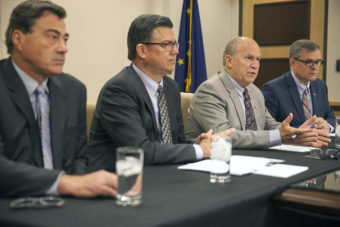
Alaska Gasline Development Corporation President Keith Meyer, Alaska Gov. Bill Walker and Department of Natural Resources Commissioner Andy Mack discuss meetings with potential buyers of Alaska’s LNG during a press conference on Friday Sept. 30, 2016 in Anchorage, Alaska. (Photo by Rashah McChesney)
Alaska Gasline Development Corp. President Keith Meyer, Alaska Gov. Bill Walker and Department of Natural Resources Commissioner Andy Mack discuss meetings with potential buyers of Alaska’s LNG during a press conference on Friday in Anchorage. (Photo by Rashah McChesney/Alaska’s Energy Desk)

Gov. Bill Walker and several of his energy advisers returned this week from a journey to Singapore and South Korea.

The trip comes as the state’s lead partners, ExxonMobil, BP and ConocoPhillips, are backing out of the Alaska LNG megaproject the state is preparing to take over.
Walker says over the last 10 days, his team had 20 meetings with ambassadors from Japan, Qatar, Singapore and others.

They’re working to raise awareness and market the $45 billion to $65 billion Alaska LNG project.

And, while they didn’t return with any firm commitments to buy into the project, Alaska Gasline Development Corp. President Keith Meyer said the team made progress.

“I would say we moved the ball quite a bit. Now we didn’t sign MOUs (memorandums of agreement) and we’re a little ways from that. What we’re doing now is raising awareness. Also correcting, as the governor indicated, correcting some misperceptions out there that the project had stopped. There were some bad headlines preceded us,” Meyer said.

As the state seeks buyers for North Slope natural gas, it must also continue with the regulatory process of permitting the massive project. And it’s unclear exactly how much that’s going to cost the state.

Meyer said the team is working on budget scenarios for different levels of activity, including further engineering work. Though, he says that work takes a lower priority to getting permits and finding funding for the project.

Walker said he confirmed in several meetings that it’s still possible to complete the project by 2025.

Walker and Meyer are aiming to get firm commitments and contracts from buyers within a year.

It’s unclear if the state will move into the next phase of the pipeline, which would require financing an estimated $2 billion in final engineering and design plans.

The state’s financial resources are strained with multibillion-dollar deficits and it’s unknown if the legislature would continue appropriating funds for the project.

But Walker said he thinks the legislature is just as focused on selling the state’s gas as his administration.

“Given our financial situation, some have said, ‘Can we really afford to do this?’” he said. “And I guess, I’d say, ‘Can we really afford not to do this?’”

Walker plans to be in Asia again in November to speak in Tokyo.

Fishermen, state, in flux after circuit court overturns state control of Cook Inlet salmon

United Cook Inlet Drift Association Vice-President Erik Huebsch talks about a court ruling in his commercial fishing organization’s favor on Sunday, Sept. 25, 2016 in Kasilof, Alaska. (Photo by Rashah McChesney/Alaska’s Energy Desk)
United Cook Inlet Drift Association Vice-President Erik Huebsch talks about a court ruling in his commercial fishing organization’s favor on Sunday in Kasilof. (Photo by Rashah McChesney/KTOO-Alaska’s Energy Desk)

In Cook Inlet, managing the salmon runs for commercial, sport and subsistence interests is so controversial, it’s often called a fish war.

A group of commercial fishermen who think the state is mismanaging the fisheries, have won the latest battle.

A three-judge panel at the U.S. Ninth Circuit Court of Appeals ruled last week that the area needs federal oversight. But no one knows exactly what that will mean.

The United Cook Inlet Drift Association and the Cook Inlet Fishermen’s Fund say that instead of addressing habitat problems or fighting invasive species that eat salmon in Cook Inlet – the state simply restricted commercial fishing.

So the fishing groups sued the National Marine Fisheries Service. They argued against a 2011 decision to remove several Alaska salmon fisheries — including Cook Inlet — from federal management and transfer the responsibility of managing salmon to the state.  A three-judge panel of the U.S. Ninth Circuit Court of Appeals agreed.

For commercial fishermen like Brian Harrison, in Homer, the court’s decision is a victory. But, he’s not sure what to expect going forward.

“I think we are as in the dark as anyone else. The layman drifters here in Homer. We are hopeful that this will be a place to start to help turn around this fishery and to manage this resource in a way that science tells us is the best way to manage it and not politicians,” Harrison said.

Harrison’s not the only one in the dark. Federal and state fisheries managers will have to work together on a new plan for how to manage the various fisheries.  But, no one is sure what that plan will look like.

“The United States has made it very clear they don’t want to manage salmon. The state has made it very clear that we don’t need the U.S. government to help us manage salmon,” said Alaska Department of Fish and Game commissioner Sam Cotten.

Fish and Game is responsible for day-to-day management of the state’s fisheries.  There is a federal fishery management plan for most of the state, but Cook Inlet, Prince William Sound and Alaska Peninsula salmon fisheries are specifically excluded from that plan. 

Now that a new plan has to be written to include Cook Inlet, it’s not even clear which fishermen are going to be covered under it.

Typically federally fishery management plans don’t include sport or personal use fishing. But because salmon spend their lives in rivers and in the oceans, federal oversight could expand to include them both.  

Cotten said, he doesn’t know which groups will be covered under a new plan.  

“There’s a lot of unanswered questions before we even get to the design of a management plan,” he said.

He said, the National Marine Fisheries Service, or the state, could appeal. 

He doesn’t think there will be a new management plan in place in time for next summer’s fishing season. And, it’s not clear if the ruling allows the state to continue managing the fisheries without a federal plan.

“We do not want to have any areas closed. Most of the area that the people drift in, is federal waters,” Cotten said.

Erik Huebsch, Vice President of the United Cook Inlet Drift Association,  said his group wants to see the state continue to manage the fisheries — but under federal guidelines.

No matter what’s next, Huebsch said he thinks federal oversight will simplify salmon management and that might help calm Cook Inlet’s fish wars.

“It’ll level the playing field, everyone will have the same set of rules to play by. I think that will go a long way to calming some of the angst and some of the contention that goes on over resource management in this area,” he said.

Federal fisheries regulators said developing a new plan could take years. 

Alaskans weigh in on this year’s smaller dividend check

Anchorage Permanent Fund Dividend Office 2016 03 14
Alaskans file their Permanent Fund dividend applications in downtown Anchorage in March 2016. (Photo by Rachel Waldholz/Alaska Public Media)

It’s PFD announcement day in Alaska — but it’s a little less exciting than usual. That’s because this year, for the first time in the program’s history, it’s been cut.

Gov. Bill Walker announced in a pre-recorded video on Friday exactly how much Alaskans would receive in this year’s Permanent Fund Dividend check: $1,022.

This year’s dividend checks could have been about twice as much, but Walker vetoed half the money appropriated to dividends earlier this year while the state battles a $4 billion deficit.

On Thursday, Alaska’s Energy Desk asked Alaskans how they felt about this year’s smaller dividends. Some people already knew to expect a change.
MCCHESNEY: Do you know how much the PFD is this year?

Benji Neice, of Juneau: What it should be, tomorrow, should be about $1500.

Katrina Dennis, of Juneau: My guess is maybe about, $1200.

Daryl Shaw, of Anchorage: I know it’s not what it should be.

Back in July, Gov. Bill Walker’s veto capped the dividend at about $1,000. Without the veto, there would have been about $1.4 billion available for dividends.

“That number would equal a little bit over $2,000 per Alaskan,” said Ken Alper, director of the Alaska Department of Revenue’s Tax Division.

Alper and Walker argue that with the current budget crunch, the state couldn’t afford that amount. 

As oil prices have crashed over the last two years, the state has covered billions in budget deficits by drawing from its savings accounts. If lawmakers continue on their current path, they’ll burn through the state’s primary savings account in about two years. Then they’ll have to use the account the dividends come out of. Right now that account has about $7 billion in it. At current spending levels it will be drained in a few years as well. Then there wouldn’t be money for the budget or dividends.  

“That could go away in another couple of years and when the governor talks about, in 2020, the dividend would go away unless there’s a fiscal plan, that’s just not an idle threat, it’s a mathematical fact,” said Alper.

Alper and Walker want lawmakers to restructure the permanent fund and pass a combination of taxes and spending cuts to balance the budget. And in the meantime, they say we shouldn’t spend the nearly $700 million it would have taken to give everyone in the state $2,000 checks this year.

For now, that money is just staying in the account.

“It’s not going anywhere, it remains in the earnings reserve, it continues to be invested and it’s going to be producing income for future generations,” said Alper.

A lot of people aren’t happy with the idea that Walker is messing with the Permanent Fund.  One lawmaker sued. For a lot of Alaskans, that fund is inviolate.

That includes Anchorage resident Daryl Shaw, who was born in Alaska. His daughter was born just in time for the first dividend check in 1982. He says when the fund was started, it was supposed to be untouchable.

“I’m not the sharpest tool in the shed and I’m not a politician, but I’m an Alaskan and I just don’t think it’s right for Gov. Walker to actually reach into that fund and be able to even touch it in any way shape or form,” said Shaw.

But the amount of this year’s dividend isn’t uncommon. In fact, if you take an average over the last 33 years, it’s just under $1,100.

We talked to Alaskans in Anchorage, Juneau and Unalaska, and a surprising number said that $1,000 is good enough for them.

John Bosh, of Juneau: That’s fine, you know. It’s better than taxing me.

Suzi Golodoff, of Unalaska: If you’re on a fixed income, it makes a difference. Yeah you count on it, you do. But I guess I’m thinking that $1,000 is a pretty fair cap.

Keith Hermann, of Juneau: I always joke that people call it the permanent dividend funds thinking that the dividends are what’s permanent. The dividends are not permanent, they’re very temporary. They’re a way of getting the public to support the necessity of saving money for the future.

It’s likely that one way or another, the future means smaller dividends.

In latest high-profile resignation, head of state’s oil and gas division quits

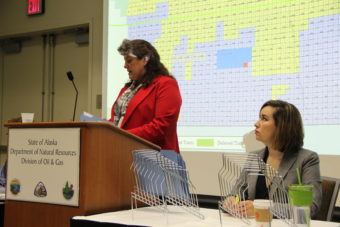
Corri Feige of DNR’s Division of Oil and Gas reads out bids during the state’s annual North Slope lease sale. (Photo: Rachel Waldholz/Alaska's Energy Desk)
Corri Feige of DNR’s Division of Oil and Gas reads out bids during the state’s annual North Slope lease sale. Feige is resigning from her position as the state’s top oil and gas regulator. (Photo: Rachel Waldholz/Alaska’s Energy Desk)


The state’s top oil and gas regulator is stepping down.

Corri Feige emailed colleagues on Tuesday saying her last day is Oct. 3.

“This decision has been incredibly difficult for me, but opportunity rarely knocks at convenient times and in this instance, I have got to answer that knock!,” Feige wrote.

She also said the move would reduce her daily commute and allow her to spend more time with family.

Feige, whose division is a subset of the state’s Department of Natural Resources, didn’t return a message seeking comment.  But spokesperson Diane Hunt said Feige was busy and wouldn’t be available to talk about her decision for the “next few days.”

Feige has been the face of an ongoing fight between the state and the oil companies that control Prudhoe Bay, over the companies’ plans for marketing natural gas from the North Slope.

The state is taking the lead role in a massive project designed to move natural gas from the North Slope to Asian markets. And Feige’s division wants more specific information from the companies on how they plan to make the gas available.

The companies have argued they either don’t have that information or can’t legally share it.

It’s the latest in a series of high profile officials leaving Governor Bill Walker’s oil and gas team. Former Department of Natural Resources Commissioner Mark Myers retired in February, followed by acting commissioner Marty Rutherford, who resigned in June.  


Pipeline Promises: Alaska’s quest for a natural gas line

For more than 40 years, the state has tried, and failed, to bring natural gas from Alaska’s North Slope to market.

In all, there have been at least 10 different versions of the pipeline mega-project. And not one has come close to breaking ground.

This week, Alaska’s Energy Desk is examining some of the reasons why the state has struck out.

Check out the five-part series below:


PART I

Video: Forty years of Alaska’s failed gas line plans

PART II

Gas Line: A love story

PART III

Man on a mission: Gov. Walker and the gas line

PART IV

The man with the plan: Can Keith Meyer sell the gas line?

PART V

Meet the skeptics: Questions surround Walker’s gas line plan

Site notifications
Update notification options
Subscribe to notifications