Rashah McChesney

Daily News Editor

I help the newsroom establish daily news priorities and do hands-on editing to ensure a steady stream of breaking and enterprise news for a local and regional audience.
In Bethel House race, candidates question Democratic cred

If you had to put the two Bethel House candidates somewhere on the political spectrum, they’d both be Democrats. But, maybe with a lowercase “d.”

Each accuses the other of not being Democratic enough.

House District 38 has one of the highest population of voters registered as Democrat. The district encompasses Bethel, the lower Kuskokwim River and several coastal villages.

With no Republican challenger, the race will be decided in the Aug. 16 primary.

Incumbent Bob Herron is running for his fifth term in the legislature. He said he’s been registered as a Democrat since the 1970s, but he votes with the Republican-controlled majority in the House. He’s even joined the Republican leadership team.

Party affiliation doesn’t mean as much in rural parts of the state as it does in urban areas, Herron said.

“When you live in Western Alaska, people vote for the person, not necessarily the party,” he said.

But, his party has had enough.

Democrats are hoping to build a bipartisan coalition in the House, and they see District 38 as key to that effort.

In an unusual move, state Democrats have thrown their support behind a challenger, Zach Fansler, who wasn’t previously registered as a Democrat. Fansler changed his party affiliation the day he filed to be a candidate.

He was either non-partisan or undeclared, though he said he doesn’t remember which.

Fansler’s liberal values align with the Democratic platform — and better reflect the district, he said.

“I’ve always been the person that has been kind of independent,” he said. “It always worried me when we see the exact situation that’s played out. You join a caucus and all of the sudden you are forced to do what they want you to do.”

The district includes more than 30 far-flung communities, from Nunivak Island in the Bering Sea to Russian Mission on the Yukon River and the regional hub, Bethel.

The district has some major challenges.

It’s among the poorest in the state and its schools are some of the lowest performing on the state’s annual exams.

For example, fewer than 10 percent of the Lower Kuskokwim School District students meet state standards for reading and math, according to the state department of education and early development.

In the Bethel census area nearly a quarter of the population lives in poverty, according to the United States Census Bureau.

Herron has a long history in the region. A former Marine, he served as Bethel’s city manager and was a legislative aide for more than a decade.  He also owned Bethel Cablevision and currently owns Golden Eagle LLC, a school bus transportation company.

The best way to represent the district is to join the Majority, Herron said.

“Historically, rural legislators joined whatever majority is, Democratic-led or Republican-led. By joining it you have a better chance of protecting your constituents,” Herron said.

Communities in Herron’s district have seen more than $600 million in capital project funds during his time as a legislator, he said. Programs like power cost equalization would have been harder to defend outside of the majority.

Herron has put the caucus above his district, Fansler said. As a member of the Majority, Herron is  required to  vote with House leadership on the budget, which means opposing amendments from Democrats to restore funding to programs that could benefit his district.

Fansler is a math teacher at the University of Alaska-Fairbanks, an attorney and a former race manager for the Kuskokwim300 sled dog race. He’s currently a city council member in Bethel and works as the development director at Bethel’s public radio station, KYUK.

If elected, Fansler said, then he’ll vote differently, particularly when it comes to what gets cut during tough fiscal times.

“One, I won’t be in the Republican majority,” he said. “So, anytime there’s an amendment that comes forward that said ‘hey, let’s restore funding to Head Start.’ My vote would be yes, let’s do that. Not no, which is what the incumbent did. If there’s a restoration of funding to VPSO programs or to Trooper dispatches, my vote’s going to be yes, not no.”

Fansler will vote to keep money in the state’s revenue sharing program, which helps communities fund basic services, he said.

“If there’s a vote to have other revenue streams. My vote’s going to be yes, not no. Conversely, when it comes to oil tax credits, I’m not going to vote no time and time and time again to rolling those back,” he said.

Fansler is targeting one vote in particular: Herron supported the Legislature’s lawsuit challenging Gov. Bill Walker’s decision to expand Medicaid, which offers health insurance to low income Alaskans.

That vote wasn’t about rejecting the expansion, Herron said. It was about what he considers an overreach of the governor’s power.

The two candidates do agree on some things.

Both say Walker’s budget veto that capped Permanent Fund Dividend checks at $1,000 this year will have a disproportionate impact on the state’s rural residents.

Both are opposed to a statewide sales tax, but say an income tax would spread the burden of paying for state government more evenly.

State responds to two oil spills at Drift River in Cook Inlet

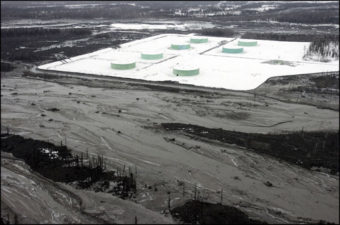
(Courtesy Photo/Peninsula Clarion) State regulators are monitoring two small spills at the Drift River Terminal Facility show here on March 24, 2009 where it sits about 22 miles from the summit of the Mount Redoubt volcano on the west side of Cook Inlet. The facility is operated by Hilcorp Alaska's Cook Inlet Pipe Line Company.
State regulators are monitoring two small spills at the Drift River Terminal Facility shown here on March 24, 2009, where it sits about 22 miles from the summit of the Mount Redoubt volcano on the west side of Cook Inlet. The facility is operated by Hilcorp Alaska’s Cook Inlet Pipe Line Company. (Photo courtesy Peninsula Clarion)

State regulators are monitoring the cleanup of two small oil spills at a storage site  on the west side of Cook Inlet.

The spills were discovered at the Drift River Terminal Facility, which is owned by the Cook Inlet Pipeline Company, a subsidiary of Hilcorp Alaska. 

Young Ha, of the Alaska Department of Environmental Conservation, says the spills were found after the company began emptying two tanks for a once-a-decade inspection in late June.

Operators mistakenly transferred the oil through a fill line, into the wrong tank.

“Apparently in the past, no one knew that it was actually going into the 20-inch fill line and I guess all this time it was but no one caught that over, it looks like, several decades,” she said.

The company then shut down the tank the oil was being pumped into, without realizing the line still had oil moving through it.

After discovering the problem, operators shut down the line. Then, Ha says they went looking for leaks.

In early July,  inspectors found 14 gallons of crude pooled inside a valve box. Then, last week, they found an oil stain covering about 280 square feet of ground.

The company estimates about 28 gallons of oil contaminated the ground, but Ha said that could change.

“You have to really dig it up, dig up the soil. It could be more, it could be less,” she said.

Ha says, so far, there isn’t any evidence that the nearby Drift River was contaminated, or that any wildlife was affected.

Hilcorp bought the facility, and the company from Chevron in 2011. No one from the Cook Inlet Pipeline Company or Hilcorp returned calls on Wednesday. 

The company reported that it has already cleaned up the oil from the first spill. Ha says that it will have to dig up and dispose of the contaminated soil found from the second leak.

So far, she says, there isn’t any evidence that the nearby Drift River was contaminated, or that any wildlife was affected.

But, ADEC inspectors will be monitoring the cleanup process and testing on the line to ensure there are no further spills.

Federal, state researchers map Alaska’s geochemical atlas of rocks and minerals

Geochemical Atlas
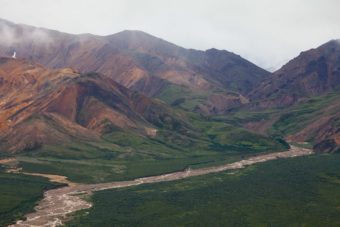
The colorful Polychrome Mountains emerge from the clouds on July 22, 2016, in Denali National Park. The mountains get their color from volcanic rock. The U.S. Geological Survey released the first updated geochemical atlas of Alaska in nearly 40 years. (Photo by Rashah McChesney/KTOO)


What’s in the dirt in Alaska?

Federal and state researchers teamed up to make it easier for everyone to find out. For the first time in nearly 40 years, Alaska has an updated atlas of the chemical composition of its earth, rocks and minerals.

The updated geochemical atlas was an outgrowth of another project. Geologists and surveyors were on a mission to find rare earth elements and minerals that could be strategically important to the country.
Melanie Werdon is the acting chief of the mineral resources section of the Alaska Division of Geological and Geophysical Surveys and one of the geological scientists who teamed up with the U.S. Geological Survey, or USGS, to investigate the state’s minerals.

“China was restricting the exports of rare earth elements and they were a large source of that worldwide and it caused an awareness that the United States needs to know more about all of the strategic minerals and metals that it is heavily reliant on for imports,” she said.

That national survey of critical minerals isn’t done yet, but the newly updated geochemical atlas of Alaska was released in June.

The atlas helps determine which parts of the state can be used for metals or mineral production; where the state’s geothermal resources are; and potential geologic hazards to buildings, roads and bridges.

One biologist talked to Werdon about how geochemistry could inform his wildlife research in the northern part of the state.

“He was interested in studying why there were some deformities in moose up there and one of the ideas he had was to look at the chemistry of the area. Look at the alders and see if they had elevated cadmium levels and then tried to correlate that with rocks and moose habitat for eating willows.”

A lot has changed since the last time geologists made a comprehensive map of the state.

Jeff Mauk, a research geologist at the USGS in Denver and one of the authors of the atlas says testing of the soil samples has become more complex.

For example, 50 years ago, labs were well-equipped to test for elements like copper. Now, batteries, cellphones, and laptops require soft metals that were previously unknown.

“Praseodymium, gadolinium, neodymium, those are used in smartphones, for things like speakers and microphones. We weren’t even analyzing for those 50 years ago. We just don’t know about their distribution in the Earth’s crust in Alaska.”

The new atlas isn’t exactly a tell-all book about where to go in Alaska to find things like platinum or gold.

Rather, it maps the distribution of 68 elements that can be found across the state and indicates the mineral resource potential in Alaska.

The atlas also isn’t a comprehensive look at the state’s geology. Mauk says in some areas, it’s difficult to gather reliable data.

“It’s mostly around the Yukon Delta where there’s simply no rocks at or near the surface and because of that there just aren’t a lot of geochemical samples there. Even if there were, it’d be very difficult to interpret, because they really aren’t sampling bedrock. They’re just sampling stuff that’s been washed in from huge distances.”

Mauk says there will be lots of opportunity for researchers to use the maps as a launching point to dig deeper into the dirt.

EPA fines BP, Hilcorp for spills on the North Slope

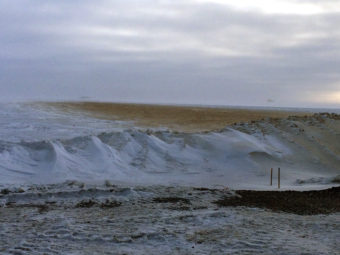
Contaminated snow-covered tundra on April 29, 2014 from a BP Exploration Alaska spill in Prudoe Bay, Alaska. (Photo/ADEC)
Contaminated snow-covered tundra on April 29, 2014, from a BP Exploration Alaska spill in Prudoe Bay. The EPA fined the company $30,000 for the spill, the state of Alaska fined it an additional $100,000. (Photo courtesy ADEC)

BP Exploration Alaska and Hilcorp Alaska have agreed to pay fines after spilling oil and waste on the North Slope.

The Environmental Protection Agency announced the companies will pay $130,000 in federal penalties.

According to the EPA, the Clean Water Act violations by both companies affected Arctic wetlands that support wildlife like caribou, ptarmigan and geese.
EPA spokesman Mark MacIntyre said the North Slope is one of the harshest environments where companies operate in Alaska. It’s also one of the most ecologically sensitive.

“We know that the tundra is kind of like a big sponge and is completely overlaying water that drains off and runs to various tributaries to rivers and then rivers to the sea,” he said.

Hilcorp had a breach in a production line in its Milne Point field. The leaky pipeline caused nearly 10,000 gallons of crude oil and water to spill onto about an acre of land. The company will pay $100,000 to the EPA.

Piping showing oil from the BP spill in Prudhoe Bay on May 2, 2014 in Alaska. (Photo/John Ebel-ADEC)
Piping showing oil from the BP Exploration Alaska spill on May 2, 2014, in Prudhoe Bay. (Photo by John Ebel/ADEC)

BP will pay $30,000 in federal penalties for spilling 700 gallons of waste onto 33 acres of tundra and gravel pad. That spill was caused by a frozen rupture in one of the company’s lines in Prudhoe Bay.

MacIntyre said spill cleanup on the North Slope can be complicated by winter weather. Hilcorp response crews had to struggle through blizzard conditions while BP workers had to remove acres of contaminated snow.

“A lot of times, frankly these spills happen at the worst time of the year, when it’s the coldest, when it’s the darkest, when (it) really puts people at risk in terms of responding and trying to fix things when they spill,” MacIntyre said. “So it’s really in nobody’s interest to have anything spill.”

Neither company agreed to interviews about the incidents. Both sent prepared statements.

Hilcorp spokeswoman Lori Nelson said it is proud of its response to the spill and inspected other similar pipeline sections as a result of the incident. While BP spokeswoman Dawn Patience said the company has worked to strengthen safety and risk management.

EPA relies on the companies to report spills. After the agency notifies a company it is considering a fine, MacIntyre says the companies can weigh-in.

“They come in and negotiate with us and we end up with a final penalty,” he said.

Each case is resolved differently. Sometimes the money goes to the state, sometimes to the federal government. In BP’s case, the company will pay $30,000 in penalties directly to a federal fund that is used to pay for cleanup when spills occur and the responsible party is either unknown, or refuses to pay.

BP also settled its case with the Alaska Department of Environmental Conservation after its spill. It will pay the state $100,000.

Hilcorp could still face further fines from its Milne Point spill. A spokeswoman from DEC said the state is investigating the incident and its case is still open.

Both companies have reported dozens of spills in Alaska since 2014, but most of the discharges are minute amounts of fuel or oilfield chemicals.

Former commissioners, lawmakers criticize Walker’s oil tax credit veto

Lt. Gov. Byron Mallott & Gov. Bill Walker - budget vetoes
Gov. Bill Walker announces line-item budget vetoes at the Atwood Building on June 29, 2016, in Anchorage. Lt. Gov. Byron Mallott is also pictured. (Photo by Rachel Waldholz/Alaska’s Energy Desk)

Two former commissioners and several lawmakers are criticizing Gov. Bill Walker’s decision to veto more than $430 million from the state’s budget. The money would have gone to pay tax credits to oil companies.

Former Department of Revenue Commissioner Patrick Galvin and former acting commissioner of the Department of Natural Resources, Marty Rutherford, are encouraging state lawmakers to override Gov. Bill Walker’s budget veto that would delay hundreds of millions in oil tax credit payments to companies.

They say Walker’s decision destroys the state’s credibility with the industry it depends on to develop oil and gas resources.

“What seems to have developed in this particular moment is the governor having to kind of take hostages in order to get the legislature to act on what he wants them to act on with regard to a fiscal plan,” Galvin said.

He’s currently the chief commercial officer for Great Bear Petroleum, one of the independent producers that’s waiting on those payments the state is putting off.

Deputy Commissioner of the Dept. of Natural Resources, Marty Rutherford, gives an overview of the Alaska Liquefied Natural Gas Project in House Finance, Feb. 23, 2016. (Photo by Skip Gray/360 North)
Former Deputy Commissioner of the Dept. of Natural Resources, Marty Rutherford, gives an overview of the Alaska Liquefied Natural Gas Project in House Finance, Feb. 23, 2016. Rutherford and a former revenue commissioner weighed-in on Gov. Bill Walker’s budget veto of oil tax credit payments. (Photo by Skip Gray/360 North)

Galvin and Rutherford, wrote an editorial in the Alaska Dispatch News saying the state’s refusal to pay its tax credit bill could have a chilling effect on development.

The governor’s veto will be felt not just by companies like Great Bear, Galvin said, but by all of the businesses that support the oil and gas industry in the state.

“It has an impact down the chain for all of the business that company wanted to do and they were expecting to get these payments and now they’re basically stuck waiting to see when the state will ultimately pay its bill,” he said.

Rutherford has not returned repeated calls seeking comment since she stepped down as acting DNR commissioner in late June.

Lawmakers have also pushed back against Walker’s veto. Members of the Senate Finance Committee grilled tax division director Ken Alper on the veto during a special session meeting in Anchorage on Wednesday.

Alper told legislators that the governor’s decision to veto the credits is necessary without a comprehensive fiscal plan to bring the state out of its budget hole.

“In the absence of that, suddenly the governor’s larger concern is, how are we going to keep the lights on two or three years from now? We’re on a path to deplete the constitutional budget reserves a year from now,” he said.

Alper’s explanation, and his presentation on the hundreds of millions in deferred credits that will hang over the state in future budget years, drew the ire of Fairbanks Republican Sen. Pete Kelly.

trans alaska pipeline taps 2010
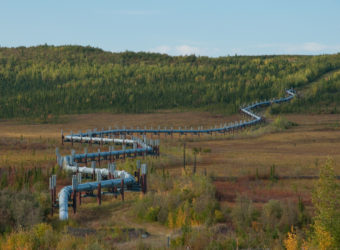
The Trans-Alaska pipeline along the Dalton Highway in August 2010. (Creative Commons photo by Timothy Widley)

“Yeah Ken, what you’ve done, it appears to me, is you’ve put together a slide that essentially cries out, ‘Help. Stop me before I make another irrational veto.’ Because as Sen. MacKinnon said, you created a problem and now you’re saying that somehow the problem — that the governor created with the veto — that we have to make a complete fix, or a complete change to our oil taxing regime rather than just have him start acting a little more savvy,” Kelly said.

The state House invited the Senate to meet Friday to discuss voting to override the tax credit veto and the more than $1 billion Walker stripped from the budget. That includes a $1,000 per-person reduction to Permanent Fund dividends this year.

Senate President Kevin Meyer told the Juneau Empire late Thursday that they would not accept the invitation.

As energy prices drop, Alaska’s inflation rate follows

Richard Carrillo, of Juneau, gases up his suburban on July 7, 2016, in Juneau, Alaska. State economists said low energy prices caused a slower growth of inflation in Alaska last year. (Photo by Rashah McChesney/KTOO)
Richard Carrillo of Juneau gases up his suburban on July 7 in Juneau. State economists said low energy prices caused a slower growth of inflation in Alaska last year. (Photo by Rashah McChesney/KTOO)

As oil prices have dropped and the state has struggled to pay its bills, Alaskans saw one benefit. The cost of living in Anchorage increased by the smallest amount in nearly three decades.

At a Tesoro near downtown Juneau, Tim Young makes a quick stop to put a few dollars’ worth of gas in his SUV.  When he pays less to fills up his tank, he said it’s easier to afford other essentials, like food and rent.

“When it goes down, it helps tremendously,” Young said.

The price on this day: $2.78. 

Damien Thorne pulls up in Jeep Liberty, which he describes as getting less than stellar gas mileage.

“I gotta fill it up at least two times a week and spending about 50 bucks every time,” he said.

When gas prices dropped, Thorne said he and his wife noticed the extra money in their monthly budget. But, he’s not sure he’d trade higher energy prices and a balanced state budget, for the money he saves when gas is cheap.

“I would just rather just have just regular gas prices, you know?” he said.

Thorne, who’s spent time living in Ohio, said a regular gas price for him is $1.65 a gallon. 

Still, Thorne said a high price at the pump wouldn’t stop him from buying gas, just like the high cost of living in Alaska wouldn’t stop him from living in Juneau.

“It’s gas, so we need it. I’m going to get it if it’s $4 a gallon, ‘cause I got to get around. So it’s just, yeah, supply and demand,” he said.

Alyssa Rodrigues is an economist with the state’s Department of Labor.

She said the average cost of living — that’s the amount of money it takes for Alaskans to buy milk, put fuel in their cars and pay rent or for healthcare — still went up last year. But that increase was slowed significantly by a 10 percent decline in energy prices in Anchorage 2015.

“Because, energy factors into other things that we spend our money on and one big piece is transportation, it brought the price of transportation down and we spend a lot of our income on transportation,” Rodrigues said.

Anchorage is the only city in the state where inflation is measured. Last year, Anchorage’s inflation rate went up half a percent, according to Department of Labor data. That’s the lowest recorded increase in 27 years.

This isn’t the first time that energy prices have dropped. Rodrigues says they’ve been dropping for the last four years – though last year’s was the largest drop in nearly a decade.

And, in Alaska’s off-the-road system communities, energy costs dropped, but they’re still extreme.

“It might have one effect on Anchorage but when you look at a place like Arctic Village or something  that has to have all of their fuel flown in, obviously that cost is going to be magnified because you have additional costs for the fuel just to get the fuel to you,” Rodrigues said.

In Arctic Village, residents are paying $10 a gallon at the pump.

Clarification: Where Damien Thorne is from has been clarified. He spent time living in Ohio, but is from Juneau. 

Site notifications
Update notification options
Subscribe to notifications