Rashah McChesney

Daily News Editor

I help the newsroom establish daily news priorities and do hands-on editing to ensure a steady stream of breaking and enterprise news for a local and regional audience.

Walker’s trade mission highlights links to China, opportunities for Alaskans

Alaska Gov. Bill Walker peeks out for a photo after a group signs an agreement to study a partnership between China and Alaska to build a gas pipeline megaproject on Nov. 9, 2017, in Beijing, China. (Photo courtesy Alaska Governor’s Office)

This week, more than 40 Alaskans are traveling to China to talk trade.

From seafood companies to the Alaska Gasline Development Corporation and even a brewery — the group is hoping to spotlight shared interests between China and Alaska.

At the 49th State brewpub in downtown Anchorage on Tuesday, about 30 people gathered in a private room to talk about the trip, and how they’re going to woo Alaska’s largest trading partner into developing deeper ties with the state.

Representatives from more than 20 businesses, along with state officials and politicians will leave for China this weekend. There, they’ll peddle everything from baby food to seafood to tourism to Chinese consumers.

49th State Brewing Co. owners David McCarthy and Jason Motyka at their Anchorage brewpub on May 15, 2018, in Anchorage, Alaska. McCathy and Motyka are headed to China with a trade delegation, seeking to bring Alaska beer to Chinese stores. (Photo by Elizabeth Harball/Alaska’s Energy Desk)

They’ll also bring beer.

David McCarthy co-owns Denali Visions 3000, the corporation that owns the 49th State Brewing Co.  He is hoping to expand the brewery’s reach and get Alaska beers into Chinese hands.   

“So when we had a meeting the other day in the governor’s office with the entire group… there’s seafood companies that are going there presenting seafood and we said ‘oh, can we match up our beer?’ But how do we get it there?” McCarthy said. “So they’ve been working hand-in-hand actually to get our beer over to China to have there available for people to try as part of these events over there. So, obviously we’re extremely excited about it.”

It isn’t all just food and travel. Two potentially major infrastructure projects are also hoping to find access to oil and gas markets in China.

One is the state’s gasline development corporation.  The other is the A2A Railway Development Corporation. They’re trying to link Canada and Alaska by rail in order to bring Canadian oil sands, and potentially minerals from the Yukon to ports in Alaska — then ship them to Asia.

“From the point of view of the Asian business community, this is a great opportunity to achieve access to raw materials out of the north of Canada and Alaska,” said Peter Wallis who handles public affairs for the railway corporation.

The delegation will travel throughout China for the 10-day trip with stops in Shanghai, Beijing and Chengdu.

Walker’s oil & gas advisor leaves for job at NANA

John Hendrix started work as Gov. Bill Walker's chief oil and gas adviser in July 2016. Photo: Rachel Waldholz, Alaska's Energy Desk
John Hendrix started work as Gov. Bill Walker’s chief oil and gas adviser in July 2016. Photo: Rachel Waldholz / Alaska’s Energy Desk

Gov. Bill Walker’s chief oil and gas advisor has taken a new job.

Later this month, John Hendrix will join the NANA Regional Corporation as the president of its commercial group.  That group includes subsidiaries that do oil field and mining support services, as well as construction and capital projects. 

Hendrix has been in Walker’s cabinet for nearly two years.  When he was hired in 2016 for the $185,000 a year position, his focus was on figuring out how Alaska can produce more oil.

In a media release, Walker’s office congratulated Hendrix on the new position and said  he’ll continue working on projects with the Office of the Governor.

State corporation announces tentative deal with BP to buy gas for Alaska LNG project

Updated at 4:30 p.m. 

Alaska is one step closer to getting a gas supply for its massive natural gas pipeline project.

The Alaska Gasline Development Corporation announced on May 7 that it settled on the terms of a gas sales agreement with BP Alaska.  

The final agreement hasn’t been signed yet. But corporation President Keith Meyer said the key terms — that is, the volume of the gas and how much it will cost — have been figured out.

BP owns more than a quarter share of Prudhoe Bay and about one-third of the nearby Pt. Thomson field.

Meyer said the company has committed to selling all of the gas it can produce from those fields, but that won’t fill the pipeline.

The state corporation will need gas supply agreements with all of the North Slope producers for the project to run at full capacity.

What this agreement could do is help the project get financing this year. Meyer said he sees the gas supply agreements as a key piece in that process.  

“So now that we’ve got the the supply pieces falling into place now that lets us get a lot more clarity on the financing piece which is also underway. But that’ll take really through the balance of this year,” Meyer said.

This agreement is one of many the state corporation is negotiating right now. It is on a tight timeline to get them done in time to meet peak gas demand in 2025.

The state corporation must get final agreements to buy gas from producers, line up buyers and secure the federal and state permits to build the $45 billion project.  

Original story

Alaska is one step closer to getting a gas supply for its massive natural gas pipeline project.

The Alaska Gasline Development Corporation announced on May 7 that it had agreed on the terms of a gas sales agreement with BP Alaska.  According to a media release from the state corporation, the two have not finalized that long-term gas sales agreement, but they expect to do it this year.

BP owns more than a quarter share of Prudhoe Bay and about one-third of the nearby Pt. Thomson field. But, it is not clear how much gas BP has committed to selling to the state-led project.

This agreement is one of many the state corporation is negotiating right now. It is on a tight timeline to get them done in time to meet peak gas demand in 2025.

The state corporation must get final agreements to buy gas from producers, line up buyers and secure the federal and state permits to build the $45 billion project.  


Oil prices are up, but how long will it last?

conocopipeline_Harball
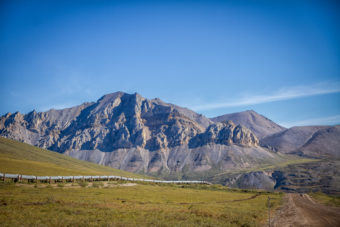
Pipelines stretch toward the horizon on NPR-A land leased by ConocoPhillips. The company announced it’s found 300 million barrels of recoverable oil nearby. (Photo by Elizabeth Harball/Alaska’s Energy Desk)


Oil prices are up again.

Alaska North Slope crude jumped above $70 per barrel two weeks ago and has stayed above that mark.  While that’s several dollars higher than state economists predicted, it doesn’t quite fill the hole in the state’s budget — and, it doesn’t mean oil prices are going to stay up.
Still, when oil prices inch up it adds up fast for the state.

“Once you’re in the $70s you’re getting maybe $80 million dollars or so of additional revenue for each dollar of oil price increase,” said Alaska Department of Revenue Chief Economist Dan Stickel.

Each year, his department puts out a forecast for the price-per-barrel of oil.  Right now, prices are well above the $63-per-barrel price state economists predicted for the next fiscal year.

But, in Juneau, lawmakers are still leaning toward balancing the budget using money from Permanent Fund earnings.

That’s because, prices are still well below the $91 dollars Stickel said the state would need to fill the $2.5 billion hole in the state’s budget.

If the legislature does decide to draw from the Permanent Fund earnings, Stickel said it would take about $72 dollars per barrel to balance the budget.

“So right around current prices, ” he said.

But the effect oil prices have on Alaska’s economy is much broader than just the impact to state spending.

Institute of Social and Economic Research economist Mouhcine Guettabi said another pressing question is how the uptick in prices could affect jobs and capital spending in the private sector — that is, money that companies spend on property or equipment or to take on new projects.

Nobody knows the answer to that,” Guettabi said. “I think what we can say is … firms have adjusted to lower levels of employment and so how quickly will they ramp up in terms of adding employees is the really million dollar question.”

Alaska is in a recession. What what will it take for companies to start hiring again, to pump more money into local economies?

That is not a simple question to answer. Oil development economics are dramatically different between fields. It’s not as simple as producers turning the spigot on and off whenever the math works out in their favor.

Glacier Oil and Gas Chief Executive Officer Carl Giesler has some insight.  Glacier is a smaller, independent oil & gas company in the state – so its economics aren’t necessarily the same as those of ConocoPhilllips or BP.  

But Giesler said there are some fundamentals to the relationship between oil prices and companies investing in Alaska.

To get an idea of why companies haven’t rushed to hire more workers or bring more fields online, Giesler said it’s helpful to look at oil futures.  Basically, oil futures are contracts that allow traders to buy and sell oil that will be delivered months or years later.

This becomes kind of a prediction for what the price of oil could be.

“The punchline is that even though oil prices are up meaningfully over the last three months or so, people are still cautious,” Giesler said.   

One reason they’re cautious is that the oil market has shifted into backwardation — basically the future price is less than the current price. 

“That backwardation is the one thing that’s giving a lot of companies pause before they really start ramping up drilling, before they really start ramping up hiring. Before they sort of jump in with both feet,” Giesler said.

Still, he said the jump in oil prices is good news. 

“I mean, holy cow we’re above $70, we’re almost at $75 right? You know, fire the gun, lets start running. But, you know, if you look at the futures, you don’t want to run that fast because you know it’s going to be a long race, potentially.”


Undead Arctic microbes feel the heat, unleash disease

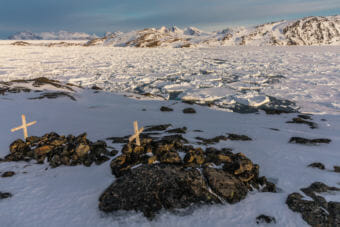
Graves under stones on a small hill near Kulusuk, Greenland. (Photo courtesy Markus Trienke)
Graves under stones on top of permafrost, on a small hill near Kulusuk, Greenland. (Creative Commons photo by Markus Trienke)

For hundreds of years, animals and people have been buried in the frozen ground in the Arctic. Now, that permafrost is thawing and it’s exposing those bodies, and whatever killed them, to the outside world.

Michael Bruce is a public health physician and medical epidemiologist based at the Centers for Disease Control and Prevention in Anchorage. He told a crowd last week at the Bear Tooth Theater in Anchorage that infectious diseases are a growing threat throughout the Arctic.

“I think Louis Pasteur was right when he said “it’s the microbes that will have the last word,” Bruce said. “Or is it, it’s the zombies that will have the last word?”

Bruce spoke at length about the zombie apocalypse that could be happening in the Arctic. But, it turns out he didn’t mean the “shuffling around, eating brains, making zombie noises” kind of apocalypse.

“I think my analogy to zombies was more the ability of infectious diseases to come in and wreak havoc on populations and the planet,” he said. “Not so much, reviving dead bodies to come back to life.”

Still, there are some very real threats locked up in all of that ice and frozen permafrost.

In Russia, for example, an anthrax outbreak two years ago killed one 12-year-old boy and sickened dozens of other people.

That outbreak has been linked to the region’s reindeer herds and melting permafrost.  

“What happened is reindeer herders in the Yamal Peninsula were grazing their reindeer over reindeer that had died of anthrax decades or centuries ago,” Bruce said. “And they then  contracted anthrax because of this and were exposed to it because it melted out of the permafrost.”

Bruce also said that anthrax is a very resistant organism. Once it gets into the environment, it can be hard to kill. Other types of infectious diseases might be more difficult to spread.

“That’s kind of the big question, I think, is whether those bacteria and viruses survive intact,” he said.

Research is showing that there are some that survive intact, but Bruce said most of them don’t appear to be causing diseases in human beings.

Still, a warming Arctic could cause Alaskans to be sickened in other ways. Bruce said there are more ticks coming into the state. The pests can hitch rides on pets or wild birds.

Bruce said the ticks do better in a warmer climate and they may be able to migrate into the state, survive, and spread diseases.

Boroughs, university, private companies to explore trade with China

Alaska Gov. Bill Walker peeks out for a photo after a group signs an agreement to study a partnership between China and Alaska to build a gas pipeline megaproject on Nov. 9, 2017, in Beijing, China. (Photo courtesy Alaska Governor’s Office)

An Alaska delegation will explore new trade opportunities in China at the end of May. The group includes a baby food maker, several seafood processors and the Mat-Su Borough.

The trip is part of a trade mission that Gov. Bill Walker’s office announced earlier this year. China is the top consumer of Alaska’s goods and Walker says he wants to deepen those ties.

On Tuesday, Walker’s office announced 26 groups that would travel with the state during the 11-day trip. They’ll have opportunities to meet with potential customers and government officials on the trip.

They’ll also be traveling with Alaska’s Gasline Development Corporation. The state corporation is working to develop a $45 billion natural gas export project; it wants China to finance the bulk of it.

Site notifications
Update notification options
Subscribe to notifications