Rashah McChesney

Daily News Editor

I help the newsroom establish daily news priorities and do hands-on editing to ensure a steady stream of breaking and enterprise news for a local and regional audience.
Muñoz faces Democrat challenger in general election, Kito unopposed

Dennis Egan, Cathy Munoz, Sam Kito
Juneau Sen. Dennis Egan speaks as Reps. Cathy Muñoz and Sam Kito III listen during a meeting between the capital city’s legislative delegation and the Juneau Assembly in 2015. (Photo by Casey Kelly/KTOO)

Three people are running for Juneau’s two House seats in November.

Republican Rep. Cathy Muñoz has a challenger in newcomer Justin Parish. Democratic incumbent Rep. Sam Kito III is unopposed.

Parish, a 33-year-old Democrat, is challenging Muñoz for House District 34, which covers Juneau’s Mendenhall Valley and out the road.

Justin Parish
Justin Parish chats with fellow Democrats during a party meeting on Thursday, May 26, in Juneau. Parish is challenging Republican Rep. Cathy Muñoz for her seat in the legislature. (Photo by Rashah McChesney/KTOO)

It’s the second consecutive term Muñoz has faced a Democratic challenger. She beat her previous opponent with 62 percent of the vote in 2014.

Muñoz, 51, has been in the House for eight years and was on the Juneau Assembly for seven. She says the contested race will benefit Alaskans.

“You know, I can’t really speak to my opponent’s record; I haven’t had the opportunity to sit down and talk with him about his background. But, I think it’s very positive for the public to have a broader discussion of the issues. By having a contested race, I think we afford the public that opportunity.”

Alaska Democratic Party member Parish announced his candidacy during the state convention in May.

He decided to run after learning that no one else would be challenging Muñoz. He says he believes current legislators aren’t doing a good job navigating the state through its budget troubles.

“I really want us to have a functional legislature that serves the needs of the people rather than, you know, sometimes serving the needs of the people and otherwise accommodating major industry and going for ideological instead of practical goals.”

Parish unabashedly wears a large Bernie Sanders pin in support of the far-left Democratic presidential hopeful.

The candidates identify with different parties, but they’re not quite on opposite ends of the political spectrum.

“I absolutely respect the work that many of the legislators have done, but I feel like when you have such a stark imbalance of power, it lends itself to one coalition running roughshod over another and it doesn’t incentivize compromise the way we need in a democratic society,” Parish said.

Rep. Cathy Muñoz (R-Juneau) in her office before the start of the 2016 legislative session. (Photo by Jennifer Canfield/KTOO)
Rep. Cathy Muñoz, R-Juneau, in her office before the start of the 2016 legislative session. (Photo by Jennifer Canfield/KTOO)

Muñoz refuses to weigh in on presidential politics. She says Juneau residents know her as a moderate. She wants to keep the discussion focused on her record. When pressed, she said she likes Abraham Lincoln and supports the politics of U.S. Sen. Lisa Murkowski.

“I’ve demonstrated that I have the ability to bring kind of differing sides together. I’m considered the bridge often between kind of the more right and more left factions of the legislature, kind of the ability to find the center and to bring people toward agreement,” she said.

Juneau Democrat Rep. Sam Kito III is the sole candidate for his district. It includes Haines and Skagway.

Kito was appointed to office in 2014 and now represents House District 33. He says he isn’t sure how long he’d like to work as a legislator, but has unfinished business to address during the next legislative sessions.

“I think I anticipated being in as long as I felt like I was being beneficial, useful and doing work that I felt good doing, and I’m still doing that work,” he said. “There are definitely times that it’s challenging, there are definitely times that it’s difficult. But the work, in general, is work that I really enjoy.”

Juneau Sen. Dennis Egan, whose district includes all of Juneau, Haines and Skagway, is not up for re-election this year.

Alaska’s general election is Nov. 8.

Two dead, one hospitalized after boat sinks near Gustavus

Visualization of Glacier Bay, based on Landsat imagery and USGS elevation data
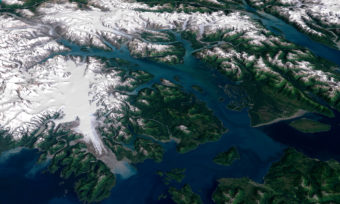
Visualization of Glacier Bay, based on Landsat imagery and USGS elevation data. (Public Domain photo)

A father and son died and another person was hospitalized after a boat sank near Gustavus Monday evening.

Larry Roger McWilliams, 75, and his son Gary Roger McWilliams, 48, were among the six people who ended up in the water after their boat, the Invader, sank while they were fishing near Strawberry Island in Glacier Bay National Park and Preserve.

At about 5 p.m., the National Park Service in Glacier Bay called the Coast Guard for assistance in a water rescue. Passengers from the 27-foot recreational boat were in trouble, said Coast Guard spokesperson Lt. Jennifer Ferreira.

“It began taking on water and eventually capsized near Strawberry Island there in the park,” Ferreira said.

Ferreira said the Coast Guard sent a helicopter from Sitka to assist the Park Service. She says everyone had been rescued by the time the helicopter arrived. The Coast Guard did transport one critically injured person to Juneau’s Bartlett Regional Hospital.

Park Service spokesperson Tom Vandenberg said one of the passengers managed to make it to shore and shot off a flare. Several private vessels were in the area and reached them before the Park Service or Coast Guard arrived.

“Everything from the day tour boat to a small research vessel, larger tour vessel and some other private and charter boats converged on the area and began picking people out of the water,” Vandenberg said.

He said it isn’t clear what time the Invader sank, but the passengers, who were most likely fishing for halibut, had been in the water for awhile and were severely hypothermic.

A tour vessel, the Wilderness Discoverer, located two unresponsive victims. Vandenberg said they were given CPR but never regained consciousness and were pronounced dead when they arrived at Bartlett Cove.

He said next of kin for the two who died have been notified.

According to a Park Service news release, the weather was calm and clear Monday. A response team is headed to the area Tuesday to find and secure the Invader. The incident is being investigated.
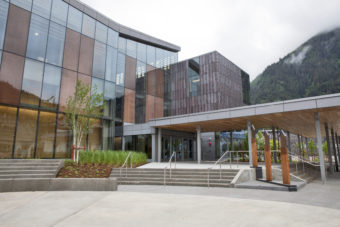
Touring the new State Library, Archives and Museum building

A 14-year-old project in downtown Juneau is nearly complete.

The finishing touches are being put on the new Father Andrew P. Kashevaroff State Library, Archives and Museum, widely known as the SLAM building, as facility managers prepare for its grand opening on June 6.State LibaryThe nearly $140 million facility combines the state library’s information services and historical collections as well as the state’s archives and state museum into one 118,000-square-foot building.

Bob Banghart, deputy director of libraries, archives and museums, gave us an early tour of the facility last week. Here’s a sneak peak.

SLAM Tour
Left: Workers move across a map of Russia, Alaska and Canada in the lobby of the building. The map includes nine site names including Juneau, Sitka, Fairbanks and Bethel. Top right: The map is laid out in the true north direction and could be modified with more coins marking specific geographic locations in the future.  Bottom Right: Cast glass pieces by Portland artist Walter Gordinier adorn the lobby of the building. (Photos by Rashah McChesney/KTOO)
An old favorite from the Alaska State Museum was installed in the building before the roof was closed.

Because of its size, the eagle-laden tree’s trunk had to be lowered into position by crane. The roof was then completed, the tree unwrapped and the eagles installed.

The main staircase in the lobby of the building is shadowed by a life-sized model of an eagle nesting tree complete with eagles that were on permanent display in the former Alaska State Museum and were restored before installation in the new building. (Photo by Rashah McChesney/KTOO)

A Ketchikan artist’s first foray into glass will be the dividing line between the library and research center of the state library.

Evon Zerbetz’s 10-foot tall, 80-foot long piece was scanned to black and white and then printed on the glass, then Zerbetz worked with the color and additional layers of glassing to give it a 3-D aspect.

Evon Zerbetz’s “We are Written Between the Layers of the Earth” is on display in the new state library. Zerbetz, typically a printmaker, ventured into the world of stained glass with this piece. (Photos by Rashah McChesney/KTOO)

The 55 workers moving into the building were still unpacking in the two weeks before the building was scheduled to open.
Left: A woman unpacks her desk in the administration wing of the building. Top right: The research wing in the archives is unpacked. Bottom right: Workers clean the carpets in the state library. 

A controversial, 38-year-old sculpture was put into place in front of the building before work began on the driveway and landscaping.

The brilliant green Nimbus was first partially restored. The restoration work included a fresh coat of paint in 2015 when the sculpture was installed on new steel beam framework.

Canadian sculptor Robert Murray traveled to Juneau to inspect the restoration in progress and make sure that the sculpture’s arch form fit in with its surroundings.

Nimbus has been criticized for both its abstract form and color in the four decades that it has been in Juneau. The National Endowment for the Arts, the Alaska Court System and the Alaska State Council for the Arts originally funded the sculpture. In 1984, disgruntled state lawmakers found a way to force Gov. Bill Sheffield to remove the sculpture from the court building site.

[youtube https://www.youtube.com/watch?v=Jik3-TSu4tA&w=560&h=315]
Top left: Robert Murray’s Nimbus was commissioned in 1977 and first installed in front of Juneau’s Dimond Courthouse.  The 5-ton steel sculpture is 16 feet tall and was removed from the courthouse at the request of the Alaska Legislature and turned over to the museum. Right: Walter Gordinier’s glass artwork leads to the entrance of the building. (Photos by Rashah McChesney/KTOO)
You can watch video of our tour with Bob Banghart here.

How the suburbs killed a salmon creek and science informs its restoration

Duck Creek
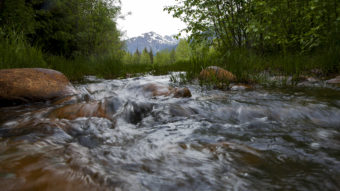
Duck Creek flows past the Nancy Street wetland and under Nancy Street in the Mendenhall Valley. The Alaska Department of Environmental Conservation has awarded a watershed coalition a nearly $10,000 grant to collect water quality data to measure the effectiveness of environmental improvements on the creek. (Photo by Rashah McChesney/KTOO)

Federally funded environmental science on a geologically doomed creek in Juneau could inform fish-saving restoration on other impaired water bodies.

Alaska’s Department of Environmental Conservation has announced nearly $300,000 in grants to improve water quality in some of the state’s most damaged watersheds, including the orange-tinted Duck Creek.

The 4-acre Nancy Street wetland, much like the tiny creek that meanders through it, could be serene and full of wildlife if it weren’t bordered by busy suburban streets and houses.

As it is, the bird calling and chitter of the occasional ground squirrel are consistently drowned out by traffic from the road to the west and noise from the neighborhood that runs along the east end of the wetland. Similarly, Duck Creek has suffered from a loss of fish habitat and a decline in water quality from at least 50 years of that same type of development in Juneau’s Mendenhall Valley.

Juneau residents might recognize it as the creek with an odd orange tint, a symptom of iron-rich groundwater. As neighborhoods and commercial developments sprung up in the valley, the creek has been diverted into ditches and culverts making it even harder to recognize as a flowing water body.

Twenty-two years ago, the state put Duck Creek on its impaired water bodies list. At the time, it was full of fecal coliform bacteria, metals and debris.

A squirrel explores near Duck Creek as it flows past the Nancy Street wetland in the Mendenhall Valley on May 20, 2016, in Juneau, Alaska. The Alaska Department of Environmental Conservation has awarded a watershed coalition a nearly $10,000 grant to collect water quality data to measure the effectiveness of environmental improvements on the creek. (Photo by Rashah McChesney/KTOO)
A squirrel explores near Duck Creek on May 20. (Photo by Rashah McChesney/KTOO)

By 2001, its chum salmon run – historically up to 10,000 fish – was extinct. Its coho salmon run was fewer than 20 fish and its trout fishing, closed. The Alaska Department of Fish and Game has yet to reopen fishing on the creek.

The Nancy Street wetland habitat was one project among a long list including culvert maintenance and upgrades, revegetation of stream banks, sediment removal and stream cleanup. Next spring, scientists will begin sampling the creek’s water quality in the wetlands to see if the bio-filtering project is improving the watershed.

Amy Sumner, a biologist and project manager with the Juneau Watershed Partnership said the effort will be coordinated with the University of Alaska Southeast and train budding student biologists in water quality assessment.

“We’re hoping to see that as the water filters through the wetland the water quality is improving.”

Funding for the student position and testing of the water samples will come from a $10,000 Alaska Clean Water Action grant.  The state’s Department of Environmental Conservation announced nearly $300,000 in grant funds this year for water bodies it said are in the greatest need of protection and restoration.

In Southeast Alaska, the projects include Juneau’s Nancy Street wetlands assessment, bacteria monitoring on a heavily used beach in Petersburg, and plant-filled ditches in Haines designed to filter snowmelt runoff before it mixes with a salmon stream.

Statewide, projects include an ongoing campaign to stop people from feeding ducks and other waterfowl in a popular midtown park in Anchorage, copper and zinc monitoring on the Kenai River, a beach monitoring project in Nome and a program to educate miners near Fairbanks on the impacts of turbidity and sediment on fish.

Since 2005, the state has awarded nearly $5.4 million to fund things like municipal stormwater master plans, fish passage assessments, habitat monitoring, boating education, and even septic system education for homeowners.

Cindy Gilder, a program manager at the Department of Environmental Conservation, said the grant funds come through the Environmental Protection Agency. The program has been around for decades.

Like Duck Creek, the most troubled watersheds in Alaska are in urban areas, or at least they’re the ones that get the most grant funding. Gilder said similar programs in other states are concentrated in rural areas, where agricultural runoff is often a culprit in watershed pollution.

If I looked back over the history of the grants, there’s probably, usually a grant in Anchorage, maybe in Fairbanks, in Juneau, there’s usually in Mat Su, something down the Kenai.  Because a lot of non-point source pollution, it’s the non-permitted stuff. It’s you and I driving our cars and my car leaking oil or my stepping on the brake pads all the time.”

On Duck Creek, nearly $57,000 has come through the grant program to help restore the watershed.

With all the restoration in Juneau, we have not been very good about following up with water quality monitoring to see if these efforts are actually being effective. So that’s what this project is trying to accomplish. We’re going to test above the wetland, inside the wetland area and then at the wetland outlet to see if water quality is being improved as the water filters through that wetland.”

In the end, it’s probably too late for the dwindling numbers of fish who migrate in and out of Duck Creek. The Mendenhall Glacier seems to be finishing off what decades of dumping, development and diversions started.

“So as the glacier retreats our land is rebounding and that is causing Duck Creek to disconnect with some of its groundwater source that provides its base flow. So a lot of times Duck Creek will dewater and it’ll look like a dry streambed so that is providing some problems for fish getting upstream and because of that interaction between the uplift and the dewatering, Duck Creek is really no longer able to provide viable fish habitat.”

Sumner said it’s not clear how long it will take for the creek to become completely uninhabitable. But the process of restoring its water quality, and monitoring which projects were the most effective, can inform rehabilitation projects on other impaired watersheds.

Despite state budget cuts, new Juneau budget is mostly status quo

Juneau City Hall
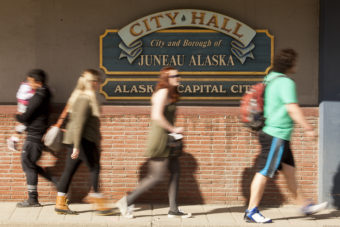
Two men cross the street in front of Juneau City Hall on May 10. (Photo by Rashah McChesney/KTOO)

Normally the Juneau Assembly sets the municipal budget two years in advance. This year, that will be hard with so much uncertainty in state funding and the economy.

Despite anticipating nearly $4 million less in state support, city officials are proposing a relatively flat budget for the next fiscal year and a placeholder budget for 2018.

If the state’s budget is a hurricane, Juneau could be in the eye of the fiscal storm next year.

“What we’re seeing is, we have roughly, you know, a $330 million budget and the difference between 2016 and 2017, it’s basically two-tenths of one percent,” said City Finance Director Bob Bartholomew.

He said the city has been preparing for a fiscal cliff.  It cut more than $3.5 million from its budget over the last three years. The city also lost about 20 staff position during that same time period.

“We reduced tax exemptions for sales tax on both businesses and individuals. We raised tobacco tax revenues and then we merged two city departments, and we had a lot of other program and efficiency reductions.”

City departments shouldn’t be losing any staff this year but Bartholomew said the relative calm of a flat budget will likely be over by the time the 2018 fiscal year rolls around.

The budget for that year is a placeholder and will likely be reduced as state funding continues to drop.

“When we talk about FY18, which is really when we’re going to start having to address the next round of loss of revenues, we’ll have three options: We can reduce costs, we can raise revenues, and we can use savings. We expect that we’re going to have to use all three of those tools.”

Some changes will be made between the city’s revenue and spending. For instance, the current budget proposal is to fund the Juneau School District to the maximum allowed by state law, in this case, $83 million. That’s down from more than $85 million last year and could drop even more by 2018.

“That has to do with how the formulas have evolved during the year. We had the change in student population; the change in assessed values all coming into a formula on who pays for school funding. The state will be paying $2 million less, we’ll be paying, give or take, $100,000 more.”

In committee, the Juneau Assembly also decided against lowering property tax rates.

The city is expecting to bring in about $49 million next year from property taxes. That’s $1.8 million more than last year. That increase in revenue is, in part, due to a significant jump in property values, Bartholomew said.

The city is also expecting to lose $450,000 in sales tax revenue next year.

The assembly is scheduled to meet Monday at 7 p.m. Bartholomew said public input during the process could be valuable now, but will also be useful in the fall when the assembly begins to discuss the budget for the following year.

“I think what’s important for the assembly and management to know is just, what areas do people think things are not working and they need to be improved? If we start getting into a situation where we have to reduce our expenditures, what areas should we be looking at first?”

The agenda for Monday’s meeting has not yet been set, but Bartholomew said he’ll be surprised if its members choose not to vote on the budget. The school district’s budget must be approved by May 31, and the assembly won’t meet again until June.

Juneau breaks ground on its new homeless housing initiative

Housing First
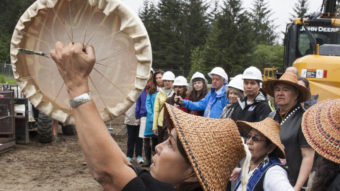
Nancy Barnes sings during a groundbreaking ceremony for a homeless housing facility on Monday in Juneau. The Juneau Housing First Collaborative is overseeing the project which will put a 32-unit facility in place. Barnes and others in a multicultural Yees Ku Oo dance group performed on the construction site as part of the celebration. (Photo by Rashah McChesney/KTOO)

In 2012, the Juneau Homeless Coalition identified 55 of the most vulnerable homeless people living in the community. Since then, nine have died.

Now, a project designed to give permanent shelter to that population is breaking ground.

Technically, the dirt is already moving on Juneau’s Housing First project. Still more than 100 people crowded into a warehouse in Juneau to celebrate the groundbreaking of a facility that is designed to get the area’s most chronically homeless off the streets.

On a lot donated by the Tlingit-Haida Regional Housing Authority in an industrial area of Lemon Creek, the first support pilings have been drilled into the ground and contractors are working to install the foundation of the 32-bed facility.

On Monday, there was food, music and celebration of several years of effort and interagency cooperation to get Juneau’s Housing First project into the ground. But organizers have not yet reached the finish line.

Housing First
Representatives from several agencies working to bring a Housing First project to fruition pose for a photograph during a groundbreaking ceremony on Monday to celebrate the construction of the facility in Juneau. The Juneau Housing First Collaborative is overseeing the project that will put a 32-unit facility in place. (Photo by Rashah McChesney/KTOO)

The project is not fully funded. Mariya Lovishchuk, executive director of Juneau’s homeless shelter, The Glory Hole said organizers at Juneau’s Housing First Collaborative are still about $1.7 million short of their goal.

“So we’re kind of going on faith here,” she said.

Lovishchuk said the coalition is waiting to hear back on three grant applications. Meanwhile, they are still taking donations through the Juneau Community Foundation.

Proponents of the project say the new shelter has the potential to save lives.

In 2012,  the Juneau Homeless Coalition surveyed 55 of the most vulnerable homeless people living on the streets, in cars, under bridges or in the forest. More than half identified as mentally ill, while 96 percent of them had substance abuse issues, according to the coalition.

Since then, Lovishchuk said, nine of the people who were surveyed have died.

Supporters of the Housing First model say that if a homeless person is given a permanent, stable place to live, it’s easier to address issues like a lack of income, substance abuse or mental health issues.

But as the two other Housing First facilities in the state have learned, it isn’t always easy to get someone into a home.

“For many of them, it was a huge adjustment,” says Colleen Ackerman, program manager at the Karluk Manor Housing First facility in Anchorage. “Many of our folks were used to shelters, camping or Homeward Bound, which is transitional. Many had not had an apartment or had many apartments over the years but had been in the streets. So it was kind of like the Wild West in the beginning.”

Everything you would imagine would happen when you would have, we have 46 people, many of them drinking. People passing out in the hallways and inappropriate behaviors and all of that.  So, in the beginning was probably the toughest because it was very new to the staff, new to even our division even though we had been working with the homeless folks for a while. But we’ve learned a lot of lessons.”

Among those lessons, Ackerman said, is that Anchorage’s Housing First program is a bit more restrictive than others in the country.

“We learned early on that when we brought in too many visitors, many of them were intoxicated along with the tenants, it got pretty crazy. Visitors became even more of a problem and it just is too much safety risk. So immediately, we did not allow more than 10 visitors in the building at a time. We had visiting hours.”

Housing First
At least 100 people celebrated during a groundbreaking ceremony for the construction of a homeless housing facility on Monday in Juneau. The Juneau Housing First Collaborative is overseeing the project which will put a 32-unit facility in place. (Photo by Rashah McChesney/KTOO)

The staff at the Karluk Manor also don’t allow residents to bring in more than a fifth of hard liquor at a time.

They can bring beer until the cows come home. They can’t really carry that much anyway,”

Ackerman said staff at Karluk Manor will also try to confiscate alcohol if residents are extremely intoxicated or aggressive.

Other challenges include tracking down homeless people on the waiting list to get into the facility. Once found, Ackerman said getting paperwork, like Social Security cards or drivers’ licenses, can be a problem.

Still, she believes the Anchorage Housing First program is working.

“Once they can get into permanent housing and places like Karluk and the Juneau program, then they can begin to have a better quality of life. It looks different for all of them. Some of them, it may just be that they’re off the streets and they’re surviving, but they’re getting meals and we take them to appointments and others it may mean that they do some employment.”

Back in Juneau, project contractor Jim Triplette said the building should be finished in about a year.

Once open, the facility is expected to cost more than $800,000 a year to operate. But, more than half of the projected operating costs would come from Alaska Housing Finance Corporation vouchers, rental income and the Juneau Community Foundation.

Site notifications
Update notification options
Subscribe to notifications