I help the newsroom establish daily news priorities and do hands-on editing to ensure a steady stream of breaking and enterprise news for a local and regional audience.

Both happened during his time working for Wright Services, the property management company. The first was a coworker, named Robert Nicks who asked for a protective order in 2004.
In court documents, Nicks said that he had reported Buzard to the borough for allegedly leaving junk vehicles on public property. He said Buzard was retaliating against him, and he said he feared physical injury or death because Buzard carried his gun around with him.
A judge dissolved the initial protective order and didn’t grant a long-term one.
Buzard said Nicks was fired and angry about it.
He also said he is not a criminal.
“I’m a firearms enthusiast. I own guns. I have a concealed carry permit. If I was a criminal, I would not have a concealed carry permit,” he said.
Nicks lives outside of Alaska now. He said he didn’t want to talk about the incident but he also sticks by his original story.
In the other protective order request, a woman who lived in one of the properties Buzard managed said he was spying on her and making lewd comments while her husband was away at work. A judge didn’t grant that order either.
Buzard said the woman and her partner were manufacturing drugs in the park.
“An opportunity came up for us to evict them when they failed to pay their rent one month and we jumped on that,” he said.
He said she filed for that protection order after getting the eviction order. That woman also appears to have left the community; she didn’t respond to any messages seeking more information about the incident.
Buzard points out that he’s been on both sides of the state’s protective order process. In a more recent case, he was granted an order against a man who threatened his family with violence.
“What I would like people to know is that — number one — I’m glad that the law is in place. But there’s two problems, one is that the law does not require enough proof to issue even a temporary restraining order,” he said. “The second problem is that if it’s granted — the restraining order — it’s only good for one year. It should be good for five years.”
Buzard also had a run-in with the city after he fell behind on his sales taxes and ended up owing thousands of dollars.
“When I bought the pest control company, it was a one-man show and I was on my own,” he said. “I had a really difficult time keeping up with all of the paperwork stuff — and I tried. I was behind and I just could not get it together. It’s not really my forte.”
He ended up owing the city nearly $12,500; he and his wife set up a payment plan. Now, he said, they pay their taxes every 30 days.
“We’re never late,” he said. “My wife has got it all handled under control. That’s why she runs the business because she’s so much better at the administrative side than I am.”
Court records show that the judgment was paid off in 2017. Buzard said he was frustrated by the situation because he and his wife thought the agreement was with the cityand wouldn’t end up in court unless they fell behind on their payments. But that turned out not to be the case.
As a school board member, Buzard would be helping with the school district’s budget process. When asked what he learned from the situation he said: “Keep your paperwork current. Don’t let things fall behind, fall by the wayside. Make the time necessary to get it done in a timely manner, always.”
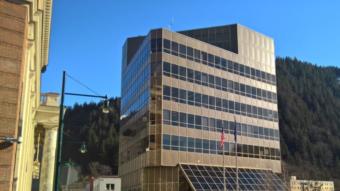
The Dimond Courthouse in Juneau on Feb. 27, 2017. (Photo by Jeremy Hsieh/KTOO)
Ibn Bailey is one of eight candidates running for a seat on Juneau’s school board. He said he’s running to be a political-free, data-driven voice in local education policy.
In 2019, two Juneau women say he harassed and stalked them, including the principal of Sayéik Gastineau Community School, Brenda Edwards. She was granted stalking protective orders against Bailey — twice.
Ibn Bailey
When first asked to explain the orders, Bailey said he didn’t want to rehash the situation. But, he described them as a direct result of his attempts to talk to school staff about his nephews. He said their dad was having trouble caring for them.
“In that situation where he was homeless, and they’re facing shelter and food insecurities, they were children and in transition,” he said. “And that’s how the initial order came about — where I was banned from the schools.”
Bailey said he knows it’s jarring to see those restraining orders in his background.
“They were not domestic violence related. They weren’t. There wasn’t any violence, there wasn’t any sexual coercion, there wasn’t any of those things that you normally associate with domestic violence and stalking,” he said.
Stalking in Alaska isa specific type of restraining order. It’s one where someone who isn’t a member of a person’s household has nonconsensual contact with them. And because of that contact, they fear physical injury or death.
But Bailey said that what the court decided was stalking was actually the result of a miscommunication.
“This was an order to keep me away from communicating with the principal of the school that my nephew attended, and also to keep me away from continuing on with my attempted advocacy for these children,” he said.
He said the Juneau School District struggles with race. He said data shows that police are called to the schools far more often for disputes involving Alaska Native and Native American students, and other nonwhite students. He said all three of his nephews are Alaska Native, African American and Asian. Bailey is Black.
He told a story about his brother being profiled while on a local school football team and that his family was threatened with arrest. And he said he thinks that’s why the school district got the police involved.
“We’ve had prior experiences, so it was a surprise to actually receive the [protective] order, but actually, it wasn’t a surprise,” Bailey said. “Our police and our responders have bigger concerns to be dealing with than the school activating what has historically been the way it has been to get unruly or disagreeable families and advocates out of school by threatening them with police action, or court orders.”
But it turns out that his description of how he landed in court for stalking is notaccurate. Or, at least, it wasn’t the whole story.
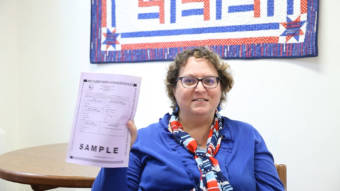
When Brenda Edwards went to court to ask for a protective order, she brought a stack of emails that Bailey sent that described his attraction to her.
Edwards said she didn’t want to talk about the incident, but her filings in court tell a very different story than Bailey’s.
She began by describing her meeting with Bailey at the school in 2019. She wrote that she was nervous at first because she had suspended his son four years prior and at the time, Bailey threatened a civil rights lawsuit for discrimination. But, Edwards said she thought they had a good interaction; he apologized to her for their previous conflict.
But then Bailey sent her a message telling her that the universe was speaking to his spirit and heart. She didn’t respond. He wrote again, and she didn’t respond to that one either. Then he sent a third email with his number in it and another saying he wouldn’t write to her again.
At this point, she said in court documents, she called the district superintendent because his emails made her uncomfortable. After they consulted, Edwards sent Bailey an email that ends with the phrase “it is my expectation that you would not email me in the future.”
But he sent another email saying he was separated from his wife and was a safe guy. Another saying “I know you said to stop with the emails but…” He sent a third email saying that he thought the world of her. He told her he had feelings for her and called her “stunning.”
She didn’t respond to any of those.
In his court filings, he said these personal emails were to show her that he wasn’t lying about his intentions. He said he was trying to reassure her that his interest in her and in his nephews were two separate things.
At some point, she blocked his emails.
Then, Bailey got a call from Juneau police informing him of the protective order. He told the court that his first thought was, “Why me? Who gets served papers for trying to be a nice guy?”
In court documents, Bailey asked the judge not to grant the protective order. He apologized to Edwards and said that he is not a threat to her or her family. He also said he believed that Edwards filed for an order of protection for professional reasons and not because he was stalking her.
But he said that he recognized that Edwards and her staff were doing their jobs: protecting the children in their school. Then he said he wouldn’t contact her again.
But, a week after Edwards’ first protective order expired in August of 2019, he sent flowers and a handwritten poem on a notecard to the school for her. She went to court again. She told the judge she had finally reached a point where she wasn’t thinking all the time about being stalked, but getting that gift at the school brought back all of the feelings of being unsafe.
The court granted her another protective order, this time for a year.
When reached again to explain why he hadn’t told the entire truth about the protective orders, Bailey said he was trying to be discreet and avoid embarrassing anyone.
But he also insisted that he and Edwards had romantic feelings for each other.
The one thing Edwards said on record is that she had no social, personal, romantic interactions or relationship with Bailey. In court, she wrote that he clearly wanted to be involved beyond her professional role — and that was clearly not mutual, because she didn’t respond to him.
The other local woman who requested a protective order said she, too, had frequent, unwanted contact with Bailey. She said that he showed up to her job uninvited. She asked for a short-term protective order, which she got, but the judge denied a long-term order.
Bailey said what he regrets the most about the whole situation is that he didn’t help his brother and said the situation was very traumatic for his brother and his nephews.
But, he also wants voters to know that he believes violence against women is a real problem in Alaska.
“I would say that, that our rates of domestic violence, violence against women, our murdered and missing Indigenous women, our African American women, our women of color, that we have a real issue in Alaska,” he said. “And that we need to do more, there’s so much more that we need to do, but understanding that this is real. And this is impactful. And it needs to be a concern for every single Alaskan.”
And, for voters in this community that want to know more about his character, he said to look to the women in his family who stand by him.
According to the latest Alaska Victimization Survey, 1 in 3 women reported being stalked in their lifetimes. That includes being watched or followed from a distance, getting unwanted cards, flowers or gifts and getting unwanted emails or messages.
If you are a survivor of domestic violence, sexual assault or stalking in Alaska, you can find legal help through the Alaska Network on Domestic Violence & Sexual Assault. You can also call Juneau’s local domestic violence shelter AWARE on their free and confidential CareLine at 1-800-478-1090.
Note: In an unrelated case, the reporter filed for and received a long-term stalking protective order against a different Juneau man in 2019.
For the second year, Juneau’s local election will be held by mail. This year’s municipal election day is on Oct. 5, but the city began mailing ballots out on Sept. 14.
City clerk and election official Beth McEwen answered some common questions that she’s heard from voters.
What if I don’t get a ballot in the mail?
If you have not received a ballot in the mail by the end of September, please contact our office at 907-586-5278 — choose option 4. You can also email CBJElections@juneau.org.
You can get a replacement ballot at one of the two Juneau vote centers either at the Mendenhall library or the city hall vote center. We will go ahead and issue you a ballot at that vote center. You can vote it right there, put it into the drop box and it will be put into the ballot review process. The way we ensure that there are no duplicate ballots and only one voter gets to vote one ballot is that — if for some reason – somebody got a replacement ballot but then their original ballot came in the mail, we would count only the first ballot that was received. Any other ballots would be disallowed.
What if I get someone else’s ballot in the mail?
If, by any chance, you receive a ballot in the mail that is not addressed to you — maybe a former resident or someone else that used to receive mail at that address — we ask that you please write on the envelope itself that the ballot came in “no longer at this address, return to sender.” That will help us communicate that information to the state Division of Elections so they can update their voter registration.
Once I’ve voted with my ballot, then what?
Once you’ve actually received the ballot in the mail, you’ve gone ahead and looked at all of the candidate information and the information about the proposition on the ballot and decided how you were going to vote, you’re going to place that voted ballot into a secrecy sleeve, the secrecy sleeve is going to go inside your outer return envelope. You’re going to sign that outer return envelope, please put a personal identifying number right by your signature in the space provided. Then, you can return it in a number of ways:
Via post office, we are paying the postage so there’s no stamp required. If you are putting it in the mail on election day, we encourage you to get it postmarked so that the actual postmark is actually visible for the date, so your ballot can be counted.
You can drop it off at one of our two drop boxes. One is located at the Douglas Library, or out at the Auke Bay boat launch parking lot.
We will have two vote centers available that you can drop your ballot off at the vote center and those are at the Mendenhall Library Monday through Friday from 10 to 6 p.m. starting on Sept. 20 through election day. The other vote center is located here at city hall in the Assembly chambers and that will be open from 8 to 4:30 p.m. Monday through Friday starting Sept. 20.
On election day itself, both vote centers will be open the normal poll hours from 7 a.m. to 8 p.m. so you could bring your ballot then.
How often will those drop boxes be emptied?
We will have election worker staff going out in teams of two and collecting those ballots on a daily basis starting Sept. 16 through election day. They will be closed right on the dot at 8 p.m. on Oct. 5, election day.
How do you process the ballots?
Once we’ve checked the signatures on the envelope and we’ve ensured that that voter has only one ballot cast, then it gets approved for counting. We open the ballot envelopes, we separate the ballot from the secrecy sleeve and then those ballots get put through the ballot scanner and the Dominion machinery takes a picture of every single ballot that gets scanned.
If there’s any discrepancies such as an overvote where there’s more than one ballot mark on the ballot where you have a race that can only be marked for one where there’s two ovals that have been marked, that would go through the adjudication process. That ballot would still be counted however that race if it was overvoted would not be counted.
Once all the ballots are scanned then those go through the preliminary results. When we are done doing all of that process in Anchorage, any of the ones that are questioned are going to be coming back to Juneau — our canvas review board will review each and every one of those questioned discrepancies and make a determination and then they will certify the final results of the election based on their final determination after that full review.
Will we have results on election day?
No. With vote by mail election all of the ballots that are going to be received this year — we will be packaging those up, taking all of those up to Anchorage and processing them. So we will not have any preliminary results on election night.
When will we have results?
If we can, we will have preliminary results on Friday, Oct. 8 in the evening. If not it may have to wait until Monday, Oct. 11. The official results, when we actually know when the persons are actually elected, is certification by the canvas review board on Tuesday, Oct. 19. So, any results prior to the 19th are unofficial preliminary results.
We will be posting results, preliminary results initially on our juneau.org website for the elections and then we will also be posting our final results on the same website. So you can follow along with us as we are doing updates to those preliminary results, we’ll be posting those to our website juneau.org.
A nearly empty critical care unit at Bartlett Hospital on April 7, 2020, in Juneau, Alaska. on (Photo by Rashah McChesney/KTOO)
A Juneau man in his 50s died from COVID-19 on Saturday at Bartlett Regional Hospital. So far, nine Juneau residents and one non-resident who tested positive for COVID-19 in Juneau have died during the pandemic.
State health officials say 95 Juneau residents tested positive for the virus over the weekend.
Five people are currently being treated for the virus at Bartlett Regional Hospital.
The Juneau School District reports two more people who have tested positive and were infectious while at school. One at Riverbend Elementary, where one classroom is quarantined, and one at Sit’ Eeti Shaanax Glacier Valley School, where one additional class has been quarantined.
Bartlett Regional Hospital’s CEO Rose Lawhorne in a wing being converted for COVID-19 patients in April 2020, when she was Chief Nursing Officer. In September 2021, she resigned as CEO after six months on the job. (Photo by Rashah McChesney/KTOO)
After just six months on the job, Bartlett Regional Hospital CEO Rose Lawhorne has resigned.
City staff said she was having an “inappropriate relationship” with a hospital employee which violates the city’s conflict of interest code. Technically, Bartlett employees are Juneau city employees.

Juneau City Manager Rorie Watt said Lawhorne’s relationship predated her time as CEO. But, once she became CEO, someone informed the city attorney about the relationship
“Under city code, the city attorney is required to investigate those types of things,” Watt said. “The city attorney found evidence. He provided the evidence to Rose to give her the opportunity to provide other evidence.”
The city has been investigating Lawhorne for some time, Watt said it has been weeks because “it takes a little while to work on these issues.”
Watt said once the city attorney went to Lawhorne with proof that the relationship was happening, she stepped down.
The hospital’s Board of Directors held a special meeting on Saturday to accept her resignation; then the board voted to fire her. Board President Kenny Solomon-Gross has, so far, deferred questions to Watt.
Bartlett staff got an email on Saturday saying that Lawhorne was gone.
In her resignation letter, Lawhorne said she could no longer serve the hospital as CEO and has enjoyed her years of service at the regional hospital. Lawhorne has been at the hospital since 1993, and before she accepted the CEO position, she was the Emergency Department director, a staff nurse, a data entry clerk, head nurse and an assistant chief clinical officer.
While her resignation letter does not allude to the relationship that led to her resignation she thanked the board for “respecting my need for privacy of my own personal issues.”
Watt said Lawhorne is aware that the city is sharing the details of that relationship and that it is the catalyst for her resignation. In this case, he believes Lawhorne’s relationship with this person pre-dated her time as CEO. Though, he said the city wasn’t aware of the relationship when she was promoted.
“Could this have been dealt with prior to promotion? It could have. There could have been an accommodation made where we created some alternate reporting structure. But, that didn’t happen,” he said.
He said he’s talked to her.
“She clearly regrets her actions,” Watt said. “She’s a long-term, really excellent employee of the hospital who has dedicated her whole career to providing good healthcare to the public. And, she was willing to put herself forward to run the hospital in a pandemic. It’s really sad for all of us. She did a lot of good for the community, and she made a mistake.”
At the same time, he said there isn’t any wiggle room in city code for an employee who has a relationship with a subordinate.
But Watt also said he thinks that’s important.
“I think in the national media, you can find examples where inappropriate relationships resulted very poorly for subordinate employees,” he said. “In this case, I believe the relationship was completely consensual. But I think it’s a really important principle to uphold.”
The board has appointed Kathy Callahan as an interim CEO. Callahan recently retired as the hospital’s director of Physician Services.
This story has been updated with details provided by the Juneau city manager. And, it has been corrected to show that while Lawhorne resigned her position, the Bartlett Board of Directors ultimately voted to fire her.
SEARHC personnel test a colleague for COVID-19 at the employee screening tent behind the hospital in Sitka in April 2020. (Photo by Berett Wilber / KCAW)
State health officials reported a record 1,091 new COVID-19 cases on Wednesday, and while that’s the most cases they’ve ever reported in a single day, that figure doesn’t necessarily represent how many people tested positive on a single day.
High case counts are leading to backlogs in testing and contact tracing, but they’re also leading to backlogs in state reporting.
In Juneau, local emergency planning officials say case counts from the state have been lagging for weeks.
A state health department spokesperson hasn’t yet responded to questions about how far the state is lagging behind in reporting new cases.
But in a data summary email, the state acknowledged that when it gets a high number of reports, that may cause delays in getting them entered into the state’s system and counted.
“Personnel continue to focus on the effort to process and count reports and minimize the delay from receipt to posting on the hub,” according to the email.
Juneau’s Emergency Manager Mila Cosgrove said she’s hearing of occasional case lags in state reporting of sometimes a week to ten days from the date the COVID-19 test was taken.
She said it’s a good idea to look at the seven-day average test positivity rate because it helps to flatten peaks and valleys in the number of positive tests that are reported each day. Right now, Alaska’s seven-day average test positivity rate is at a record high 9.6%. Health officials say that anything above 5% indicates that more testing needs to be done.
In Juneau, state health officials flagged 61 new COVID-19 cases on Wednesday. That includes 58 residents and three visitors to the community.
The Juneau school district reports 10 new people who have tested positive for COVID-19 and were infectious while in school, that includes:
One each at Yaaḵoosgé Daakahídi High School and Juneau-Douglas High School: Yadaa.at Kale and two at Thunder Mountain High School, where all classes are operating on regular schedules.
One at Auke Bay Elementary School, where part of one class is quarantined.
One each at Floyd Dryden and Dzantik’i Heeni Middle schools, where all classes are operating on regular schedules.
And three new cases at Sítʼ Eetí Shaanáx̱ – Glacier Valley. Those cases are still being investigated.
Cosgrove says there have been lower cases counts coming through Bartlett, though that lab is only part of the overall picture of Juneau’s positive cases.
Six people with the virus are currently being treated at the hospital, and just 11 of the hospital’s 57 total beds are currently available according to Juneau’s COVID-19 dashboard.
The hospital is having trouble medevacing patients out because hospitals throughout the Pacific Northwest are strained.
Bartlett Chief Nursing Officer Kim McDowell said that while the hospital hasn’t seen the surges that have been experienced by hospitals in Anchorage and Seattle, there are more and more patients who need care for COVID-19 and its after-effects — things like heart and lung issues. Those patients aren’t counted in the hospital’s daily tally of COVID-19 patients because they aren’t infectious anymore.
It hasn’t gotten to the point where hospital staff are having difficulty keeping up with the number of patients who show up for treatment, but “It would not take much to get to that point,” McDowell said.
She said the majority of the patients who are having to be seen for long term impacts from COVID-19 are unvaccinated.
“I’m going to sound like a broken record,” McDowell said. “We know vaccines work. We see that firsthand when we’re comparing people that have been vaccinated who contract COVID: The compare-and-contrast when you see people who are unvaccinated is amazing.”
This story has been updated with additional information from Bartlett Regional Hospital.
Close
Update notification options
Subscribe to notifications
Subscribe
Get notifications about news related to the topics you care about. You can unsubscribe anytime.