Rashah McChesney

Daily News Editor

I help the newsroom establish daily news priorities and do hands-on editing to ensure a steady stream of breaking and enterprise news for a local and regional audience.
Contact tracing lags as Juneau’s COVID-19 cases add up, including one at an elementary school

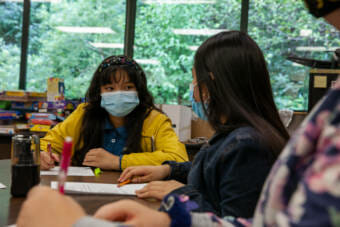
Tanner and Amnara Cooper meet the new principal of Sayéik Gastineau Community School during their first day of in-person classes on Thursday, Jan. 14, 2021, in Juneau, Alaska. (Photo by Rashah McChesney/KTOO)
Tanner and Amnara Cooper meet the new principal of Sayéik Gastineau Community School during their first day of in-person classes on Thursday, Jan. 14, 2021. During the first week of the new school year in August, someone tested positive for COVID-19 at the school.  (Photo by Rashah McChesney/KTOO)

Staff and parents with children at Sayéik: Gastineau Community School learned on Wednesday that a person at the school has tested positive for COVID-19. According to an email from the district, they’re still working on contact-tracing to figure out who may have been exposed and needs to be isolated. Someone will notify those close contacts and, according to the district, if you haven’t gotten a call you don’t need to quarantine at this time. Classes are continuing to meet as regularly scheduled.  

Juneau city officials reported 32 new cases of COVID-19 on Wednesday.

There are no details on how those people caught the virus and that is, in part, because contact tracing is lagging.

Mila Cosgrove, Juneau’s incident commander, says they only got to 50% of the positive COVID-19 cases reported in the last week, partly due to the volume of cases, and partly due to people not returning calls.

Juneau’s Public Health Department is asking that if you get a positive test result and haven’t heard from them, to call 465-3353. They’re also asking that people who test positive notify their close contacts so they can quarantine and get tested. A close contact is anyone, masked or unmasked, that you were within six feet of for more than 15 minutes over a 24 hour period.

There are 168 active cases among Juneau residents, including 9 nonresidents. Three people with COVID-19 are being treated at Bartlett Regional Hospital.

Statewide, the department of health says 647 new people were identified with COVID-19, including 30 nonresidents. They’re also reporting four more deaths — three men from Anchorage and one from Palmer. So far, 404 Alaskans have died during this pandemic.

Juneau kids head back to school, but it’s different again this year

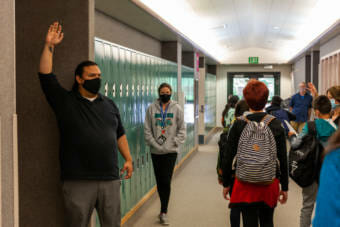
Thunder Mountain High School seniors Kafoa Maka and Ammon Kawakami watch students head to lunch on the first day of school on Monday, August 16, 2021, in Juneau, Alaska. (Photo by Rashah McChesney/KTOO)
Thunder Mountain High School seniors Kafoa Maka and Ammon Kawakami watch students head to lunch on the first day of school on Monday in Juneau. (Rashah McChesney/KTOO)

It’s the first week of school for hundreds of Juneau public school students. Students, teachers and administrators all said they were excited to see each other in person on Monday. 

As lunch period started at Thunder Mountain High School, Kafoa Maka and Ammon Kawakami watched a sea of masked students rush down the stairs. 

Maka, a senior, said he switched to learning at home last year when the COVID-19 pandemic hit, and he thinks being in-person will be better for him academically. 

“I took all online classes, and they were all pretty easy to get distracted in, but now that I’m back here in the real school, I think I’m going to be able to learn better and like — I don’t know — just learn more and be more focused on what I need to do,” he said.

Kawakami homeschooled last year. He said heading back to in-person classes feels normal. But the masks are complicating things for him. 

“I get, like, completely confused because I don’t want to approach [people] and call them by the wrong name and have them be a completely different person,” he said.

Rusel Rotano serves lunch on the first day of school at Thunder Mountain High School on Monday in Juneau. The Juneau School District is offering free lunch to all students this year. (Rashah McChesney/KTOO)

At lot of students headed through the lunch line at Thunder Mountain, though a few brought their own or headed outside.

Another change this year is that the district is offering free breakfast and lunch to all students at every school. And Juneau School District Chief of Staff Kristin Bartlett says a lot of students took them up on that offer. 

At Dzantik’i Heeni Middle School, registrar Maria Kappler said she is happy to be back — and the kids are too. The school feels alive, and Kappler said she’s excited for a return to normalcy. 

“Last year it was pretty lonely actually, especially the first part when it was all distanced,” she said. “And then even when they came in, there were so few students it just didn’t feel the same.”

Maddie Bass watches as Zara Ritter ties her shoe during an art class on the first day of school at Dzantik’i Heeni middle school on Monday in Juneau. (Rashah McChesney/KTOO)

Kids ran around and laughing and playing on their phones — it did feel normal. But there were a few things that stood out at the middle school. For example, students that filed into Miah Lager’s art class had to sit in very specific spots at each table. It took a few minutes for them to figure out the map and settle in. Lager apologized to the class but told them it’s important to know which kids are sitting next to each other. 

Kappler said that’s for contact tracing, in case anyone gets sick. 

“We’re trying to keep close tabs on that even though, you know, we had more students than expected because of budget cuts, so a little tight. But of course knowing where they’re sitting and sitting next to each other is essential,” she said.

Students at Dzantik’i Heeni middle school listen to Ray Imel talk about a Makerspace class on the first day of classes on Monday in Juneau. (Rashah McChesney/KTOO)

Next door to Lager’s art class, Ray Imel continually reminded kids to pull their masks up over their noses. He told them that it’s important so they can all continue to meet in person. 

The school district’s plan right now is for five full days a week of in-person learning. Everyone has to be masked when they’re inside, but they can remove those masks when they go outside. 

The district reported 300 more students than last year attended school on the first day, though they won’t have a full count until after Kindergarten starts on Thursday.

Juneau woman with COVID-19 dies at Bartlett Regional Hospital, city officials report 58 more people test positive

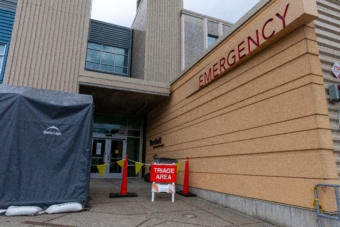
A triage tent is set up to screen patients for symptoms of COVID-19 outside on Monday, April 7, 2020 at Bartlett Hospital in Juneau, Alaska. (Photo by Rashah McChesney/KTOO)

Another Juneau woman died of COVID-19 at Bartlett Regional Hospital on Sunday night. She was in her 80s. She is the seventh Juneau resident to die from the virus since the beginning of the pandemic.

Another 58 new people tested positive for the virus over the weekend. Most of them are residents of Juneau, but two are nonresidents.

Juneau city officials reported Monday that 22 people got the virus through secondary transmission from someone who has already tested positive for the virus. Two people got it through community spread, and they’re still investigating the rest of the cases.

There are two people with COVID-19 being treated at Bartlett.

The state health department reports that 1,063 people — mostly residents — tested positive for COVID-19 over the weekend. That figure includes 62 nonresidents who tested positive while in Alaska.

More than 66% of Juneau residents are fully vaccinated, though that doesn’t mean they won’t spread the virus. Last week, city data showed some 47% of the new cases over the two-week period ending Aug. 9 were breakthrough cases, or people who were fully vaccinated and caught COVID-19.
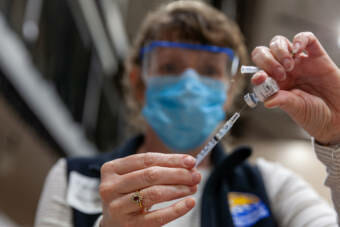
It’s difficult to find data on the severity of those infections, but Juneau public health reported to the city that most people who are vaccinated and have gotten COVID-19 say they have symptoms ranging from none at all to a bad cold or sinus infection. Among the partially vaccinated or unvaccinated, people are reporting symptoms ranging from none to severe illness.

Statewide, 94% of all cases and hospitalizations and 97% of all deaths among Alaska residents in the first six months of this year were in people who weren’t fully vaccinated.

Anyone who is 12 years old or older is eligible to get a covid vaccine. In Juneau, call 907-586-6000 or go online to make an appointment.

Immunocompromised? The CDC says it might be time to get a booster shot of the COVID-19 vaccine

The Moderna and Pfizer vaccine bottles compared during Juneau’s COVID-19 vaccine clinic at Centennial Hall on Jan. 15, 2021, in Juneau. The Centers for Disease Control and Prevention says immunocompromised people should get a third “booster” dose of the vaccine. (Photo by Rashah McChesney/KTOO)

The Centers for Disease Control and Prevention has paved the way for vulnerable Alaskans to get a third “booster” dose of the COVID-19 vaccine. 
The CDC said Friday that people who got the Pfizer and Moderna vaccines could get a third dose. The idea is to help prevent serious infections in people with weakened immune systems.  

In a prepared statement, CDC director Rochelle Walensky called it an “important step in ensuring everyone, including those most vulnerable to COVID-19, can get as much protection as possible from the COVID-19 vaccination.”

About 3% of the U.S. adult population is at risk for serious, prolonged illness, according to CDC data. That’s close to 10 million people. 

Mila Cosgrove, Juneau’s incident commander, said given that it’s a fairly narrow slice of the population, she’s not worried about Juneau’s vaccine supply. 

So, who should take a third dose? The CDC says people who meet the following conditions: 

  • Receiving active cancer treatment for tumors or cancers of the blood
  • Received an organ transplant and are taking medicine to suppress the immune system
  • Received a stem cell transplant within the last 2 years or are taking medicine to suppress the immune system
  • Moderate or severe primary immunodeficiency (such as DiGeorge syndrome, Wiskott-Aldrich syndrome)
  • Advanced or untreated HIV infection
  • Active treatment with high-dose corticosteroids or other drugs that may suppress your immune response

The Moderna vaccine is approved for people 18 or older.  The Pfizer vaccine is approved for people 12 or older. And, the CDC recommends getting a booster dose of the vaccine four weeks after the second dose.  

The agency also says that people should try to get a third shot of whatever their first round of shots was. But, if that’s not available, an additional dose with another vaccine is OK. 

Earlier this week, the Food and Drug Administration also authorized an additional dose of certain vaccines. 

But, because there isn’t enough data, the FDA didn’t extend its authorization to include the single-dose Johnson & Johnson vaccine.  

Anyone 12 years old or older is eligible to get a COVID-19 vaccine. In Juneau, call 907-586-6000 or use the city’s website to make an appointment. 

Staff member at Juneau’s Wildflower Court sick with COVID-19 had no contact with residents

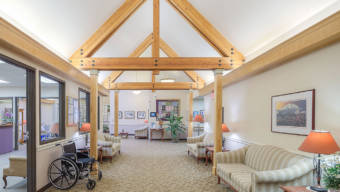
Wildflower Court, a longterm care facility, in Juneau, Alaska. The facility has had an outbreak of COVID-19 among residents and staff, but despite the vulnerable patient population most cases have had no symptoms. (Photo courtesy Wildflower Court)
Juneau longterm care facility Wildflower Court, where a staff member tested positive for COVID-19 on Monday. (Photo courtesy Wildflower Court)

Over the weekend a staff member at Juneau’s Wildflower Court nursing home started to feel mildly ill. That person got tested on Monday and turned up positive for COVID-19.

Family of residents were sent notices on Tuesday. So far, no else has tested positive.

“We had one staff member that tested positive, but they had no contact with residents and very limited contact with any other staffers,” said Kirk Elmore, an administrator with Wildflower Court.

Because of the surge in cases in Juneau, unvaccinated staff are being tested weekly. After they had a positive case, the nursing home tested all unvaccinated staff members and two vaccinated staff members who were close contacts. In its letter to families, Wildflower Court reported that nearly 84% of its staff and about 88% of its residents are vaccinated.

Elmore said they’re still urging people to wash their hands, keep their distance from each other, and limit the sizes of their social bubbles. Despite evidence that vaccinated people can carry and spread the Delta variant of COVID-19, Elmore said it’s still a good idea to get one.

“I think being vaccinated is our best defense, even against the variant, for us to keep our residents safe and our staff safe as well,” he said.

Wildflower Court is still allowing visitors with some restrictions. Everyone has to wear a mask, they’re screened when they come in, they’re only allowed to visit one resident at a time and they’re asking for unvaccinated people to stay away from the facility and find alternative ways to communicate with residents.

This is the third time Wildflower Court has reported positive cases onsite, though only one involved patients. The facility was one of the first of its kind in the state to have over 80% of its staff vaccinated.

Elmore said the hope is that while people can still carry COVID-19 while vaccinated, it will prevent more severe infections.

“From what I am understanding…if there are breakthrough cases the nice thing about that is they’re either asymptomatic or they’re not as sick as what we’ve seen in the pattern of unvaccinated people,” he said.

A dozen women have accused former Juneau-area chiropractor Jeffrey Fultz of sexual abuse

The Dimond Courthouse in Juneau on Feb. 27, 2017. (Photo by Jeremy Hsieh/KTOO)
The Dimond Courthouse on Feb. 27, 2017, in Juneau. Former Juneau-area chiropractor Jeffrey Fultz has been indicted three times on felony charges of sexually abusing a dozen of his female patients.  (Photo by Jeremy Hsieh/KTOO)

Content warning: This article includes mentions of sexual assault and abuse that may be uncomfortable for some readers. Resources are available at the bottom of this post.


Five more women have accused former Juneau-area chiropractor Jeffrey “Jeff” Fultz of abusing them under the guise of treating them for medical problems. 

And while several of his accusers — and the state’s prosecutor — have again asked that he be returned to Juneau to post a higher bail and be monitored, a judge decided against it in early July. 

Fultz worked for the Southeast Alaska Regional Health Consortium, or SEARHC, for seven years. He left after a Juneau woman told police in April that he sexually assaulted her. 

Initially, he faced three charges of sexual assault, but when those charges became public, more women came forward. A total of 12 women are accusing him of abuse; he faces 17 charges of felony sexual assault and misdemeanor harassment.   

Currently, Fultz is out on bail. A total of $45,000 in cash has been put up by him or on his behalf, according to case records. The court has ordered him to turn over his passport, avoid contact with SEARHC or any of the women accusing him of assault. He has also been ordered not to provide medical care – regardless of the status of his license. 

But, several of the women who are accusing him of assault and the district attorney want the court to change those conditions. 

The accusations

Each time Fultz has faced new charges, State Assistant District Attorney Jessalyn Gillum asks that the court reconsider its decision to allow him to live out of state, unmonitored. 

“I believe this is our third time addressing bail regarding this case. Each time the circumstances have changed such that the state feels that readdressing the conditions of the defendant’s release is of paramount importance,” Gillum said during an early July arraignment. 

She went on to describe accusations from women who said they were groped during sessions, including one woman who described being treated after-hours. 

“When the entire office was emptied out and most of the office was actually dark. Where she was made to fully undress and the defendant then spent a significant portion of the session massaging her buttocks in a way that did not serve any legitimate chiropractic or massage therapeutic function,” Gillum said.    

She noted the similarities between the details of some of the women’s accounts, saying that multiple women described discovering that Fultz was sexually excited during their sessions with him. 

“All of these women describe being required to undress for these appointments to continue. The defendant never explained why disrobing was necessary. Some of these women have since gone to other treatment providers and now see the distinction and differences in the way they were treated and the way their bodies were handled to fully understand that what was done when seen by this defendant was in fact a violation and an assault rather than legitimate medical treatment,” Gillum said.  

Main Street on July 2, 2013 in Durango, Colorado. Former Juneau chiropractor Jeff Fultz has been accused of assaulting 12 women while working at the Southeast Alaska Regional Health Consortium. He is currently out on bail and living in Durango. (Photo courtesy Daveynin/Flickr)
Main Street on July 2, 2013, in Durango, Colorado. Former Juneau chiropractor Jeff Fultz has been accused of assaulting 12 women while working at the Southeast Alaska Regional Health Consortium. He is currently out on bail and his lawyer said he recently moved to Durango. (Photo courtesy Daveynin/Flickr)

‘I think he should be here’

Gillum said the state is concerned that Fultz is still a threat to the communities he lives in and that the court should weigh the strength of the state’s case against him heavily when considering the conditions of his release. 

“The concern that the state has is that the defendant has shown himself to be an individual that goes from Native community to Native community and seems to have a history of allegations such as this arise at multiple placements,” she said.

According to Indian Health Service records, before Fultz practiced in Juneau he primarily treated citizens of the Navajo Nation working in Arizona and New Mexico for at least 14 years including in: 

The court also heard similar arguments from a handful of the predominantly Alaska Native women who have accused Fultz of sexual misconduct. The court did not identify the women or ask them to identify themselves; it is KTOO policy not to name alleged victims of sexual crimes. 

The Four Corners Regional Health Center is one of a handful of places former Juneau chiropractor Jeffrey Fultz has worked for the Indian Health Service. Fultz has been accused of assaulting 12 women during his time practicing in Juneau. (Photo courtesy Indian Health Service)

A woman referred to as C.E.L. told the court that it is incredibly difficult for her and other victims to come forward and speak. But she characterized Fultz as a “methodical predator” and said she doesn’t want other women to be victimized by him. 

She asked that the court listen to what Fultz’s accusers say they want of him, instead of deciding what is best for them. 

“The truth is that we will eventually have to face Mr. Fultz here in the court,” she said. “But I can honestly say that the discomfort of possibly running into him at the store or anywhere here in Juneau is nothing compared to the thought of him running free in another state without the supervision and monitoring that needs to be in place.”

Another woman cried as she told the court that she met Fultz after seeking treatment from SEARHC during her journey toward sobriety. 

“I could have easily just went down that road again,” she said. “But, as of now I have two years of sobriety and I can’t — and I refuse to let him be any purpose for me to self-destruct anymore.”

She, too, said Fultz should have to be in-person in court in Juneau. 

“You know I feel like I’m coming to court and putting all of this energy into these meetings and he’s able to just call on the phone and just be wherever he’s at and just let the court know, ok well I’m moving to this place now,” she said. “You know, this incident happened in Juneau and I think under the circumstances … I think he should be here and I think he should be monitored also.” 

Fultz is not supposed to be practicing while the case is working its way through the court system. And he can’t legally practice in Alaska. In April, the state’s Director of the Division of Corporations, Business and Professional Licensing asked Alaska’s Board of Chiropractic Examiners to suspend his license to practice, arguing that he posed a “clear and immediate danger to the public health and safety.” Fultz then surrendered his Alaska license on May 17. 

But Gillum said there is no way for the state to enforce the provision that he does not practice when he is living, unmonitored, outside of Alaska. 

Defense attorney Natasha Norris makes her closing arguments before the jury on Monday, Oct. 7, 2019 during the Laron Graham double homicide trial in Juneau Superior Court.
Defense attorney Natasha Norris makes her closing arguments before a jury on Oct. 7, 2019, Juneau Superior Court. Norris is representing former Juneau chiropractor Jeffrey Fultz who has been accused of sexually assault a dozen of his former patients and a colleague at the Southeast Alaska Regional Health Consortium. (Photo by Matt Miller/KTOO)


Pushing back

Neither Fultz nor his attorney, Natasha Norris, have responded to repeated requests for comment. But in court, Norris pushed back against the state’s request that Fultz’s bail be raised or that he be required to move back to Juneau. 

She said it is important to remember that the charges are just accusations, that Fultz is presumed innocent and pointed out that he has cooperated fully with the state. 

“As compelling or heartfelt as some of these statements are, these are allegations at this point,” she said. 

She argued that he isn’t a flight risk because his passport is sitting in her office. And she said he has put up enough money for bail. 

“My client has put up $40,000 of cash,” she said. “He is about tapped out financially. That is a lot of money to put down on the line. My client is not going to run, my client is facing these charges head-on.”

Norris told the court that Fultz is moving to Durango, Colorado to be closer to his daughter. She said he bought a house and gave an address that, according to Zillow,  sold for more than $900,000 in June. 

Juneau Superior Court Judge Daniel Schally addresses those who attended his installation ceremony March 29, 2019 at the Dimond Courthouse. (Photo by Matt Miller/KTOO)
Juneau Superior Court Judge Daniel Schally on March 29, 2019 at the Dimond Courthouse in Juneau. (Photo by Matt Miller/KTOO)


A presumption of innocence

Alaska Superior Court Judge Daniel Schally ultimately sided with Norris, He said he understands how challenging it is for the women to come forward and share their experiences publicly.

“Many such crimes are never reported, period. Whether to authorities, family members, the court… it is incredibly difficult to discuss those matters, and at least a couple of folks who spoke quite eloquently here in court today have spoken in court previously as well — and obviously have testified at a grand jury proceeding, and that takes a lot of courage, and I acknowledge that,” he said. 

Though Schally said the nature of the charges Fultz is facing indicates some level of flight risk, he also noted that Fultz doesn’t have a criminal history. He joined Norris in saying the presumption of Fultz’s innocence applies. 

And, as he has said before, Schally said he believes Fultz shouldn’t be in Juneau. 

“While I understand it makes some people unhappy, I think it’s actually a very good thing on multiple levels,” Schally said. “Usually a geographical distance between the alleged victims of crime and alleged perpetrators of crime is a good thing, and given the number of folks involved in this matter, having Mr. Fultz elsewhere, I think is the best course.”

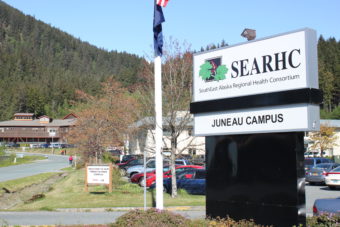
The Southeast Alaska Regional Health Consortium’s Juneau campus. Former SEARHC chiropractor Jeffrey Fultz has been accused of sexually assaulting a dozen women while working at the facility.  (Photo by Lisa Phu/KTOO)

SEARHC responds

Fultz worked for SEARHC, but the consortium says he was a federal employee assigned to the facility by the U.S. Public Health Service Commission Corps — a type of uniformed health worker that follows quasi-military rules. 

A spokesperson from SEARHC says the organization removed Fultz from the workplace and informed the public health service about the situation in 2020 after getting patient complaints  

“This was before criminal charges were filed,” the spokesperson wrote. 

He is the latest in a string of Indian Health Service medical providers who have been accused of abusing patients. It’s something the U.S. Department of Health & Human Services — the Indian Health Service’s parent agency — acknowledged late last year continues to be a challenge for the service to address. 

As the case against him unfolds, a SEARHC spokesperson said the health consortium is taking steps to address the conditions that led up to the complaints against Fultz. In an email, the spokesperson wrote that consortium leadership has met to review policies with managers. 

“Additional trainings were mandated for all employees to address sexual assault, harassment and offense behavior,” she wrote. 

In early 2021, the Indian Health Services established a hotline for callers to report suspected child abuse or sexual abuse by calling 1-855-SAFE-IHS (855-723-3447) or submitting a complaint online IHS.gov website. The hotline may be used to report any type of suspected child abuse within the IHS, or any type of sexual abuse regardless of the age of the victim. The person reporting by phone or online may remain anonymous.

Locally, people can call AWARE in Juneau at 907-586-1090. 

Fultz’s next hearing is Sept. 8. 

Site notifications
Update notification options
Subscribe to notifications