I help the newsroom establish daily news priorities and do hands-on editing to ensure a steady stream of breaking and enterprise news for a local and regional audience.
That means that beginning at noon on Friday indoor gatherings are limited to 50 people and masks will be required. The city is recommending people instead gather outside.
Indoor bars and gyms must stay at or below 50% of their capacity. Restaurants are recommended to reduce capacity and require reservations. And personal service businesses, like barbers and hairdressers, must require appointments and can’t have waiting areas.
Health officials continue their push for testing and vaccinations. Nearly 65% of Juneau’s population is fully vaccinated.
Anyone 12 years and older can sign up to get vaccinated at juneau.org/vaccine or by calling 586-6000, seven days a week between 8 a.m. and 5:30 p.m.
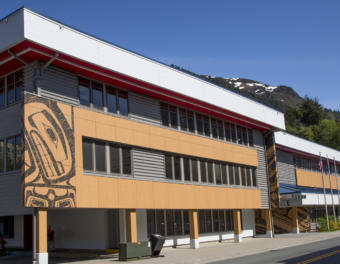
The Andrew Hope Building, pictured here on Feb. 10, 2021, houses the headquarters of the Central Council of Tlingit and Haida Indian Tribes of Alaska. In July 2021, leadership of the council decided to require the COVID-19 vaccine for employees. (Photo by Jeremy Hsieh/KTOO)
Southeast Alaska’s largest tribal organization will be requiring its employees to be vaccinated against COVID-19.
Leadership at the Central Council of Tlingit & Haida Indian Tribes of Alaska met Friday and decided to require the vaccine. There will be an exemption process, though it hasn’t been explicitly laid out.
The executive council will also require delegates who attend the September tribal assembly in-person meeting to be vaccinated as well.
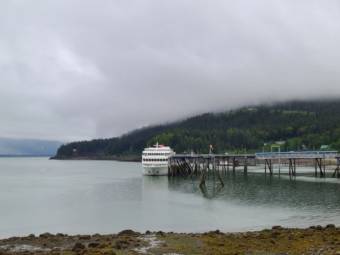
The American Constellation docked in Haines on June 12, 2021 coming from Skagway the day before. Three people connected with the ship tested positive for COVID-19 while it was docked in Petersburg. The ship is headed to Juneau for a 10-day stop and has cancelled its July 14 cruise. (Corinne Smith/KHNS)
The American Constellation cruise ship is headed to Juneau after three people tested positive for COVID-19 while visiting Petersburg.
The ship has 162 guests, all fully vaccinated. According to a City and Borough of Juneau press release, all will be flying out from Juneau once they arrive. There are also 52 crew members, but they are not all fully vaccinated.
The first case in the outbreak was discovered Thursday, though the Petersburg Medical Center reports that the risk to the community is considered to be low.
Despite the positive case, the company — American Cruise Lines — allowed passengers to leave the boat Friday morning for their tourist activities because they are fully vaccinated, according to a media release from the medical center.
Two new cases were discovered on Friday. All three stayed behind in Petersburg to isolate. The company also left a representative in Petersburg. Crew on the ship who are close contacts with the infected will quarantine on board.
In a prepared statement, the company said two of the people who tested positive are fully vaccinated.
The ship is set to arrive in Juneau early Saturday morning and will stay for 10 days, according to a City and Borough of Juneau media release.
The Constellation’s July 14 voyage has been cancelled.
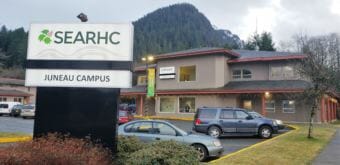
The Juneau campus of SEARHC, pictured here on Dec. 19, 2018, is located off Hospital Drive. Several women have accused a chiropractor who worked for the regional health consortium of sexual abuse. (Jeremy Hsieh/KTOO)
Seven women have accused a former Juneau-area chiropractor of sexually abusing them while he was working at the Southeast Alaska Regional Health Consortium, or SEARHC.
Jeffrey Fultz was working for SEARHC until 2020. Last April, Juneau Police heard from a woman who said he sexually assaulted her while she was receiving medical care from him.
Initially, Fultz — who goes by Jeff — faced three charges of sexual assault in the second degree and one harassment charge.
But Assistant District Attorney Jessalyn Gillum said that after those charges became public three months ago, four more women stepped forward saying they were also abused by Fultz.
“There are a couple of things that keep coming up. The first is the fact that they were all made to undress regardless of the type of treatment they were expecting to receive,” Gillum said.
She said there are other common threads between the women’s stories as well. Gillum said several of the women described sexual contact that was disguised as normal medical care — making it difficult to distinguish between the two.
“It was contact that made them uncomfortable or that raised concerns as far as whether it was appropriate. And then, either through the defendant giving some explanation as to the reason for the contact or the individual patient just sort of assuming they were being overly sensitive or just feeling like they were overreacting in some way, they convinced themselves that it was normal,” Gillum said.
Six of the women are Alaska Native. SEARHC is a non-profit, Native-run health consortium. The seventh accuser is a former colleague of Fultz’s, according to court documents.
Maegan Bosak, a spokesperson for the consortium, wrote in an email that they are aware that Fultz has been charged with sexual assault and harassment. Bosak also wrote that Fultz was a federal employee who no longer has any affiliation with the group.
“SEARHC terminated Fultz’ assignment following patient complaints about inappropriate conduct,” Bosak wrote.
Fultz was given the opportunity to resign from SEARHC rather than being fired in light of the criminal investigation, according to court documents Gillum submitted on Friday.
SEARHC Senior Vice President and Chief Administrative Officer Matthew Ione, in a prepared statement, said that the organization — which offers medical, dental, wellness and social services to 27 communities in Southeast Alaska — doesn’t tolerate assault, harassment or offensive behavior.
“Due to the ongoing criminal prosecution, we cannot say anything more about this specific matter. But we want to assure our patients that they have the right to safe health care at SEARHC,” Ione said. “We will do everything in our power to assure that this is the case. There are no exceptions.”
Altogether, Fultz is accused of eight felony counts of sexual assault and one count of harassment from alleged incidents that happened between 2014 and 2020.
He was arraigned on the new charges Monday afternoon at the Juneau courthouse, where he appeared by video.
Fultz is out on a $25,000 bail and is allowed to live out of state in New Mexico despite testimony last month from two of his alleged victims who asked that he be required to stay in town while the case moves through the court system.
Gillum asked that the court reconsider Fultz’s bail, given that he faces new charges. She asked for bail to be increased by $25,000 cash and for Fultz to be arrested, returned to Juneau and held at Lemon Creek Correctional Facility.
She said he’s a flight risk and a risk to community members because there is no way for the state to monitor his behavior to ensure that he’s not practicing massage therapy, physical therapy or chiropractic care and working in the conditions that led to the current allegations of abuse.
Two of Fultz’s accusers also testified, including a woman the courts are identifying as C.E.L.
“I have come to know Mr. Fultz to be highly intelligent and highly manipulative,” she said. “The risk of further violence to us as victims is low, but I believe the risk to the community that he lives in as well as to our community is high.”
She asked that he be returned to Juneau and that his bail be set at a point that he cannot post. She asked that the court remove Fultz’s ability to practice any type of medical care and that he be monitored if he is released on bail.
Both Gillum and C.E.L. reiterated that the majority of Fultz’s accusers are Alaska Native. C.E.L. told the court that, in her view, the alleged crimes should be considered racial abuse.
Another woman, who did not identify herself but was identified as an accuser by Gillum, also asked that Fultz be returned to Juneau and put in jail.
“It was really hard for me to understand how Mr. Fultz is out and about and free to do what he is doing right now,” she said.
She said that every day is a struggle and her entire family has felt an impact from her contact with Fultz.
“I have to find a medical facility that I’m comfortable with now because of him,” she said. “I just think the conditions on him need to be more serious because these crimes are very serious.”
Fultz’s attorney, Natasha Norris, said that he was willing to pay a higher bail and has been cooperating with the court throughout this process.
“We understand that the stakes have risen and, in meeting that, he is willing to put down another $15,000 cash,” Norris said. “That’s pretty much going to financially tap him out.”
Judge Daniel Schally agreed with Norris, saying that Fultz has been cooperating with the court.
“Past behavior is also an indicator of future behavior, and in that regard, the past behavior is good. Now I understand also on the other side of that coin given the very serious and increased number of allegations here the state could as well argue that that’s an indicator of future behavior as well — and point taken,” Schally said.
Schally said he did not agree that returning Fultz to Juneau is a good idea.
“I frankly like the idea of Mr. Fultz not being anywhere near these folks in Juneau,” he said. “He’s not here, he’s not going to be here under the court’s current orders. That, in my view, provides a significant degree of assurance that future behavior of these sorts that are alleged here are not possible in this community.”
Schally said he understood that people who are accusing Fultz of abuse feel strongly that he should be in jail, but that desire was not sufficient for the court to keep him incarcerated.
“That’s simply not how this works,” he said. “And that is not how it works pre-trial, when — at this point, although there is significant evidence to support these allegations — there is a presumption of innocence that applies.”
Ultimately Schally ordered Fultz not to practice medicine of any kind anywhere, required that he pay $15,000 more in cash and said he can’t have contact with any of his accusers.
Fultz’s next hearing is September 8.
The Juneau Police Department is asking that anyone who knows about this case or who may have similar allegations contact its Criminal Investigation Unit or call AWARE — the shelter and support institution for survivors of domestic and sexual violence — at 907-586-6623.
This story has been updated with details and comments from Monday’s arraignment hearing
Correction: A previous version of this story referred to Jeffrey Fultz as a doctor. He was a chiropractor.
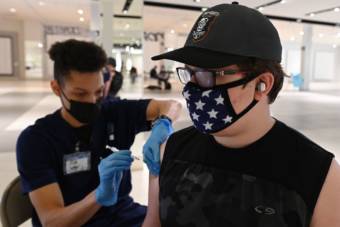
Josh Gardner, a nationally certified medical assistant, gave Kael Harrod, 15, his first dose of the Pfizer vaccine at the Visit Healthcare vaccination site in the Dimond Center on Thursday, in Anchorage. (Bill Roth / ADN)
This spring, Alaska was hailed as a vaccination success story — shipping doses via plane, snowmachine and boat to remote corners of the vast state. But it has gradually fallen from first place to the middle of the pack in the six months since the first doses of COVID-19 vaccine arrived here in mid-December.
In March, Alaska became the first state in the country to open up vaccinations to all residents 16 or older, without other restrictions on eligibility. Health officials say that in the months since then, however, a saturation of available vaccine hasn’t translated into a corresponding number of vaccine recipients.
“We’re definitely seeing more supply than demand,” said Matt Bobo, the director of Alaska’s immunization program, during a call with reporters Thursday.
The state even opted to donate about 3,000 doses of its allocated vaccine recently to a federal pool based on an assessment that the vaccine wouldn’t get used, Bobo said.
In contrast, some cities and states in the Lower 48 are chugging toward widespread vaccine coverage. The national average of those 12 and older with at least one shot is 61.5% while Alaska’s average is 54%. By Thursday, Alaska had fallen to No. 28 among states for per capita vaccinations, according to data from the Centers for Disease Control and Prevention.
This week, Seattle Mayor Jenny Durkan announced that with 78% of those 12 and older having received at least one vaccine dose, “Seattle is America’s most vaccinated major city,” the Seattle Times reported.
San Francisco was neck-and-neck with Seattle: The city’s vaccine tracker showed that about 79% of its eligible residents had received at least one vaccine dose by Wednesday — at or close to a “herd immunity” benchmark that epidemiologists say can occur once 70% to 80% of a population is immune to a virus.
Meanwhile, just over half of eligible Alaskans had received at least one dose of COVID-19 vaccine as of Thursday morning while a higher percentage of its more vulnerable 65-and-older population — about three-quarters — was at least partially vaccinated.
That puts Alaska’s current vaccination rate several points below the national average, said Dr. Joe McLaughlin, Alaska’s state epidemiologist.
“We’ve got a lot of work to do to kind of catch up with the rest of the nation,” he said.
Although Alaska’s coronavirus case counts have been falling since early spring, slumping vaccination rates through the summer could mean an uptick in cases come fall. There will be more COVID-19 activity in the colder months, McLaughlin suspects, but the number of people vaccinated in the state will likely help determine how much virus spread may occur.
Six months into the vaccine rollout, vaccination rates have varied widely across Alaska. Some of the least vaccinated regions happen to be some of the state’s most populated and connected areas, where vaccines are available at restaurants, fairs and just about every major grocery store chain. Meanwhile, some of the state’s more remote and hard-to-reach regions are recording some of the highest rates of vaccination.
For example, 84% of eligible residents in the Aleutians East Borough — which leads regions statewide — have received at least one dose of vaccine. Regions including Skagway, Bristol Bay and the Nome Census Area are also seeing some of the highest vaccination rates.
On the opposite end of the spectrum, the Southeast Fairbanks Census Area has a 31% vaccination rate, followed by the North Slope with 35% and the Mat-Su Borough with 37%. The Municipality of Anchorage, Fairbanks North Star Borough and the Kenai Peninsula Borough are all in the bottom third as well.
Much of the success in many rural communities in Alaska can be attributed to strong tribal health presence in those places, where primary care providers and public health nurses have strong relationships with their patients and the communities they serve.
In communities with lower vaccination coverage, the slowdown can’t entirely be traced to vaccine hesitancy, McLaughlin said. Rather, he said, many young, healthy people are busy and likely have not gotten around to taking the time to get a shot.
Six months ago, state leaders expected to have significantly fewer doses of the shots, said Dr. Anne Zink, Alaska’s chief medical officer, and being able to vaccinate people as young as 12 is another unexpected development that has boosted the vaccine effort. Goals have changed, and health officials are putting their efforts into driving up demand for the shots.
State officials said this week that they hoped that over time, more Alaskans would opt to get vaccinated, and they emphasized how well the vaccines appeared to be working: Since Jan. 1, 98% of COVID hospitalizations have been among people who were unvaccinated.
“The vast majority of people who have gotten vaccinated are not getting sick,” added Louisa Castrodale, an epidemiologist with the state health department. “I think that speaks to the effectiveness of the vaccines.”
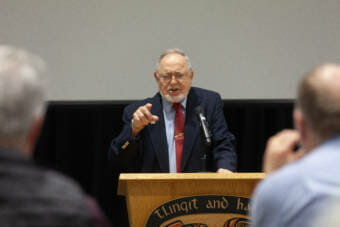
State Sen. Jesse Kiehl, D-Juneau, listens to U.S. Rep. Don Young, R-Alaska, speak during a Juneau Chamber of Commerce lunch on Thursday, at the Elizabeth Peratrovich Hall in Juneau. (Rashah McChesney/KTOO)
For the first time in nearly 15 months, Juneau’s Chamber of Commerce met for lunch, in person. About 55 people gathered, unmasked, to hear U.S. Rep. Don Young, R-Alaska, speak.
McHugh Pierre, the president and CEO of Goldbelt, Inc., is on the chamber board. He said they decided to host an in-person lunch after looking at the community’s COVID-19 vaccination level — just over 60% of the total population is fully vaccinated.
Pierre said Elizabeth Peratrovich Hall on Thursday is a kind of reward for social responsibility among community members, but it was also a little awkward.
“You definitely see people trying to get used to engaging,” he said. “A lot of people are unsure, sometimes they don’t know if they want to fist bump or shake hands or hug. And I think really it’s out of respect. It’s respect for their friends and neighbors to make sure that they don’t step over someone’s boundary inadvertently.”
The event was unmasked, though staff for the lunch wore them. Pierre said that was refreshing, too — especially for members who have been keeping each other company over Zoom for more than a year.
“I love seeing everyone smile. You know, we’ve learned to show it with our eyes, but now we can do it like we used to. Use our entire face for expressions and it just feels good to welcome everyone and see the joy,” he said.
U.S. Rep. Don Young, R-Alaska, takes questions from people who attended an in-person Juneau Chamber of Commerce lunch on Thursday at the Elizabeth Peratrovich Hall in Juneau. (Rashah McChesney/KTOO)
Young only spoke for about five-and-a-half minutes, but he said that was purposeful.
“I was an old schoolteacher. You know the attention span of a fifth-grader is five minutes. You know what the attention span of an adult is? Four,” he said to laughter from the audience.
Young spent about 30 minutes taking questions about everything from energy and mining to tourism to the job market and locally grown foods. Pierre asked about how Young advocates nationally for rare earth mineral mining in Alaska, especially given the nation’s dependence on China for them.
Young said this is a huge issue and that the country needs Alaska to develop its mineral resources responsibly. He referenced President Joe Biden’s 30-30 executive order, which promises to protect 30 percent of U.S. land and oceans by 2030.
“I talked to him and said ‘you’re n— I didn’t say ‘he’s nuts,’ you can’t tell that to the President. But I sure thought it. But why not take an inventory of what’s on those lands first. If it’s highly mineralized, that’s not included,” Young said.
State Sen. Jesse Kiehl, D-Juneau, asked about the prospects of getting an infrastructure bill through Congress given rocky negotiations between President and Senate Republicans. Biden announced a roughly $2 trillion plan in April that would fund U.S. infrastructure but most Republicans have balked at the price tag.
“I want to say there will be a bill. I’m not sure yet if it’s going to look like a polka-dotted horse or what,” Young said. “I really get irritated with the president right now because people are pushing him to do things that should be in infrastructure and it’s a huge cost. And the public wants infrastructure, but they want bridges and roads, rails and planes, ships and harbors. They don’t want removal of lead pipes — good as it is — from people’s homes in an infrastructure bill. They don’t want all of that other stuff.”
Close
Update notification options
Subscribe to notifications
Subscribe
Get notifications about news related to the topics you care about. You can unsubscribe anytime.