Rashah McChesney

Daily News Editor

I help the newsroom establish daily news priorities and do hands-on editing to ensure a steady stream of breaking and enterprise news for a local and regional audience.
Alaska providers pause use of Johnson & Johnson vaccine while feds investigate rare risk of blood clots

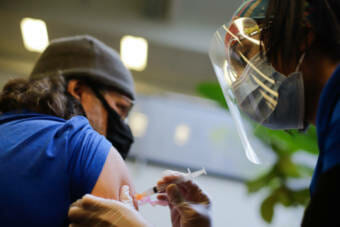
Vauoti Tuga receives a vaccine at the Manai Fou Assembly of God Church in Airport Heights on Feb. 23, 2021. Alaska providers are pausing use of the Johnson & Johnson vaccine while the CDC and FDA investigate a rare blood clot that a handful of people have developed after receiving the shot. (Jeff Chen/Alaska Public Media)

Alaska providers are following the federal recommendation to pause use of the Johnson & Johnson COVID-19 vaccines while they figure out the clotting risk. 

About 6.8 million doses have been administered in the U.S., and a handful of people have gotten a rare blood clot afterward. 

During a mid-morning call, state medical officials said they’ll be talking to all of the Johnson & Johnson providers in the state about what to look for and what to do with the vaccine supplies they currently have. 

Pharmacist Coleman Cutchins said this type of issue with new drugs happens often because clinical trials are performed on just a few thousand people. Then, when the drug or vaccine gets to market and millions of people start taking it — these types of rare side effects become clear. 

“I remind people that Ibuprofen has a similar bleeding risk to this and it’s in the black box warning on the packaging,” he said.  

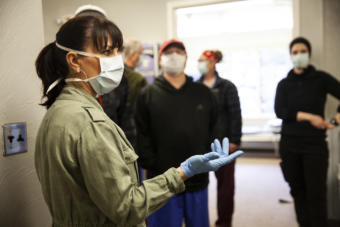
Charlee Gribbon, infectious disease preventionist from Bartlett Regional Hospital, left, and Adam Crum, Alaska Department of Health and Social Services commissioner, center, answer questions about coronavirus on March 5, 2020. (Photo by Rashah McChesney/KTOO)

The specific type of clot that the Centers for Disease Control is investigating is called a cerebral venous sinus thrombosis or CVST. And it’s essentially in an area of the brain where when the blood clots off, it can cause a lot of pressure to build. The symptoms can vary, but Providence Alaska Medical Center Dr. Lisa Rabinowitz said when it’s severe – symptoms are similar to a stroke. 

“So headache, visual changes, dizziness, syncope or passing out, decreases coordination or weakness on one side, one arm one leg. Seizures and even a coma,” she said. 

One issue is that the go-to medication for these clots can make people sicker because these clots are being seen in combination with low levels of blood platelets. 

Rabinowitz said doctors and medical providers in Alaska need to know the different treatment options. 

“So we’ll be getting that information out to providers throughout the next few days,” she said.  

The CDC’s principal deputy director, Dr. Anne Schuchat told NPR that people who got a Johnson & Johnson shot more than a month ago are at low risk for developing a clot. But people who got one within the last few weeks should be on the lookout for symptoms like headache, abdominal pain and shortness of breath and should seek medical treatment if they develop them. 

The data the CDC released indicates that there may be about a one in a million risk of blood clots. The agency told NPR that it expects this pause to last for a “matter of days.”

Juneau’s Emergency Operations Manager Robert Barr and Rebecca Embler, a member of Bartlett Hospital quality team during Juneau’s COVID-19 vaccine clinic at Centennial Hall on Jan. 15, 2021, in Juneau. (Photo by Rashah McChesney/KTOO)

While the state health department hasn’t yet heard from all of the providers it knows are using the Johnson & Johnson shot — they’re scheduled to meet with many of them Tuesday afternoon —  state health officials, municipalities and providers in the state said that halting the use of this particular vaccine isn’t much of a burden. 

A spokesperson for the Alaska Native Tribal Health Consortium said the group is following the guidance to pause use of the vaccine. But, she said, the Johnson & Johnson vaccine isn’t a big part of the organization’s vaccination plans because they had just started ordering it.

At Juneau’s city-owned hospital, Bartlett Regional, infection preventionist Charlee Gribbon said they’d given out 10 vials of the vaccine by the end of March. That’s about 50 doses. The hospital got 20 vials in April and has used five of them so far, Gribbon wrote in an email. They’re pausing on using the rest of them and waiting for further direction. 

Gribbon wrote that so far there haven’t been any adverse reactions. 

Gribbon said Bartlett hospital was relying on the Johnson & Johnson vaccine to vaccinate people who are needle-phobic, who only want one shot or who want a vaccine that seems a little less experimental. 

Unlike the Pfizer and Moderna vaccines, the Johnson & Johnson vaccine is a viral vector vaccine. That means it uses an inactivated cold virus to stimulate the body’s response to COVID-19. It doesn’t contain live virus, so you can’t get COVID-19 from it. 

“It’s definitely fair to say that it’s a more traditional vaccine,” said Juneau Emergency Manager Robert Barr. 

Barr said this pause will impact people who have been specifically interested in the Johnson & Johnson 

“The needle phobia thing is significant,” he said. “There are people who have a sort of automatic response to needles and it’s not necessarily something they control.”

But, it won’t affect the city’s planning too much. 

“I think that we’ve only just scheduled our first Johnson and Johnson clinic,” he said. It’s supposed to be on Friday. They’ve decided to switch that clinic to the Pfizer vaccine.

There are a number of providers in the state listed as using the Johnson & Johnson vaccine in upcoming clinics. 

In Juneau, Barr said individual providers can trade in their Johnson & Johnson vaccine supplies to the city for a different kind. 

As of April 12, there have been at least 11,178 Johnson & Johnson vaccine doses administered in Alaska out of 35,500 doses allocated to Alaska so far, according to state data. Those doses have been delivered to a combination of sites like outpatient clinics, pharmacies, federally qualified health centers, local public health authorities and health systems.

Those figures don’t include the doses administered by the Veteran’s Administration or Department of Defense.  

One thing that state and local health officials in Juneau are questioning is whether the rare event of a blood clot outweighs the benefit of getting large numbers of people vaccinated against COVID-19. 

Gribbon wrote that there are other types of commonly used medications that have much higher risks — like some types of birth control. She said it’s important to know about the risks of contracting COVID-19 and of adverse reactions to a vaccination to make informed choices. 

“Yes, there may be something that is happening in a rare group of people,” she wrote. “And people should know how to recognize a clot and get treatment. We can treat a clot, and we can treat [COVID-19]. But making an informed choice about known risks and how to manage them is what this is all about.”

Another concern is that this revelation will cause people who are already hesitant to get vaccinated for COVID-19 to be even less inclined to do it. 

“This is a concern that will cause some people to be more hesitant about the vaccine,” said the state’s Chief Epidemiologist Dr. Joe McLaughlin. “In terms of how we counter that, I think the biggest thing is really relaying the information … It’s really important to be as transparent as we possibly can as quickly as we possibly can so that the public realizes that we’re not holding anything back.” 

The CDC will meet on Wednesday to review the cases and the Food and Drug Administration is also continuing to investigate. 

Editor’s note: This story has been updated.

Federal funds could fill in Juneau’s budget gap from last year and take a big bite out of next year’s

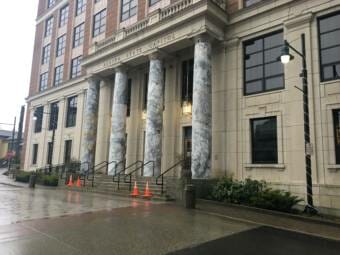
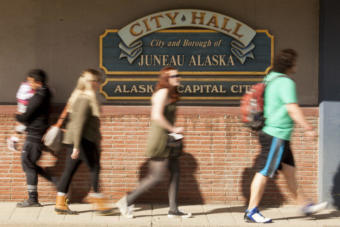
A group walks in front of Juneau City Hall on Tuesday May 10, 2016 in Juneau. City leaders are in the process of figuring out next year’s budget. (Photo by Rashah McChesney/KTOO)

It’s budget season again and Juneau city leaders are projecting another year of spending more than the city brings in.

But, city manager Rorie Watt told members of the Juneau Assembly’s finance committee that it could be worse. The city is supposed to get $12.8 million from the American Rescue Plan Act — that’s the latest federal economic stimulus bill. 

“Not to say that it’ll be a slam dunk, but the position we find ourselves in — nearly $13 million to the better makes for a substantially different budget season,” Watt said. 

Those funds could go a long way toward filling Juneau’s budget gap, depending on how Assembly members decide to spend them.

 In his budget message to the Assembly, Watt said there will likely be public calls to instead use that funding to support Juneau’s struggling families and businesses. But he also noted that there is more than $1 billion coming to the state government that could benefit people who need help as well. 

Last year, the city spent a lot of money during the pandemic that the Assembly hadn’t originally budgeted for — that’s everything from city busses running for free to standing up an emergency operations center.
It wasn’t bringing in as much money either. In addition to the massive hit from the loss of the cruise season, Juneau also lost funds from the closure of libraries and pools and city recreation facilities.

The city got federal stimulus funds from the CARES Act and reimbursement from the Federal Emergency Management Agency, but the end result of the unexpected expenses is a nearly $4.6 million gap between what the city made and what it spent. 

Watt is recommending that some of the funds from the American Rescue Plan be used to backfill that loss.

The city’s finance office is projecting that it will bring in slightly more money next year than it did last year. But Watt’s budget assumes that life will be slow to return to normal, and while the city might see an uptick in independent travelers this year, the lack of a cruise season will still be a huge hit. 

Still, Watt’s budget is not balanced. It anticipates a more than $7.8 million shortfall that the city will have to absorb. 

This budget isn’t final. Assembly members ultimately must decide how money will be spent. They’ll be meeting every week to talk about it through the end of May — including this coming Wednesday when they’ll be hearing from the airport, hospital and Eaglecrest. They’ll also be talking about the American Rescue Plan Act and what it means for the city. 

Watch: Juneau to give its latest update on COVID-19

City leaders will give an update the on Juneau’s COVID-19 response at 4 p.m. on Tuesday. They’ll also answer questions from residents.

The meeting can be streamed here or via Zoom.

The city also announced its April vaccine allocation:

  • 2,340 Pfizer
  • 800 Moderna
  • 300 Johnson & Johnson

The Pfizer doses will go to the city clinics, while the Moderna and 200 of the Johnson & Johnson doses will be allocated to local pharmacies. The remaining 100 Johnson & Johnson doses will go the hospital ER.

The city is also holding an April 9 vaccine clinic specifically for eligible high school students. Registration will be conducted through the school district.

On Wednesday, the city will host a community forum on vaccines at 5 p.m. with state Chief Medical Officer Dr. Anne Zink, Juneau’s Dr. Robert Urata, State Division of Public Health nurse Ali Gottschlich, Bartlett infection preventionist Charlee Gribbon and pharmacist Scott Watts. Community members will be able to ask questions in advance, via Zoom.

Juneau’s new hospital CEO has been working at Bartlett for 28 years

Bartlett Regional Hospital Chief Nursing Officer Rose Lawhorne walks through a newly converted spillover facility designed to house COVID-19 patients on Monday, April 7, 2020 in Juneau, Alaska. The city decided to remove patients from the Rainforest Recovery Center alcohol and drug treatment building and convert it into a facility for non-critical coronavirus patients. (Photo by Rashah McChesney/KTOO)

After a nationwide search for a new CEO — the hospital’s Board of Directors chose Rose Lawhorne, the current chief nursing officer to fill the vacancy left by Chuck Bill. 

Lawhorne has been with Bartlett since 1993. She has worked in many positions at the hospital including the Emergency Department director, a staff nurse, a data entry clerk and as an assistant chief clinical officer before becoming the head nurse. 

She’ll start on April 4 and will earn a salary of $320,000 a year — about $33,000 less than what Bill was making when he retired.

This is a developing story. Check back for updates.

Bartlett Regional Hospital cited for infection control issues

A mostly empty hospital hallway
The critical care unit at Bartlett Hospital on April 7, 2020, in Juneau. State inspectors have found infection control violations at the hospital. (Photo by Rashah McChesney/KTOO)

Inspectors from the state’s health department visited Bartlett Regional Hospital in Juneau in January after an employee complained of an unsafe workplace. 

Then, in late February, the hospital got a notice of the violations the inspectors found. And because the hospital was out of compliance for some conditions needed for federal Medicare and Medicaid funding, the issues had to be fixed quickly. 

Acting CEO Kevin Benson told the hospital’s Board of Directors during a Feb. 23rd meeting that Bartlett had 10 days to respond with a plan to correct each problem. 

“Those have to be implemented and in place within 90 days or more bad things happen,” Benson said. 

The issues that the state inspectors flagged generally focused on screening and infection prevention. 

“They did find that we had good policies but we weren’t 100% in following all of our safe practices,” said Bartlett Infection Preventionist Charlee Gribbon.

For instance, the hospital set up a screening station at the front door. But, inspectors saw people come into the building,  take a mask, get their temperatures checked and then walk right by the hand sanitizer.  

Also, some staff weren’t filling out an internal symptom screening worksheet when they came on shift — sometimes for weeks at a time.

Gribbon said they were on something of an honor system with that symptom screening worksheet and it wasn’t clear whose job it was to make sure that staff were doing what they were supposed to be doing. 

“We didn’t have good communication,” she said. But now, she said, they’ve delegated those roles among her office and shift leaders. 

Another issue is that a staff member turned up to work feeling sick and was allowed to keep working, despite meeting the criteria to be sent home. 

Gribbon said this happened right around the time that most of the staff — including the employee who had symptoms — were getting vaccinated for the virus.

“At that point, I was thinking that it was a side effect of the vaccination and it was still mild and we would test her but yet it didn’t meet the threshold that she needed to go home,” Gribbon said. 

It turns out that the employee had contracted COVID-19. 

But, the staff member who tested positive wore a mask and washed her hands at work and Gribbon said it didn’t spread to other employees that had worked with her.

Despite the embarrassment of being called out — Gribbon said she is glad that inspectors came and called attention to places where the hospital can improve. She said Department of Health nurses still have to come back to the hospital and make sure its plan to correct the problems is working.  

“It was a learning experience and I thought it was really validating for the importance of the little things,” she said.

Bartlett isn’t the only hospital in the state to be dinged for COVID-19 infection control issues. The Yukon-Kuskokwim Delta Regional Hospital was cited in August of 2020. And the Samuel Simmonds Memorial Hospital in Utqiaġvik was cited in November 2020. 


Two Alaska Senate staff members test positive for COVID-19

(KTOO file photo)

Two staff members in Alaska’s Senate tested positive for COVID-19 on Monday. 

Legislative Affairs Director Jessica Geary wrote in an email that the cases are related to each other. But contact tracing is still underway so it’s not yet clear how many people are quarantining after possible exposure. 

So far this year, nine total staff and lawmakers have tested positive for the disease. 

However, over the last two weeks, the Southeast Alaska Regional Health Consortium and Beacon — the Alaska-based company performing the COVID-19 testing and safety protocols for the legislature — have teamed up to vaccinate people who work in the Capitol, with Native health consortium providing the vaccine and Beacon staff administering it. 

Geary said 243 people have received their first dose of the vaccine so far, that’s a little over half of the 450 people who work in the building. 

Everyone who enters the capitol building — even those who have been vaccinated — is supposed to be screened for COVID-19 symptoms. Lawmakers, staff and members of the media are also supposed to be tested regularly. 

But that screening process isn’t foolproof. At least one lawmaker, Eagle River Republican Lora Reinbold, wasn’t following those rules for months before she was banned from the Capitol — other than the Senate gallery during sessions. 

A second legislator, Wasilla Republican Christoper Kurka, was asked to leave the House floor Monday morning after he called COVID-19 safety rules a “thinly veiled power play,” and removed his mask. 

Site notifications
Update notification options
Subscribe to notifications