Rashah McChesney

Daily News Editor

I help the newsroom establish daily news priorities and do hands-on editing to ensure a steady stream of breaking and enterprise news for a local and regional audience.
State launches new COVID-19 grant program requiring officials to address barriers to health care

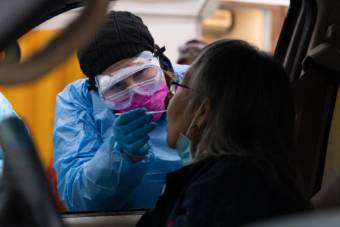
Maria Rogers answers questions as she gets registered for her second vaccine appointment during Juneau’s COVID-19 vaccine clinic at Centennial Hall on  Jan. 15, 2021, in Juneau. (Photo by Rashah McChesney/KTOO)

The state health department is rolling out a new program designed to get millions in federal funds directly to boroughs and communities to help them combat COVID-19.

Applications for the first round of $37.5 million must be made to the Department of Health & Social Services by March 15.

“I know this has been a really quick turnaround time,” said Department of Health and Social Services Program Coordinator Maria Caruso. She’ll be administering the new program. “But again we’ve been trying to get this together as quickly as possible and get it out to the communities as quickly as possible.” 

The money is supposed to be used to help with COVID-19 testing and administering vaccines. And, each grant comes with the requirement that at least 10% has to go toward activities that address obstacles to health, like poverty or discrimination. 

Caruso and others at the health department encourage communities to team up with local nonprofits and other organizations to get the funds spread out equitably among residents. 

“Let’s say you have a goal of advancing equitable vaccine distribution among the Alaska Pacific Island community,” Caruso said during a public meeting on Friday. “That might look like a local government giving funds to the Polynesian Association of Alaska which will allow them to work with trusted community leaders on community education and outreach efforts on the vaccine.”

There’s a cap on how much funding is available for each city or borough based on population size. The City of Anchorage is eligible for more than $13 million while Lime Village, near Bethel, is eligible for less than $650. 

And tribal health organizations are not eligible for the first round of funding. Caruso said they’re hoping to roll out that program by March. There will be a different application process for that one  — and it’s a much smaller pot of money.

“The overall funding for tribal health organizations is $4.6 million, that will be divided also by population. So it just has to be a slightly different process because it’s a different type of entity so that’s why they’re not included in this round of funding, but we’re hoping to get that information up as soon as possible,” Caruso said. 

Local governments will have to pay for the expenses upfront and then invoice the state for reimbursement. 

“We are going to try and make that happen as quickly as possible,” Caruso said. 

Denali Borough Mayor Clay Walker said Tuesday during a community meeting that his borough needs the money. The borough has spent its CARES Act funding and doesn’t have many medical clinics or a hospital.

“We plan on using this funding to continue the robust testing and also the partnering that we’re doing to deliver the vaccine here where there’s currently no medical backing for that. So, we need the partner and we need this funding to help,” Walker. 

 Applications are due to the state by March 15.

Update: Alaska House Republicans name lawmaker who tested positive for COVID-19

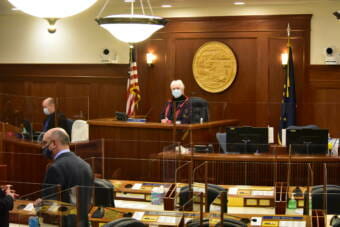
Speaker of the House of Representatives Rep. Louise Stutes, R-Kodiak, waits for lawmakers to arrive for a floor session on Friday, Feb. 12, 2021. (Peter Segall/Juneau Empire via AP, Pool)

Updated Post — Feb. 25, 12:25 p.m.

Alaska Rep. Mike Cronk tested positive for COVID-19 on Wednesday. He announced the result on Thursday through a press release from the House Republican caucus. He began quarantining after receiving the results, and is experiencing mild symptoms.

By late Thursday morning, no other legislators or staff had tested positive, including all of Cronk’s staff. Contact tracers are identifying Cronk’s close contacts. Cronk is a Republican from Tok.

The Alaska Landmine reported that Cronk and five other legislators were at an event on Saturday in Palmer that Gov. Mike Dunleavy also attended. Dunleavy also has tested positive for COVID-19.

Original Post — Feb. 24, 8:45 p.m.

A member of Alaska’s House of Representatives has tested positive for COVID-19.

This is the second COVID-19 scare the legislature has had this week, though someone who tested positive earlier this week has since had two negative tests.

Legislative Affairs Director Jessica Geary said the two don’t appear to be related and they aren’t close contacts of each other.

The House member has not yet been publicly identified. In a letter first reported by the Anchorage Daily News, House Speaker Louise Stutes, R-Kodiak, cancelled all House meetings on Thursday.

The legislative staff member who tested positive on Monday was sent home for quarantining and follow-up testing. Geary said up to 15 close contacts quarantined.

But that person then got two negative tests and has since been cleared by public health.

Legislators and staff who work at the Capitol must be tested for COVID-19 every five days and are screened for symptoms daily in order to gain access to the building.

Alaska Gov. Mike Dunleavy also tested positive for COVID-19 on Wednesday.

Correction: A previous version of this story used the phrase “false positive” to describe a person who tested positive for COVID-19 on Wednesday and then negative twice afterwards. The State of Alaska’s Department of Health & Social Services specified that despite subsequent negative tests, people who have tested positive and their close contacts must still isolate and quarantine according to the guidance they receive from public health. In some instances, people may test negative within a few days of testing positive. But, this is not routine and does not mean that they were not positive to begin with. 

Update: avalanche risk for Juneau ‘considerable’ with urban slides still likely

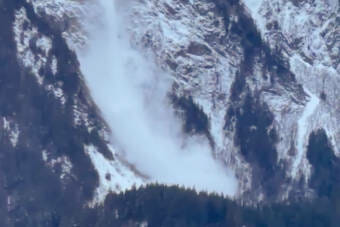
An avalanche from Mt. Juneau on Jan. 4, 2021. Juneau’s avalanche danger is considerable, and conditions are forecast to get worse. (Screenshot of social media video)

Updated Post — Feb. 22, 2021, 11:30 a.m.

The avalanche danger for downtown Juneau was lowered from “high” to “considerable” on Monday. But the city’s avalanche forecaster says the risk could go back up again if temperatures rise higher than expected.

Emergency programs manager Tom Mattice wrote in his daily urban avalanche advisory on Monday that natural slides are still possible in downtown Juneau. Human triggered slides remain more than likely.

Mattice said there were slides observed over the weekend on the White Path, the furthest north avalanche path off of Mount Juneau. No slides have come down above the Behrends Neighborhood. He wrote there has not been a lot of slide activity there this season and wrote that “we have a great deal of snow up there now.”

He advises residents to limit their time in Behrends Neighborhood and to avoid the Flume Trail.

Meanwhile, the state Department of Transportation & Public Facilities says they plan to do avalanche hazard reduction above Thane Road on Tuesday between 10:00 a.m. and noon. Thane Road will be closed during that period. If any avalanche debris covers the roadway, then the road will remain closed until heavy equipment can clear the snow.

Original Post — Feb. 21, 2021, 11:30 a.m.

Juneau’s avalanche danger is high this weekend, which means human-triggered avalanches are very likely. And emergency officials say that when avalanches do happen, they’re likely to be large. 

Emergency Programs Manager Tom Mattice issued a warning to avoid the Flume Trail and the area beyond the gate on the Behrends Avalanche Path near downtown. 

“Even limiting time spent in the Behrends neighborhood is probably a good idea today with the potential size of the avalanches,” Mattice wrote in an urban avalanche advisory. 

In that advisory, Matttice pointed to the strong storm activity Juneau has had for the last several days. The Eaglecrest Ski Area has seen about 20 inches of snow over the last three days. And daily winds have peaked at 90 miles an hour throughout the region.

That combination of high snow loads and high winds puts a lot of pressure on previous weak layers of snow. 

“We have seen multiple natural avalanches around the region over the last 2 days,” Mattice wrote. 

The National Weather Service currently has Juneau under a winter weather advisory until 9 a.m. Monday. Sunday morning, there is a light rain but it’s expected to turn into snow showers later in the day and into the evening. 

That will add to the snow load and Mattice wrote that one big issue is the weak snowpack structure in the Juneau area. 

On Saturday, when they tested the stability of the snow layers, Mattice wrote that it didn’t take much pressure for the snow layers to crumble. 

One concern is that a slide triggered on the weak layers at the top of the snowpack might spread to the deeper weak layers at the bottom, he wrote. 

In a message on Saturday, the Alaska Department of Transportation & Public Facilities said that there is also an avalanche hazard above Thane Road. They warned people not to stop or park in the avalanche danger zone — which are marked by warning signs. 

They also warned that Thane residents should be ready for extended road closures. 

Newscast — Friday, Feb. 19, 2021

  • The nonprofit health organization SEARHC is giving some of the COVID-19 vaccine supplies it gets from the federal Indian Health Services to Juneau for its next mass vaccination clinic in March,
  • Federal aviation safety investigators have closed the book on the Guardian Flight fatal crash in 2019 that killed three crew members,
  • Before the November election, political groups made last-minute ad blitzes to try to tip the state House toward their agendas. But up until recently, there was no way for Alaskans to know who was paying for the attacks,
  • If you want to cross the lake to visit the ice caves in the Mendenhall Glacier, do so a your own risk,
  • Republican Gov. Mike Dunleavy has told Republican Sen. Lora Reinbold his administration will no longer respond to her as the chair of the Senate Judiciary Committee.
Dunleavy’s public safety commissioner says she was forced to resign

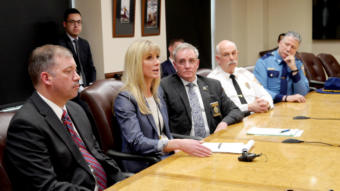
Amanda Price, commissioner designee for the Alaska Department of Public Safety gives an overview of Gov. Mike Dunleavy’s proposed budget for the department to the Senate Finance Public Safety Subcommittee, March 4, 2019. She was accompanied by the division director of the Office of Management and Budget, Dan Spencer. (Photo by Skip Gray/360 North)

Another leader in Gov. Mike Dunleavy’s administration is leaving her post. 

According to a Friday media release, Department of Public Safety Commissioner Amanda Price resigned. 

In a Facebook post — first reported by The Alaska Landmine — Price says she was forced to resign.

She says she was told that the administration is “taking public safety in a different direction.” 

Price says she believes she was removed because she advocated for improving 911 dispatch services in rural communities in ways that Dunleavy opposed and because she made a decision to remove a person — a decision she says was “untenable to the Governor.”

Price goes on to say that she is disappointed in the governor and that “Candidate Dunleavy and his philosophies are not how Governor Dunleavy governs.”

A spokesperson for Dunleavy’s office says they won’t respond to Price’s assertions because they don’t comment on personnel issues.

Price faced a contentious confirmation vote in 2019 when Dunleavy nominated her for the post; she had been accused of chronic absenteeism at her previous job. 

This is the second abrupt departure from the administration in February. Ten days ago, acting Alaska Attorney General Ed Sniffen resigned as the Anchorage Daily News and ProPublica were reporting on allegations of sexual misconduct.

Dunleavy has appointed Kelly Howell to act as an interim commissioner until Price can be replaced.

Editor’s note: This story has been updated with more information.

Haines comes together after fatal landslides and flooding

Site notifications
Update notification options
Subscribe to notifications