Rashah McChesney

Daily News Editor

I help the newsroom establish daily news priorities and do hands-on editing to ensure a steady stream of breaking and enterprise news for a local and regional audience.
‘You can’t bubble the Legislature’: How Alaska’s lawmakers and capital city are coping with COVID-19 this session

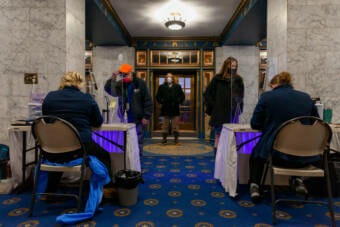
Staff of the state legislature line up for screening on Jan. 20, 2021, in Juneau, Alaska. (Photo by Rashah McChesney/KTOO)
Staff of the state Legislature line up for screening on Jan. 20, 2021, in Juneau. (Photo by Rashah McChesney/KTOO)

There are more than 130 legislators and staff in Juneau for the legislative session. 

The Legislature is taking steps to limit the spread of COVID-19. For instance, the Capitol building is closed to the public. And the Legislature has a $1.5 million contract with a company to test and screen everyone who is allowed in the building. 

But, there is still a risk to having so many people working out of the same building in downtown Juneau. 

Over the weekend, Juneau Sen. Jesse Kiehl sat down for his COVID-19 test in a building just across the street from the state Capitol. It’s invasive, the nasal swab makes his grimace, his eyes water. But, he said it’s necessary to keep the legislature functioning.

“You can’t bubble the Legislature. There’s no dorms. You can’t keep folks from going to restaurants or seeing family here in town and there are legislators who go home to their districts occasionally. So the responsible thing — to put legislators together so we can talk face to face in the same room —  is to just test constantly,” he said. 

Sen. Jesse Kiehl gets a COVID-19 test on Saturday, Jan. 23, 2021, in Juneau, Alaska. Regular testing and daily screening is a requirement for working the state capitol this session. (Photo by Rashah McChesney/KTOO)
Sen. Jesse Kiehl gets a COVID-19 test on Saturday, Jan. 23, 2021, in Juneau. Regular testing and daily screening is a requirement for working the state Capitol this session. (Photo by Rashah McChesney/KTOO)

So, every few days, Kiehl goes in for a test. At the beginning of the session, this is something everyone was obligated to do every 72 hours. Now, they’ve moved to a 5-day testing cycle. 

It takes about 15 minutes and Kiehl gets his negative test result. Each day that he walks into the Capitol, he has to answer a few questions about how he’s feeling and if he’s been exposed to anyone who has COVID-19. He shows the screeners his negative test result. They take his temperature and if he doesn’t have a fever, he’s good to go until the next day when he has to do it all over again. 

But, even with all of that preparation in place, it’s not likely that they’ll be able to keep COVID-19 completely out of the Capitol building. Kiehl said no one is operating under that illusion.

“At some point, there’s going to be a positive and they’re very quick on the contact tracing so you can isolate that and keep cases from becoming outbreaks,” he said.

Beacon, the Alaska-based company doing all of the testing and screening is also tasked with caring for anyone who tests positive for COVID-19 during that process. They’re supposed to arrange transportation for that person — either their own home or maybe a local hotel room. Then, they check in on that person a few times a day until they’re COVID-free. 

That positive case is also supposed to trigger a phone tree. Beacon informs the person they’ve tested positive. Then the company informs staff at the Legislature. The company also must inform the state.  Then the state calls the city. 

City Emergency Manager Robert Barr said that should be a relatively fast process. But this is all new territory. 

“So we don’t know exactly how that’s going to go yet but that’s how we think it’s going to go. And there’s a person at public health assigned to liaise directly with the legislature,” he said.

Barr said it’s not really Juneau’s role to track which employers in town have outbreaks unless something goes wrong and the city needs to step in. Instead, he said Juneau has taken on a role of being a back-up in case Beacon needs help. 

“You know maybe they need some rapid testing and they don’t have the kits or they don’t have the people or something like that. That’s the kind of thing that they’ll reach out to us directly and we’ll just provide that support in an immediate sort of way,” he said.

Further complicating the issue is that there are supposed to be penalties for things like refusing to wear a mask in the building. But according to legislative affairs, it’s not actually clear who is responsible for enforcing those rules among legislators. 

Worth the wait: More than 1,000 people in Juneau vaccinated against COVID-19 during weekend clinic

Khalid Srour, a pharmacist at Bartlett Regional Hospital, prepares Pfizer’s vaccine during Juneau’s COVID-19 vaccine clinic at Centennial Hall on Friday, in Juneau. (Photo by Rashah McChesney/KTOO)

Over the weekend, Juneau’s COVID-19 response team hosted a vaccine clinic for people 65 and older and health care workers who hadn’t already been vaccinated.

At exactly 4 p.m. on Friday evening, a line started to form outside of Centennial Hall in downtown Juneau.

A puppy leashed near the entrance yipped loudly as the group of elderly residents stood six feet from each other and, despite the gusts of wind whipping them with rain, waited politely for the doors to open.

Some of the dozens of volunteers marveled at how willing people were to wait patiently. For four hours, despite the lines and registration technology that clearly baffled some, no one could recall any complaining from the hundreds of Juneau residents who were inoculated against COVID-19 on Friday night.

Some people came to the clinic alone. Others, like Richard and Gail Hattan walked hand-in-hand inside the building, stopping to show their identification to a woman with a clipboard who checked their names off of a list.

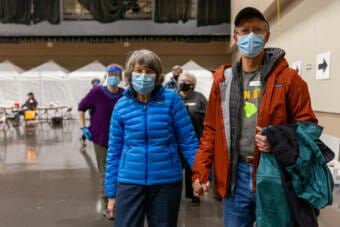
Gail and Richard Hattan wait in line during Juneau’s COVID-19 vaccine clinic at Centennial Hall on Friday in Juneau. (Photo by Rashah McChesney/KTOO)

Richard said he managed to get appointments for both of them during the 25 minutes that the city’s registration website was open before all the slots filled up.

“It was easy. The website was really good. Much better than the state website,” he said.

There are about 4,500 Juneau residents who qualify for the vaccine — people 65 and older or frontline healthcare workers, but the city made appointments available for 1,100 doses of the Pfizer vaccine. In the end, they vaccinated more than that over the course of the weekend since some vials of the Pfizer vaccine yield a few bonus doses.

By the end of the weekend, 10% of Juneau’s Pfizer-vaccine eligible population (people aged 16 and older) were thought to have been vaccinated, according to Robert Barr, Juneau’s Emergency Operations Chief.

Everyone who got a dose has to be able to come back in early February to get their second. There’s a QR code on the back of an inoculation card given during registration that people can use to book that second appointment.

Maria Rogers answers questions as she gets registered for her second vaccine appointment during Juneau’s COVID-19 vaccine clinic at Centennial Hall on Friday. (Photo by Rashah McChesney/KTOO)

That gave people like Maria Rogers pause. She walked through the clinic wearing a shirt that read “Matriarch. The Woman. The Myth. The Legend.”

She said she’s the oldest member of her family. She didn’t register herself for an appointment to get the vaccine because she doesn’t do computers. She said the light isn’t good for her eyes and makes it hard to see her crocheting. Her husband did it for her.

Each person who made their way to a vaccination station in the ballroom of Centennial Hall was asked several questions about allergies and reactions to previous vaccines. Then, they had to pick an arm — the injection site can be sore afterwards — and then relax it enough for the 0.3 milliliter injection to be quickly absorbed into the muscle. It doesn’t have to go any deeper than one that goes into the vein and many people said they didn’t feel it at all.

Of the more than 1,100 doses administered during the weekend clinic, there was only one reported adverse reaction, but it was described by paramedics as mild and not anaphylactic.

Elaine Hickey, a public health nurse, gives a Juneau man an injection during Juneau’s COVID-19 vaccine clinic at Centennial Hall on Friday. (Photo by Rashah McChesney/KTOO)

After she got her shot, Rogers slowly made her way to the other side of the ballroom to sit in a waiting area set up for the newly vaccinated. Everyone has to wait between 15 – 30 minutes to make sure they don’t have a reaction to the vaccine or need medical attention. A tent in the corner was filled with snacks and drinks.

Rogers took a chair and a volunteer sat down nearby with an iPad to help her register for her next appointment. It took several minutes and a lot of questions to set everything up.

“Are you pregnant?” the volunteer asked.

“That would be interesting,” Rogers said, laughing.

When they were done, she picked up her knitted bag and dug through it. “I thought I was going to crochet,” she said.

“Oh, you can now. You still probably have a few minutes left,” the volunteer told her. Then she checked the time and said “Oh! Actually, you can go if you’re feeling good.”

Rogers stood up to go catch her husband before he came inside for his appointment.

Some people said they felt like they were part of a historical moment.

“I’m so excited to be part of this,” said Bartlett Emergency Department Director Kim McDowell, who was immunizing people. “It’s just, it’s amazing. It’s such an honor to be part of the community immunizations…So many people are happy to be here.”

Pualei Galletes, officer manager at Juneau Public Health, directs people into the main hall after registering them during Juneau’s COVID-19 vaccine clinic at Centennial Hall on Friday. (Photo by Rashah McChesney/KTOO)

Other staff said they were relieved the night had gone so smoothly.

The staff didn’t have their full names listed on the name tags they wore on their chests.

“They told us not to use our last names,” said Michelle Brown, a greeter at the front door. “Just in case someone wants to go slash our tires I guess.”

But that didn’t happen. There were no protestors or people who didn’t seem like they wanted to be there.

Juneauites came in waves, about every half hour. And they were moved through each station quickly — in and out in about 20 minutes.

This went on for four hours until nearly 400 people had been vaccinated. At the end of the night on Friday, with just a handful of vaccine shots left over, Barr called up some residents who are on the waiting list to see if they could get to Centennial Hall quickly.

Juneau’s Emergency Operations Manager Robert Barr and Rebecca Embler, a member of Bartlett Hospital quality team during Juneau’s COVID-19 vaccine clinic at Centennial Hall on Friday. (Photo by Rashah McChesney/KTOO)

The same thing happened again on Saturday evening. After making it through the roughly 360 people who had made appointments, Barr said they had about 17 shots left over. So, they called some more people on the list to see if they could come early.

One of them, Blake Rider, was volunteering to help with the clinic on Sunday.

He ran up the steps to the convention center and enthusiastically checked in with the woman at the front door. His grin was visible through his mask.

“This is like, one of the best days of my life,” he said. “I feel like it’s the beginning of the end.”

In Juneau, state and local officials are on edge but hopeful there won’t be local violence

The Alaska State Capitol in downtown Juneau is open for business on Tuesday morning, Jan. 17, 2017, the opening day of the 30th Alaska Legislature.
The Alaska State Capitol and Dimond Courthouse in downtown Juneau. (Tripp J Crouse/KTOO)

State lawmakers in Juneau and local law enforcement are preparing for the possibility of violence after the FBI warned of potential armed protests in each state capital on Sunday. 

While it’s not clear if a protest will take place in Alaska — or even where it might be — the threat of violence has already had an impact. Republican Senator Gary Stevens said he doesn’t want to go into details, but the legislature has plans to protect the state capitol and the people in it.

“We’re very concerned about it,” Stevens said. “You’d be foolish not to have paid attention to what went on in Washington, D.C. and the various plans we’ve heard around the country, so I’m certain we’ll see something in Juneau as well.” 

Alaska’s Capitol building is closed to the public because of the COVID-19 pandemic, but Stevens says there will be plenty of people in it on Sunday. Lawmakers and staff have been coming into town for days to prepare for the upcoming legislative session, which is scheduled to begin on Tuesday. 

Sen. Gary Stevens (R-Kodiak) during a Senate Labor & Commerce Committee meeting on March 14, 2017. (Photo by Skip Gray/360 North)
Sen. Gary Stevens (R-Kodiak) on March 14, 2017. (Photo by Skip Gray/360 North)

After the deadly violence in Washington, D.C., when rioters broke into the nation’s Capitol building, Stevens says they had to beef up security. 

“We’re not going to barricade the building, we’re not going to have National Guard in front of the building, nothing like that. But we have access to other police and protection people if things become dangerous,” Stevens said. 

Stevens said it never really crossed his mind that Alaska lawmakers would have to be concerned about rioters breaking into the building.

But several other states have responded to the threat as well. Earlier this week, Wisconsin Gov. Tony Evers activated the National Guard to support police in Madison, and state workers boarded up windows at the state’s Capitol building. 

State officials in Arizona and Michigan took steps to protect their Capitols as well, according to the Washington Post. 

After the violence in Washington, D.C., Rayme Vinson, the security chief for Alaska’s Legislative Affairs Agency, emailed staff and legislators saying they would be taking extra precautions, including regular patrols by Juneau police and issuing key cards to the Capitol to Juneau-based Alaska State Troopers. 

Stevens said he’s hearing from a lot of staff and lawmakers. 

“There are going to be 200-300 people coming into this building,” Stevens said. “They’re concerned about what’s going to happen and concerned about putting themselves in jeopardy.”

But he doesn’t think the violence happening in other parts of the country will happen in Alaska. 

“I’ve been involved in politics for many years, and I don’t think it’s going to happen here. It could and it would be foolish of us not to be prepared for that,” he said. “My guess is there’s not going to be any invasion at the Capitol, but should there be — we’re going to be prepared for it.”

Juneau Police Lt. Krag Campbell said they don’t yet have any concrete information about plans for a rally in Juneau, though that could change this week. He said they’re coordinating with other state and federal law enforcement agencies to make sure that they’re ready in case something happens.

“And if we plan and staff and do all these things and nobody shows up? Great,” he said.

Campbell said rumors on social media that protestors are planning to be armed changes the calculation that police have to make when they’re deciding how to respond. Campbell said that even though it’s legal, it’s generally not a good idea to bring a weapon to a protest. 

Leave guns, weapons, any type of weapon at home. Because bringing a weapon to a protest is generally going to increase the stress level of everybody there — as the increased likelihood that something will go bad, and it’s just not worth it. Some people will be perfectly peaceful, but not everybody may be,” he said.

Like Stevens, Campbell said he doesn’t think Juneau residents are likely to get violent. But he urged residents not to jump onto social media platforms and get sucked in by the hate. 

“Go on a hike. Do something peaceful. Stay at home. Do something other than what is trying to be planned,” he said. “If somebody hears things, feel free to share that with us. It really just helps us be aware, to anticipate what’s going on.”

Juneau officials aren’t the only ones preparing for the possibility of unrest. 

The Dimond Center, a shopping mall in Anchorage, will be closed on Sunday. An online flyer listed the center as the location for an armed rally.  Alaska’s News Source later reported that the location should have been listed as Juneau.

According to that story, the organizers confused the Dimond shopping center with the Dimond Courthouse, which is across the street from the Capitol building in Juneau.  

It’s not clear if there will be extra security at the courthouse over the weekend. Area Court Administrator James Kwon wrote in an email that the Alaska Court System defers to law enforcement agencies like the state’s Department of Public Safety, local and federal law enforcement for security expertise. 

He did not return a phone call seeking clarification on what type of security the court system has in place in Juneau. 

The courthouse is closed on the weekend and will also be closed on Monday for the Martin Luther King Jr. holiday. 

Dunleavy appeals permit denial for the proposed Pebble Mine

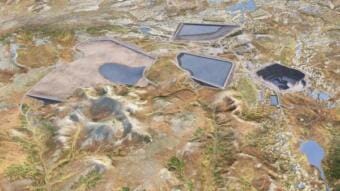
A digital simulation of what the proposed Pebble Mine’s foundation will look like. The State of Alaska is appealing the U.S. Army Corps of Engineer’s denial of a permit for the mine. (U.S. Army Corps of Engineers)

Alaska Gov. Mike Dunleavy is appealing the U.S. Army Corps of Engineer’s decision to deny a permit for the proposed Pebble Mine, back in November. 

The state’s Department of Law will file an administrative appeal with the federal government, according to a media release. 

In that release, Dunleavy calls the denial a “dangerous precedent” that would harm Alaska’s future.  His Department of Natural Resources Commissioner Corri Feige echoed that sentiment in the release, saying that it has “ominous implications for our rights as a state to develop our resources for the benefit of all Alaskans.”

Alaska Gov. Mike Dunleavy announced on Friday, Jan. 8, 2021 that the state is appealing the U.S. Army Corps of Engineer’s decision to deny a permit for the proposed Pebble Mine. (Nat Herz/Alaska Public Media)

The Army Corps denied the permit after determining that the plan for the mine would not comply with the Clean Water Act, and that the project is not in the public interest. 

Fishermen and tribes in Bristol Bay have been fighting the project for more than a decade.

If built, the open-pit gold and copper mine would be one of the largest in North America. 

Dan Cheyette, Vice President for Lands and Resources at the Bristol Bay Native Corporation, said they “completely disagree” with the governor’s decision. He said the corporation has “always held” that Pebble is unlike any other resource development project. 

 “Because of its location, because of its size, because of the type of deposit that it is, and the fact that it is in the midst of one of the world’s greatest wild sockeye salmon fisheries, it can’t be judged against any other project,” he said.” 

Cheyette said he believes the Army Corps will uphold its decision to deny the permit.

The United Tribes of Bristol Bay are strongly opposed to the project.

Protestors of the Pebble Mine in Anchorage
Opponents of the Pebble Mine protested in Anchorage in 2019, arguing that the Corps of Engineers’ environmental review of the mine was inadequate. (Liz Ruskin/Alaska Public Media)

“Bristol Bay residents and Alaskans have been clear that we will not trade one of the world’s last robust salmon fisheries for a gold mine,” wrote Deputy Director Lindsay Layland in an emailed statement. “It’s outrageous that Gov. Dunleavy and his administration would go against the will of Alaskans to benefit a foreign mining company that has no value to our state, and shows once again how out of touch he is.”

Robin Samuelsen is the chairman of the board of the Bristol Bay Economic Development Corporation. He has opposed Pebble for more than a decade and he’s not surprised by Dunleavy’s announcement.

“We’ve got two of our federal senators opposing the Pebble Mine, hundreds of thousands of people opposed to the Pebble Mine. And we’ve got a rogue governor that doesn’t care what Alaskans think,” he said. “We’ve always asked our congressional delegation, the state of Alaska to treat us fairly out here. And they always said they’re going to treat us fairly. But now, it just goes to show that the governor is stepping outside the bounds.”

Despite this most recent development, Samuelson said, he thinks Pebble is “on its way out.”

“I’m not against mining, but that mine is in the wrong place,” he said. “It’s in the spawning grounds — the most productive spawning grounds in the world. We have our gold, it’s called sockeye salmon.”

Sue Anelon, who works with the Iliamna Development Corporation, said she supports the governor’s decision. She said that the lack of jobs in Iliamna is forcing people to look for work.

“If we don’t do anything, we’re going to be stagnant,” she said. “We’re going to still depend on the government. I don’t want to move out of my hometown just to get a job, but people are moving, and I love this place and I’d rather be home.”

Anelon says people in her community commercial fish, and they also depend on a subsistence way of life, but that they need money even when fishing and hunting for food.

“If you’re going to go catch a moose, you have to buy your shells, you have to buy your gun, you have to buy your gas. You have to buy everything to keep your meat — your vacuum sealers and your bags,” she said. “So it takes money to put your food away.”

The Canadian-based parent company of the Pebble Limited Partnership is currently caught up in a class-action lawsuit alleging that the company mislead its shareholders about the viability of the project.  

Correction: A previous version of this story misspelled Robin Samuelsen’s name, it has been updated.

Alaska Supreme Court strikes down Rep. Lance Pruitt’s challenge to his election loss

(Photos by KTOO and courtesy Liz Snyder's campaign)
(Photos by KTOO and courtesy Liz Snyder’s campaign)

State Republican Rep. Lance Pruitt lost his legal challenge attempting to overturn the results of his East Anchorage district election. He lost to Democrat challenger Liz Snyder by just 11 votes. 

Alaska’s Supreme Court agreed with a lower Superior Court ruling on Friday shortly after justices heard arguments in the case. 

Pruitt’s lawyer, Stacey Stone, told the court that the Division of Elections mishandled how it moved the polling location in that East Anchorage district. She argued that the state didn’t give voters enough time or notice to find their new polling location. 

“And I will say, this is not challenging the entirety of the election, the election had integrity. This is one precinct in one house district where there was a significant problem. Where errors happened, malconduct happened and therefore the only remedy to ensure that everyone has a constitutionally protect right — is able to exercise that right — is to have a new election,” Stone said.

The state changed the polling place in that district twice in 2020 — once just a day before the primary election and again the week before the general election.  Stone argued that the state should have moved faster to determine whether it would need to change polling places again — that way it could have given more notice to voters in the district. 

A Superior Court found in late December that the state could have done more but had acted in “good faith.” And the state’s lawyer, Assistant Attorney General Laura Fox told the court that the state had acted reasonably, especially given the extraordinary events of the pandemic. 

“As the Superior Court found, the COVID[-19] pandemic created significant challenges and it was a dynamic situation, so you have to look at the division’s actions in that context,” Fox said.

Pruitt’s challenger, Liz Snyder, also intervened in the case. Her lawyer, Holly Wells, argued that Pruitt had made many changing claims as the case had gone on.

“It feels like a witch hunt. It feels like you are trying to do exactly the opposite of validating an election. You are trying to tear it down and you’ll do it by any means possible,” she said.

Snyder will take her seat after the legislature gavels in on Jan. 19

‘Hope and horror’: Juneau residents respond to the riot in Washington D.C.

Protestors on the steps of the on Jan. 6, 2021, in Washington, D.C. (Photo courtesy Brett Davis via Flickr)

A handful of protesters showed up at the Alaska State Capitol building on Wednesday morning, but they didn’t stay for long. 

Juneau Police Department officers were also briefly there — but Legislative Affairs Director Jessica Geary said it was a misunderstanding as state capitol security had just called to ask to be added to their daily patrol route.  

And even though it was quieter here than in the nation’s capital, a lot of Juneau residents said they were anxious and scared as they watched rioters disrupt a joint session of Congress that was working to certify President-elect Joe Biden’s win.  

Juneau Sen. Jesse Kiehl, a Democrat,  was working from his office on Wednesday in the state’s capitol building. He spent the day working on the rollout of the state’s COVID-19 vaccine page for senior citizens. 

Sen. Jesse Kiehl, D-Juneau, in 2018. (Photo by Skip Gray/360 North)

He said he isn’t concerned about escalating violence locally, even with the small group of protesters on the front steps.  

“Alaska’s capitol is secure and safe,” he said. “They all executed their constitutional right to protest on the capitol steps. They did so forcefully and peacefully and I disagree with them but they were well within their rights. It was a totally different situation than the people in D.C. who are trying to overthrow a free and fair election… you know, night and day.”

Kiehl said he was sickened by what happened in D.C. and frightened to see the U.S. Capitol overrun, both for the people who are getting hurt and for the future of the country’s government. 

“But we will get through this,” he said. “Those trying to overthrow America’s free and fair election will not succeed and we will have a system of government where the voters decide who works for our country when this is over.”

Some people who watched as the mob stormed in and destroyed parts of the Capitol saw white privilege in action. Security forces shot and killed one rioter but they have reported arresting just a few dozen people during the Capitol invasion — and videos appear to show Capitol police moving barriers for the mob of mostly white people and standing aside as they breached the building, which led lots of people to wonder aloud on social media how the scene would have been different if it had been a mob of Black people.

Juneau entrepreneur and artist Christy NaMee Eriksen wrote on social media that she was struck by how far the people got with their violence.  

“It hurts to see what white people are truly capable of, that is, that they can respect even the most outrageous among us, have patience and compassion, withhold violence. Under our outrage is envy — the wish that America loved black people, or indigenous people, or asian, latinx and arab people, or immigrants or muslims or queer or trans or female-bodied people as much as it loves a white armed terrorist mob staging a coupe,” she wrote. 

What strikes me the most is that white nationalists do not fear death the way so many of my friends in america fear…

Posted by Christy NaMee Eriksen on Wednesday, January 6, 2021


Juneau resident Joshua Hunnel also noticed how differently the extremists in D.C. were treated from the protesters for Black racial justice who demonstrated across the country last year. 

“If that was a bunch of Democrats out there, Black Lives Matter, there’s no way they would have gotten into that building,” Hunnel said. “The cops would have been ready for a riot and they would have used their riot stuff.” 

Hunnel hesitated to find a race-based motive in that disparate treatment, but he said he had a hard time believing that anyone could have gotten into such a heavily guarded building if law enforcement didn’t want them to. 

“I feel like it was almost staged,” he said. “I know how protected these buildings are — there could be 100,000 people outside and not one of them will get in,” he said. “And then that’s the part of my mind that says ‘you know, the Democrats are out to cause a scene, but there’s another part of my mind that’s like ‘Yeah how did they get in there?’ knowing how protected it is.” 

Hunnel and his wife are supporters of President Donald Trump — that makes him something of an outlier in his family. 

“You know, I got Trump banners that I don’t hang outside. Not for fear of reprisal, just because there’s no point in it for me,” he said. “I guess I don’t want to stand out because of that.” 

What he saw on Wednesday made him uncomfortable. But, he said, he’s not afraid of it. 

“I don’t think it would happen here,” he said. 

He thinks the community has shown repeatedly that there can be civil unrest and demonstration without violence. 

“I don’t really like the cops too much, but the ones in Juneau are fantastic as far as handling things,” he said. 

But, he also doesn’t think that Juneau residents can get a clear picture of what’s going on thousands of miles away. That the extreme actions of the few tend to be amplified and can overshadow the message of the whole of Trump’s base. 

“The majority of them are just law-abiding citizens who work their 9-to-5, or they’re retirees or they don’t really know any better and they’re just going off what they’re told,” Hunnel said. “As far as the violence goes, like I said, I’m a huge Trump supporter and I’ve probably been around more violence than most because of my history — but I won’t engage in any of that. You’re not going to gain anything by storming the Capitol.”

Local resident Christie Hendrich watched the angry mob forced the Capitol to lock down and said she was frightened. 

“This is the moment where I’m feeling my worst. I had hoped it wouldn’t come to this but I was afraid it would,” she said. “I was afraid we were going to have violence just because there’s so much incitement going on.”

She was watching the coverage with her 14- and 10-year-old daughters. 

“Yeah, and I actually feel like I’ve not done a very good job of reassuring them,” she said. “So that’s kind of like my next step… is to take a deep breath and kind of talk about ‘this is what we can control and this is what we can’t control,” she said. “I’d like to figure out how to tell them how to be resilient in this scary, unpredictable world.”

Hendrich said she’s fairly politically active, but wishes she could tune it all out for a time — there doesn’t seem to be any space to do that. She also said she’s not sure how to respond because she doesn’t want to inflame her neighbors or put her anger on them in a way that makes it difficult to move forward together. 

“There’s ‘hope and horror,” she said. “But I do feel like we’re in a particular time where it’s so volatile and so uncertain just because so many of the norms have — you know everybody is treated equally,” she said. “But, to just blow it up completely so there’s no room for discourse and discussion and all that — which feels like kind of where we’re all at right now — it’s really disturbing.”

Site notifications
Update notification options
Subscribe to notifications