Rashah McChesney

Daily News Editor

I help the newsroom establish daily news priorities and do hands-on editing to ensure a steady stream of breaking and enterprise news for a local and regional audience.
Alaska records 933 new cases of COVID-19, while ICU capacity reduced to zero in part of the state

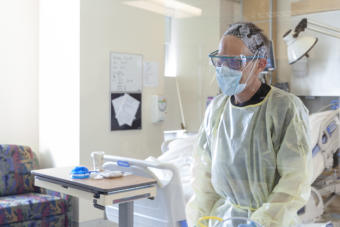
A healthcare provider, wearing several types of personal protective equipment that is being tracked by the State of Alaska, provides care on April 7, 2020, for a woman hospitalized in an isolation room in the critical care unit of Bartlett Hospital, in Juneau, Alaska. on (Photo by Rashah McChesney/KTOO)

On Saturday, Alaska state health officials reported a record 933 new cases of COVID-19.

Most of them were Alaska residents, with the highest numbers in Anchorage (298), Wasilla (177) and Fairbanks (89). But there are new cases in communities from Utqiagvik to Dillingham to Metlakatla.

There are 25 new cases among nonresidents in the state as well.

One COVID-related death was reported on Saturday: a woman in her 70s from Anchorage.

There were 12 deaths in the state reported on Friday. Three were recent while the other nine were identified following a death certificate review, according to the Alaska Department of Health and Social Services.

So far, state health officials have reported more than 34,000 cases of COVID-19 among Alaska residents and more than 1300 in nonresidents in the state.

Every region in the state has areas where community transmission is widespread.

Right now, 150 people with COVID-19 and 14 waiting on test results are in hospitals all over the state. Among them, 24 are on ventilators.

On Friday, Anchorage health officials announced worsening pandemic metrics. The city only has five adult ICU beds left.

Nearby, the Mat-Su Borough is already at zero empty adult ICU beds.

COVID-19 patients typically spend much longer in ICU care than non-COVID patients, according to the Anchorage Health Department. Should hospitals run out of ICU space, director Heather Harris said they’ll increase capacity by reallocating some beds and staff for intensive care. But long-term, if case counts continue to stay high or rise further, Anchorage epidemiologist Janet Johnston says COVID-19 deaths will be frequent.

“This level of new cases translates into one or more new deaths per day as we move forward,” she said.

In the last week, Anchorage reported 11 deaths.

Hunker down or happy holidays? How Alaskans are choosing to celebrate this week.

Amy Jackman, her friends and coworkers are gathering for a night of “Crabs and Cannabis” on Thanksgiving, Thursday ,Nov. 26, 2020, in Kenai, Alaska. (Photo courtesy Amy Jackman)
Amy Jackman, her friends, and coworkers are gathering for a night of “Crabs and Cannabis” on Thanksgiving, Thursday, Nov. 26, 2020, in Kenai. (Photo courtesy Amy Jackman)

Alaskans are finding ways to celebrate the Thanksgiving holiday. But they’re having to balance the appeal of spending time with family and friends against the potential of contracting, and inadvertently spreading, COVID-19. 

Some are finding that choice easier than others. 

Amy Jackman, of Kenai, is doing exactly what she would be doing in any other year. She’s meeting with friends and coworkers for an evening she jokingly dubs “Crabs and Cannabis.”

“We bought 20 pounds of this really amazing crab meat… and we’ve all pitched in for it,” she said. 

She doesn’t really support the roots of Thanksgiving but said it’s more of an excuse to get together and find joy in each other’s company. 

“For me, and the people that are going to be gathering together — there was never even a second thought,” she said. “We’re together every week. We spend time having dinners with our families. We work together, we are basically cultivating and preserving this normalcy, right? Where we don’t live our lives in fear.” 

She is frustrated and concerned by the state and federal response to the spread of the virus — especially guidance about public masking and restrictions on the number of people who can gather in one place. 

“And it baffles me how many people are going outdoors or basically begging for tighter restrictions,” she said. 

Jackman worries that impacts like economic harm to businesses and isolation felt by children who are out of school and seniors who are cut-off from contact with the outside world are causing significantly more harm than the virus. 

But state health officials have repeatedly cautioned against gathering and helping to spread the virus. 

As coronavirus cases continue to climb, hospitals all over the state have warned that staffing shortages coupled with a surge in patients could be disastrous. 

The president of the Alaska State Hospital and Nursing Home Association, Jared Kosin, said on Tuesday that Thanksgiving celebrations could make it worse. 

Some Alaskans have changed their plans this year. 

Winter on the Elliot Highway in 2013. (Creative Commons photo by Jason Ahrns)
Winter on the Elliot Highway in 2013. (Creative Commons photo courtesy of Jason Ahrns)

In Fairbanks, Alyssa Enriquez generally hosts something of an orphans’ Thanksgiving, where people who have no other place to go can find company and food. 

But she didn’t feel comfortable doing that this year. She said a friend who is in her bubble is immuno-compromised. 

So Enriquez decided to unplug for the weekend. She rented the Fred Blixt cabin just off of the Elliot Highway, about an hour and a half north of Fairbanks. 

“I just want to be able to disconnect for the weekend, or for a couple of days, and not have to think about the world,” she said.  

Four friends will come to visit, but not all at the same time, and Enriquez says they’ll keep their interactions as safe as they can.

“The stuff we’re going to do as a group is probably going to be outside. And it’s supposed to be really warm. It’s supposed to be in the mid-20s here. It’s not too bad, at least it’s not 20 below,” Enriquez said. 

Even though a lot of things are different this year, Enriquez said it still feels like she’s following her normal holiday tradition of spending quality time with good friends. And in some ways, she thinks planning for a safe holiday might have helped her rethink her Thanksgiving traditions.

“It’s definitely scaled back, really thinking about who’s in my bubble. Really thinking about having a really nice time,” she said. “This is something I would probably do in the future so that it’s just being out in a cabin and enjoying the space and the presence that you’re in.”

Douglas Bridge in Juneau in December 2018 (Photo by David Purdy/KTOO)

In Juneau, Rebecca Smith also found a way to see friends and neighbors on Thursday, but it will be more of a take-home Thanksgiving. 

Her next door neighbor has a carport, and they’ve turned it into a party space. It has enough room to spread out chairs in groups for the three households that are coming. There will be some other stray friends and coworkers stopping by, too. 

“So this past week I had purchased some rope lights, and the next door neighbor had purchased some lights as well …. Then Jesse around the corner has a new propane heater, so he’s going to bring that over,” she said.

They’re all going to bring the dishes they normally eat to celebrate the holiday. Her neighbor is bringing sweet corn and drunken sweet potatoes. Rebecca Smith has smoked a turkey and is bringing cornbread stuffing, Chex mix, smoked cider and several other dishes. She said there will be plenty of pies.

Everyone will show up Thursday afternoon with their food. 

“We’ll socialize with masks on at their appropriate distances for a little bit, and then everybody just gets to pack up whatever food they want from all the offerings. Take it back home, reheat their Thanksgiving dinner so we can all eat the things we normally eat even if we can’t all eat them together. It’s our way of still sharing the holiday but still being responsible,” she said.

Like Enriquez, Rebecca Smith said her holiday tradition still feels intact. It’s still the same people. It’s still the same foods. 

“Oh, the other good thing is that I didn’t have to clean my house,” she said.

Smith said there was an unspoken agreement among her friends and neighbors that they have to make it work. 

“I think just because we are all so isolated at this point in time. We just have to cling to some way to make things as close to normal as we can. Nothing is going to be normal. Nothing is going to be normal for a long time, we’ve all come to that realization I think. And, quite frankly, it sucks,” Smith said. “I think we just all sort of, without even necessarily talking about it, we all just realized that we have to have something to celebrate.”  

Generally, she said she feels pretty comfortable with the group of people she’s seeing this week. They’ve been isolated or working alone, or they’ve been careful. But that’s not something she’s seeing reflected in the whole community.

“I look at the number of people who traveled this week. How full the airports were, having been fuller than they’ve been since March and I’m just like ‘you people are all insane,’ she said. “But clearly there are people who still aren’t taking this seriously. I’m worried because it’s clearly not going away. It’s not fake. It’s not a hoax. People are sick.” 

Eli Smith makes deviled eggs for his family’s Thanksgiving celebration on Thursday, Nov. 26, 2020, in Kenai. (Photo courtesy Todd Smith)

Normally, Todd Smith (no relation to Rebecca) would find a way to celebrate Thanksgiving with his extended Kenai family — parents, grandparents, siblings and their children. 

“You know, everybody ends up at somebody’s house,” he said. “We have family in Anchorage and Kenai, so we’ll kind of pick a spot and everybody meets up. We’ll have dinner, hang out for the weekend.”

And that could still have happened this year, though Smith said they would have had to put some thought into how to keep the parents and grandparents safe. 

But while Smith’s two kids are home for remote school, he and his wife Megan are still working. She works at a school in the Kenai Peninsula Borough School District, and he does plumbing and heating. His sister is a nurse in Anchorage. 

“We’re smart about it, but at the same time, we have more exposure every day, just out being about and working, than we do hanging out with our family,” he said. 

Plans changed when Smith and his family got sick with COVID-19 last week. It’s not clear where they picked up the virus.

“I don’t know, one of us got it. I got sick first, but several of our friends got it at the same time. Went in and got tested, three of four of us tested positive. We all three got sick,” he said.” My 14-year-old now says he didn’t feel good today, so we’ll see if he’s got it too.” 

So far, he said it’s just like a bad cold. But it’s lingering, and they’re tired.

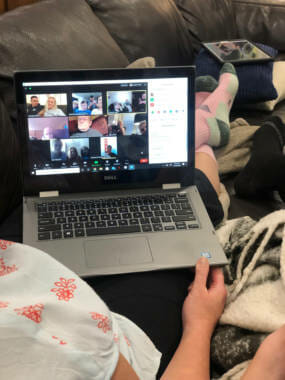
Members of Todd Smith’s family meet up via Zoom to celebrate Thanksgiving together on Thursday, Nov. 26, 2020 in Kenai, Alaska. (Photo courtesy Todd Smith)
Members of Todd Smith’s family meet up via Zoom to celebrate Thanksgiving together on Thursday, Nov. 26, 2020, in Kenai. (Photo courtesy Todd Smith)

“I’m moving around, but I’m by no means completely recovered. It just hangs on,” he said. 

Once they got sick, any ideas they had about gathering with the rest of the family evaporated. And that influenced the rest of the family too. 

“The whole family now is like, ah we’ll just have our own little … We’re going to have a Zoom family Thanksgiving meeting and play a game or something. But I think everybody is probably just going to stay home,” he said. 

Juneau woman among thousands of Americans taking part in COVID-19 vaccine trials

A health care provider places a band-aid on the injection site of a patient who just received a flu vaccine. (Lauren Bishop/CDC)

The drugmaker Pfizer recently applied for an emergency use authorization for its COVID-19 vaccine. 

And Alaska state health officials said this week that if the U.S. Food and Drug Administration gives companies the go-ahead, the first vaccines could arrive in Alaska before the end of the year.  Though, they probably won’t be widely available until March. 

Meanwhile, tens of thousands of Americans have been helping to develop these vaccines by going through clinical trials — including a Juneau woman who has been part of Pfizer’s vaccine trials.  

Fiona Brown grew up in Juneau, but right now she’s in Ohio, working on a Ph.D. in biomedical sciences. 

So, when she saw an ad on Facebook looking for volunteers for Pfizer’s clinical trials for its COVID-19 vaccine, she knew that as a science nerd she had an edge. 
“It was pretty funny when I got in there and they gave me the protocol, and it’s like ‘Alright, so there’s going to be some technical science stuff in here’ and I’m like ‘Don’t worry, my undergrad is in biomedical engineering; nano-particles are kind of like, my thing. I could explain it to you if you’d like me to’,” she said, laughing.

So, here’s how it worked. 

She had a 50-50 chance of either getting the vaccine, or a saline solution injected into her. And, the study was double-blind. 

“I don’t know what I got, the nurse injecting me doesn’t know what I got, the doctor in the study doesn’t know what I got,” she said.

That being said, Brown is pretty sure she got the actual vaccine. That’s because saline injections don’t generally cause immuno-reactions. The vaccine, though, can and she got sick. 

“I actually had a fairly moderate reaction,” Brown said. “It’s pretty rare, they say about 5% of people had what I had which was a fever, nausea, fatigue, body aches. But because I had that reaction, that tells me that I’m like 98% sure that I got the actual vaccine.”

Just to be sure, Brown said she went and got a COVID-19 test. And that came back negative.

The study isn’t over. It’s about two years long. Brown said she got two shots, two weeks apart — that’s the immunization process. Then, they called her back three weeks later and drew some blood. They’ll call her back at 6 months and 12 months and two years later. 

“That’s going to be where they’re measuring how long the effectiveness of this vaccine is going to last because that’s a major question right now, right? Is this going to be like a flu shot where we have to get this every year? Or is this going to be like chicken pox — you get it once and you’re done?” Brown said. “We just don’t know.”

Another unexpected side effect of the vaccine is that Brown is carrying a lot less stress now.

“It’s such a relief to not go into the grocery store and not constantly be thinking about ‘What am I touching? How close am I to people’,” she said. “I was really scared at the beginning of getting asymptomatic COVID[-19] and spreading it to people and not knowing. And that was just a constant concern of mine, I didn’t want to be that person.”

Now, it’s much less likely that she will be that person.

She’s using her knowledge of how the vaccine works to try and demystify it for people. She can rapidly explain it in a sea of multi-syllabic science jargon, but has also come up with a simple way to illustrate how it works. 

Some vaccines, like the traditional flu vaccine, use live virus or dead virus or pieces of a virus, and scientists use that to train your immune system how to recognize an invader and your body learns how to fight it off. 

But, there’s this middle step where you have to have a ton of that virus in order to make enough vaccines. Brown said the problem with that is that it takes a long time to make. 

Pfizer though, went in a different direction. The drug company’s vaccine is mRNA-based. 

“I think the best way to explain it is, in science class, what we typically learn is that the DNA is the manual — it has all the information you could ever actually need. And from that manual, you have mRNA which are like photocopies. So the mRNA is like 200 copies of this one page of the manual that’s important,” Brown said.

Essentially, the mRNA gets delivered to the cells and then the workers in the cells use that photocopy to produce whatever needs to be produced. In this case, Brown says it’s proteins that your immune system learns to recognize and fight — using photocopies, instead of real virus, to teach your body how to fight off COVID-19. 

“So there’s no infection going on, there’s no damaging of cells. It’s just a process of giving a different photocopy,” she said.

Brown said she hopes giving people an idea of how the vaccine works will prompt them to make more informed decisions about whether they should take it. She wishes that everyone could talk to their personal doctor about the vaccine and if it’s a good choice for them, but knows that’s not realistic. 

She said that people who don’t want to get the vaccine should weigh their concerns carefully.

“Is it because you’ve had really bad reactions to vaccines in the past? Is it because you don’t trust pharma companies? Is it because you believe that the process has been politicized and you don’t necessarily trust our government?” Brown said. “Really analyze what is it that you’re afraid of with the process and then decide from there. Is this a reasonable fear when weighing it against having a pretty deadly virus circulating in our country and around the world and the economic toll that’s taking.”

Either way, she said it’s a personal choice.

If the FDA authorizes Pfizer’s vaccine, the company says it could have 50 million doses by the end of the year and 1.3 billion by the end of 2021. 

‘Southeast has just been hammered’: Economists try to see what’s ahead for Alaska’s pandemic recession

Businesses all over Alaska have been shuttered due to the COVID-19 pandemic. (Photo courtesy Hannah Lies/Alaska Public Media)

Economic forecasting is always something of an exercise in prognostication — that is, gazing into a crystal ball and hoping to see Alaska’s future.  

But state economist Neal Fried said it’s particularly difficult to figure out what next year is going to look like. 

“If there’s someone out there that can forecast what’s COVID is going to do … and then, of course, guess what consumer behavior is going to be, that’s a tough one,” he said.

Alaska’s economy, much like the rest of the country, has taken a hit from COVID-19, though some of the impacts won’t be clear for a few years. 

Fried laid out some of those details at the Resource Development Council’s annual conference on Wednesday.  

“How does what’s going on now, this COVID recession compared to previous ones? It’s already lost more jobs than any of the previous ones,” he said. “Is it going to be the worst recession? I don’t know.”

The COVID-19 pandemic came at a particularly rough time for Alaska. The state was just beginning to climb out of its recession from the 2015 oil-crash, and Fried said everyone expected that growth to continue this year — especially in the tourism industry

Instead, as the pandemic unfolded and shut down the tourism season, businesses closed and a record number of Alaskans found themselves out of work. 
“If you look at April, we peaked at almost 70,000 individuals in Alaska receiving unemployment. And you know, when you think about a workforce of about 320-330,000, that’s a lot of folks,” he said. “The numbers have come down some but still remain sort of stubbornly high.”

Nearly every sector of the state’s economy lost jobs. One, federal employment, added jobs this year. That’s because of hiring for the U.S. Census.

There are indicators that the pandemic scared away some private investment. Fried said three new hotels that were supposed to open in Anchorage never materialized. 

And some parts of the state have felt the impacts of the downturn more than others. Interior Alaska has had a boost from the military. The Anchorage region has been buoyed by growth in the Mat-Su. 

But it’s a different story in Southeast. 

“Southeast has just been hammered,” Fried said. “It’s been hammered by two things. Of course their very big dependence on the cruise ship and visitor industry, and then to add insult to injury they had a lousy fisheries season. So they just got hit very, very hard.”

The pandemic was swift and, in some ways, surprising in how it impacted the state’s economy. 

We went basically from a near, if not record low unemployment rate … to record high the next month,” he said.

Fried said state economists have been looking for new ways to measure its impact and the health of specific sectors. 

For instance, Fried said they are looking at the number of people who have been stopped and frisked every week at the Anchorage International Airport for the last few years and comparing it to this year. They’re using it as a way to measure the drop in travel to Anchorage. 

“I didn’t even know this data exists,” Fried said. “But you can see transportation in Anchorage, passengers dropped as much as 86% and it stayed quite low. You know it’s still 50% below where it was a year ago up to the current period. It is beginning to improve. When you look at these numbers for Juneau, Fairbanks, they look very similar and in some cases even worse.” 

They’re also looking at cargo landings at the Anchorage airport. There has been a sharp increase in cargo traffic there during the pandemic. Fried and others have said it was the world’s busiest airport during parts of 2020. He attributed that volume, in part, to supplies coming in from China and other parts of the world, and to the explosive growth of e-commerce. 

There are a few bright spots in the state’s overall economic health. 

For one, the military is still growing in Alaska. Personnel are moving to the state along with the new F-35 jets. 

The marijuana industry is hitting record-high sales. 

And Fried said mining did well during the last recession and is still doing well during this one. Mineral prices are good right now, he said, and it’s an indicator that the state’s economy may be more diverse than many people think. 

ConocoPhillips Alaska plans to restart drilling on the North Slope this year

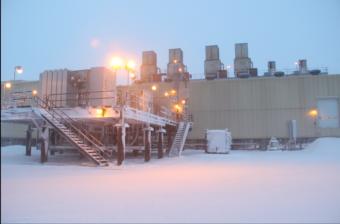
A unit at the edge of ConocoPhillips’ Kuparuk oil field, on Alaska’s North Slope. (Photo by Rachel Waldholz/Alaska Public Media)

Next year’s budget hasn’t been approved yet, but ConocoPhillips Alaska is planning to restart some of its drilling projects on the North Slope. 

The company’s president, Joe Marushack, outlined plans at the annual Resource Development Council conference on Wednesday in Anchorage.  Marushack said by the end of this year, the company plans to restart some drilling on the North Slope. 

And, they plan to build up operations next year. 

“By the end of 2021, there will be four rigs running between [Great Mooses Tooth] 2, Alpine and Kuparuk. Each rig normally employees about 100 people and each of those jobs support multiple jobs throughout the state economy,” he said.

It has been a challenging year for the oil industry.

Marushack said 2020 was supposed to be the company’s largest exploration and winter construction season ever. 

“We came into the year very excited. It was also slated to be a big drilling year with the startup of the Doyon extended reach drilling rigs at Kuparuk and robust drilling programs in the core fields of Alpine, Prudhoe and Kuparuk,” he said.

As COVID-19 spread, the company saw a steep drop in demand, followed by a collapse of oil prices. First, it suspended development in 2020 and then cut production from the North Slope. 

Thousands of workers left the North Slope as the company tried to reduce the risk of a large outbreak of the virus. Marushack said they worried it could overwhelm health facilities there. The company also asked staff in its Anchorage offices to work from home. 

Now, Marushack said that for the first time since its fields were brought online, Prudhoe Bay, Kuparuk River and Alpine have no rigs running in them.  But, the plan is to have rigs working on two of those fields by the end of 2021. 

One other thing, while the company is planning to continue operating next year — Marushack isn’t. After more than 30 years with ConocoPhillips, he said he’s retiring in January. 

Former Gov. Walker leads effort to take over Alaska’s gas pipeline megaproject

Alaska Gov. Bill Walker and Alaska Gasline Development Corporation head Keith Meyer during a meeting in Beijing. (Photo courtesy Alaska Governor Bill Walker’s Office)

For more than 40 years, the state has tried and failed to bring natural gas from Alaska’s North Slope to market. Now, a new private venture — formed by some familiar players — wants to make an attempt. 

Former Gov. Bill Walker led a press conference on Monday with the group who call themselves Alaska Gasline & LNG, LLC.  

Walker is a man with a mission. He has spent decades working to bring the megaproject into existence.  And, much like he has in the past, he emphasized what it could bring to the state — jobs, money, cheap energy.

“You know we’re not out to get rich off of this project, we want to make it happen,” he said.

Walker was joined by the man he tapped to lead the state’s gasline corporation during his administration — Keith Meyer. As the state’s highest-paid employee, Meyer ran the Alaska Gasline Development Corporation for two years before he was ousted after Gov. Mike Dunleavy was elected. 

This is the second time this year Meyer has pitched taking over the state-led gasline project.   In January, Meyer went to the state corporation with an idea to take the project over again, this time with private backers. At the time, he would not disclose the company that was backing him.

Walker and Meyer are partnering with Fairbanks entrepreneur Bernie Karl and a labor union — Laborers Local 341.

Right now, those four are the only investors in their new venture. But Walker said that could change. 

“While there’s four now, we think there will be 400 or 4,000 because I think Alaskans are ready for this project to happen,” he said.

The group is responding to a message from leaders of the state’s gasline corporation who said this spring that they want to transition the project over from state control into private hands. They’re hoping to transfer the project by the end of the year. 

According to a written statement from the state corporation, “State of Alaska policymakers have made it clear that adequately funded third parties will need to fund Alaska LNG construction and lead the project forward. Any party with the appropriate resources and qualifications to help advance the Alaska LNG project is welcome to participate in the strategic path for Alaska LNG that the AGDC board defined this past spring.”

The corporation estimates the project will cost about $38.7 billion to build.  Alaska has struggled to hit the right market conditions to make its expensive project a reality. And, demand dropped in 2020 in part due to the COVID-19 pandemic, driving gas prices even lower. 

But Meyer and Walker are undeterred.  They point to the success of a years-long federal permitting process. 

Meyer says the next step is to move the project into the market; get it in front of people who may want to invest in it.

“It’s a very good time in the LNG industry, the world is moving to natural gas as a much cleaner hydrocarbon. So we now have 42 countries that import LNG,” he said.  “So the industry has matured and Alaska is in a beautiful position to really participate in this industry.”

Meyer says if the state will turn the project over to their venture, they’re aiming to get it built by 2028.


Site notifications
Update notification options
Subscribe to notifications