Rashah McChesney

Daily News Editor

I help the newsroom establish daily news priorities and do hands-on editing to ensure a steady stream of breaking and enterprise news for a local and regional audience.
Judge orders Dunleavy administration to treat Alaska Landmine journalists like other media

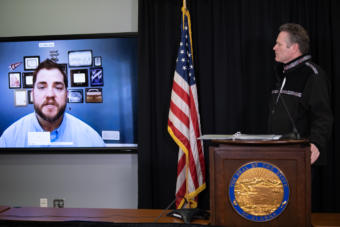
Alaska Gov. Mike Dunleavy speaks about the state's COVID-19 response from the Atwood Building in Anchorage on March 20, 2020.
Alaska Gov. Mike Dunleavy speaks about the state’s COVID-19 response from the Atwood Building in Anchorage on March 20, 2020. A judge has ruled that his administration must treat Jeff Landfield and The Alaska Landmine like other media in the state and allow them into press conferences while a lawsuit is resolved. (Creative Commons photo courtesy Alaska Governor’s Office)

For the next two weeks, Gov. Mike Dunleavy’s administration will have to treat Jeff Landfield and The Alaska Landmine the same way it treats other media in the state. That is, he must be invited to press conferences and other press events the governor’s office holds. 

The temporary order came from U.S. District Court Judge Josh Kindred after a hearing on Wednesday. Kindred said Landfield’s legal team and the evidence they’d shown so far persuaded him that the Landmine would likely win its lawsuit against the state. 

Landfield sued Dunleavy and members of his administration on Dec. 22 after he was barred from participating in a press conference in early December. In the lawsuit, Landfield details a year of the governor’s office refusing to invite him or the Alaska Landmine to press events. Landfield and his lawyers say it’s a violation of his rights as a journalist. 

During Wednesday’s hearing, the state argued that Landfield is not a member of the “traditional media.” It’s not clear exactly what that phrase means, but Kindred ordered the state to treat him as it does other members of the traditional media — however the state is defining that.

The order is in effect until Jan. 13, when the next hearing is scheduled. It’s not clear if Dunleavy plans to hold any press conferences in that time period. His spokesperson didn’t immediately respond to a message asking if there were any scheduled

Bartlett’s board of directors taps hospital CFO to lead after CEO Chuck Bill leaves

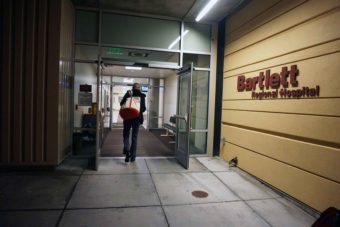
Emergency room entrance at Bartlett Regional Hospital. (Photo by Jennifer Canfield/KTOO)

Bartlett Regional Hospital’s board of directors has a new president. 

During its last meeting of 2020, the board voted Kenny Solomon-Gross to be its president. Members also voted to keep Rosemary Hagevig in the vice president’s spot and Mark Johnson as board secretary.  

That’s not the only leadership change on the horizon for the city’s hospital. 

CEO Chuck Bill is retiring in early 2021. 

The board decided to temporarily promote the current Chief Financial Officer Kevin Benson into the role. Currently, he makes just over $236,000 a year and they gave him a raise to just over $307,000 a year — that is lower than what an analyst told them would be a competitive salary for a CEO.   

Benson says he doesn’t want to take on the job permanently, so he’ll transition out of the role when they find a new CEO. 

The COVID-19 vaccine is here, but Juneau city officials say it’s not time to relax

Updated Post — Dec. 23, 9:30 a.m.

Juneau city officials say the vaccine is here, but it’s not yet time to relax.

“What we continue to know right now is that the vaccine is pretty effective, 95% or higher effective at preventing the symptoms of COVID-19. So what that means is that it’s good at keeping you from getting sick,” said Emergency Operations Center Planning Chief Robert Barr. “We don’t yet know if it’s effective at presenting the virus that causes COVID-19.”

Deputy City Manager Mila Cosgrove said Tuesday that Juneau is scheduled to receive about 400 doses of the Moderna vaccine and has gotten just over 1,000 doses of the Pfizer vaccine.

The city reported that 12 people are newly diagnosed with COVID-19 as of Tuesday. But overall, Cosgrove says the city’s numbers and percent of positive tests are down. She said she would like to keep it that way.

“As you celebrate the holidays, please keep your indoor time with people outside of your immediate family members as small as possible,” she said. “We are hoping that our numbers stay low over these next several weeks and that in early January that will set us up to drop our community mitigation level down and set ourselves up for schools to reopen.”

Barr and Cosgrove spoke during the city’s regular COVID-19 update on Tuesday.

Barr said Juneau’s airport testing program is scheduled to continue through the end of January. According to the city’s latest data, they’ve found 61 COVID-19 positive travelers under this program since June.

The state is looking for a vendor to take over that program in February.

Additionally the city has installed a Roche testing machine at the hospital and staff are being trained as to how to use it. Right now, they estimate they can test about 960 people per week once it’s up and running.

Barr said the city is hoping to have its local testing program ready to go by the end of January.

Original Post — Dec. 22, 1:19 p.m.

City and Borough of Juneau staff will give their latest COVID-19 update at 4 p.m. today.

City Manager Rorie Watt and member of the local emergency operations center will give a presentation and then answer questions from community members and media.

Meanwhile, Bartlett Regional Hospital reported Tuesday that 7,000 Alaskans have been vaccinated with the first dose of Pfizer’s vaccine against the virus, 495 of them are staff at the hospital. The hospital has 105 vaccines ready for staff who haven’t signed up to receive it yet. There are currently two vaccines circulating in Alaska. Both require two doses.

You can stream the city’s update here, join the Zoom webinar or call 1-346-248-7799 or 1-669-900-6833 or 1-253-215-8782, and use the Webinar ID: 985 6308 5159.

If you want to ask a question in advance, you can email COVIDquestions@juneau.org.

Gov. Dunleavy splits health and social services department into two new agencies

Update — Dec. 22, 3:54 p.m.

Alaska Gov. Mike Dunleavy announced Tuesday that he’s splitting the state’s health department in two.

He and Alaska Department of Health and Social Services Commissioner Adam Crum say the department is too big, too unwieldy and needs sharpened focus to better serve Alaskans. 

Crum said his department has more than 3,500 employees, the largest in the state.

“We are operating under the tyranny of time,” Crum said.  “There is just not enough time and bandwidth in the day for the commissioner’s office and staff to do anything other than move from fire to fire and crisis to crisis.” 

Dunleavy’s plan is to create two new state agencies through an executive order. 

One would be the Department of Family and Community Services, it’s focus would be protecting vulnerable Alaskans. That means the Division of Juvenile Justice, the Office of Children’s Services, the Alaska Psychiatric Institute and the Alaska Pioneer Homes management would be nested under it. 

The second agency will be the Department of Health, it will include the Senior & Disabilities Services, Behavioral Health, Public Health, Public Assistance and Health Care Services divisions. 

Beyond those agency divisions, it’s not clear how the reorganization will work. The executive order hasn’t been drafted yet, and Dunleavy said he doesn’t know how much it would cost.  

“We don’t feel there really is going to be a cost,” he said. “As a matter of fact, we believe that over time the division — probably a short period of time — the dividing out of these two departments will result in better services delivered which will then result in, we think, more efficiencies and less call upon the Legislature, for example, for more resources to patch holes in the organization of the department because of less oversight, less management.”

But, he said he doesn’t think anyone working for the health department currently needs to worry about keeping their jobs. 

“We don’t see any need for reapplication, the individuals that are in the programs, in the divisions will stay where they are, will do the jobs that they are,” he said.

It’s not clear how long the process will take. According to documentation on the governor’s website, if the executive order goes into effect, Gov. Dunleavy will need to appoint a new commissioner who will then need to be confirmed by the Legislature. 

The state is soliciting questions about the reorganization, you can send yours to dhssreorg@alaska.gov.

Update — Dec. 22, 2:20 p.m.

By executive order, Gov. Mike Dunleavy said he will create two new state agencies. One, the Department of Family and Community Services will include the Division of Juvenile Justice, the Office of Children’s Services, the Alaska Psychiatric Institute and the Alaska Pioneer Homes

The second agency will be a Department of Health. That department will include the Senior & Disabilities Services, Behavioral Health, Public Health, Public Assistance and Health Care Services divisions.

Dunleavy said the idea is to provide better services for Alaskans as the department has continued to grow.

Original post — Dec. 22, 2:00 p.m.

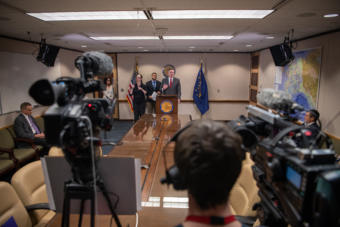
Gov. Mike Dunleavy and members of his administration will discuss a reorganization plan for Alaska’s Department of Health and Social Services at 2 p.m. today.

Dunleavy will be joined by DHSS Commissioner Adam Crum, Deputy Commissioner Heather Carpenter and special assistant Suzanne Cunningham.

The State’s Chief Medical Officer Dr. Anne Zink will also give the latest update on the state’s vaccination program. Acting Attorney General Ed Sniffen will also attend the meeting.

There are currently two vaccinations for COVID-19 circulating in Alaska, one from the company Pfizer and the other from Moderna. Both require two doses.

According to a health department media release, 5,674 doses of the Pfizer vaccine have been administered in the state, out of the total 35,100 the state got. Alaska should be getting 26,800 doses of the Moderna vaccine — that doesn’t count vaccines allocated to Veterans Affairs and Department of Defense personnel operating in the state.

As those vaccines pour into the state, questions about who should get them and when are being decided Gov. Mike Dunleavy who has the ultimate authority. But, so far, the state has been following recommendations from a new advisory committee largely made up of health care providers, saying they’re best-suited to consider the science and data around the vaccine.

Right now, first in line are hospital-based front-line health care workers who are frequently exposed to COVID-19 patients and long-term care facility residents and staff, front-line emergency medical and fire personnel, community health aides and health care workers who are providing vaccines. According to a state media release, the next phase of treatment is expected to start Jan. 4 and will include other healthcare workers and those who provide personal care or home and community-based services. There will be a public comment meeting over the state’s plan for who should be next in line on Dec. 28. Details on that meeting can be found here.

Dunleavy’s administration is also expected to give an update on federal COVID -19 relief legislation.

You can stream the conference here or on the Governor’s Facebook page.

Online news outlet Alaska Landmine sues Gov. Mike Dunleavy’s administration over access

Gov. Mike Dunleavy unveils his budget on Wednesday, December11, 2019, at the Capitol in Juneau, Alaska. (Photo by Rashah McChesney/KTOO)
Gov. Mike Dunleavy at the Capitol in Juneau in 2019. Alaska Landmine owner Jeff Landfield has sued Dunleavy and members of his administration, saying they’re violating constitutional protections he has as a journalist by barring access to press conferences.  (Photo by Rashah McChesney/KTOO)

Alaska Landmine owner and journalist Jeff Landfield is suing Gov. Mike Dunleavy’s administration. He says the administration has violated his constitutional rights by excluding him from Dunleavy’s press conferences.

While Landfield said he’s been considering legal action for some time, the incident that prompted the lawsuit happened in early December when Dunleavy held a press conference announcing his new budget.

As he has done since taking office in 2018, Dunleavy began the press office by laying out some key points. Then spokesperson Jeff Turner called on reporters with questions.

At the end of that Q&A, Turner gave reporters some instructions and then turned it back over to the governor — but Landfield interrupted. 

“Can I ask a question,” he asked over the phone line. 

“I’m sorry, who was that,” Turner responded. 

Landfield identified himself and repeated, “Can I ask a question?”

Spokesperson Jeff Turner gestures to reporters during a press conference on Gov. Mike Dunleavy's newest budget proposal on Wednesday, December 11, 2019, at the Capitol in Juneau, Alaska. (Photo by Rashah McChesney/KTOO)
Spokesperson Jeff Turner gestures to reporters during a press conference in 2019.  (Photo by Rashah McChesney/KTOO)

“Sorry Jeff, we’re going to closing comments — thank you,” Turner said. 

Landfield runs the website Alaska Landmine. It started as a political news blog in 2017 but has since branched out to covering other topics. 

He said he had a question about how the governor’s budget might go over in the Legislature. But he wasn’t called on to ask it. In fact, Landfield had not been invited to the press conference at all — other reporters sent him the information he needed to call in. 

“I just got really kind of pissed off that I couldn’t ask a question and I was treated like that,” he said. 

Landfield describes a tense relationship with the Dunleavy administration that has gotten worse this year.  

“I’m treated like a second class or second-tier person,” he said. He doesn’t get notices of press conferences. “I have to rely on somebody telling me, and that doesn’t always happen.”

And after that last press conference, Landfield says he had enough. He contacted law firm Schwabe, Williamson & Wyatt, which sent a letter to the Dunleavy administration saying they were violating his constitutional rights by barring him from press conferences. They demanded that Landfield be allowed full access to the governor’s press conferences and that he’d get the same notice that other members of the media get. 

Jeff Landfield (Photo courtesy Facebook)
Jeff Landfield

The governor’s office didn’t do that, so the Alaska Landmine sued. The lawsuit names Gov. Mike Dunleavy, his spokesman Jeff Turner and his Chief of Staff Ben Stevens — three people Landfield said he has tried to talk to to find out why he’s being locked out of press conferences. 
To date, they haven’t given him a reason. But Landfield said Turner has implied that he isn’t a “real” journalist. 

That idea — that Landfield isn’t a real journalist — is something he and his lawyers have worked to disprove in the lawsuit. 

They point out that he has thousands of readers in Alaska, that he’s broken news that has shaped national, state and local government policy. Those stories are often picked up by other news organizations. 

Gov. Mike Dunleavy’s Chief of Staff Ben Stevens talks to Senate Majority Leader Lyman Hoffman, D-Bethel, after Dunleavy's State of the State address on Monday, January 27, 2020 in Juneau, Alaska. (Photo by Rashah McChesney/KTOO)
Gov. Mike Dunleavy’s Chief of Staff Ben Stevens talks to Sen. Lyman Hoffman, D-Bethel, in 2020 in Juneau. Stevens is being sued by Alaska Landmine journalist Jeff Landfield. (Photo by Rashah McChesney/KTOO)

Landfield said he doesn’t think the journalism he does is much different than others in the state, so he’s not sure why he’s having issues with this administration. He said he hasn’t always written critically about them. 

“You couldn’t argue or say that I’ve gone after them unfairly. I think I’ve been pretty fair,” Landfield said. “But, again, they probably don’t like the way I say things, and they don’t have any recourse to call the boss when I say something they don’t like.

Landfield said it’s hard to do his job when he can’t ask questions of politicians and people in power in public

“There’s a difference between asking someone a question one on one and then asking someone a question when everybody’s watching. You know, the answers might change,” he said. “I think it’s important to hold these legislators and the governor accountable.”

To be clear, Landfield does some things that you probably wouldn’t find a journalist at other organizations doing. He weaves opinions into his news stories sometimes. He ran for office this year in Senate District L. His campaign lasted from June 1, when he filed, to August 31, when he withdrew. 

But both Landfield and his lawyer say he is a journalist. And there are foundational legal protections that come with doing his job. 

I’m tired of having to fight to be able to go to these press conferences,” he said. “I never really appreciated the freedom of the press. I always believed in it, but I never really appreciated it until I started doing the Landmine. And, you know, we — through reporting — have changed policy. We’ve exposed things that would never have been exposed otherwise. That’s a very powerful thing and that should not be hampered. That should not be minimized by anybody.” 

The governor’s office doesn’t issue press passes. There isn’t a board in the state that decides who is or is not a journalist. The legislature has issued Landfield a press pass. 

And even if members of Dunleavy’s administration take exception to his brand of journalism, his lawyer Matt Singer argues that they can’t stop him from writing about them or politics. 

“One aspect of a free press is that the government — including the governor — don’t get to pick and choose which media are entitled to report about government affairs,” he said. 

Singer said Landfield does a type of journalism that is disruptive. But he said the nature of media is evolving.

“Just because it’s different, just because it’s a different approach, doesn’t mean that it’s not entitled to the same constitutional protections and that it isn’t a valuable source of information for Alaskan citizens,” he said. 

Singer said it would be a simple fix to do what he and Landfield are asking them to do. 

“In this time of COVID, many of the governor’s press conferences are being done virtually. So fixing this issue would be as easy as adding the Alaska Landmine to an email invitation for virtual press conferences,” he said. 

It’s not clear what kind of argument the state could make against allowing Landfield into the press conferences. Maria Bahr, a spokesperson for the Department of Law, said the state has seen the lawsuit, but she wouldn’t talk about the particulars of the state’s response to Landfield’s demand letter or how the state plans to argue in court. She wrote in an email that they’d file a response with the court.

Landfield’s legal team filed an injunction on Tuesday, essentially asking for the court to require that Landfield be allowed to attend press conferences while the lawsuit works its way through the system. They’ve asked that a hearing be set to consider their request on Dec. 30. 

Editor’s note: This story has been updated with the injunction filed by Jeff Landfield’s law firm on Tuesday. 

More Haines residents prepared to evacuate their homes as weather deteriorates

The high school gym in Haines set up as a shelter for evacuees from flooding and landslides
The high school gym in Haines set up as a shelter for evacuees from flooding and landslides on Sunday. The neighborhoods on the mountain overlooking downtown Haines are prepared to evacuate and they will gather here if that becomes necessary (Rashah McChesney/KTOO)

Haines’ high school gym has been converted into an evacuation center. It has enough cots for 50 people in it, but no one has moved in yet. 

On Saturday night, Haines city officials put out a warning that people living on the mountainside overlooking downtown should be prepared to pack a bag and flee from landslides. But by Sunday afternoon, only two families had to evacuate their homes.

“We did that because we got information that geologically … there is an aquifer that underlies all of that that has some pressure building that we’re trying to watch,” said interim Borough Manager Alekka Fullerton during a Sunday press briefing. 

She said there has been some pushback about that evacuation watch notice. It covers a large area, by some estimates nearly one-third of the town lives on that hillside. 

“Certainly it’s not our intent to scare people,” she said. “We do need people to be informed. We do need people to be ready and prepared and we made the decision that knowledge and keeping people informed was more important — even if it feels a bit scary — so that people can make their own decision.”

Interim borough manager Alekka Fullerton gives an update on Saturday to people who fled their homes after flooding and landslides in Haines. (Photo by Rashah McChesney/KTOO)

Residents woke up to a thick crust of ice on top of several inches of snow Sunday morning — and rained on and off for most of the day. 

That complicated the efforts of city and state crews that have been working to clear roads of landslides and debris, because most of them spent the morning clearing snow before they could get to work. 

Despite the weather, two helicopters were able to get into the air. 

One helped with the search effort for a Haines businessman and his tenant, a local kindergarten teacher, who were caught up in a  landslide on Wednesday and have been missing since. 

The 600-foot landslide is still thought to be dangerously unstable and ground crews have been unable to get too far onto it.

“We continue to hope, we continue to search. I think we continue that until we can’t,” Fullerton said. “So we’re not going to give up.”

The other helicopter had geotechnical experts on board who are helping the city determine whether any of the 50 families who have evacuated can safely return home. 

Fullerton and Haines Mayor Doug Olerud didn’t share any information about when that might happen yet. But, they are bringing city and state experts to talk to evacuees on Sunday evening. 

Fullerton said she knows evacuees are hungry for information. 

That’s a sentiment Dawn Woodard echoes from her room at the Captain’s Choice Motel in downtown Haines.  

As she pet her 156-pound malamute named Gooch, who was rescued after she was evacuated, she explained that she and her neighbors are worried about their homes. They don’t currently have power and while the cold temperatures mean that the food in her chest freezers is less likely to spoil — it also means that her pipes could freeze.

But, she assumes she’s going to be out of her home for a long time. 

Scott Gray with the state’s Department of Transportation on plows frozen snow and ice before on Dec. 6. DOT is working to clear landslide debris and work on roads in Haines. (Rashah McChesney/KTOO)

Department of Transportation Superintendent Scott Gray said the damage to streets and culverts and hillsides in town is “catastrophic.” He said crews will do what they can to patch roads long enough for them to hold through the winter, but points out that several areas are still in danger of sliding again so that work is ongoing. 

Fullerton, the borough manager, said at least 100 volunteers have registered to be on-call to help. Some of them were flagging for road crews on Sunday, while others were on foot helping with search and rescue efforts. Still others helped open another hotel to house more evacuees and volunteers. 

A state ferry arrived Sunday afternoon with more supplies and people ready to get to work. 

But, first things first, Fullerton said the Haines Borough police department and shuttles were waiting to meet the ferry to take everyone that disembarked to be tested for COVID-19. 

Site notifications
Update notification options
Subscribe to notifications