Rashah McChesney

Daily News Editor

I help the newsroom establish daily news priorities and do hands-on editing to ensure a steady stream of breaking and enterprise news for a local and regional audience.
Juneau nursing home outbreak could be a model for what COVID-19 looks like after vaccine

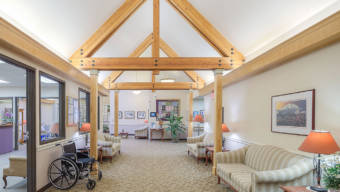
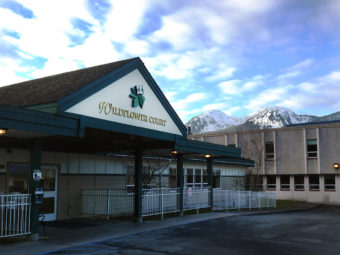
Wildflower Court, a longterm care facility, in Juneau, Alaska. The facility has had an outbreak of COVID-19 among residents and staff, but despite the vulnerable patient population most cases have had no symptoms. (Photo courtesy Wildflower Court)
Wildflower Court, a long-term care facility, in Juneau, Alaska. The facility has had an outbreak of COVID-19 among residents and staff, but despite the vulnerable patient population, most cases have had no symptoms.
(Photo courtesy Wildflower Court)

Over the last two weeks, at least a dozen people, including both staff and patients, at a Juneau nursing home have tested positive for COVID-19.

But while Wildflower Court caters exclusively to people who are among the most vulnerable to getting very sick or dying from the deadly virus, staff say nearly everyone who has been infected has been symptom-free.

“Other than one resident that developed a little bit of shortness of breath … which is not unusual for that person outside of COVID,” said Wildflower Court Administrator Ruth Johnson.

Ruth Johnson (Photo courtesy Wildflower Court)

Staff and outside experts attribute the health of these people in the face of their COVID-19 infections primarily to the Pfizer and Moderna vaccines. Nearly 80% of the people who live and work in the facility have received at least one of the shots in the two-shot series.  

And while medical experts say they have a lot of questions about the circumstances that led to the outbreak at the nursing home, and how patients and staff who have been vaccinated are responding to the virus — none are surprised by the outbreak. 

“I hope it’s kind of the canary in the coal mine,” said Dr. Sar Medoff, an emergency room doctor who also works for the State of Alaska’s Division of Public Health “That we will still have outbreaks in facilities, but the higher percentage of the population is vaccinated and the higher percentage of residents and staff that are vaccinated, the smaller and less severe these outbreaks will be moving forward.”

Medoff advises staff for the 700 nursing homes, assisted living and psychiatric facilities in the state. And, he said this particular outbreak at Wildflower Court is interesting because it is a mix of people.

“Some of the populations who tested positive for COVID have had both doses of the vaccine. Some of them have had one dose of the COVID-19 vaccine and some of them had no doses,” he said. 

Medoff said it’s not surprising because when the vaccines were being developed, researchers tested them to make sure people who were exposed to COVID-19 didn’t get sick. And the vaccines are really good at that. 

During trials, the Pfizer vaccine — which is the one most people at Wildflower Court have received — was 95% effective at preventing severe COVID-19 cases. 

But, keeping people from getting sick and keeping people virus-free are not the same thing. 

“What the studies did not look at is whether or not someone who has been vaccinated is able to become infected with COVID and maybe is infected at such a low level that they don’t develop symptoms,” Medoff said. “However, they are still able to transmit the virus to others.”

What that means is that people who are vaccinated could be carriers for the virus even if they don’t become sick from it.

That’s why, post-vaccine, health officials say people should still practice safe pandemic behavior by wearing masks, avoiding crowds, limiting the number of people in your bubble and washing your hands — all things Wildflower Court administrators say they continued doing as they vaccinated people. 

But both Medoff and the Wildflower Court administrators say there are some other things that could have happened to explain why vaccinated and partially vaccinated people tested positive for COVID-19. 

The first is that there’s a possibility that the people who got sick didn’t have a strong immune response to the COVID-19 vaccine. 

The Pfizer vaccine is 95% effective. But that still leaves 5% of people who just won’t respond as strongly to the vaccine.

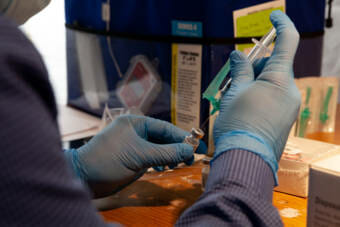
The Moderna and Pfizer vaccine bottles compared during Juneau’s COVID-19 vaccine clinic at Centennial Hall on Jan. 15, in Juneau. (Photo by Rashah McChesney/KTOO)

“So it’s possible that … their immune response just wasn’t as strong,” Medoff said. 

Or, some of the people at Wildflower Court who caught the virus may have gotten it shortly before or shortly after receiving the vaccine — so their bodies didn’t have the time to learn to fight the virus off. 

“So they may have been within that window where they were infected before the body could build its immune response,” Medoff said. 

And a third possibility is that they were infected with a strain of COVID-19 that the Pfizer and Moderna vaccines aren’t as effective at fighting.

Those vaccines were developed before new strains of the virus popped up in South Africa and Brazil. There’s some evidence that the Pfizer vaccine may be less effective against those strains. 

“We just don’t have as much data yet on the South Africa and Brazil variants so far,” Medoff said. 

Neither of those strains of COVID-19 has been detected in Alaska yet. But, they could be here. The state only does genomic sequencing — the process needed to detect which strain of COVID-19 a person has — on a small fraction of its positive COVID-19 tests. 

In an interview right after the Wildflower Court outbreak was discovered, the state’s chief medical officer, Dr. Anne Zink, said they will prioritize getting genomic testing on the Wildflower Court population, but results from that analysis haven’t been released yet.

Medoff said the state is part of a national collaborative effort to find out how effective vaccines are at fighting these new strains of COVID-19. 

“We want to make sure that if those strains are present in [Alaskans], we’re detecting them early again,” Medoff said. “It is one of the reasons that those specimens will jump to the head of the line for sequencing.”

Wildflower Court Director of Nursing Emily Merli said morale among residents is pretty good.

“I think the initial reaction is shock, especially for the vaccinated folks,” she said. “Then there’s just kind of like, sort of a sense of resignation that like — of course this is happening now.” 

After the initial shock wore off, most of the residents passed through the rest of the quarantine period uneventfully; five of the seven positive residents came out of quarantine over the last week. 

In the last week of January, the home did two rounds of testing. And, in a letter to residents on Friday, Merli wrote that they did find one newly COVID-19 positive resident in an area of the nursing home outside of its current COVID unit. That patient has also gotten both doses of a COVID vaccine and doesn’t currently have any symptoms. 

“We are anticipating a symptom-free duration as this is what we have been seeing with all our other vaccinated positives,” Merli wrote. 

Administrators say Wildflower Court will continue to test twice a week until they detect no more positive cases. 

And, administrators are gearing up for another round of vaccinations for residents and staff which will bring the homes vaccination rate up to 87% for residents and 81% for staff, according to the letter. 

Two Juneau students test positive for COVID-19

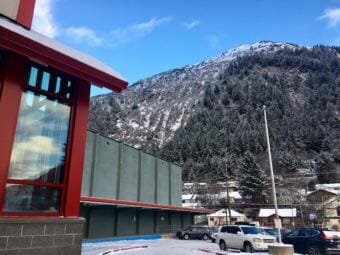
Juneau-Douglas High School: Yadaa.at Kalé sits at the base of the mountain from which it takes its Tlingit name, Jan. 8, 2019. (Photo by Zoe Grueskin/KTOO)
Juneau-Douglas High School: Yadaa.at Kalé in January 2019. (Photo by Zoe Grueskin/KTOO)

Two Juneau School District students have tested positive for COVID-19, including one student who played in a basketball tournament in late January. 
Players on every basketball team at Juneau Douglas Yadaa.at Kalé High School and Thunder Mountain High School are quarantining and will be tested for COVID-19 because of possible exposure during a series of basketball games between the two schools the last weekend of January. 

Another case at the Auke Bay Elementary School has one whole class, staff and students, currently quarantining, according to a media release for the City and Borough of Juneau. 

The outbreaks and potential exposure hasn’t disrupted in-person learning at either school, according to the release. And, city health officials say that everyone who may have been exposed at either school has already been contacted. That means that students and staff who have not been contacted do not need to quarantine or be tested for the virus, according to the release.

The city also identified another case in the cluster at Wildflower Court. So far, 11 staff and residents have tested positive for the virus.

Nearly 80% of the population of that nursing home has been at least partially vaccinated. While most of the people in that cluster who have tested positive have had no symptoms, Administrator Ruth Johnson said Wednesday that one person had difficulty breathing over the weekend but has since recovered and was treated at the facility. Three people at Wildflower Court are considered recovered.


Juneau’s Wildflower Court reports virus outbreak, most staff and residents vaccinated

Wildflower Court is a non-profit, 57-resident long-term-care facility in Juneau. (Photo by Ed Schoenfeld/CoastAlaska)

Juneau’s Wildflower Court nursing home has an outbreak of COVID-19 among staff and residents, including some who have been fully vaccinated against the virus.

Administrator Ruth Johnson says two staff members tested positive last week. They put that part of the home in isolation and tested staff and residents. 
“They’re all asymptomatic, nobody is sick,” she said. “We had two more staff members show up positive as well and neither of them are sick either.”

Johnson says 70% of the patients and staff have been fully vaccinated against COVID-19 already and 80% have had at least their first shot of the vaccine. 

“Several of these positives, people were exposed after their second vaccine,” she said. 

Johnson says they may be seeing in real-time, what some state and federal medical officials have been saying since the vaccines became available. 

If you are vaccinated against COVID-19, it will most likely keep you from getting sick. But, it may not keep you from carrying the virus and infecting someone else. 

This is the first outbreak among patients at Wildflower Court and Johnson says she is grateful that so many residents have been vaccinated. 

“It’s a huge relief because the data we’ve seen so far in the Pfizer vaccine is that it’s 95% effective in preventing disease. Five percent who did experience COVID after being fully vaccinated did not get seriously ill. So they’re saying it’s 100% effective at preventing serious illness,” she said.

Bartlett Hospital Infection Preventionist Charlee Gribbon said it’s entirely possible that people who have been partially or even fully vaccinated can still pass the virus around. 

The vaccine works by giving your immune system a way to identify the virus that causes COVID-19. 

“So we know that it takes a while for your immune system to do the work and produce the antibodies that actually protect you,” Gribbon said. 

And for people who have had one dose of the vaccine but not the second? Gribbon said they’re not fully protected. 

“We know that after one dose from the studies that people get between 50-80% protection. So in real life, that means if you’re exposed 10 times, you’re going to fight it off between five and eight times,” she said. 

Ultimately, vaccines aren’t supposed to eliminate COVID-19 entirely. 

“As is the case with all coronaviruses that cause the common cold … they’re still circulating, just not causing destructive disease where it gets people really sick,” she said. 

This is the first outbreak among patients at Wildflower Court and Johnson said she is grateful that so many residents have been vaccinated because it’s less likely that they’ll get a serious illness.

Wildflower Court is divided into four separate areas. They call them neighborhoods. And right now, the outbreak is confined to one neighborhood — she said no one is going between neighborhoods right now. 

And they stopped putting multiple people in rooms at the beginning of the pandemic. That means people can isolate themselves in their own rooms if they do get sick.

This story has been updated.

Juneau plans for another mass vaccination event

Elaine Hickey, a public health nurse, asks a man screening questions during Juneau’s COVID-19 vaccine clinic at Centennial Hall on Friday, Jan. 15, 2021, in Juneau, Alaska. (Photo by Rashah McChesney/KTOO)

Another mass COVID-19 vaccination event is on the horizon for Juneau residents. 

City officials announced Wednesday that seniors aged 65 and older and healthcare workers will be able to sign up for appointments beginning Monday, Feb. 1 at noon. Starting at that same time, anyone who can’t sign up online can call 586-6000 to make an appointment.
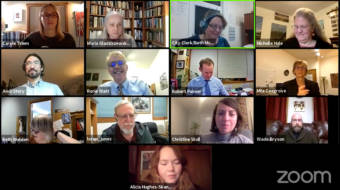
The city has set aside 100 appointment slots for people who call in. 

The city plans to distribute about 1,000 doses of the Pfizer vaccine over two days, but that will be just the first dose. Anyone who wants to make an appointment needs to be available for a second dose in early March. 

Juneau will be getting more than 1,400 vaccine doses in February. The bulk of them will be going into this vaccination clinic. About 100 doses are being reserved for homebound seniors, according to a city media release.  

Anyone who gets an appointment for the city’s mass vaccination event must have been in Juneau for at least five days prior to the clinic dates Feb. 11-12 and needs to bring a photo ID to the clinic. Everyone must also wear a mask, according to the city release. 

While some area providers bill insurance for the cost of administering a COVID-19 vaccine — there is no cost for the city’s mass vaccination clinic. 

The rest of the city’s February quota of COVID-19 vaccines — that includes 500 Moderna doses — will be distributed among three area providers: 

  • 300 Moderna doses to Southeast Alaska Regional Health Consortium
  • 100 Moderna doses to state-enrolled provider Ron’s Apothecary Shoppe
  • 100 Moderna doses to state-enrolled provider Safeway Pharmacy

This information is about vaccines that are set to be administered to the general public through the State of Alaska. There may be other ways for Juneau residents to receive a COVID-19 vaccine. SEARHC has a separate quota of vaccines that it gets from the federal Indian Health Services; there are also vaccines available for members of the military. Juneau veterans should be contacted by their VA medical providers, but any veteran 70 years or older who hasn’t been contacted can reach the Juneau VA clinic at 796-4300.

Juneau residents who received their first dose at the last vaccination event, Jan. 15 – 17, will receive their second doses Feb 5 – 7. Those people should not sign up for this new vaccination event.

Juneau works to make ‘Zoom bombing’ a criminal offense

Juneau Assembly members, along with city clerk Beth McEwen, sign on for a regular meeting on Jan. 25, 2021 via Zoom. (Screenshot from Facebook)

Last year, as the world adjusted to the COVID-19 pandemic and city governments started meeting remotely, many turned to the video conferencing platform Zoom to conduct meetings.

Juneau’s city assembly started holding its committee and regular meetings via Zoom in early 2020. While many say it expanded access, allowing people from all over to weigh-in without having to travel to City Hall, it also opened up those meetings, and Assembly members, to potential abuse. And right now, it’s not easy to track down abusers and hold them accountable.

City officials estimate that there have been about a dozen instances of what’s known as “Zoom bombing” or disrupting a meeting. Zoom bombers have successfully hijacked other public meetings in Alaska and throughout the rest of the world, often with lewd, racist or pornographic material.
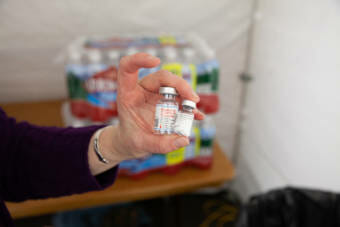
“We’ve had a few at the assembly level, we’ve had a few at the school board level, we’ve had a few in some committee board time meetings,” said City Attorney Rob Palmer during a Monday evening meeting.

City Assembly member Carole Triem was targeted during an Assembly meeting.

People who were listening describe a man calling in and making lewd comments about Triem’s body. There were also graphic sounds played at one point.

Triem described it as a startling and disgusting thing to have to listen to while she was at work.

“Certainly, as a woman, that kind of thing has happened before,” she said. “But, no. Not in any kind of official capacity and it was very embarrassing that it happened in this public meeting where I think probably hundreds of people were watching on Facebook.”

When it happened, no one seemed to know how to respond. The city clerk who was moderating immediately worked to remove the person from the meeting, but that took several seconds. No one hit the mute button.

“When it happened, I was just too shocked to kind of feel anything,” Triem said. “I had quite a few fellow assembly members who spoke up publicly in the meeting and who texted me. And I really appreciated that but I was just kind of like, I don’t know – ‘let’s just get on with the meeting’.”

City officials say they’ve changed the way they’ve run meetings, but they don’t want to describe exactly how they’ll respond when it happens again in order to prevent someone from circumventing their plans. They did say that someone’s hand is always near the mute button.

Juneau police launched a criminal investigation into who was harassing Triem. But, Palmer said Zoom, the company software the city is using to host the meetings, isn’t cooperating.

“It has been incredibly difficult working with Zoom to try to track down where those bombs came from,” he said.

That’s, in part, because the city doesn’t have anything in its local code that identifies Zoom bombing as a crime.

Palmer is working on that now. He said once that law gets on the books, they can force the company to turn over any identifying information the company has on Triem’s harasser and anyone else who bombs a city meeting.

Triem said she never really thought that they’d find the guy who called in to harass her, and she’s not really focused on that.

Instead, she wants to go through the process of making Zoom bombing a crime and send a message to the public that it isn’t acceptable. And, she wants the city to back her up, publicly.

“It would really mean a lot to me because I was a little disappointed that — other than my few fellow assembly members who spoke up at that meeting, it wasn’t really addressed at all,” she said.

Editor’s note: We’ve updated this story to reflect that while city officials initially refused to make a full recording of the Assembly meeting during which Carole Triem was harassed available, it has since agreed to provide it to KTOO. 

Juneau to get more than 1,400 doses of COVID-19 vaccines in February

Update | 7:50 p.m.

Juneau officials are getting more doses of the COVID-19 vaccine in February, but not as many as they had hoped.

“We’ll be receiving another tray of Pfizer,” said City Emergency Manager Robert Barr during a weekly city update on Tuesday. 

A tray is technically 975 doses, but the Pfizer vials have been coming with a few extra doses

“We generally plan for around 1100,” Barr said. 

The city is also getting about 500 more doses of the Moderna vaccine. 

“That’s a little bit lower a number than we had hoped, to be honest,” Barr said. “We certainly have the capacity to administer more than that.”

The city could organize another mass vaccination event, like the one it held earlier in January

Other providers in Juneau have requested additional doses of the vaccines as well and many maintain their own waitlists. 

There are seven providers in Juneau registered with the state. 

  • Costco Pharmacy 
  • Fred Meyer Pharmacy
  • Genoa Healthcare LLC
  • Juneau Public Health Center
  • Juneau Urgent & Family Care
  • Ron’s Apothecary Shoppe
  • Safeway Pharmacy

But, the 1,475 doses of the vaccine that are supposed to come to Juneau in February will likely not be split equally between each of the local providers. 

Nurse manager with the Alaska Division of Public Health Alison Gottschlisch told the Juneau Assembly on Monday that the state is changing that part of the vaccine rollout. 

Up until now the process has been that an individual provider, like Ron’s Apothecary, would reach out to the state with a request for vaccine doses for the upcoming month. Then the state would get its doses from the federal government and would determine how much each local provider would get. 

Now, that’s going to be the city’s responsibility. Gottschlisch said Juneau’s vaccine task force will be deciding how many doses go to which providers.

That task force has members from the state’s public health department, the city, Bartlett Regional Hospital, Southeast Alaska Regional Health Consortium, Central Council of Tlingit and Haida Tribes of Alaska and Capital City Fire/Rescue. 

In response to questions about how the task force would decide which clinics get doses, and how much — City Emergency Manager Robert Barr said there are a lot of criteria but one big one. 

“The first thing that we look at is how quickly we can get that vaccine into arms,” he said. 

That means mass vaccination events — like the one the city recently held that saw more than 1,100 people vaccinated in one weekend — are ideal. 

But, he said, the city also wants other providers to keep vaccinating because as the city receives more and more doses, they’ll need every provider who can administer them to be ready to do it. 

City officials also urged Juneau residents to be careful, even if they have already been vaccinated. 

Especially because the state announced on Tuesday that it had found its first case of a more contagious strain of COVID-19 that has made headlines globally. 

But that Anchorage resident tested positive more than a month ago. Barr said that the state is doing viral genetic sequencing — the process that’s required to find that more contagious variant of COVID-19 — on just 4 to 5 percent of the positive COVID-19 tests. 

“That’s a good number compared to the rest of the country, but it’s still only 4 to 5 percent,” he said. “So chances are good that there is more of that variant going around.”


Original story

Juneau city officials are holding their weekly COVID-19 community update at 4 p.m. today. You can watch on this post, on the City and Borough of Juneau’s Facebook page or on Zoom. The public can submit questions in advance to CovidQuestions@juneau.org.

As of today, city officials know of four new cases among Juneau residents. Currently, there are 30 people who have tested positive for the virus in the city.

City emergency officials report administering 1,182 doses of the COVID-19 vaccine during a recent mass vaccination event. A follow-up clinic for the second dose will be held Feb. 5 through 7 at Centennial Hall. So far, about 4,479 people in Juneau have received their first dose of a vaccine, according to state data.

Vaccine eligibility is limited mainly to people age 65 and up or frontline health care workers.

Correction: A previous version of this story stated that the state is doing viral genetic sequencing on a significantly larger proportion of positive COVID-19 tests than it actually is, the true percentage is somewhere between 4-5 percent. 

Site notifications
Update notification options
Subscribe to notifications