Rashah McChesney

Daily News Editor

I help the newsroom establish daily news priorities and do hands-on editing to ensure a steady stream of breaking and enterprise news for a local and regional audience.
Vaxxed, unmasked and ready to party: Juneau Drag brings hundreds out for live show

Gigi Monroe (James Hoagland) performs during Juneau Drag's first live show in 15 months on Saturday, May 22, 2021, in Juneau, Alaska. (Photo by Rashah McChesney/KTOO)
Gigi Monroe (James Hoagland) performs during Juneau Drag’s first live show in 15 months on Saturday in Juneau. (Photo by Rashah McChesney/KTOO)

Over the weekend, Juneau Drag performers hosted their first live show in 15 months.  They invited people for a rowdy night of in-person, maskless entertainment — with just one catch.  You had to be vaccinated to get in the door of the Red Dog Saloon, and you had to prove it. 

A short line snaked out of the door just before the 10 p.m. show on Saturday night. People waited to show their vaccine cards and IDs as Gigi Monroe’s voice drifted out from the swinging saloon doors.

“We’re putting the final touches on our drag backstage. Showtime in 5 minutes,” she said.

Abi Spofford shows her COVID-19 vaccination card to get into a live drag show on Saturday, May 22, 2021, in Juneau, Alaska. (Photo by Rashah McChesney/KTOO)
Abi Spofford shows her COVID-19 vaccination card to get into a live drag show. Spofford said she would love to attend other events in Juneau where people are required to be vaccinated. (Photo by Rashah McChesney/KTOO)

Once you got inside, it was a little like stepping back in time — or maybe into an alternate reality where the COVID-19 pandemic doesn’t exist. 

People are hugging. It’s hot and sweaty and vibrantly queer, there’s lots of glitter and gender-bending — there’s a shirtless bartender in suspenders. Virtually no one is wearing a mask. 

People are saying this is the first time they’ve gathered with so many other people in a long time. 

“It’s strange but it makes me feel safe,” said Abi Spofford, after she showed her vaccine card and walked into the bar. “I would support doing it in other places.”

The music starts to come up, people start to settle into their seats and are looking up at the glittery black curtained stage expectantly.

Gigi Monroe (James Hoagland) chats up the audience after her opening number for Juneau Drag's live, in-person show on Saturday, May 22, 2021, in Juneau, Alaska. The drag troupe offered the maskless, in-person drag event to people who brought proof of being vaccinated against COVID-19. (Photo by Rashah McChesney/KTOO)
Gigi Monroe (James Hoagland) chats up the audience after her opening number for Juneau Drag’s live, in-person show on Saturday in Juneau. The drag troupe offered the maskless, in-person drag event to people who brought proof of being vaccinated against COVID-19. (Photo by Rashah McChesney/KTOO)

Then suddenly, in a flouncy pile of black tulle and an impossibly tall rainbow feathered headdress — Juneau’s drag mom, Gigi Monroe (James Hoagland) appears behind the crowd.   

“Get this party started on a Saturday night,” she crooned along with P!nk, whose iconic song set the tone for the night.

It’s a classic bait and switch and it worked so well. People’s mouths dropped open comically. The energy is high and the excitement palpable — and for Monroe, whose non-stage this was a moment of realization. 

“As soon as I came out and I saw that our audience, instead of sharing like — the balcony level and the floor level to spread out more, everybody clustered together on the floor level and got as close as they could because they were just dying to have that experience and that was my signal that everyone was ready for it,” she said.

Monroe and I caught up later in the week to chat about the show and days later, she’s still a little hoarse. 

“I completely forgot how to use a microphone,” she said, laughing.

It was an adjustment to go from more than a year of digital drag shows — where she really only had to be dressed from the belly up — to a night of wearing high heels and cinching herself back into fully-corset outfits.

And there were other worries too.  When the Centers for Disease Control and Prevention, and City and Borough of Juneau guidelines relaxed vaccinated, indoor gatherings, Monroe said she wasn’t sure that people were ready to pack back into nightclubs and live shows.

Audience members watch as Juneau Drag performers put on a show on Saturday, May 22, 2021, in Juneau, Alaska. Audience members were fully vaccinated against COVID-19 and mostly maskless for the evening. (Photo by Rashah McChesney/KTOO)
Audience members watch as Juneau Drag performers put on a show on Saturday in Juneau. Audience members were fully vaccinated against COVID-19 and mostly maskless for the evening. (Photo by Rashah McChesney/KTOO)

She even mapped out possibilities with her husband Jeff Rogers — essentially things to do if the audience seemed uncomfortable or reserved.

“He went through ‘well you know maybe, you might need to lead them through like ‘turn and wave to your neighbor and then shake your neighbor’s hand and then eventually throughout the show it ends with — you know — hug somebody. This incremental process of getting people ready for physicality and intimacy.’ But they were ready to go right out the gate,” Monroe said.

And, for the most part, everything went smoothly — it was just like riding a bicycle. No one forgets how to be social or how to enjoy a live show. They just sometimes need to be coaxed back into it, she said.  

Audience members packed in together to cheer on Juneau Drag queens and kings on Saturday, May 22, 2021, in Juneau, Alaska. It was the troupe's first in-person, performance and they required audience members and Red Dog Saloon staff members to provide proof of full vaccination to attend. (Photo by Rashah McChesney/KTOO)
Audience members packed in together to cheer on Juneau Drag queens and kings on Saturday in Juneau. It was the troupe’s first in-person, performance and they required audience members and Red Dog Saloon staff members to provide proof of full vaccination to attend. (Photo by Rashah McChesney/KTOO)

But, there were some things that were different. If you paid close attention, you’d notice that she kind of kept her distance from the crowd. The other performers did too. 

Usually, they weave through the audience — amping up the crowd, teasing tips out of them. But, Monroe says they discouraged that during this show and asked people to consider tipping digitally or toss money into buckets near the stage.

Audience members were asked to tip by throwing money into buckets by the stage or by tipping digitally during Juneau Drag's first in-person show in 15 months on Saturday, May 22, 2021, in Juneau, Alaska. (Photo by Rashah McChesney/KTOO)
Audience members were asked to tip by throwing money into buckets by the stage or by tipping digitally during Juneau Drag’s first in-person show in 15 months on Saturday in Juneau. (Photo by Rashah McChesney/KTOO)

For the most part, people complied with all of the rules. They kept their distance from performers. No one at the door seemed to mind showing their vaccine cards. Though, I did see one woman get in mid-show who hadn’t bought a ticket or brought her vaccine card. She swore up and down to the door guy that she had been vaccinated though. At any other time, that would have been a normal part of going to a live show — but it felt particularly weird when show organizers were clearly trying to create a safe space for people.  

The troupe did two shows, one early and one late. Each was capped at 100 tickets. Both sold out. Monroe says there was some uncertainty in hosting an event that large. 

“I kept waiting for someone else to do it – someone else to be the first big event, whether it was for vaccinated-only or not. But just to try to host something indoors that was for a larger audience. And no one had done it, so. As time went on I said ‘ok, I really didn’t want to be the first one to push this. But, I really believe in it,” she said.

Some people in the Juneau Drag troupe were hesitant too. 

“I think on the performer side of things, it was a smaller cast because not everybody was ready to take that leap with me,” she said.

For now, they’re done with digital drag. Monroe says for those performers or audiences who don’t want to be indoors yet, they got two live outdoor shows in Skagway and Sitka coming up this summer. 

Audience members and performers gather after a drag show on Saturday, May 22, 2021, at the Red Dog Saloon in Juneau, Alaska. (Photo by Rashah McChesney/KTOO)
Audience members and performers gather after a drag show on Saturday at the Red Dog Saloon in Juneau. (Photo by Rashah McChesney/KTOO)

Alaska to end $300 per week unemployment payments

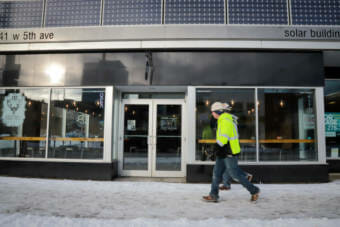
Construction workers walk down Fifth Avenue between D and E Streets on a February afternoon. (Jeff Chen/Alaska Public Media)

Alaska will join at least 12 other states in opting out of extra federal benefits for unemployed workers, citing workforce shortages.

The withdrawal will end a $300 weekly payment that was added under the Federal Pandemic Unemployment Compensation program passed by Congress last year. It’s paid in addition to regular state unemployment insurance benefits.

Alaska Department of Labor Commissioner Tamika Ledbetter said during a Friday press conference that the state’s economy is showing signs of recovery, and there are employers trying to fill jobs.

“Therefore, it is time for Alaskans who are able and available to go to work to do so,” she said.

Recently, several Republican-led states have opted to withdraw from the federally funded program, arguing that the extra payments discourage workers from taking jobs. But in an interview with Alaska Public Media’s Casey Grove last week, University of Alaska Anchorage Center for Economic Development director Nolan Klouda said the evidence points to other causes for the labor shortage.

“When economists looked at when the overall benefits expired at the end of the summer, at the end of July of 2020 — you didn’t see any kind of spike in employment happening at that point,” Klouda said. “If, when the generous benefits expired — if those payments were keeping people home, then you’d expect people to suddenly go back to work in droves after that.”

Klouda says that other factors, like health risks and the need to provide childcare, could be keeping people out of the workplace.

Ledbetter acknowledged during a Friday press conference that some Alaskans are struggling to return to work.

“For those Alaskans still burdened by lack of childcare or transportation or other issues, I understand the challenges — this period has been like no other in our history,” Ledbetter said. “However, unemployment is a temporary support system. The benefits are funded through employee contributions, and the system’s sustainability is built upon a healthy economy.”

Another UAA economist, Mouhcine Guettabi, said there are other alternatives the state could pursue to fill those open jobs.

“Cutting unemployment insurance is a fairly blunt instrument that tries to make aid less generous than work,” Guettabi said.

There are other ways to get people to return to work. In an ideal world, Guettabi said, policymakers could make work more attractive.

“You can keep unemployment insurance as-is and then provide some kind of return-to-work bonus,” Guettabi said. “Or make the wages that the worker would potentially earn higher than unemployment earnings. That way, you could potentially get the people who were staying at home because unemployment insurance was more attractive than returning to work — but you could also accommodate the people staying home for other reasons.”

In Montana, which also opted to cut off those extra federal payments, policymakers have added a return-to-work benefit. On Friday, Alaska labor officials said they aren’t planning on offering that type of benefit.

Both Klouda and Guettabi said Friday that there isn’t good data showing whether cutting off unemployment benefits would fix the problem of unfilled jobs.

When asked what data the Department of Labor used to justify its decision to cut off federal payments for unemployed Alaskans, Ledbetter described anecdotal reports.

“We’re hearing from employers, we’re hearing from the business community — I’ve been reading a lot of articles that you all have been writing — and there is a worker shortage,” she said. “We want a strong economy and that’s basically why we made this decision — it’s time to help people get back to work.”

But she also said data about available jobs in Alaska is not anecdotal. According to the Department of Labor, there are more than 16,200 job openings in industries all over the state as of Friday morning.

There are about 32,000 people are filing for unemployment benefits each week.

The added payments will end in Alaska on June 12. An extension of regular unemployment benefits will continue until September, when the federal program expires.

Alaska Public Media’s Casey Grove provided additional reporting.

This is a developing story. Check back for updates.

UnCruise started operating in Juneau early this year, several other small ships are set to join

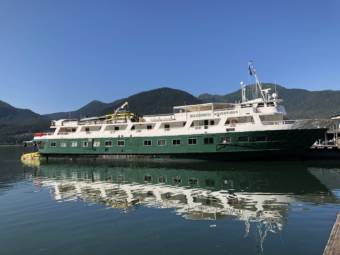
The Wilderness Adventurer, a small cruise ship operated by Seattle-based UnCruise.
The Wilderness Adventurer, a small cruise ship operated by Seattle-based UnCruise. (Courtesy Uncruise)

The small cruise ship season has started in Juneau and the visitor industry is gearing up for it — though it’s not clear how many people are coming. 

Dan Blanchard runs a small-ship cruise company called UnCruise. He told members of the Juneau Assembly on Monday that their Alaska season started sooner than they’d expected after Washington state’s COVID-19 protocols interfered with the company’s planned trips.

“You may have heard that we got shut down in Washington State … shut us down and shut every other company down on the Columbia River. A tremendous economic challenge to all of us,” Blanchard said.

Blanchard said the company pivoted and moved its boat — and the guests booked on those sailings — to Juneau. 

That boat will be joined by five other UnCruise boats soon. Blanchard said they’ll have six boats operating out of Juneau, each carrying less than 100  passengers. He estimates they’ll bring between 5,000 and 6,000 people to town this year. And all of those people must be vaccinated, according to a company policy.

“When we switched, pivoted to fully vaccinated cruise and passengers the phones went off the hook. So I think that’s just good things to keep in mind when we think about vaccinated businesses,” he said.

There are three other small ship operators planning stops in Juneau this summer. Including the UnCruise boats, there will be more than a dozen vessels making port calls.
Watch: Juneau city officials to give last weekly COVID-19 community update, before switching to monthly

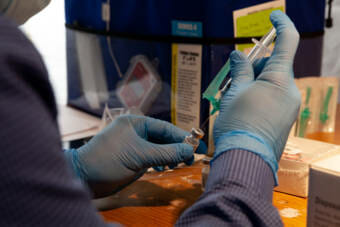
Capital City Fire/Rescue EMS Officer Andrew Pantiskas preps doses of Pfizer's COVID-19 vaccine as paramedic Lily Kincaid preps bandages at the downtown fire station in Juneau on Dec. 17, 2020.
Capital City Fire/Rescue EMS Officer Andrew Pantiskas preps doses of Pfizer’s COVID-19 vaccine as paramedic Lily Kincaid preps bandages at the downtown fire station in Juneau on Dec. 17, 2020. Pantiskas said some of the vials appear to have more than the five doses expected. Also pictured: fire mechanic Scott Reid. (Photo by Jeremy Hsieh/KTOO)

Juneau city officials will meet at 4 p.m. today to give the weekly update on the response to COVID-19.

But, after nine months of weekly updates — they’re shifting to a once-a-month schedule for the community update. Generally, members of the city’s Emergency Operations Center and the City Manager’s office use these meetings to give updates on the number of new cases that have been detected in Juneau, how the city is responding to the virus and economic fallout from the global pandemic.

Today’s meeting will also include state public health nurse Alison Gottschlich.

They also take and answer questions from reporters and Juneau residents. Questions can be sent in advance to COVIDquestions@juneau.org

You can stream the meeting here,  Online via Zoom: https://juneau.zoom.us/j/98563085159 or Facebook Live. Or, by calling  1-253-215-8782 or 1-346-248-7799 with webinar ID 985 6308 5159.

All COVID-19 community updates are recorded and available on vimeo.com/cbjuneau to watch anytime.


Juneau’s seasonal Mill Campground opens for second summer

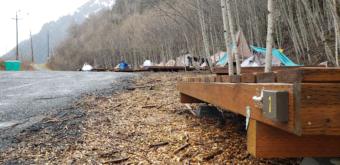
Twelve out of 20 tent platforms at the City and Borough of Juneau’s seasonal Mill Campground are occupied on April 28, 2020. The campground will open for its second season on April 26, 2021. (Photo by Jeremy Hsieh/KTOO)

The City of Juneau is opening its seasonal campground starting on Monday, April 26th, at 12:00 p.m.

The Mill campground is a little less than a mile from downtown Juneau, on the side of Mount Roberts in a power line corridor.

There’s no cost to camp, but campers need to register with staff. Generally the campground is a seasonal home to people who don’t have many other available options for housing.
Last year when the COVID-19 pandemic hit and the downtown Glory Hall kitchen and shelter had to cut capacity — staff referred people to the campground.

It has 20 tent platforms, bathroom facilities and handwashing stations, potable water and bear-proof lockers.

It will be open through October 15.

From taxes and federal dollars, to schools and capital projects — Juneau asks for public comment to build its budget

A group of first grade students play on the playground at Sayéik Gastineau Community School on Thursday, Jan. 14, 2021, in Juneau, Alaska. The school resumed in-person classes after spending months doing remote learning because of the COVID-19 pandemic. (Photo by Rashah McChesney/KTOO)
A group of first grade students play on the playground at Sayéik Gastineau Community School on Thursday, Jan. 14, 2021, in Juneau, Alaska. The city Assembly wants the public to weigh-in on how much funding it’s giving to the school district next year and other items as city leaders build the budget.  (Photo by Rashah McChesney/KTOO)

Juneau city leaders are putting together next year’s budget and they want the public to weigh in on Wednesday. 

Beginning at 5:30 p.m. residents can comment — via phone at 1-253-215-8782 and webinar ID: 914 3745 5050 or Zoom — on the city’s proposed tax hike, the plan for spending federal stimulus funds and using general funds, the school district budget and capital improvement project priorities. Written comments can be sent via email.

A broad overview of the budget that city manager Rorie Watt and the finance department proposed to the Assembly is at juneau.org/budget. 

Right now, the city is proposing increasing the school district’s budget by $838,500 over last year for a total of $92,396,600. That includes state and federal funding as well. But this is likely not the final amount that the school district will have to operate next year. State statute requires that the Assembly figure out how much it’s going to put into local educational funding by the end of April. 

The Assembly is also considering raising the mill rate by .20 to raise funds. That would bring the city’s total mill rate up to 10.86 mills — or $10.86 for every $1,000 of assessed property value 

However, property tax assessments increased significantly between 2020 and 2021 — because the assessor’s office is making big adjustments to commercial property taxes. So it’s also possible that the Assembly could leave the mill rate unchanged or even reduce it. 

The budget process is far from over — an Assembly finance committee is still reviewing individual department-level budgets throughout April and May. A final vote on the city’s full budget isn’t required until mid-June. 

Site notifications
Update notification options
Subscribe to notifications