Roblin Gray Davis reads “One Hard Day,” by James P. Sweeney.
After a successful pilot season of Writers’ Showcase, 360 North statewide public television and KTOO News would like to invite Alaska writers to participate in this next season. We’re looking for short stories and creative non-fiction around the following themes:
Holidays, November 13th (Stories that play well in November and December. Submission deadline is Sunday, October 19th)
Journeys, March 5th
(Actual or metaphorical. Submission deadline is Sunday, January 18st)
Writer’s Pick, June 4th
(Open theme. Submission deadline Friday, May 1st)
Stories should be about 10 minutes long when read aloud and should somehow reflect the theme. Broad interpretations are welcome. Please submit pieces to arts at ktoo dot org and let us know of any publication history or rights.
Show format: Stories are read aloud before a live studio audience by trained actors. The program is recorded for broadcast on 360 North and KTOO-News, with the potential for broadcast on other public radio stations in the state. Watch an example from last season here:
Unfortunately, we don’t have a budget to pay our writers or actors, but do find that the performance, high quality video recording, and statewide and internet exposure is usually ample. If you’re interested or have questions please email arts at ktoo dot org, or call 360 North producer Scott Burton at 907.463.6473.
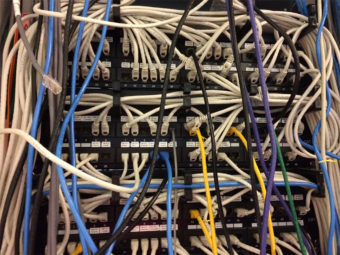
Alaska’s internet is the second slowest in the country. (Photo by Sarah Yu/KTOO)
Alaska’s internet speeds are up 33 percent from last year, but we’re only up one spot ahead of Arkansas for the slowest internet in the country, according to a pending study.
For the first quarter of 2014, Alaska had the slowest internet in the U.S. That’s according to a report by Akamai Technologies, an internet content delivery company based in Cambridge, Massachusetts. Alaska’s internet is about half as fast as the top three states: Virginia, Delaware and Massachusetts. Akamai’s studies and rankings are based off of actual content, such as websites and videos,delivered to usersfrom their servers.
What’s does “Mbps” mean?
Alaska averaged 7 Mbps in the first quarter of 2014, according to Akamai Technologies.
Mbps stands for megabits per second. Internet content such as websites and photos are measured in megabits and megabytes and Mbps is used to measure how quickly content will download. At 7 Mbps, users should be able stream video in HD. Average speeds will drop when multiple people use the same connection.
David Belson wrote the study. He’s senior director of industry and data intelligence at Akamai.
“The speeds that we do see, even in the slower states, are still pretty good,” says Belson.
The United States ranked 12th globally in internet speeds, with an average of 10 Mbps. Libya has the slowest internet speed worldwide, with an average of 0.5 Mbps.
Economy, population density and geography play a large part in how fast local internet is.
“If you can bring high speed connectivity to a city and you can hit a large percentage of the population there, that’s a good thing. But if you have to be running it along, you know, roads and over hills and across rivers, that all gets really expensive,” he says.
GCI and Alaska Communications are Alaska’s largest internet providers. They had to run fiber optic cable underwater more than 1,000 miles from Anchorage to the lower 48.
“We’re more similar to an international carrier that’s connecting continents, rather than a lower 48 provider that is connecting on land,” says ACS spokeswoman Hannah Blankenship.
She says Alaska’s large landmass and low population contributes to slower speeds. Communities off the road get internet via satellite, which is slower than cables and fiber.
David Morris, a GCI vice president, says sometimes large organizations such as the State of Alaska, hospitals or schools will pay to build infrastructure for faster internet to offer vital community services.
For example, the Yukon-Kuskokwim Health Corp. used USDA Rural Development grant funding to upgrade 65 rural communities in southwest Alaska from satellite internet to GCI’s land-based network. That meant paying for a combination of line-of-sight microwave dish relays and fiber optic cables.
The health care provider needed faster internet to keep up with changes in a federal health insurance privacy law that limited certain health care communications, but allowed for specific types of live video conferencing.
“You’ve got the village health clinic that is connected to a regional hospital and then in turn those hospitals are connected in to Anchorage, as well as to lower 48 hospitals,” Morris says.
Once the infrastructure was there, the internet provider could offer faster internet to locals.
GCI itself has spent $150 million dollars to improve internet in rural communities, in addition to having a $44 million grant and $44 million loan in Federal Broadband Stimulus Funding.
ACS just announced it will offer 30 and 50 Mbps home internet for Anchorage residents. And GCI is in the process of making 1 Gbps internet connections available in Anchorage.
Akamai Technologies’ next Internet study is due out this month.
The Pacific Queen tipped over in Harris Harbor on Tuesday. (Photo courtesy Scott Simonson)
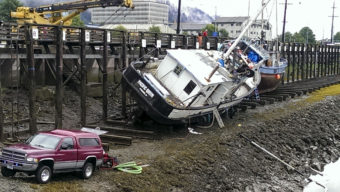
The Pacific Queen tipped over in Harris Harbor early this morning. Larry Coleman, a 67-year-old retired logger originally from Petersburg, owns and lives aboard the 63-foot ocean dragger.
Coleman says he put the boat up on the grid yesterday for routine maintenance. Around 4 a.m. today, he was thrown out of bed–the boat had slipped off the grid during low tide and fell on its side.
“As the tide went out, it just started snapping the ropes,” Coleman says.
The boat sustained a minor hole and a small amount of diesel spilled, according to the Coast Guard.
Coleman and a group of friends were able to right the boat using flotation bags and styrofoam logs, among other things. But the boat flooded during high tide.
The interior is now “like a swimming pool,” Coleman says.
The water destroyed a deep freezer, two guitars, a flat screen TV, and other possessions, Coleman says.
He lives in Douglas Harbor and has lived in the boat for about 14 years. He built a house on it about 10 years ago and hopes to salvage it.
Juneau Docks and Harbor oversaw the situation and the Coast Guard managed the diesel spill.
UAS is facing a $1.9 million shortfall this fiscal year. (Photo by Heather Bryant/KTOO)
The University of Alaska Southeast is facing a $1.3 million state budget cut this fiscal year, and a total shortfall of $1.9 million that may lead to layoffs.
Michael Ciri, interim vice chancellor for UAS, says the university plans to absorb most of the cuts by closing open positions, reducing janitorial staff, eliminating positions after employees retire and delaying certain projects.
“I don’t want to say UAS is somehow immune from layoffs during this process,” Ciri says.
However, management at the student recreation center is being restructured, which will likely lead to layoffs. The goal is to save money, not reduce the number of employees, Ciri says.
“How many people are on the payroll today and how many people are on the payroll tomorrow, that number might actually be the same number,” he says.
Personnel who are let go may apply for new positions at UAS created as a result of the reorganization.
The university system is also facing a drop in college enrollment, which means less tuition. The number of graduating high school seniors in Alaska peaked in the 2008-2009 school year and isn’t expected to rebound until the 2020s, says university system spokeswoman Kate Ripley.
UAS plans to attract more students to its university to offset the shortfall, Ciri says. It is building a new dormitory as part of a plan to make the campus more attractive to prospective students.
The University of Alaska system as a whole has a $15.9 million state budget cut this fiscal year. University of Alaska Fairbanks will see a $7.6 million reduction; it plans to lay off at least 40 people.
The University of Alaska Anchorage was cut $5.8 million.
The Department of Fish and Game had a display of bear pelts and skulls. (Photo by Sarah Yu/KTOO)
There were various booths with activities for kids. (Photo by Sarah Yu/KTOO)
The line for food wrapped around the parking lot at Sandy Beach. (Photo by Sarah Yu/KTOO)
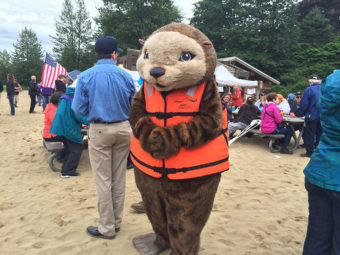
The PFD Otter teaches boat safety at the picnic. (Photo by Sarah Yu/KTOO)
There was a dedicated grill team cooking hot dogs and salmon for picnic goers. (Photo by Sarah Yu/KTOO)
Gov. Sean Parnell and Sandy Parnell serve food to Juneau residents. (Photo by Sarah Yu/KTOO)
Fifteen minutes before the scheduled start of yesterday’s sixth annual Governor’s Family Picnic, there was already a long line down the sidewalk at Sandy Beach.
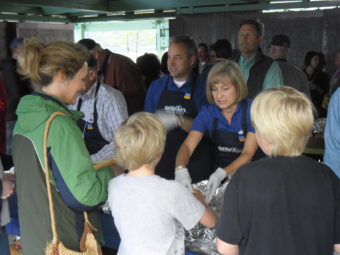
By the end of the picnic, 1,599 hot dogs had been served.
There were also salmon, cookies and chips and the Alaska Housing Finance Corp. gave out bags of popcorn. Gov. Sean Parnell, First Lady Sandy Parnell and commissioners served food.
Jan Rice, a retired Juneau School District employee, frequents Parnell’s events.
“Yeah, I’m always there at Christmastime and the parade thing. I try to see him as often as I can,” Rice says.
Raven George, a Fred Meyer employee, brought her young daughter.
“It’s our first time here at the beach, so we wanted to bring her here so she can see the people and feel the sand,” George says.
There were activities for kids including panning for gold, a bear pelt exhibit and a fishing game. Some mascots made appearances, including PFD Otter with the Coast Guard Auxiliary. PFD is short for “personal flotation device.”
But the main attraction every year seems to be the food. Particularly, the grilled salmon.
“Our first year, we had three weeks to get everything planned and the biggest deal for us is the fresh salmon that we get,” says Cathie Roemmich, CEO of the Juneau Chamber of Commerce and co-chair of the picnic committee.
Taku Smokeries, Alaska Glacier Seafoods and local fishermen donated about 200 pounds of fish.
Parnell travels to Ketchikan today to hold the last governor’s picnic of the year.
Gov. Sean Parnell and First Lady Sandy Parnell dish out food at the 2013 picnic. (Photo by Lisa Phu/KTOO)
The Governor’s Office is hoping for sunny weather for the sixth annual Governor’s Family Picnic in Juneau. The picnic will be at Sandy Beach Wednesday from 4:30 p.m. to 7:30 p.m.
Local businesses and individuals donated food for the free event. Two-hundred pounds of salmon have been provided by John Moller, a commercial fisherman and the governor’s rural affairs adviser. There will also be hot dogs, cookies and chips.
Gov. Sean Parnell and First Lady Sandy Parnell as well as commissioners will serve the picnic fare.
Juneau residents are encouraged to take the opportunity to speak with the administration.
“This is a really great time for the community to come out and meet with the governor, the first lady, talk with them and mingle with the commissioners. If they’ve got anything they want talk to them about, any issues they want to bring up, they’re there to talk with them,” says Sharon Leighow, the governor’s press secretary.
Various state departments, including Motor Vehicles, Fish and Game and Commerce will host activity booths. The Department of Corrections will provide fresh produce from Port Mackenzie Correctional Farm.
Between 1,500 and 3,000 people have attended the event in the past.
Close
Update notification options
Subscribe to notifications
Subscribe
Get notifications about news related to the topics you care about. You can unsubscribe anytime.