
Sarah Yu

EU Charges Google With Antitrust Violations, Will Also Look At Android

European Competition Commissioner Margrethe Vestager announces formal charges against Google, accusing the company of abusing its dominant position as Europe's top search engine. (Photo by John Thys/AFP/Getty Images)
European Competition Commissioner Margrethe Vestager announces formal charges against Google, accusing the company of abusing its dominant position as Europe’s top search engine. (Photo by John Thys/AFP/Getty Images)

Saying that Google has abused its dominant position in the search market “by systematically favoring its own comparison shopping product,” the European Commission has sent a list of antitrust charges to the search giant. The EU has also opened a new inquiry into the Android mobile system.

“I am concerned that the company has given an unfair advantage to its own comparison shopping service” and broken European law, says the EU Commissioner in charge of competition policy, Margrethe Vestager.

She added that Google will have a chance “to convince the Commission to the contrary. However, if the investigation confirmed our concerns, Google would have to face the legal consequences and change the way it does business in Europe.”

The EU’s “preliminary conclusions” include:

  • “Google systematically positions and prominently displays its comparison shopping service in its general search results pages, irrespective of its merits. This conduct started in 2008.”
  • While Google’s own shopping service doesn’t get penalized when it fails to match parameters in its search ranking system, Google does penalize competing services, “which can lead to the lowering of the rank in which they appear.”
  • Google’s “systematic favoring” of its shopping services have helped them grow at the expense of the company’s rivals.
  • “Froogle, Google’s first comparison shopping service, did not benefit from any favorable treatment, and performed poorly.”

Taken together, the charges could expose Google to fines of more than $6 billion, according to multiple reports.

“Google is far more dominant in Europe than it is in the U.S.,” NPR’s Ari Shapiro reports for Morning Edition. “It accounts for 9 out of 10 searches in Europe.”

Ari adds, “The U.S. did have an antitrust investigation into Google a couple of years ago. It was conducted by the FTC, the Federal Trade Commission, and it was settled without a formal complaint — though Google did agree to make some changes to the way it handles its search results in the States.”

In announcing a separate investigation into the Android mobile operating system, the EU panel noted that while the system is “open-source,” the majority of device makers pair Android with Google’s applications and services.

In that case, the European Commission says it wants to learn:

  • Whether Google has set rules or given incentives that would lead manufacturers to “exclusively pre-install Google’s own applications or services”
  • If Google has worked to prevent device-makers from releasing “Android forks” – altered versions of the operating system that could compete with the main product.
  • Whether Google used bundling or other methods to force the inclusion of a range of Google apps and services on devices, to the detriment of its rivals.

Responding to the new Android inquiry, Google says of its partner agreements: “It’s important to remember that these are voluntary — again, you can use Android without Google — but provide real benefits to Android users, developers and the broader ecosystem.”

The company’s European branch also said that its free operating system has contributed to the fast growth of the smartphone market and helped to end an era in which “[the] only way to build apps was device by device and platform by platform.”

Regarding the formal antitrust charges, the company highlighted its Google Flight Search as proof that it can serve consumers without destroying competition.

In a blog post called “The Search for Harm,” Google Search Senior Vice President Amit Singhal also noted the success in Europe of other search and review services, from Bing to Yelp. His post includes charts that show Amazon, Ebay and other companies attracting the most unique visitors in the UK, France, and Germany, with Google Shopping ranking well below those retailers.

Copyright 2015 NPR. To see more, visit http://www.npr.org/.
Read Original Article – Published APRIL 15, 2015 9:16 AM ET

Atlanta Teachers Convicted In Cheating Scandal Await Sentencing

Ten former Atlanta public school employees, who were convicted this month of conspiring to cheat on state tests to earn raises and bonuses, will be sentenced today.

Reporter Martha Dalton of member station WABE tells our Newscast unit that the judge delayed making the final decision on sentencing Monday “after he heard from defendants’ friends and families. He told them he won’t hesitate to send them to prison — for years, in some cases — but he’d give them a chance to negotiate with the prosecution.” Each of them faces 20 years in prison.

“The only thing that we have asked from the very beginning is some acceptance of responsibility for what you’ve been convicted of now,” District Attorney Paul Howard said.

Martha says that to receive lesser penalties, the defendants would have to “admit guilt and forgo their right to appeal.”

As Eyder reported at the time of the convictions on April 1, the cheating scandal is thought to be the biggest in U.S. education. (You can also read more about the context to the scandal on our education blog, NPREd.)

Here’s the background to the scandal:

“This case dates to a report produced by the state in 2011 that found a ‘school system fraught with unethical behavior that included teachers and principals changing wrong answers on students’ answer sheets and an environment where cheating for better test scores was encouraged and whistleblowers were punished.’ The report itself was prompted by a statistical analysis by The Atlanta Journal-Constitution that found some scores in the Atlanta school system were improbable. Originally, 35 educators were indicted by a grand jury, but many of them took plea deals and only a dozen of them ended up standing trial.”

But as Dana Goldstein, a staff writer at the Marshall Project, told NPR on Monday while this case is the largest of its kind, it’s by no means the only one.

“A federal report in 2013 found 40 of 50 states are showing some evidence of this type of cheating, and an older study from the Chicago public schools looked at all the classrooms in that district, and it found evidence of teacher cheating on tests in 5 percent of classrooms,” Goldstein said. “And something that’s relevant to the Atlanta case is that that Chicago study seemed to suggest that when there were lots of incentives for adults tied to these student tests, that’s when cheating increased.”

Copyright 2015 NPR. To see more, visit http://www.npr.org/.
Read Original Article – Published APRIL 14, 2015 7:48 AM ET

Forum@360: How Tumbling Oil Prices Affect Everything in Alaska

Cliff Groh of Alaska Common Ground

Oil is at the heart of Alaska’s economy, and the price per barrel a leading indicator of its health.

So with the price of oil crashing, what happens now?

Gunnar Knapp with the University of Alaska Anchorage’s Institute for Social and Economic Research and Cliff Groh of the nonpartisan public policy organization Alaska Common Ground will explain Alaska’s fiscal crisis, what we can do about it. They’ll also take your questions.

Join us for Forum@360: How Tumbling Oil Prices Affect Everything in Alaska at 5 p.m. Monday, Jan. 19 at 360 Egan Drive in Juneau.

Jeremy Hsieh hosts.


Juneau ranks No. 2 in ongoing poll of travel-worthy capitals

The Mendenhall Glacier during the summer of 2013. (Photo by Lisa Phu/KTOO)

Juneau is one of the 20 most travel-worthy state capitals, according to an ongoing online voting contest by USA Today.

As of Friday, the city was in second place behind Carson City, Nev. The contest started Dec. 9 and ends Jan. 5 at 8 a.m. Alaska time.

Nancy Woizeschke is the president and CEO of the Juneau Convention and Visitors Bureau. She says that Juneau has consistently been in the top 3 since the poll opened.

“We think that anything that puts us at the top of any such list like this is gonna be beneficial to us,” Woizeschke says.

Woizeschke says it’s difficult to measure how publicity impacts tourism in Juneau. She says the results of this contest may end up on JCVB tourism materials.

USA Today asked travel writers David Scott, Kay Scott and Larry Bleiberg to pick the initial list of travel-worthy capitals.

The Scotts have visited Juneau twice and say a number of things make it a special place.

“There aren’t too many capitals that have glaciers right outside of town,” Kay Scott says.

The Scotts are surprised that Carson City, as a small city, was leading the poll but speculate that capitals getting the most votes are supported by dedicated locals. Woizeschke says the employees at JCVB are diligently voting every day and encourage Juneau residents to do the same.

This isn’t the first time Juneau has been recognized as a travel destination. Last year, Eaglecrest was runner up in Powder Magazine’s Ski Town Throwdown and the TODAY Show came out to the Mendenhall Glacier this summer.

You can vote here.

New governor to hold annual Holiday Open House

The Governor’s annual Holiday Open House will take place Tuesday, Dec. 9 at the Governor’s House.
It will be the first event that Gov. Bill Walker and his wife Donna will hold at the residence after being sworn into office. The Walkers are the 13th family to live in the house since statehood.

“Donna and I look forward to celebrating the holiday season with our new Juneau neighbors,” Gov. Walker said in a press release. “This is a very special time for our family and we are blessed to take part in this wonderful tradition.”

The Governor’s House was built in 1912 and the traditional event has been held every year, with the exception of two years during World War II.

More than 20,000 cookies and 100 pounds of fudge and chocolate candies are being made in preparation of the event. Members of Gov. Walker’s cabinet will serve hot apple cider and treats to guests waiting in line outside. The event will last from 3 to 6 p.m.

ANSEP tripling enrollment in middle school program

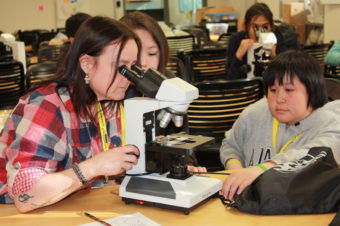
Students at a 2013 ANSEP Middle School Academy (Photo courtesy of ANSEP)

The Alaska Native Science & Engineering Program is tripling enrollment in its Middle School Academies after receiving a $6 million state grant.

The free academies were founded in 2010 and last 10 to 12 days. The program hopes to get middle school students—especially Alaska Natives—interested in science, technology, engineering and mathematics. The curriculum includes experiments and engineering challenges. Students live on the University of Alaska Anchorage campus to get a feel for college.

Seventy-seven percent of academy students take Algebra I by the end of eighth grade; the national average in 2011 was 47 percent, according to the National Center for Education Statistics.

Last year, there were four Middle School Academies in the spring and summer, each with 54 students between grades six and eight. Next year, they will have 12 sessions held all year round.

The grant money will be split over three years. Michael Bourdukofsky is ANSEP’s chief operations officer. He says the grant will go toward housing for students at UAA, travel, academic materials and staff support, among other things.

Bourdukofsky was a participant in ANSEP’s university program, but feels that students coming out of the Middle School Academies have an early advantage.

“With the exposure that we’re providing students with now to college life, to campus life, to the expectations of students once they get to college, I didn’t have any of that and I kind of went in blind,” Bourdukofsky says.

He graduated with an engineering degree from UAA and says ANSEP was critical in keeping him on track.

Bourdukofsky says ANSEP accepts about half of academy applicants and there are never enough slots for interested students. Students can only go to the program once, but are encouraged to participate in other ANSEP initiatives afterward.

Jules Mermelstein is only 15 but is set to graduate next year from West Valley High School in Fairbanks. He says that ANSEP encouraged him to set his goals higher and graduate early.

“I definitely wouldn’t have been doing a three-year track, had it not been for ANSEP’s initial push to get me interested,” he says.

Mermelstein originally wanted to be an archaeologist, but became fascinated with mechanical engineering when he attended an academy in sixth grade.

“We built a balsa wood bridge and while my group may not have done the best ‘cause there were many, many different groups competing, it was still really interesting and fun to learn how to build stuff, because that’s like nothing that’s really introduced in school other than like, a candy cane house,” Mermelstein says.

He hopes to continue along the ANSEP track in college, going to either UAA or University of Alaska Fairbanks. When he graduates, he says he would like to work on in-state renewable energy projects.

The grant to expand the Middle School Academies came through House Bill 278 championed by Gov. Sean Parnell.

Site notifications
Update notification options
Subscribe to notifications