Sarah Yu

ANSEP tripling enrollment in middle school program

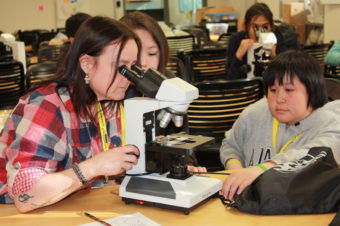
Students at a 2013 ANSEP Middle School Academy (Photo courtesy of ANSEP)

The Alaska Native Science & Engineering Program is tripling enrollment in its Middle School Academies after receiving a $6 million state grant.

The free academies were founded in 2010 and last 10 to 12 days. The program hopes to get middle school students—especially Alaska Natives—interested in science, technology, engineering and mathematics. The curriculum includes experiments and engineering challenges. Students live on the University of Alaska Anchorage campus to get a feel for college.

Seventy-seven percent of academy students take Algebra I by the end of eighth grade; the national average in 2011 was 47 percent, according to the National Center for Education Statistics.

Last year, there were four Middle School Academies in the spring and summer, each with 54 students between grades six and eight. Next year, they will have 12 sessions held all year round.

The grant money will be split over three years. Michael Bourdukofsky is ANSEP’s chief operations officer. He says the grant will go toward housing for students at UAA, travel, academic materials and staff support, among other things.

Bourdukofsky was a participant in ANSEP’s university program, but feels that students coming out of the Middle School Academies have an early advantage.

“With the exposure that we’re providing students with now to college life, to campus life, to the expectations of students once they get to college, I didn’t have any of that and I kind of went in blind,” Bourdukofsky says.

He graduated with an engineering degree from UAA and says ANSEP was critical in keeping him on track.

Bourdukofsky says ANSEP accepts about half of academy applicants and there are never enough slots for interested students. Students can only go to the program once, but are encouraged to participate in other ANSEP initiatives afterward.

Jules Mermelstein is only 15 but is set to graduate next year from West Valley High School in Fairbanks. He says that ANSEP encouraged him to set his goals higher and graduate early.

“I definitely wouldn’t have been doing a three-year track, had it not been for ANSEP’s initial push to get me interested,” he says.

Mermelstein originally wanted to be an archaeologist, but became fascinated with mechanical engineering when he attended an academy in sixth grade.

“We built a balsa wood bridge and while my group may not have done the best ‘cause there were many, many different groups competing, it was still really interesting and fun to learn how to build stuff, because that’s like nothing that’s really introduced in school other than like, a candy cane house,” Mermelstein says.

He hopes to continue along the ANSEP track in college, going to either UAA or University of Alaska Fairbanks. When he graduates, he says he would like to work on in-state renewable energy projects.

The grant to expand the Middle School Academies came through House Bill 278 championed by Gov. Sean Parnell.

Ferguson, Mo., Braces For More Protests After Night Of Violence

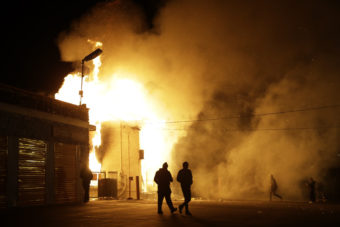
A storage facility in Ferguson, Mo., is on fire following the decision Monday by a grand jury not to charge Officer Darren Wilson in the shooting death of 18-year-old Michael Brown. Demonstrators clashed with police and set buildings on fire. St. Louis County Police Chief John Belmar said the unrest was worse than that which erupted after Brown was killed in August.

Updated at 10:06 a.m.

More protests are planned today over the decision Monday by a grand jury not to charge Ferguson, Mo., police Officer Darren Wilson in the shooting death of 18-year-old Michael Brown in August.

But, as NPR’s Carrie Johnson is reporting, Attorney General Eric Holder said the federal investigation into Wilson’s actions is ongoing and independent of St. Louis prosecutors.

The unrest began overnight soon after St. Louis County prosecutor Robert McCulloch said the grand jury of nine whites and three blacks decided that “no probable cause exists” to file charges against Wilson, who is white, in the death of Brown, who was black. He said he did not know how the jurors voted, as their votes are kept secret. But, he said, a decision on criminal charges requires agreement from at least nine of the 12 jurors.

Shortly after that announcement, demonstrators clashed with police and set buildings on fire; there were reports of heavy gunfire.

“What I’ve seen tonight is probably much worse than the worst night we ever had in August, and that’s truly unfortunate,” St. Louis County Police Chief John Belmar said, referring to the rioting that erupted after Brown was killed Aug. 9. Belmar said he had personally heard 150 gunshots.

The Federal Aviation Administration declared a no-fly zone over areas of heavy protests.

More than 80 people were arrested in the St. Louis area.

Reporter Tim Lloyd of St. Louis Public Radio said on Morning Edition that the mood at first was tense but peaceful. But soon after the decision, some in the crowd of protesters began throwing rocks at police and windows. Efforts by some demonstrators to urge calm failed. Police ordered the crowds to disperse and, when that didn’t work, fired tear gas canisters over the heads of the protesters, Lloyd said.

NPR’s Elise Hu, who is reporting on the story in Ferguson, wrote earlier that multiple businesses were set ablaze. She writes:

“It’s difficult to get a sense of the wider situation in St. Louis from any one position on the ground, as so much is happening at once. As some businesses burned, looters broke storefronts in scattered places across the area, and a St. Louis-area police officer was shot, according to the St. Louis Post-Dispatch. It’s unclear whether the shooting was related to the Ferguson unrest.”

Firefighters were dousing the remains of some of those businesses that were set ablaze.

President Obama, in remarks late Monday, urged calm and said “we need to accept that this decision was the grand jury’s to make.” He said the U.S. has made progress in race relations “but what is also true is that there are still problems, and communities of color aren’t just making these problems up.”

As NPR’s Johnson is reporting, civil rights lawyers at the Justice Department are working alongside FBI agents to examine whether Wilson intentionally violated Brown’s civil rights. Proving that Wilson violated federal criminal law will be difficult, Johnson reports.

But in the aftermath of Monday’s grand jury announcement, Holder said the federal investigation was ongoing.

“Although federal civil rights law imposes a high legal bar in these types of cases, we have resisted forming premature conclusions,” Holder said.

Protests against the decision were also held in Oakland, Calif.; New York; Washington, D.C.; and Chicago. Those protests were peaceful.

Brown’s family called for calm, but said they were “profoundly disappointed that the killer of our child will not face the consequence of his actions.”

We’re also looking at the documents that McCulloch released last night, which include testimony from Wilson and from witnesses to the encounter that led to Brown’s death, and physical evidence from the confrontation. You can find those here.

Copyright 2014 NPR. To see more, visit http://www.npr.org/
Read Original Article – Published November 25, 2014 6:01 AM ET

ANSEP tripling enrollment in middle school program

Students at a 2013 ANSEP Middle School Academy (Photo courtesy of ANSEP)
Students and staff at a 2013 ANSEP Middle School Academy (Photo courtesy ANSEP)

The Alaska Native Science & Engineering Program is tripling enrollment in its Middle School Academies after receiving a $6 million state grant.

The free academies were founded in 2010 and last 10 to 12 days. The program hopes to get middle school students—especially Alaska Natives—interested in science, technology, engineering and mathematics. The curriculum includes experiments and engineering challenges. Students live on the University of Alaska Anchorage campus to get a feel for college.

Seventy-seven percent of academy students take Algebra I by the end of eighth grade; the national average in 2011 was 47 percent, according to the National Center for Education Statistics.

Last year, there were four Middle School Academies in the spring and summer, each with 54 students between grades six and eight. Next year, they will have 12 sessions held all year round.

The grant money will be split over three years. Michael Bourdukofsky is ANSEP’s chief operations officer. He says the grant will go toward housing for students at UAA, travel, academic materials and staff support, among other things.

Bourdukofsky was a participant in ANSEP’s university program, but feels that students coming out of the Middle School Academies have an early advantage.

“With the exposure that we’re providing students with now to college life, to campus life, to the expectations of students once they get to college, I didn’t have any of that and I kind of went in blind,” Bourdukofsky says.

He graduated with an engineering degree from UAA and says ANSEP was critical in keeping him on track.

Bourdukofsky says ANSEP accepts about half of academy applicants and there are never enough slots for interested students. Students can only go to the program once, but are encouraged to participate in other ANSEP initiatives afterward.

Jules Mermelstein is only 15 but is set to graduate next year from West Valley High School in Fairbanks. He says that ANSEP encouraged him to set his goals higher and graduate early.

“I definitely wouldn’t have been doing a three-year track, had it not been for ANSEP’s initial push to get me interested,” he says.

Mermelstein originally wanted to be an archaeologist, but became fascinated with mechanical engineering when he attended an academy in sixth grade.

“We built a balsa wood bridge and while my group may not have done the best ‘cause there were many, many different groups competing, it was still really interesting and fun to learn how to build stuff, because that’s like nothing that’s really introduced in school other than like, a candy cane house,” Mermelstein says.

He hopes to continue along the ANSEP track in college, going to either UAA or University of Alaska Fairbanks. When he graduates, he says he would like to work on in-state renewable energy projects.

The grant to expand the Middle School Academies came through House Bill 278 championed by Gov. Sean Parnell.

Ex-Fairbanks priest indicted for child pornography

A former Fairbanks priest has been indicted for allegedly attempting to produce child pornography.

The Fairbanks Daily News Miner reported a federal grand jury indicted Clint Landry on one count of attempted production of child pornography and one count of attempted coercion and enticement of a minor.

Landry pleaded not guilty to both counts on Friday.

The 57-year-old former Sacred Heart Cathedral priest allegedly attempted the acts on May 18 and 19. The Catholic Diocese of Fairbanks placed him on leave that week.

Charging documents don’t specify the age of the victim or the specific actions Landry is accused of committing.

Diocese Human Resources Director Ronnie Rosenberg says staff called Alaska State Troopers after receiving a report of misconduct by Landry. The troopers passed the case to the FBI.

Walker criticizes Parnell for missing 2009 Obama visit

Bill Walker and Byron Mallott joined KTOO/360 North reporters for a roundtable discussion Sept. 12, 2014. (Photo by Sarah Yu/KTOO)

Independent gubernatorial candidate Bill Walker and running mate Byron Mallott chatted with reporters in a Friday recording of Forum@360, 360 North’s public affairs show.

Here are some highlights.

  • Walker, who until recently was a registered Republican, addresses how and why he merged his campaign with Mallott, the Democratic Party’s nominee for governor. He says, after doing some simple math in a three-way race, “It certainly appeared that neither of us were gonna be successful at replacing the incumbent governor, but together, the numbers showed that we would.”
  • Walker and Mallott say they’ll vote on the three November ballot questions the same way:
    • Require legislative approval of large-scale mining in Bristol Bay Fisheries Reserve? Yes.
    • Increase Alaska’s minimum wage? Yes.
    • Legalize marijuana? No.
  • Walker criticizes Parnell for not meeting with President Barack Obama in 2009 when he visited Alaska en route to Asia, saying, “We will meet with the president when he comes to Alaska.”
  • On state-backed megaprojects like the Knik Arm Bridge, Susitna-Watana Hydro project and Juneau Access Project, Walker says due to Alaska’s deficit, he would carefully select affordable projects with a good return on investment. “Many administrations come in and they just sort of wipe everything off the table and they start over again, and I’m not a start-over again person, I wanna finish some projects,” he says.

Gov. Sean Parnell and his running mate Dan Sullivan have been invited to a future reporters’ roundtable on Forum@360.

You can watch the Forum@360 with Walker and Mallot here. It will also broadcast this Friday at 8 p.m. on 360 North.

Maverick red aspens in a world of gold

A few aspen trees go their own way, leaves turning red and orange when the majority turn yellow. (Photo by Ned Rozell)

Will Lentz, a reader from Fairbanks, asks a question that flares every fall: why do some aspens turn red?

A few scientists from Fort Collins, Colorado, pondered that subject in the late 1970s. Curious about red aspen trees people had noticed for half a century, they studied why these existed amid those with the more common leaf color, yellow.

Before getting to the scientists’ results, a quick refresher on why tree leaves change color. Deciduous trees (the broad-leafed ones that drop their leaves in the fall, in contrast to our needle-leaved spruce) are gamblers now folding their hands after a few months of prosperity.

Sensing shorter periods of daylight, trees have quit refreshing their leaves with chlorophyll, the green pigment that helps capture the sun’s energy and allows the tree to convert it to the sugars that make it taller and bushier.

Right about now, when a tree reaches its daylight threshold, cork-like cells develop where leaf meets stem. This abscission layer, which later reveals itself as a handsome scar, is an ever-clogging pipeline that restricts the flow of sugars from leaf to tree.

As the tree informs its solar panels their services will no longer be needed, chlorophyll production stops. In mid-summer, chlorophyll was the loudest kid in the family. The parent tree replenished its leaves’ chlorophyll as the sun faded them like colored paper left on the windowsill. The tree’s autumn refusal to ante any more chlorophyll allows the quiet pigments in the leaf to express themselves.

These include yellow (xanthophylls) and orange pigments (carotenoids). Reds and purples come from anthocyanins.

Kuo-Gin Chang, Gilbert Fechner and Herbert Schroeder, then at Colorado State University, a few decades ago dropped aspen leaves into a blender and pushed the button. From the solution of liquid leaves, they determined that a sugary red pigment was indeed present in red and orange aspens, but not in yellow aspens.

The scientists hinted that the red occurs on only some trees, meaning it is probably a genetic trait — a red aspen is sort of like a person with red hair. The researchers also wrote that yellow trees remained yellow from year to year but one tree they selected for its redness at the start of their five-year observation was red only for the first year and yellow each following year. And most of those lovely reds and oranges did not endure to carpet the forest floor, fading to bland yellow within a week of falling.

Another intriguing question: in this don’t-waste-a-molecule world, why do trees invest in creating pigments other than energy-gathering green? Nobody seems to have answered that, but scientists have speculated that red acts as a sunscreen to keep played-out leaves from getting overexcited by photons. Another idea is that color might also either throw off green-munching bugs or be a tree’s way of showing insects its vigor compared to its drab, easy-to-attack neighbor.

Site notifications
Update notification options
Subscribe to notifications