Sarah Yu

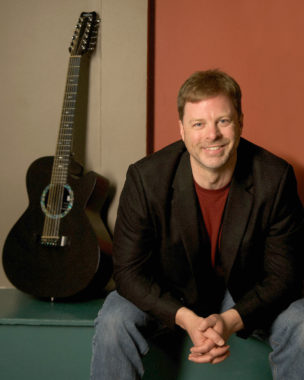
Alaska Originals: Kray Van Kirk

Kray Van Kirk will be performing on Thursday, May 15th as our next featured “Alaska Originals Artist.” Be a part of the studio audience for this live television recording. Doors open at 6:30 p.m. and the recording will start promptly at 7 p.m., @360 in the KTOO building.

Watch it later that night at 10 p.m. on 360 North.

KTOO wins 10 Alaska Press Club awards

KTOO won 10 awards at the Alaska Press Club conference last Saturday.  The KTOO website was awarded first place for best media website while Lisa Phu, Matt Miller and Casey Kelly all received first place in various radio categories. Gavel Alaska was awarded best social media package for its Facebook and Twitter presence.
CoastAlaska stations received a total of 18 awards at the event and The Juneau Empire won 12.

Here’s a list of all of the winners.

Best Media Website – All Media

First Place | Ktoo.org
“Clean, well-organized, user-friendly design that really highlights the site content. Estimated reading time at the top of story pages is a nice touch.” – Susie Cagle, judge

Best Social Media Package – All Media

First Place | Gavel Alaska
“Gavel has accomplished the very difficult task of turning something as dry as legislative session coverage into something smart, lucid, conversational and a little irreverent — in other words great social media. It’s a refreshing departure from many other niche news outlets who give up on social media because of a limited readership. Gavel’s social media may lack the audience and polish found at larger sites but its plucky approach puts it on par with any news org in Alaska.” – Abraham Hyatt, judge

Best Sports Reporting – Radio

First Place | Lisa Phu
Juneau sails to the end of summer with 3-day Regatta
“From the nat sound opening to the mix of exquisite sound under the narrative, this is what radio does best. You really ARE there with Lisa. Marvelous work, riveting. It was over too fast, rare with a radio feature.” –  Gayle Falkenthal, judge

Best Business Reporting – Radio

First Place | Matt Miller
Douglas business closed down, seized by IRS
“Great digging: through records and interviewing. Impressive you got Peterson to go on tape.” – John Ryan, judge

Best Government or Political Reporting – Radio

First Place | Casey Kelly
Juneau prepares for Federal Sequestration
“Solid work reporting on the various ways in which the sequester might affect Juneau and environs.” –  Paul Glickman, judge

Best Multimedia Presentation – All Media

Second Place | Kelsey Gobroski and Heather Bryant
Raptor rehab program dreams of a center for birds
“Such a sad story well told. Nice mixing of still and video photography. It is a little unclear to me why the center’s acreage is fallow, but the woman’s heart clearly shows through, and the stories of how each bird got to the center is compelling and sad.” – Bob Collins, judge

Best Education Reporting – Radio

Second Place | Lisa Phu
Tlingit ventriloquism, a way to keep the language alive
“I actually combined this and a companion piece into a single entry for the purposes of awards. Next to a profile piece on a mime, one on a ventriloquist must present the most challenges to a radio reporter. But what a great way to save a language! Good pacing, nice audio mix.” – Bob Collins, judge

Best Reporting on Crime and Courts – Radio

Second Place | Matt Miller
Alaska’s fast ferries getting new engines installed
“A very good job of explaining a difficult story to report.  Good tape…nat sound came a bit late in the report.  Judges enjoyed this reporter’s conversational delivery and style.  Some judges are not big fans of hearing lots of tape before speaker is identified, but understood the flow here.  Nice work by reporter.” – Doug Doyle, judge

Best Government or Political Reporting – Radio

Second Place | Casey Kelly
Republican lawmakers get riled over state vehicles blocking abortion protest
“A well told, comprehensive look at the abortion protest controversy.” – Paul Glickman, judge

Best Profile – Radio

Third Place | Casey Kelly and Rosemarie Alexander
Children’s author Jean Rogers dies
“I found myself smiling in this piece. It was well-told and also had some fun ‘nuggets’ revealed throughout with the soundbites chosen. (despite a sad topic)” – Jeff Stein, judge

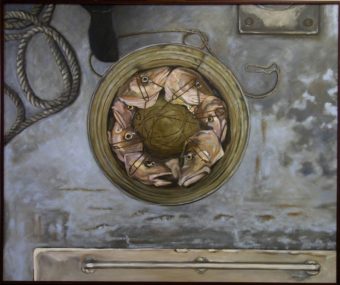
The Artist: featuring painter David Woodie

Still Life by David Woodie

Be part of the audience for the new television program: The Artist. Scott Burton interviews painter and teacher David Woodie on Thursday, May 1st, as part of a multimedia presentation of his artwork. Woodie has worked as a logger, a fisherman, and a teacher and uses the unique perspectives he gained in those fields in his paintings. Woodie refers to himself as a narrative painter and says that his paintings suggest stories. Come learn what he thinks those stories are, or make your own interpretations.
In addition to the artist’s work, see video footage of him in the classroom and in the studio, and learn what makes him tick @360 in the KTOO and 360 North building. Doors open at 6:30, cameras roll at 7:00. Admission is free.

Lawmakers make tentative deal on education bill

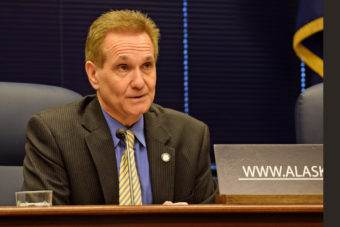
Sen. Kevin Meyer talks to reporters at a Senate Majority press availability, March 25, 2014. (Photo by Skip Gray/Gavel Alaska)

Negotiators from the State House and Senate have reached a deal on the governor’s education bill, and it includes a mix of permanent and one-time funding increases.
The compromise was announced on Wednesday night, three days after the Legislature had blown its adjournment deadline because of disagreement on the bill. The conference committee in charge of rewriting the legislation has decided to add $300 million to the education budget, spread out over three years.

Half of the money will come as one-time grants for education programs. The other half will come through the “base student allocation,” the amount of money a school gets for each child enrolled as part of the education funding formula. The new draft of the bill raises the BSA by $150 the first year, and by $50 in years two and three.

The new proposal is a blend of the House and Senate approaches to education funding. Even though both chambers are led by Republicans, the two bodies had different philosophies on education funding. Where the House wanted a slightly smaller amount that came through a more permanent source, the Senate was willing to spend more money but without putting it into the funding formula.

Sen. Kevin Meyer is an Anchorage Republican who is involved in the negotiations. He says that even if the compromise seems obvious now, it was not so clear on Sunday when the Legislature was facing its adjournment deadline.

“Well, you know, I think it took a couple days to realize that — that there’s an easy solution here,” says Meyer. “You know, we can meet halfway on the funding, that overall $100 million. And ultimately, we figured out, ‘Hey, we can meet half way on what’s in, what’s out, and we can be done and out of here.’ So, sometimes it just takes a couple days, and they you go, ‘Wow, Why didn’t we think of that?’”

The funding plan still does not meet the demands of education advocates, who pushed for a BSA increase of $400 this year alone. They argue that the state needs to give school district $450 million over the next three years, if teacher layoffs are to be avoided.

The conference committee also hammered out disagreements on more than a dozen other parts of the bill. They brought back Gov. Sean Parnell’s proposal to repeal the high school exit exam and require students to take the SAT, ACT, or WorkKeys test in its place. They also removed a section of the bill that would have required urban teachers to go through a longer probationary period before they get tenure.

The conference committee is expected to advance the bill on Thursday, the 94th day of the 90-day session.


Watch the conference committee courtesy of Gavel Alaska:

Riding the bumps of the far northern trail

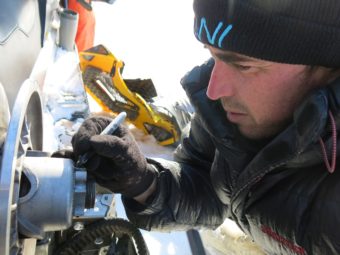
A sick snowmachine awaits rescue here on the snow-covered ice of this boot-shaped lake. After an 85-mile journey from our last stop at Umiat, one of the Ski Doo Skandics sputtered to a crawl a few miles from our intended campsite here.
The loss of one of their essential research tools has not stalled the trio of scientists traversing Alaska’s North Slope to poke shallow holes into its frozen lakes and soil. Thanks to his satellite phone, trip leader Ben Jones of the USGS Alaska Science Center in Anchorage has another machine on its way from Barrow. Two men on snowmachines are sledding it about 150 miles across the great coastal plain to us.

Chris Arp’s broken machine is one of a few not-in-the-game-plan events during the first seven days of this three-week journey across the Big White Empty between the Brooks Range and the Arctic Ocean. The ecologist with the University of Alaska Fairbanks’ Water and Environmental Research Center noticed his snowmachine was pulling to the right just a few hours after leaving our starting point at Toolik Lake one week ago. After an impressive group repair on a factory weld gone bad, executed in a breezy grove of dwarf willows, Chris coaxed the snowmachine to our planned stop at the oil exploration/research camp at Umiat. There, a mechanic spent nine hours making it like new.

Then, after a blue sky day of snowmachining from Umiat, the machine faltered near where we are camped in Arctic Oven tents on the surface of this lake that’s frozen to the bottom. Ben and Chris tried to repair the machine but found the problem (unrelated to the Umiat fix) was beyond their considerable stash of parts. Then came Ben’s call to Barrow, where teammates making a similar science traverse had a snowmachine available. That Ski Doo is now on its way here over hours of rider-punishing wind-bumpy snow. If the replacement doesn’t arrive today, there will be another plan.

Working out of a village or a research station would be more convenient for the three scientists who invited me along on their trip, but in an effort at self sufficient science they choose to pull tons of gear in two plastic sleds that trail 30 feet behind each machine. From above, we look like four snakes slithering across a white desert.

The guys cut the engines at places like this — an almost-undetectable-in-winter lake on a white prairie that spills north to the Arctic Ocean. Camping here is like setting up a tent on Mars, except for moving black dots that turn into striking red fox, a few graceful caribou kicking at snow and, at night, the piercing lights of nearby satellite oilfields.

On days like yesterday, when Ben, Chris and Guido Grosse spend some of their time troubleshooting equipment rather than drilling and dipping for water samples on arctic lakes, an observer wonders: why absorb the battering of concrete drifts and go three weeks without a shower when there are easier places to work?

“So we can learn something new,” Ben said while sitting on Guido’s cot in the propane-heated interior of an Arctic Oven tent. “It doesn’t seem right to look at a few places (on the massive chunk of Alaska north of the Brooks Range) and extrapolate over the whole region.”

On this trip, Ben, Guido and Chris will stop in four unique and far-flung settings to check the same variables on a few dozen lakes that are a good sample of the thousands that pepper the flatlands here. Snowmachines and sleds are the transport method of choice because they are cheaper than shuttling gear by helicopter or ski plane and they allow for travel in bad weather.

There is also the fun and adventure of it all. Sharing frigid, terrible, fantastic trail miles has sintered an enviable friendship among these three. They are accumulating stories of gnawing frozen tent dinners together, crashing into one another in flat light and the glory of blue-white days when they feel like the only people on Earth.
The aches in their throttle thumbs and skin that peels from their darkened faces weeks later adds color and depth to the data they see on computer screens back in the office.

“You kind of get hooked on it,” said Guido, who flew to Alaska from Potsdam, Germany, where he works for the Alfred Wegener Institute. He got his first taste of this wide-open country as a researcher with UAF’s Geophysical Institute, with which he is still affiliated.
“There’s always bad times when you think, ‘Why am I doing this when I could be home with my family?’ But a few days after coming home I start missing it out here already.”

Right now, as I type this within an orange tent while seated on an Action Packer, Ben, Guido and Chris have driven the remaining machines out of earshot, following their GPS units and memories to their study lakes and dried lake beds. I hear only the hiss of the stove’s blue flame and — just now — the plaintive cry of an arctic fox who is lounging on a rise that marks the rim of this lake.

With luck, tonight we’ll hear the distant whine of a new snowmachine driven from Barrow. Tomorrow, it will replace Chris’s hard-luck machine in our caravan. With the studies finished here at the “Fish Creek” region, we’ll motor northwest across frozen lakes, ice-wedge polygons and sand dunes to Teshekpuk Lake, the largest lake in Alaska’s arctic. “Tesh” is one of Ben’s favorite places in the world.
On its northern shore is a 50-year-old research cabin he has been restoring. There, we’ll regain the comforts of a hard roof, satellite internet and a maybe a nice long steam bath.

Next week, I’ll write of the special place Ben has resurrected on the wild shore of Teshekpuk Lake. I’ll follow that with my reflections of being a stranger in a landscape like none other. You can also follow the trip at alaskatracks.blogspot.com and Arctic Lakes blog.

Original publish date: April 17, 2014 |Since the late 1970s, the University of Alaska Fairbanks’s Geophysical Institute has provided this column free in cooperation with the UAF research community. Ned Rozell is a science writer for the Geophysical Institute.

As Legislature make progress on adjourning, KABATA bill falls apart

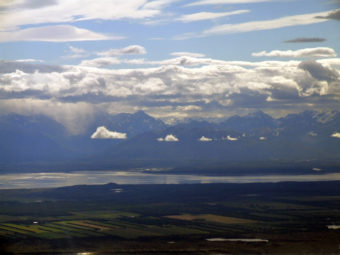
Knik Arm (Photo by Travis S.)

Less than two hours after the combative House and Senate seemed to reach a truce on education, a bill dealing with the proposed Knik Arm Bridge fell apart on the House floor.

The House rejected the Senate’s version by one vote on Wednesday night. Because 21 votes are required to pass legislation, the bill came up short when it got 20 yeas and 18 nays. Six Republicans broke ranks with their party to oppose the bill. They were Mike Hawker of Anchorage, Mia Costello of Anchorage, Lindsey Holmes of Anchorage, Kurt Olson of Kenai, Eric Feige of Chickaloon, and Paul Seaton of Homer. Two Republicans who were expected to support the bill were not present because of excused absences. Rep. Bob Lynn of Anchorage was excused for a family illness, while Rep. Lora Reinbold of Eagle River was absent because of a planned vacation.

While the bill originated in the House, it was dramatically changed in the Senate after an audit suggested that the project may be uneconomic. The new version sets up a financing plan for the billion-dollar bridge that involves a mix of federal highway grants, federal loans, and state bonds.

Because the House failed to concur, the bill may be sent to “free” conference committee with the power to rewrite it – just like was done with the education bill this week. That could extend a legislative session that has already gone three full days over its statutory deadline. While the Senate still needs to agree, the House has already named Kodiak Republican Alan Austerman, Chugiak Republican Bill Stoltze, and Anchorage Democrat Harriet Drummond.

The bridge bill is a major priority of Senate President Charlie Huggins, a Wasilla Republican.


Watch the House Floor Session courtesy of Gavel Alaska:

Site notifications
Update notification options
Subscribe to notifications