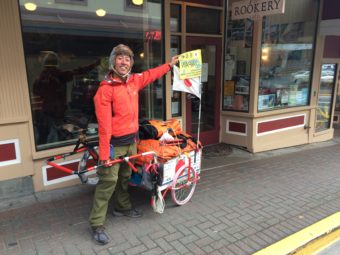
A man who is walking around the world is in Juneau through the weekend. Norio Sasaki is from Kyoto, Japan, and has been on the road for a while. I caught up with Sasaki at the Rookery Café.
Sasaki is visitng Juneau before heading to Argentina. (Photo by Scott Burton/KTOO)
“I went to Australia, New Zealand, Taiwan and Korea three years ago,” Sasaki said.
Sasaki said his English is not great, so he readily passes out a card that explains his trip. Roughly summarized, the laminated card says that he’s worked as a lifeguard and ski patroller and needs to be strong to continue helping others.
When asked why Sasaki is walking around the world he handed us this. (Photo by Scott Burton/KTOO)
Norio Sasaki spare tires, bear spray and mountain equipment. (Photo by Scott Burton/KTOO)
Sasaki says he’s been on the road for about 3 years. (Photo by Scott Burton/KTOO)
Worn tires show Sasaki’s 30 miles-per-day in the summer, and 24 in the winter. (Photo by Scott Burton/KTOO)
Walking around the world is a good way to see nature and meet people, and along the way he’s pulling a 175-pound rickshaw.
“This is my cart — all aluminum. So very light and I can carry inside an airplane. This is (my) spare tire and bear spray and mountain equipment. This is (my) speedometer. I walked 50 km in the summer season; winter season 40 km every day,” Sasaki said.
That translates to about 30 miles in summer, and 25 in winter.
“I walk through (the) pass, very hard. And downhill, very hard because my cart (has) no brake, only foot brake — (it’s) very hard,” he said laughing.
From here, Sasaki’s route includes Wrangell, Prince Rupert, Prince George, Jasper, Banff, Calgary, Yellowstone and eventually Argentina. He thinks he’ll be on the road for another three years. You can follow him on Facebook — just search for Sasaki Norio.
Last weekend, some 40 Alaskans journeyed down to Louisiana for the Blackpot music and food festival. The two-day festival is in its tenth year and takes place in and around the city of Lafayette in the south central part of the state. The weekend included a cook off, 25 bands, camping, jamming and lots of dancing.
Many of the Alaskans are musicians, music appreciators and friends who know each other through the Alaska music scene, and their trip has become a tradition.
Hear their voices and music from the Pine Leaf Boys here:
“I love how the Cajun culture marries love of food, love of dancing, love of community, and it reminds me of home.” –Kate Consenstein, Anchorage
“The energy is just so positive. I feel like if you come here it’s like getting a cultural hug.” –WeeBee Aschenbrenner, Cantwell, Alaska
“We got Cajun music. We got blues. We got rock and roll. We got zydeco.” -Paul “Bird” Edwards, Eunice, Louisiana
“One of the things we have a lot of at our festival is food—from everything and anything deep fried, to some of the great Cajun dishes like gumbo and jambalaya and étouffées.” –Derek Landry, Lafayette, Louisiana
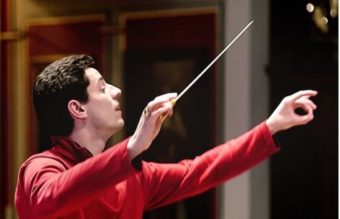
The Juneau Symphony season premieres this weekend with a performance called “New Beginnings.” The concerts will be Troy Quinn’s first shows as the new conductor. He said that their first piece, Dvorak’s “New World Symphony,” is especially fitting.
“It was his first arrival here to America … and so it’s kind of appropriate for me to be here, my first new arrival, and that’s our big work,” Quinn said.
They’ll also play Shastakovich’s “Festive Overture,” and Massanet’s “Meditation” from his opera “Thaïs” with special guest violinist Luanne Homzey. Quinn said he is enjoying his work in Juneau — a position with a unique job description.
“‘Conductor’ really comes from the word ‘to teach,’ so the Latin word,” Quinn said. “So there is the teaching element involved with it. And it’s also to inspire the musicians to play at their most passionate and capable level. You know, the conductor doesn’t make a sound.”
Saturday’s concert is at 8 p.m. and Sunday’s at 3 p.m. at Juneau-Douglas High School. Both performances include one-hour pre-concert conversations with Quinn. Sunday’s concert will also be broadcast on KRNN and KRNN.org. Tickets begin at $17 and can be purchased at juneausymphony.org.
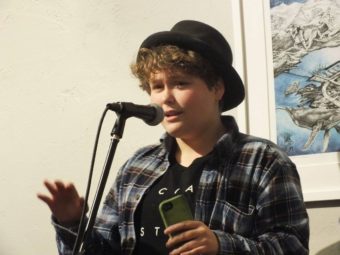
From the stage at the 2013 Grand Slam. (Photo courtesy Christy NaMee Eriksen/Woosh Kinaadeiyi)
The 5th annual Woosh Kinaadeiyi Poetry Grand Slam is Saturday. Spoken word poets have been competing for the last year and now the best of the best will perform and vie for the top spot.
You can begin to misbehave by starting small.
Stroll the city and don’t use the crosswalks. Talk to strangers. Bite hard candies. Check out a huge stack of books from the library and disregard the due dates. Bring a dozen rainbow-sprinkled doughnuts to work and don’t share them.
These are words from Woosh K co-founder Christy NaMee Eriksen’s “A Good Girl’s Guide to Misbehaving.”
Christy NaMee Eriksen. (Photo by Daniel Kantak)
After awhile,
you can try staying up past your bedtime.
When your alarm goes off, push snooze every 5 minutes for an hour.
Transition into the morning by daydreaming. Have ideas with your coffee.
While she won’t compete this Saturday, she’ll voice this piece as one of several opening performers at the Juneau Arts and Culture Center.
“It sounds so aggressive, the idea of a poetry slam. But it’s actually kind of been dubbed the friendliest competition in town. It really is about being able to share our word, share our stories in a very supportive, inclusive environment,” she says.
Eriksen says there can be differences between traditional poetry and what people can expect to hear at the grand slam.
“Spoken word is written with the intent to share it with others. So it’s different than maybe what you write in a diary and hide under your pillow. It’s work that you are willing to give to an audience and are willing to kind of perfect it in a way that makes sure that what you’re trying to convey gets conveyed,” she says. And its roots are varied.
“It’s come out of really rich traditions of hip-hop, resistance and social justice, so a lot of times spoken word poetry has been used as a voice for people who maybe don’t otherwise feel like they have a voice in community, or artistic circles—in the literary scene—whatever. And for that reason is why spoken word has always kind of been a hook for me personally. It’s been kind of my language of liberation is what I often say. I can say things in poetry that I can’t say in English, you know, sitting with someone,” she says.
On stage, Eriksen will be joined by hosts Conor Lendrum and KXLL’s Annie Bartholomew, the Woosh K House Band, Dee Jay De Rego, Amy Pinney, Caroline Garcia, Ziggy Unsicker, Erika Bergren, Fysh Houck, Mike Christenson, David Parish, Maureen Longworth and Christina Apathy.
The Grand Slam begins at 7 p.m. Saturday at the Juneau Arts and Culture Center. Admission is pay as you can.
Listen to Eriksen read “A Good Girl’s Guide to to Misbehaving” here:
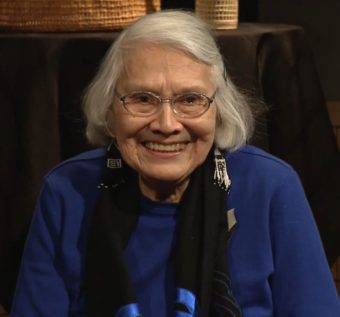
Master Haida weaver Delores Churchill is one of two keynote speakers at this year’s Alaska Federation of Natives conference in Anchorage. Churchill was born in Masset, Canada, and now lives in Ketchikan.
In 2014, Churchill shared her introduction to weaving with an audience at KTOO. She’d been wary as a child, but as a young adult, took a class from her mother, master weaver Selina Peratrovich.
“So I walk into the classroom where my mother’s teaching. And she looked at me and said, ‘What you do here?’ She spoke broken English. ‘I weave. I weave.’ ‘You no look! Go on. Go home.’ I stood there and then thank goodness the head of the art department Ron Inoue walked in and he put his arms around my mother. He said, ‘What’s wrong?’ And mother said, ‘I’m telling her to go home.’ He said, ‘No, we need her registration. We don’t have enough people.’”
Churchill is internationally known for her baskets, robes, hats and other regalia, which use materials such as wool, spruce root and cedar bark. Churchill is also known for her teaching and likes to share a tradition she learned from her mother.
“When she harvested bark, she’d say to the tree, ‘I hope to make a beautiful basket and I hope not to hurt you in any way and I really wish that you send out seeds, so trees would continue to grow, so our children and great grandchildren would be able to enjoy and do the things that I enjoy.’”
The documentary “Tracing Roots” features Churchill and premieres at 8:30 p.m. Tuesday. Churchill’s AFN keynote speech begins at 10 a.m. Thursday. Both will be on 360North and 360North.org.
Close
Update notification options
Subscribe to notifications
Subscribe
Get notifications about news related to the topics you care about. You can unsubscribe anytime.