Sharing Our Knowledge: A Conference of Tlingit Tribes and Clans took place in Sitka over the weekend. The biennial conference began in 1993 as a way to document customs and traditions and includes lectures, ceremonies, and hands-on art and technology demonstrations.
This year’s gathering, at the historic Sheldon Jackson College campus, was scheduled to coincide with Alaska Day celebrations.
On the the front lawn, participants hurled spears at an elk target using Alaska Native spearthrowing boards.
Inside, master weavers and aspiring artists’ fingers spidered across Chilkat and Raven’s Tail-style works.
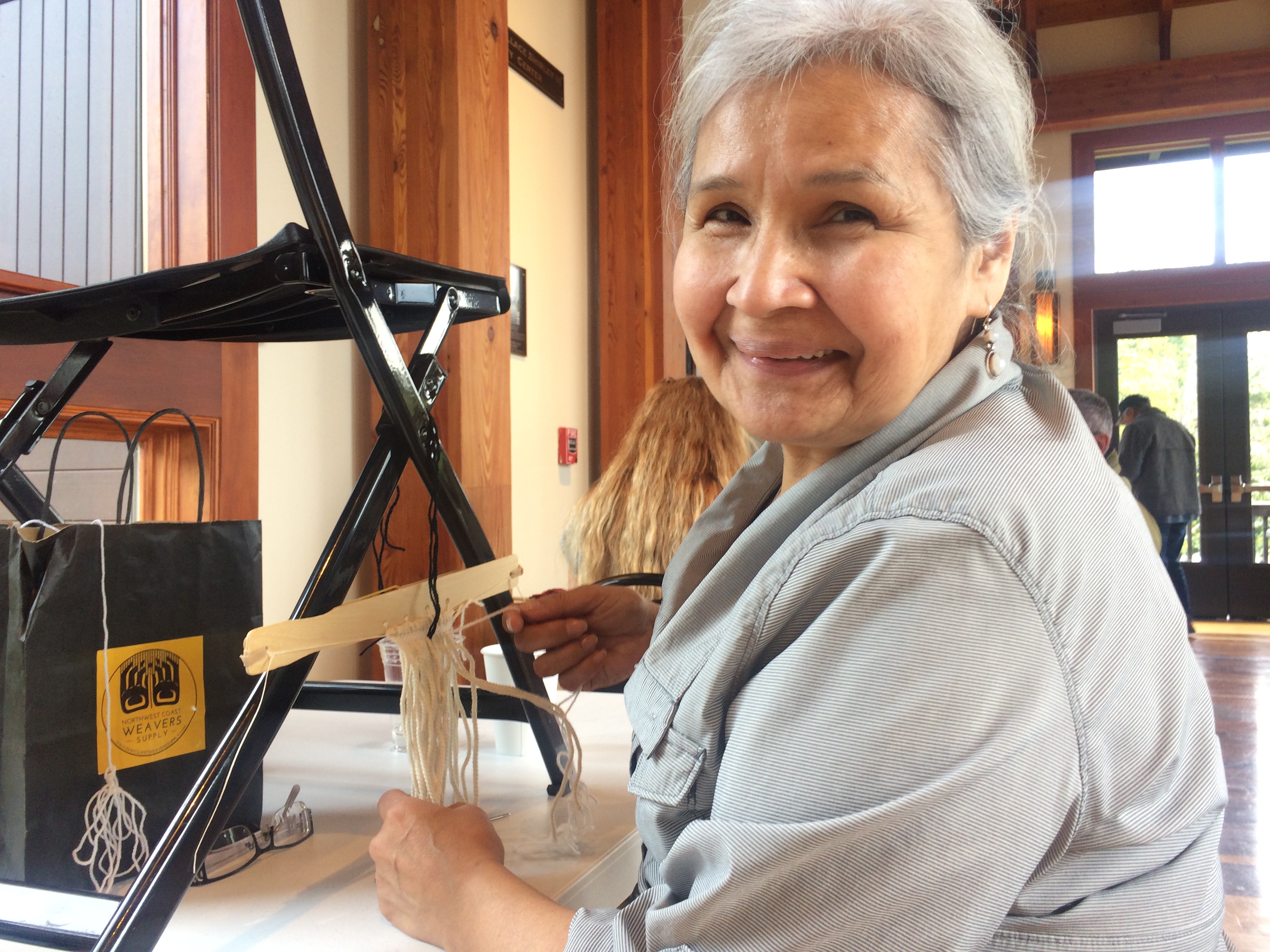
“I’m weaving again!” said Liana Wallace who was among the weavers gathering sitting in a large, windowed foyer. Abundant natural light illuminated a welcoming smile and her work.
Liana Wallace works at the weavers gathering. (Photo by Scott Burton/KTOO)
“I’m from Juneau. I’m Aak’w Kwáan from the Big Dipper house,” said Wallace who admitted she hadn’t woven in some time.
“I’ve been inspired by my sisters who are all weaving in honor of our teacher,” she said referring to the late master weaver and multi-disciplinary artist Clarissa Rizal.
“And so I am working with Lily, her daughter, and I’m working with Irene, her sister. And yes, it makes it more powerful to begin again,” said Wallace.
Elsewhere on campus, scholars and experts presented with titles like “Tlingit-Russian Interpreters Before and After 1867,” “Misconceptions about Alaska Natives,” and “The Seward Pole: Indigenous Claims in Alaska’s Sesquicentennial.”
Jixeik, or Gerry Hope, is the conference’s Executive Director. He’s Sik’nax.ádi from Wrangell. He said that he and the organizing committee decided to schedule this year’s symposium now, just before Alaska Day. For Hope, it’s been a long time coming.
“As a child growing up here, born and raised, who doesn’t like a parade? … Parades encourage fun and happiness and that’s hard to resist. As I got older into my young adulthood is when I started hearing some of the frustrations, some of the anger, and some of the resentment,” said Hope.
“I have had for quite some time negative feelings about the holiday,” said Kaasáank’ Andrew C. Williams, who was among the conference presenters.
“It’s associated to the defeat of our people in this area. It’s associated to an idea that it’s OK to take control of somebody else’s stuff as long as you have the latest technology to stomp them down and control of the history of those people,” said Williams.
Executive Director Jixeik Gerry Hope has ideas for how healing for Williams’ negative feelings might begin.
“If I were to see a vision, it would be a number of things. One is acknowledgements from the dominant society that wrongs were committed against the first people. Another outcome that I’d like to see is a healthy dialogue in how we proceed from that. It doesn’t have to be demands. It doesn’t have to be any necessarily big news events that are conflict based. … As long as it is constructive and safe, and health-based,” said Hope.
That fits with the this year’s conference theme, “Our History, We Are Healing Ourselves.”
Alex Kotlarsz performed for us in the KTOO arts room Thursday as part of our Red Carpet Concert series. Listeners may know Kotlarsz from The Wool Pullers, his solo performances, or as Alex K. and the Unmentionables.
You can catch Alex K. and the Unmentionables live at 10 p.m. Friday at McGivney’s in the valley. Stay tuned for more Red Carpet Concerts as we celebrate New Member Month here at KTOO. Next week we feature Laura Zahasky, Josh Lockhart, Jason Cornish, Sarah Jane Klinger and Jeff Bowman.
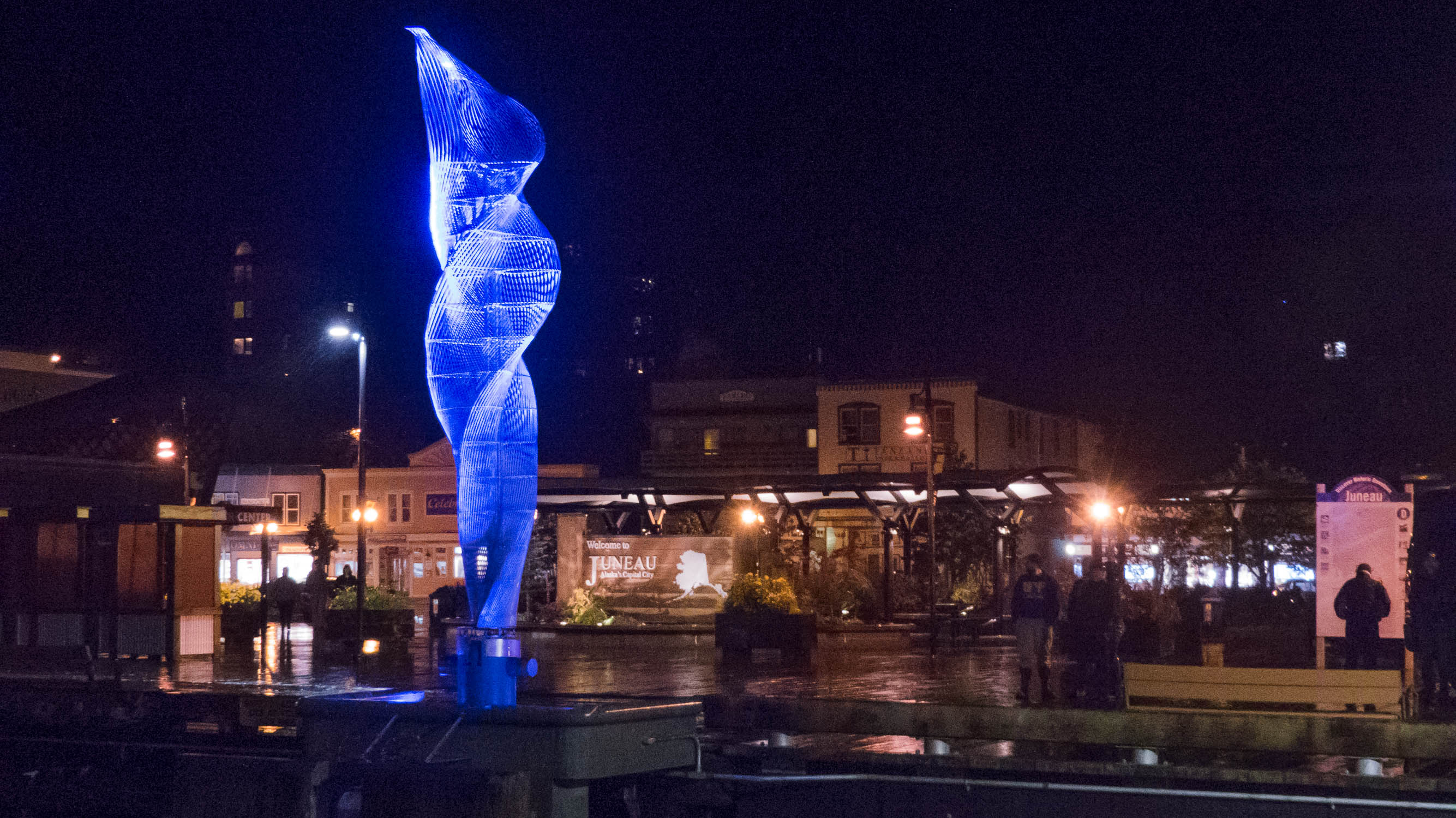
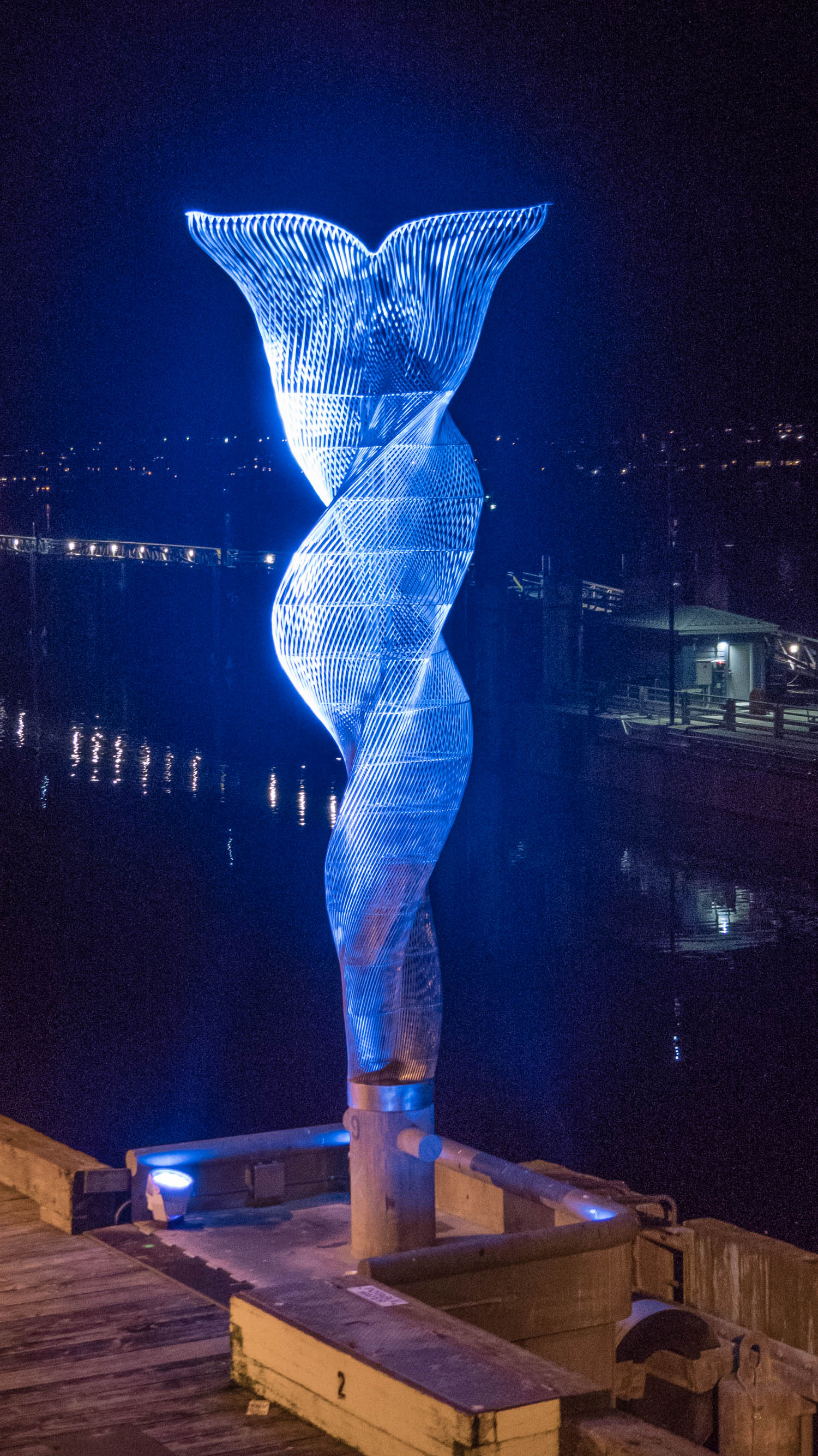
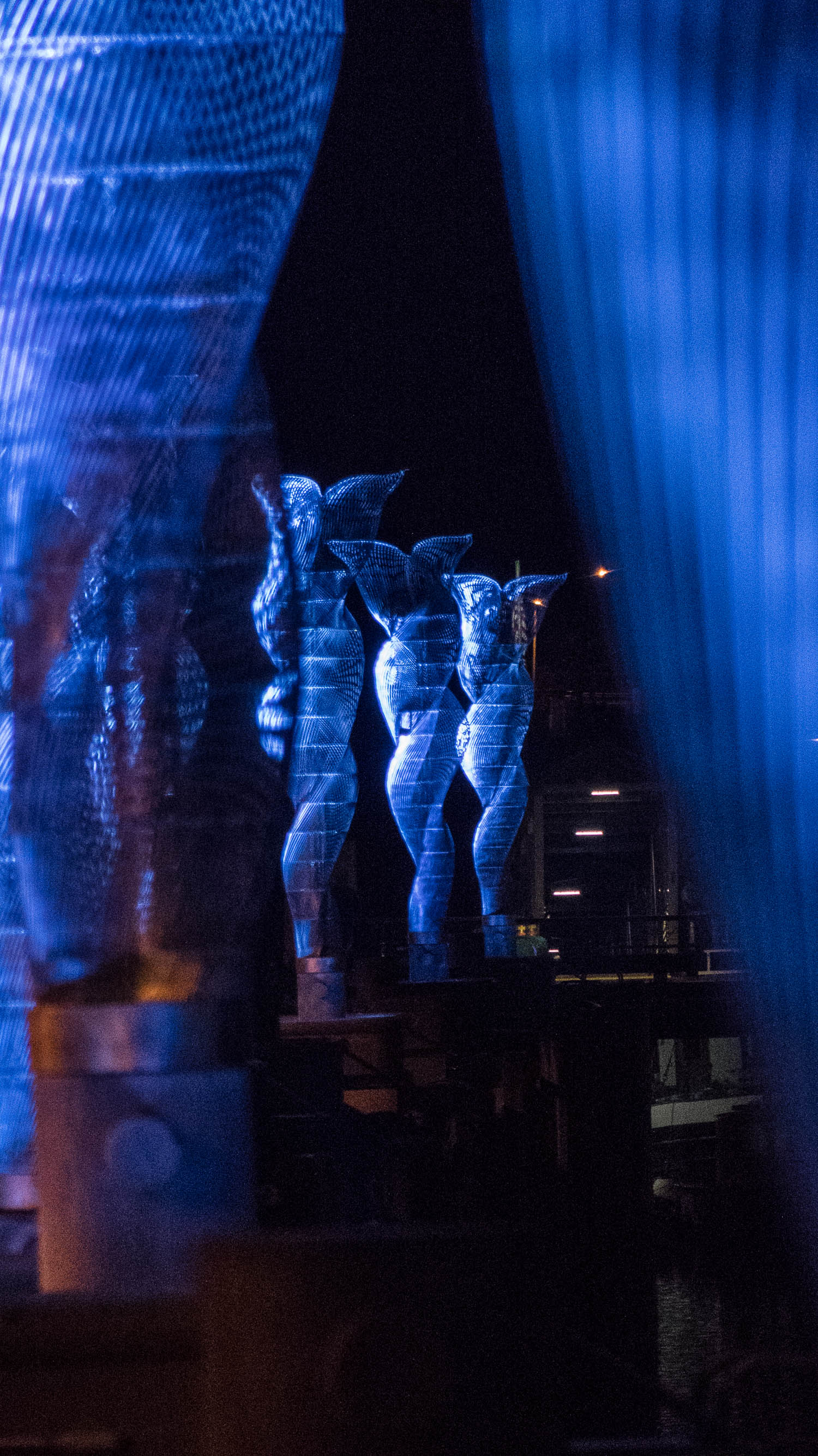
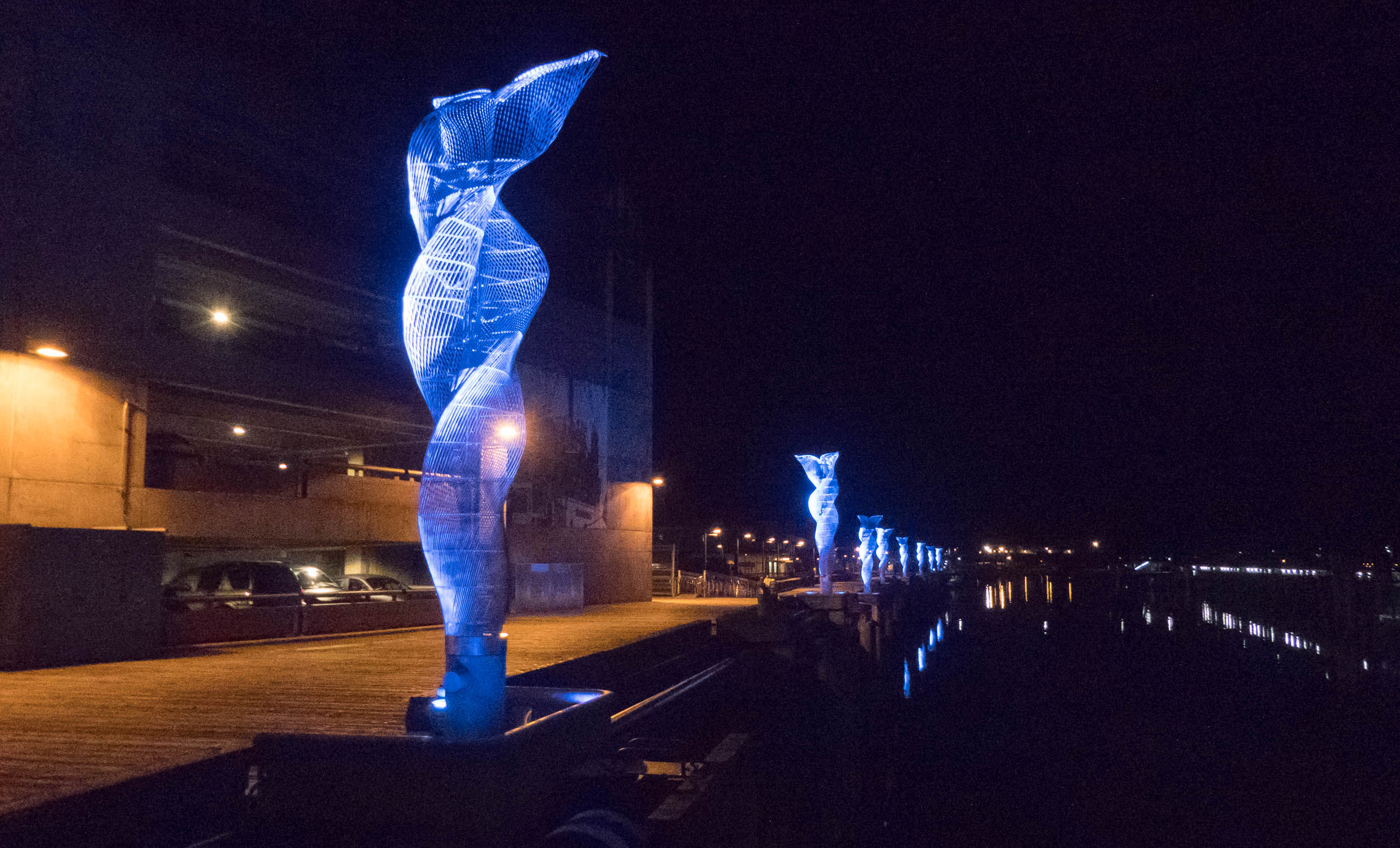
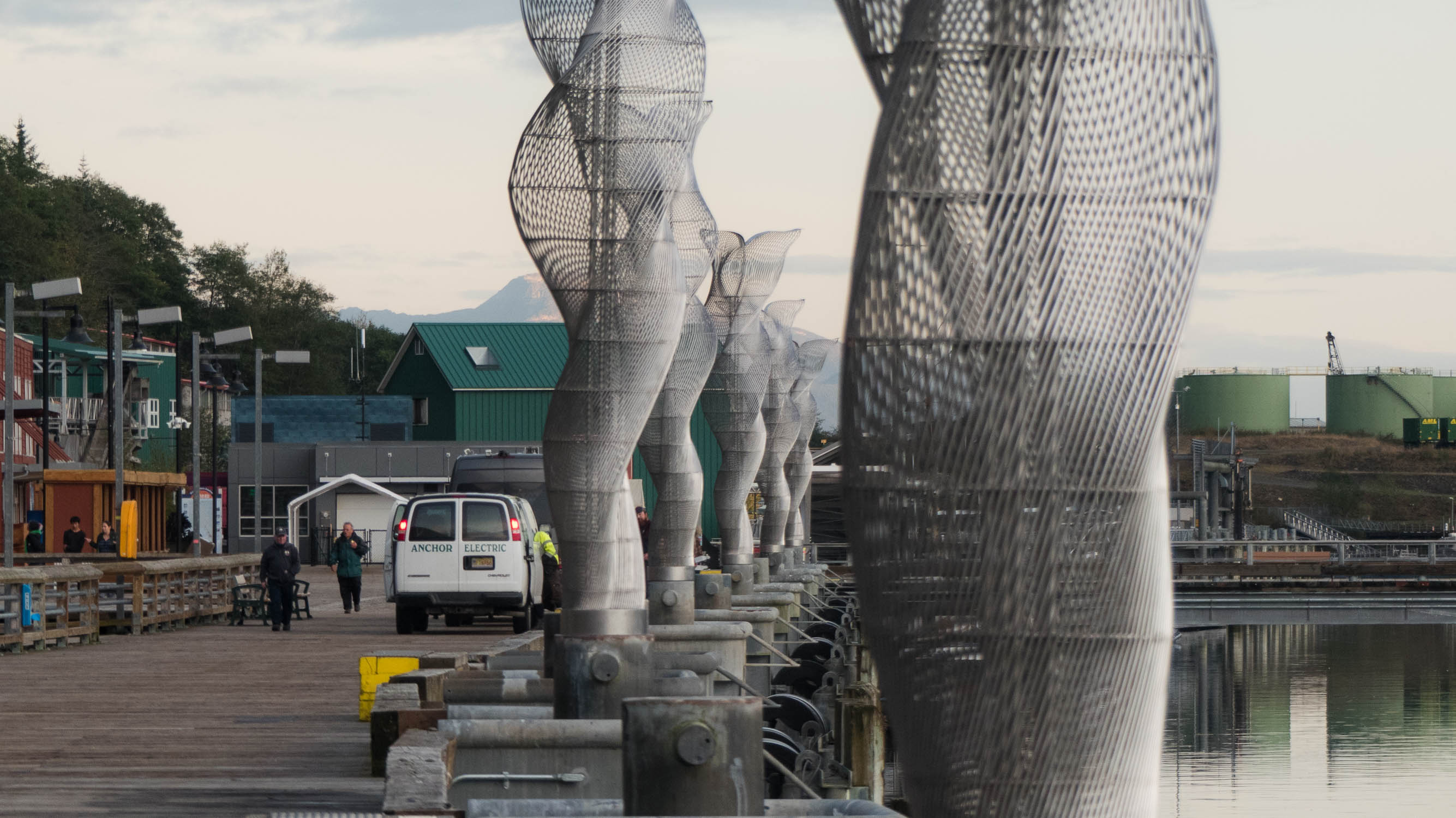
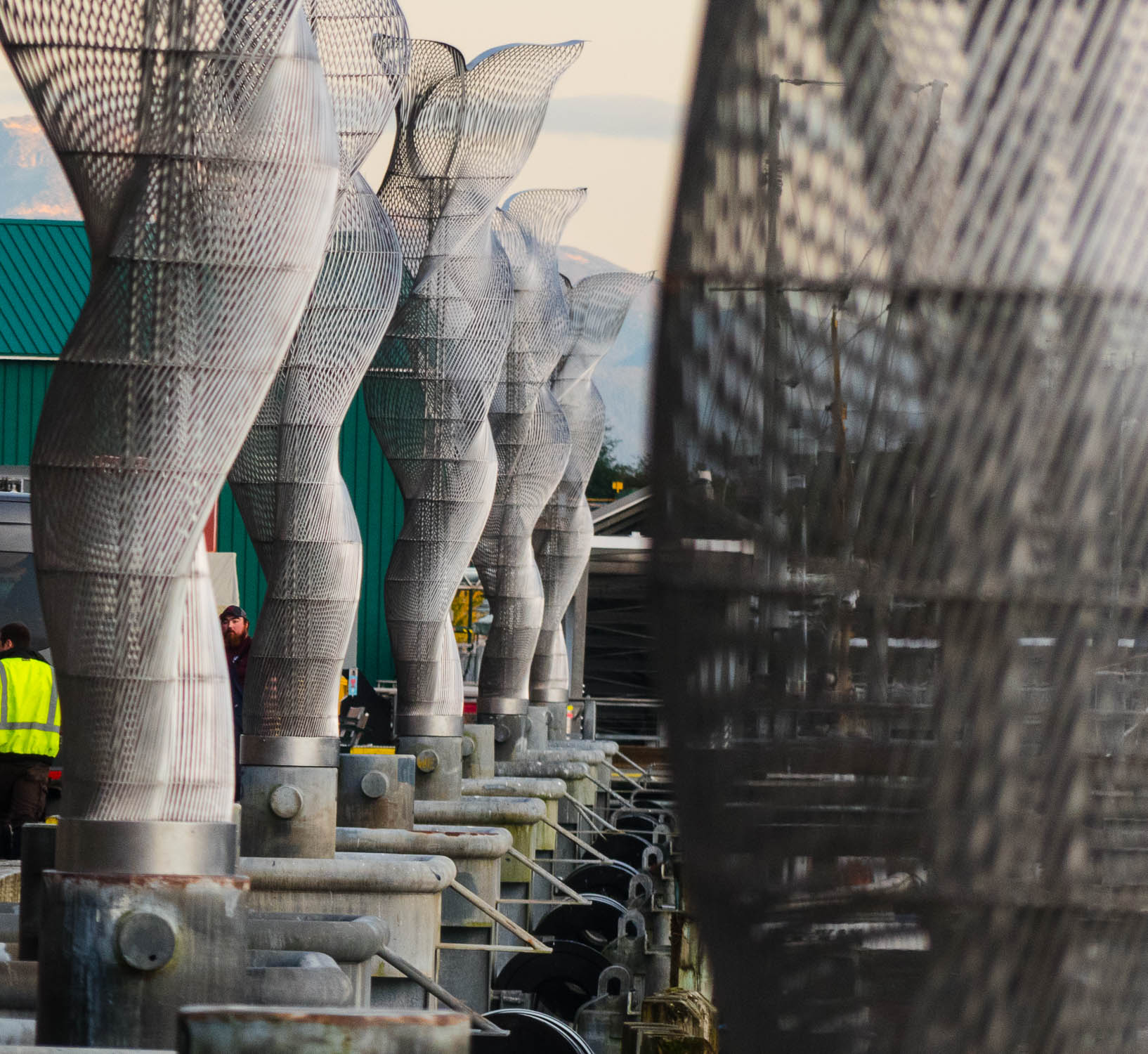
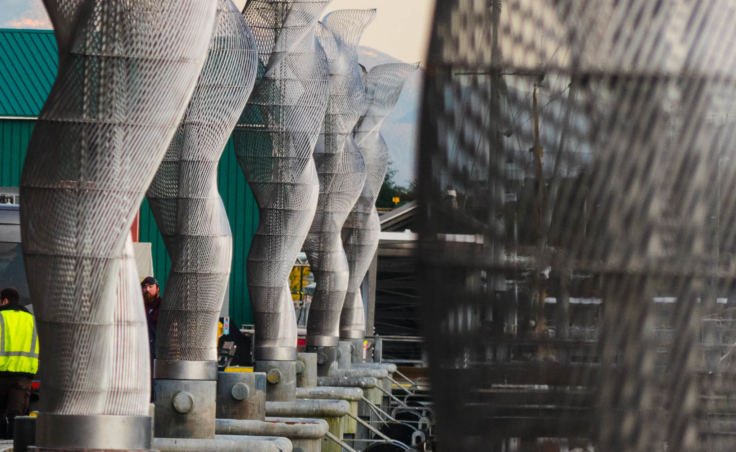
Public art … on dolphins? The new, 20-foot-high stainless steel sculptures are nearly identical, and they’re mounted on the mooring dolphins the cruise ships tie up to.
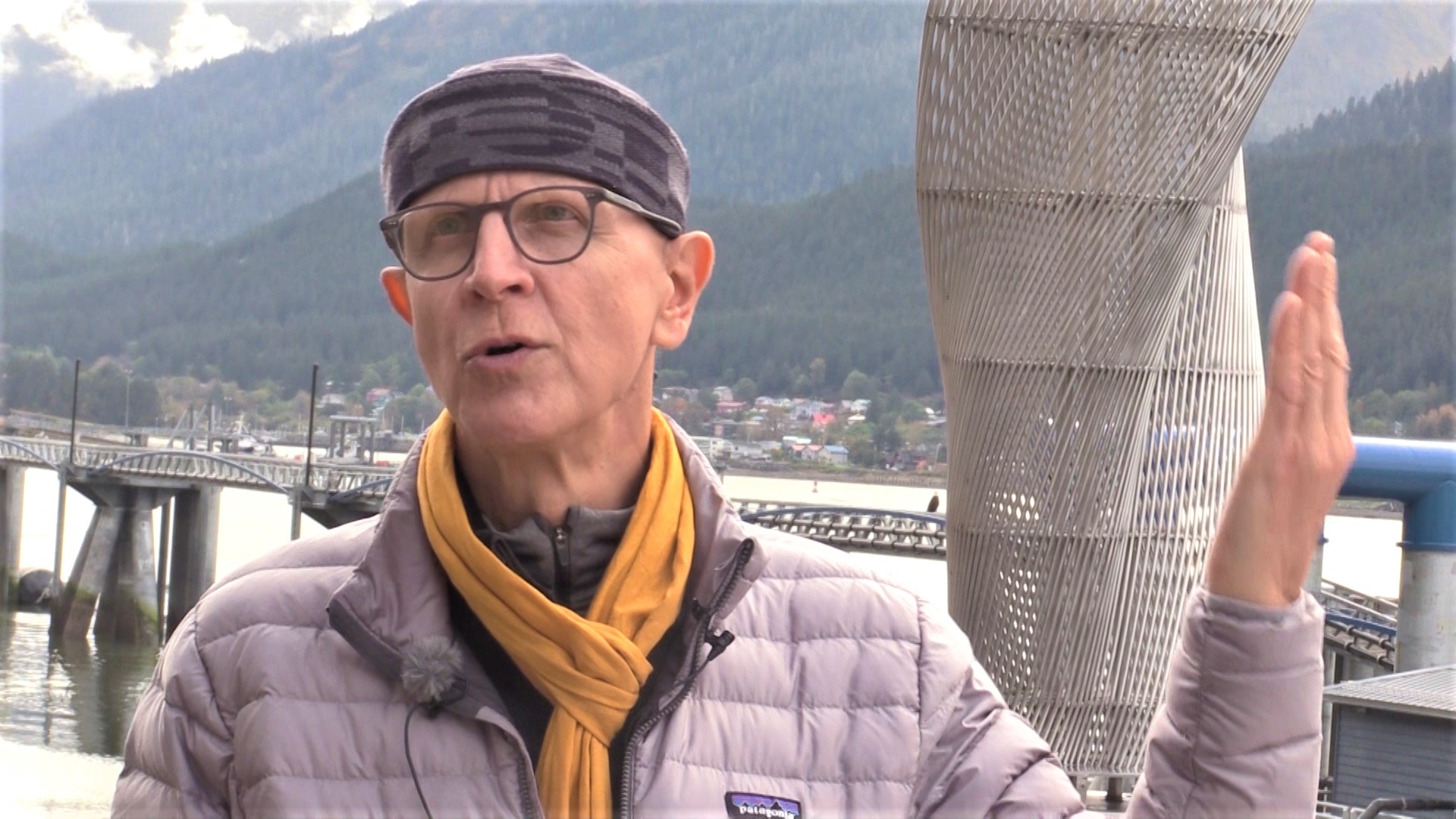
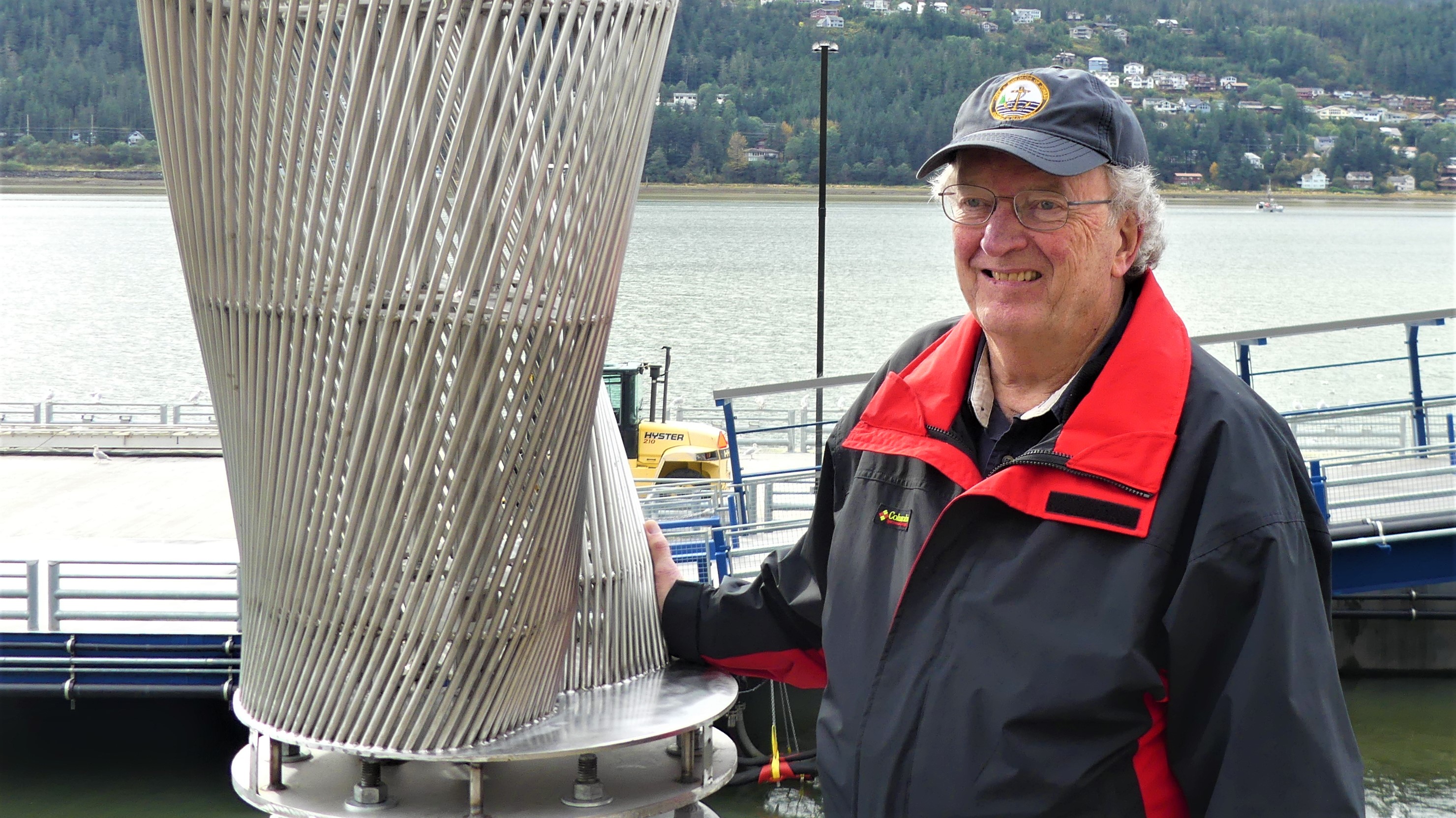
California-based artist Cliff Garten says his work is highly contextual. (Video still from video by David Purdy/KTOO)
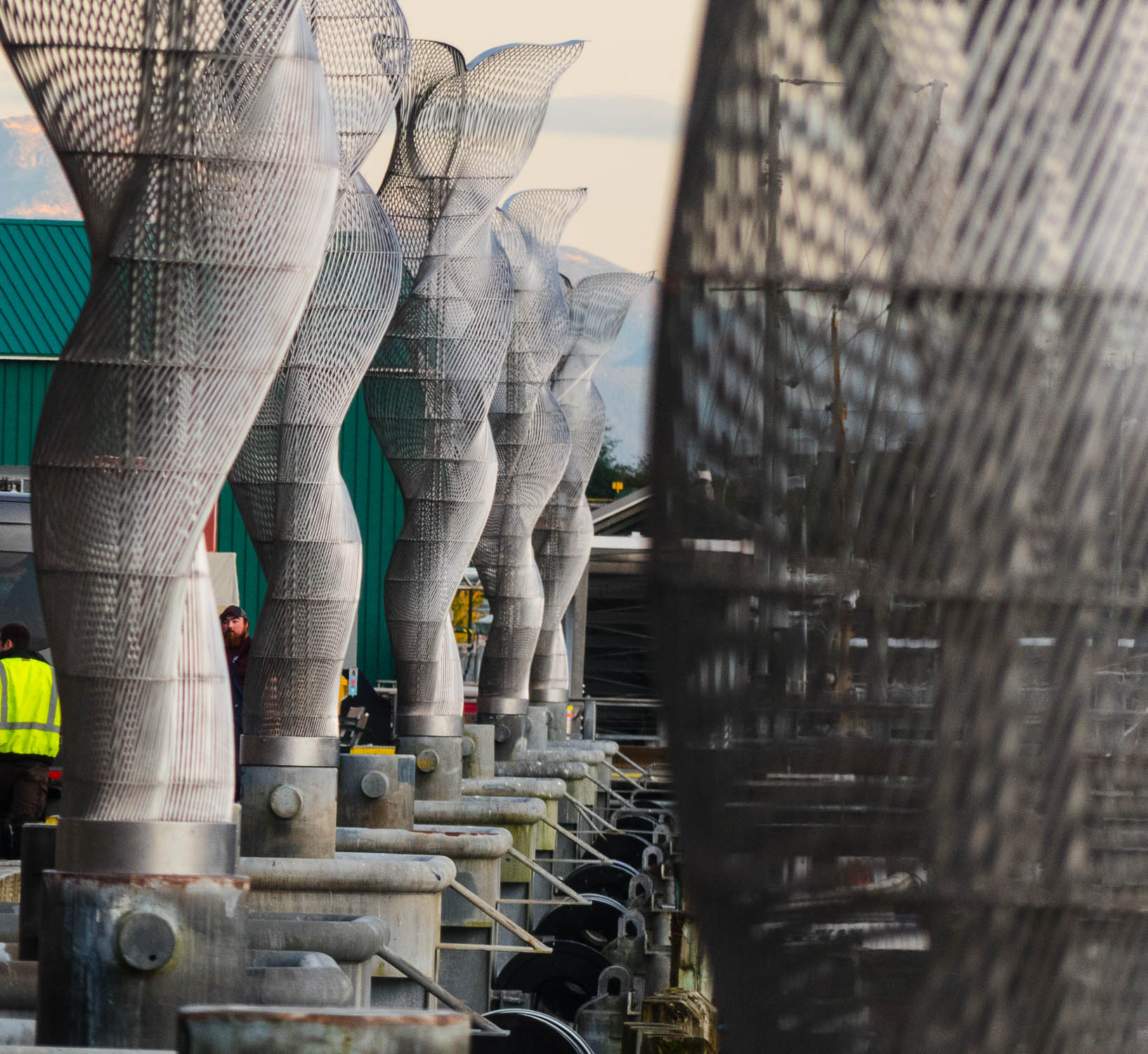
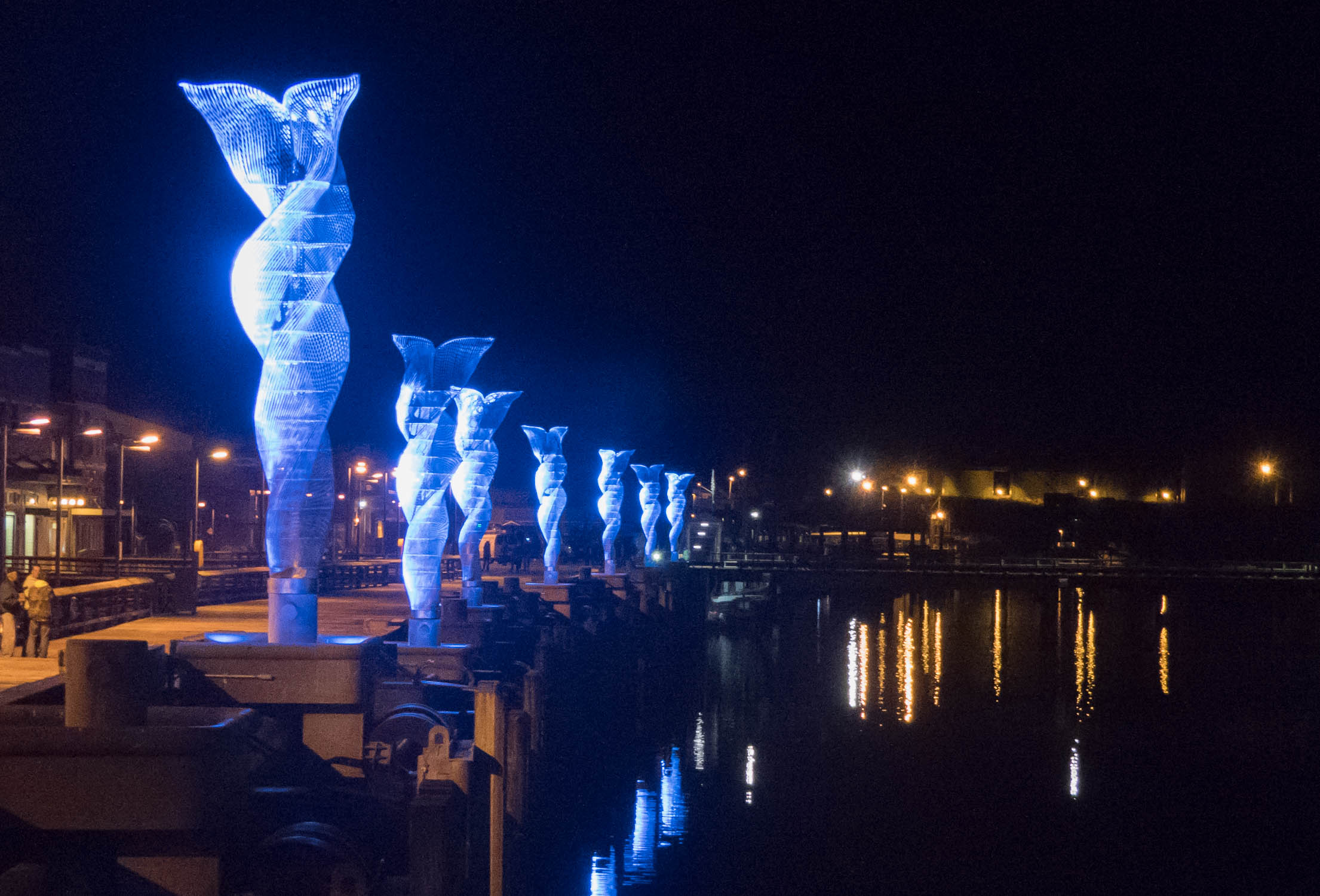
Ten LED-illuminated sculptures have been installed this week. The pieces are a byproduct of the new cruise ship berths.
Local passersby and critics on social media are asking where the money came from and why a non-Alaskan artist was chosen.
“The sculptures are called ‘Aquileans,’ which is a mashup of the Latin word for whale and the Latin word for eagle,” said artist Cliff Garten who designed the structures in his Venice, California, studio.
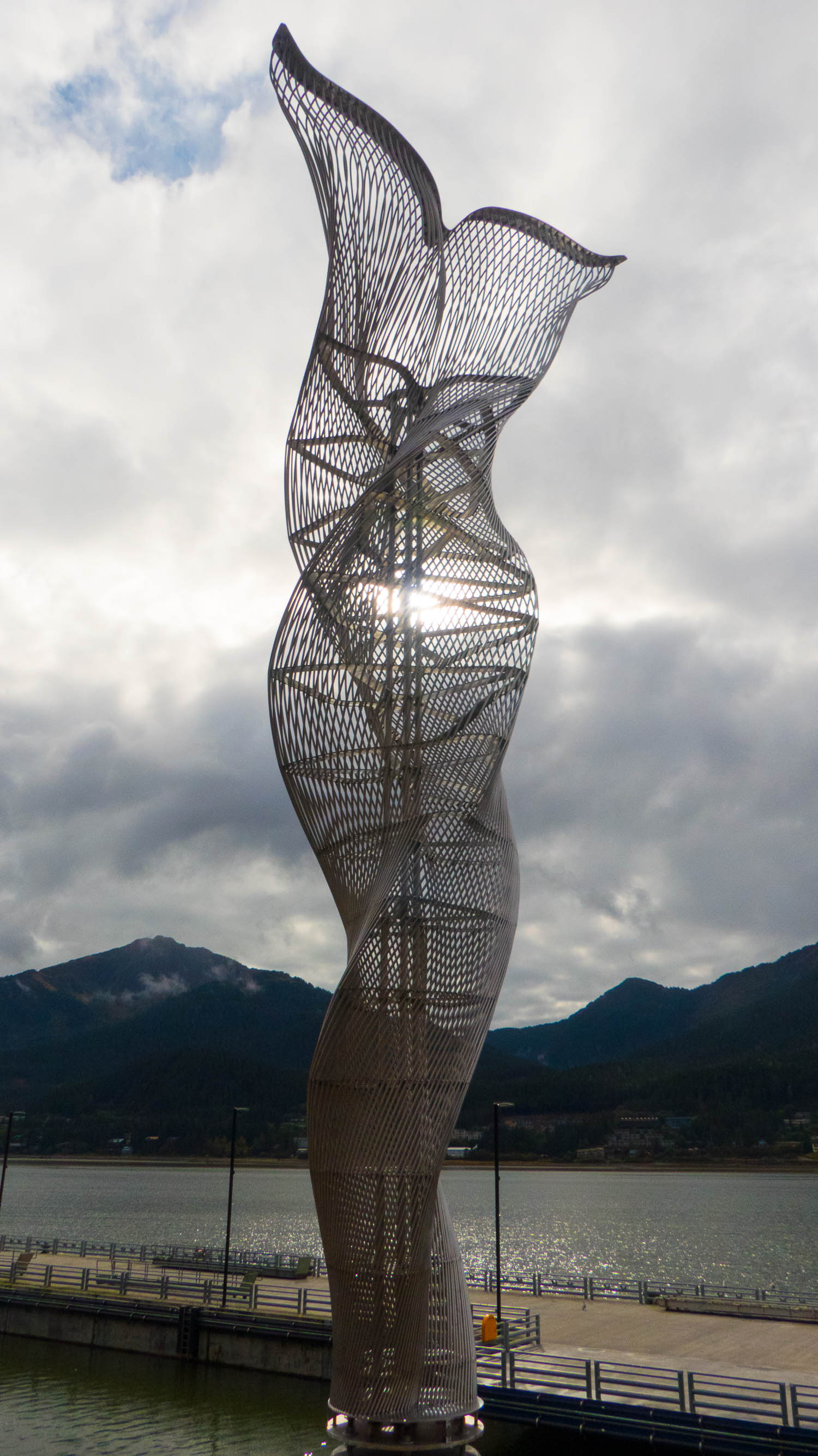
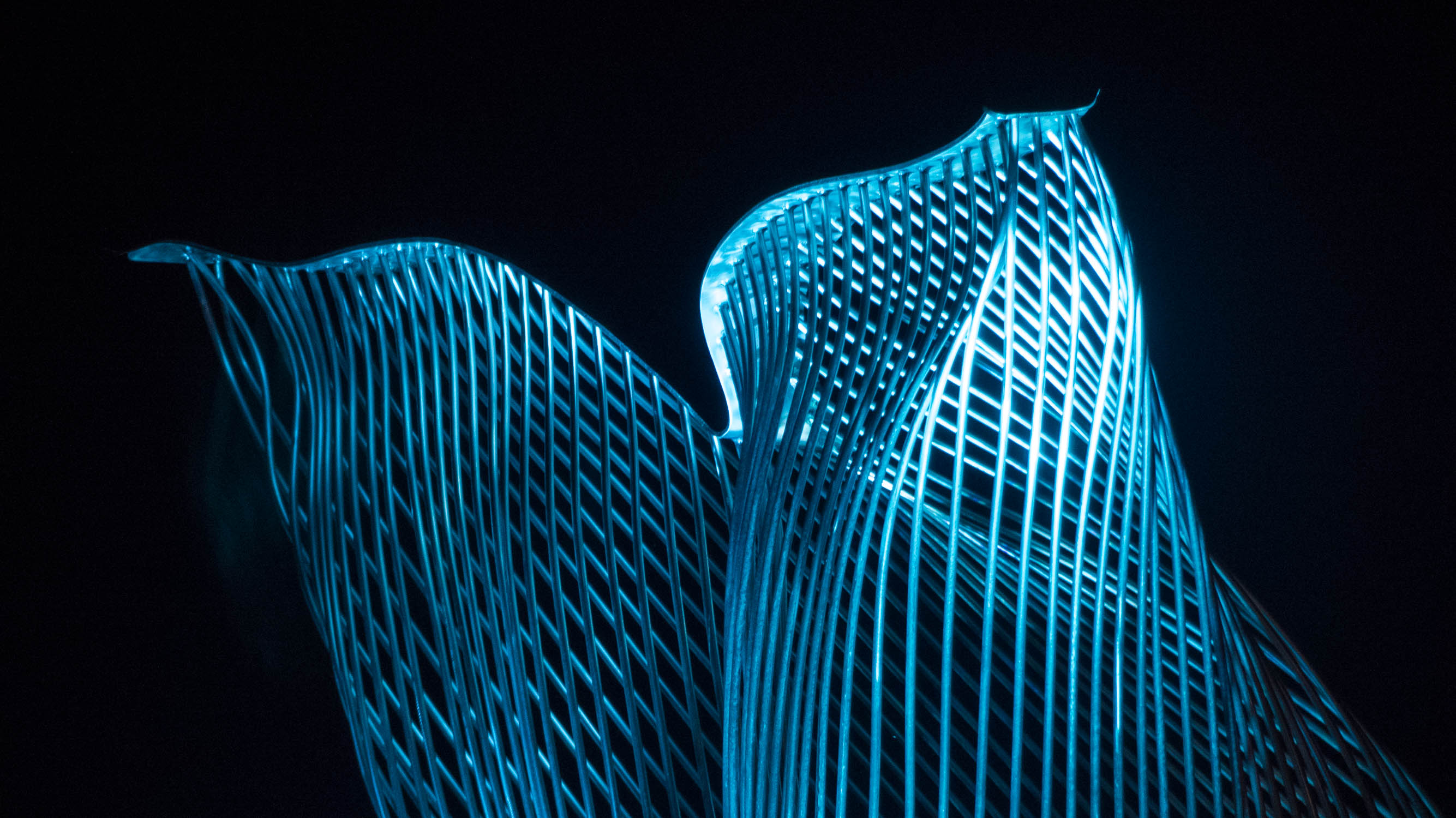
“There’s a kind of a v-form that represents the fluke of a whale or a bird in flight, which is the sectional plate of the sculpture that rises up the sculpture. And then twists so that you get this really twisting form that rises to a top which is in the shape of a fluke of a whale,” he said.
Cliff Garten's "Aquileans." (Photo by David Purdy/KTOO)
One of the "Aquileans" sculptures on the Juneau Seawalk shortly after being installed. Taken Sept. 28, 2017 (Photo by David Purdy/KTOO)
One of the "Aquileans" sculptures on the Juneau Seawalk during testing of the LED lighting on Sept. 27, 2017 (Photo by David Purdy/KTOO)
One of the "Aquileans" sculptures on the Juneau Seawalk during testing of the LED lighting on Sept. 28, 2017 (Photo by David Purdy/KTOO)
One of the "Aquileans" sculptures on the Juneau Seawalk during testing of the LED lighting on Sept. 28, 2017. (Photo by David Purdy/KTOO)
One of the "Aquileans" sculptures on the Juneau Seawalk during testing of the LED lighting on Sept. 28, 2017. (Photo by David Purdy/KTOO)
The "Aquileans" sculptures on the Juneau Seawalk during testing of the LED lighting on Sept. 28, 2017. (Photo by David Purdy/KTOO)
The "Aquileans" sculptures on the Juneau Seawalk during testing of the LED lighting on Sept. 28, 2017. (Photo by David Purdy/KTOO)
The "Aquileans" sculptures on the Juneau Seawalk during testing of the LED lighting on Sept. 28, 2017. (Photo by David Purdy/KTOO)
The "Aquileans" sculptures on the Juneau Seawalk shortly after installation on Sept. 28, 2017. (Photo by David Purdy/KTOO)
The "Aquileans" sculptures on the Juneau Seawalk shortly after installation on Sept. 28, 2017. (Photo by David Purdy/KTOO)
Garten’s design was fabricated over a year-and-a-half at a foundry in Utah. Three-eighth’s inch thick, solid stainless steel rods were hand bent around a skeleton of tubes and plates to form the creation’s outer skin. Each sculpture weighs 1,500 pounds.
“In making public art really I’m addressing one, the economic constitution of Juneau because the cruise ship industry is why we got the money to do this, I’m addressing the kind of social life of the city by setting up this new public social space. I’m addressing the urban quality of scale between the dock, and the ocean, and the city. And then I’m telling a story with the sculptures. All those things really have to come together in public to make a successful piece,” said Garten.
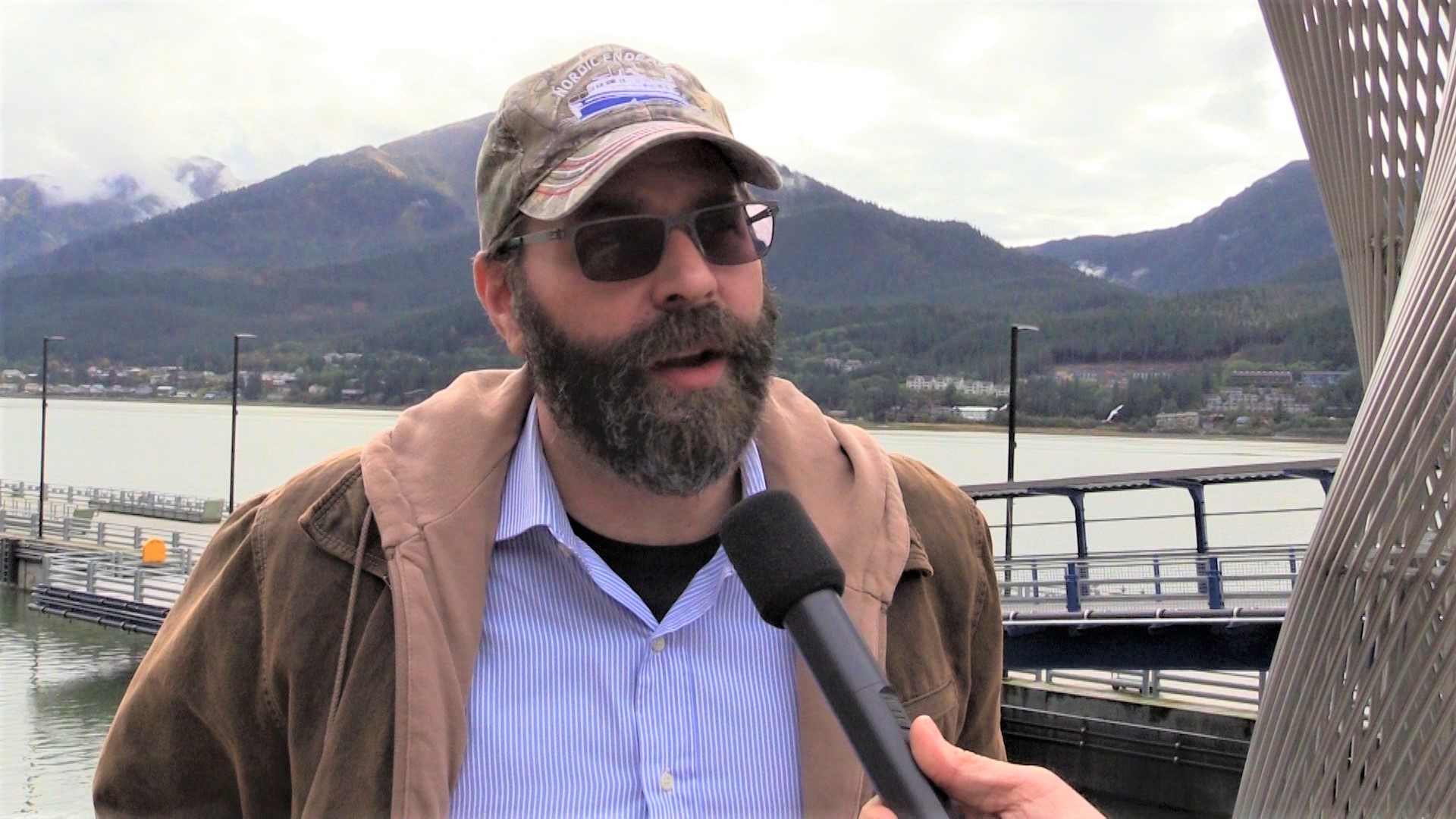
Jeff Polizzotto asks where the money for the art came from. (Still from video by David Purdy/KTOO)
“I think they’re pretty cool, they’re beautiful,” said Jeff Polizzotto who came down to the waterfront to see the new art.
“That’s a lot of stainless steel. The biggest question I have as a long-time Juneau citizen is how they were paid for,” said Polizzotto.
The berths cost $54 million, and a city ordinance requires at least 1 percent of that go toward public art – these sculptures. According to Juneau Port Director Carl Uchytil, no city sales tax or property taxes were used. Docks and Harbors fees, port dues, cruise ship head taxes and state funds covered it.
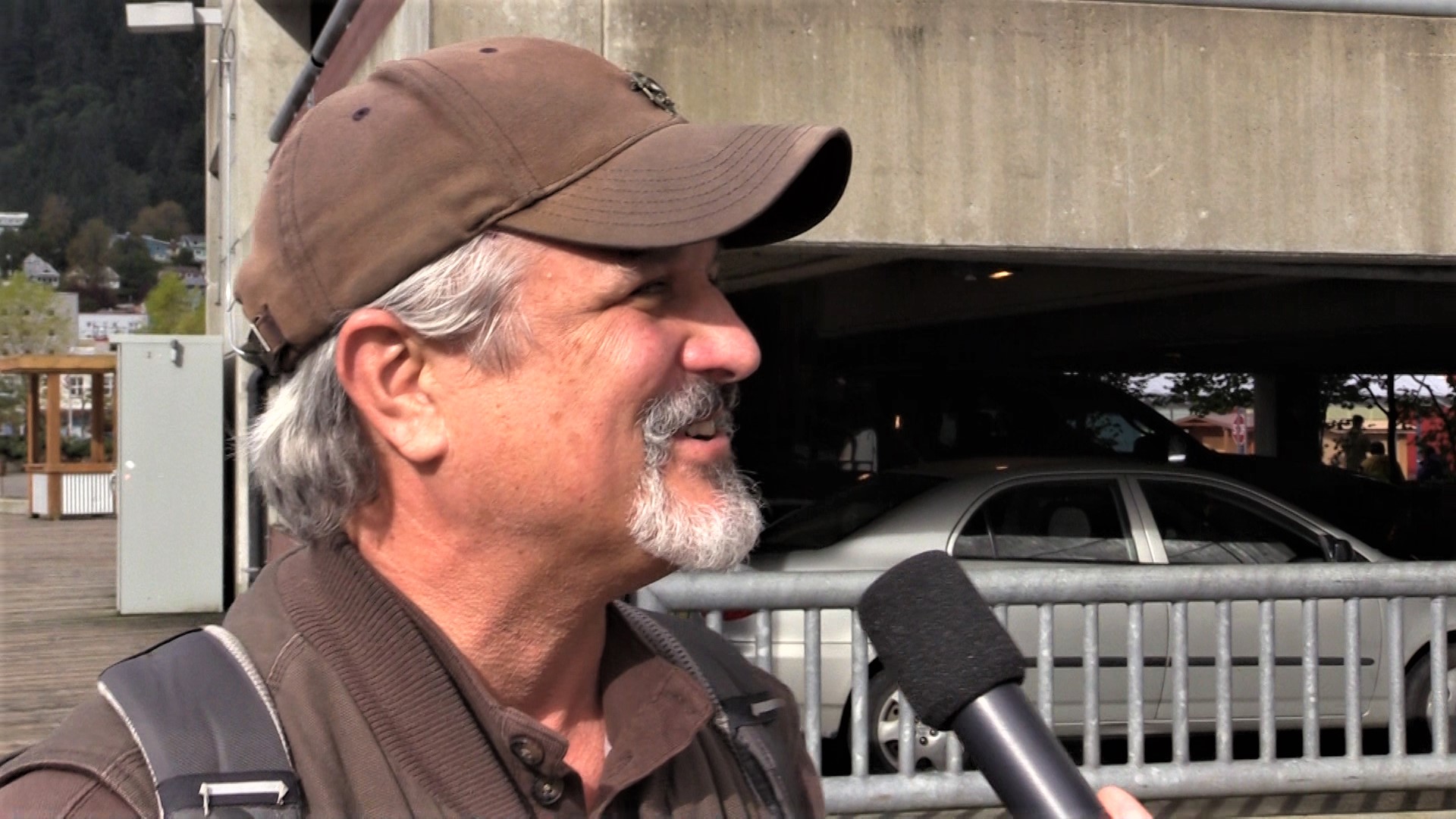
Musician Mark Whitman was on the waterfront, too.
CBJ port engineer Gary Gillette worked closely with the nine person panel that chose Garten’s proposal. (Photo by David Purdy/KTOO)
“I have to ask myself when I look at this sculpture. What kind of sound is it going to make when the Taku winds blows through it? You know it’s a sculpture, but it might be a musical instrument — I’m really looking forward to that,” said Whitman.
I asked what he thought about it in general, the whole concept.
“Well, I always like more art in the community. I wish it was a little more homegrown, you know? I think he’s from outside the community,” said Whitman.
“The selection panel made a conscious decision from the beginning not to limit it to Alaska artists,” said Gary Gillette, a port engineer for the city who worked closely with the nine-person selection committee. The panel included,“two from the Juneau Arts and Humanities Council, one from the department that is building the project — in this case Docks and Harbors and we had a board member there — one that is selected by the city manager, two that are solicited from the public and selected by the Assembly,” said Gillette.
Musician Mark Whitman wonders how they’ll sound when the Taku winds blow through them. (Still from video by David Purdy/KTOO)
Due to the large scope of the project, the assembly added three more members.
“So they added a member of the parks and rec advisory committee, and a representative of the Native community and representative of the Filipino community,” said Gillette.
After advertising for artists in Juneau, statewide, and nationally for about two months, eight artists submitted 28 ideas. There was Garten, a Canadian, and six Alaskans — five of whom were from Juneau. Gillette said the sculptures being lit at night impressed the panel.
“The committee felt that was a real benefit for the locals — this wasn’t just for the tourists — they’ll see it in the summer in the bright sunlight or even a day like this or worse, but they’ll be lit all winter long so they’ll be for the locals as well,” said Gillette.
And Mark Whitman? Please let us know if they become musical instruments in the Taku winds.
This weekend, the installation crew is fine tuning the lights.
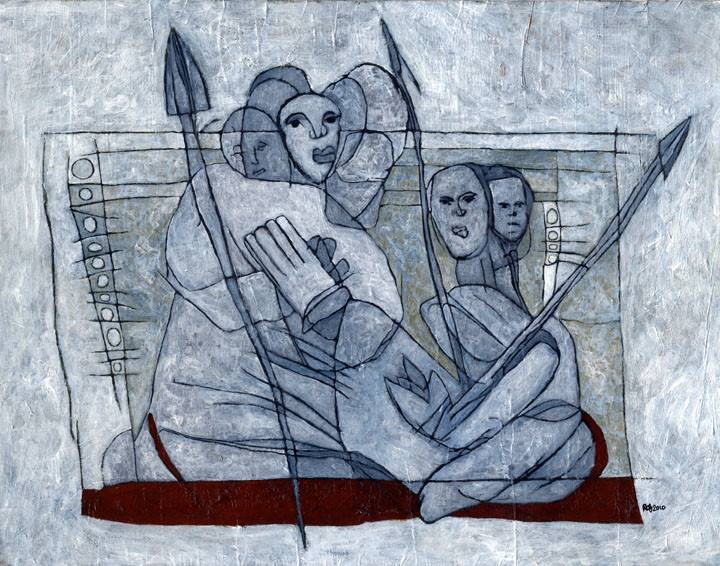
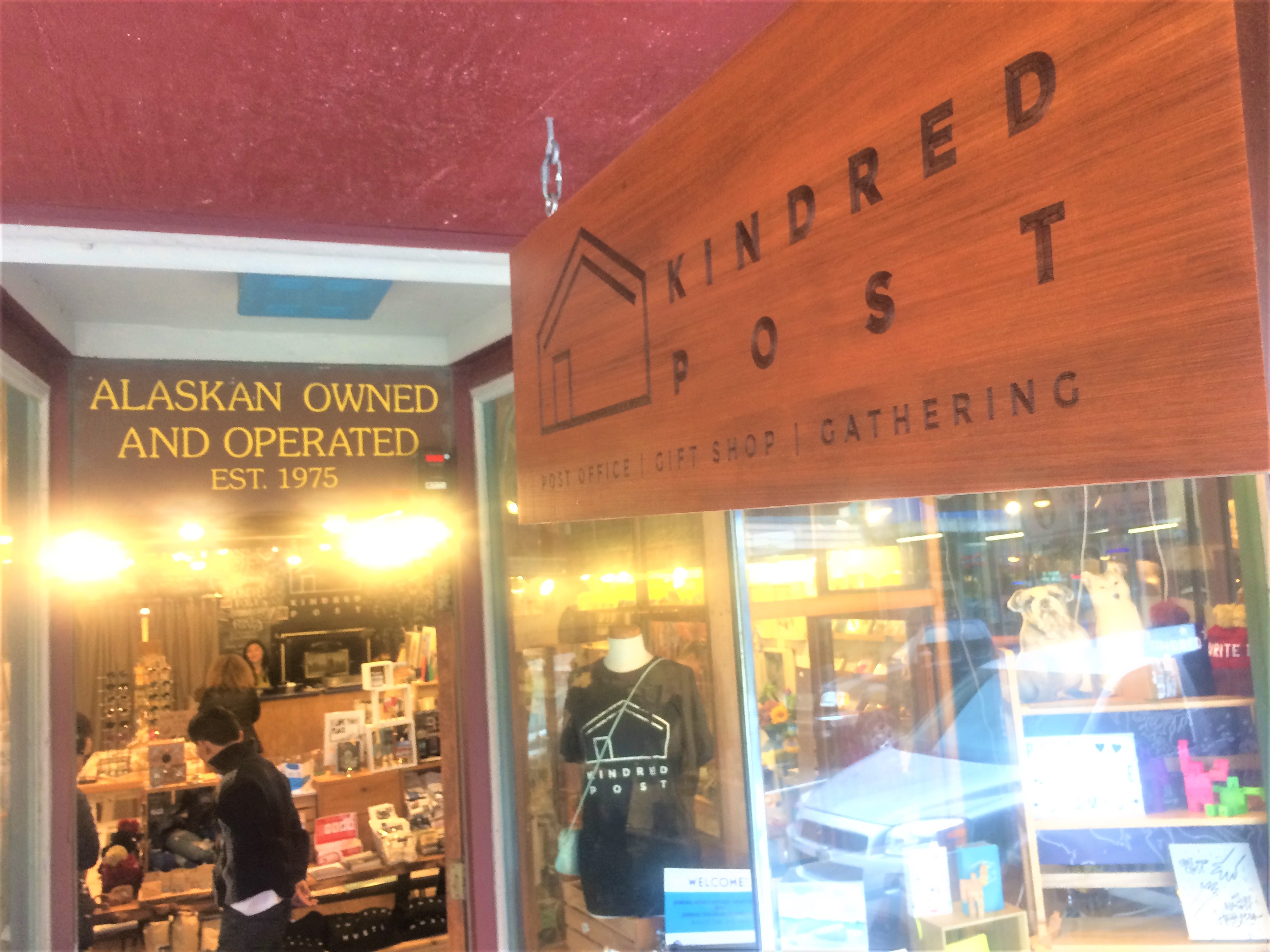
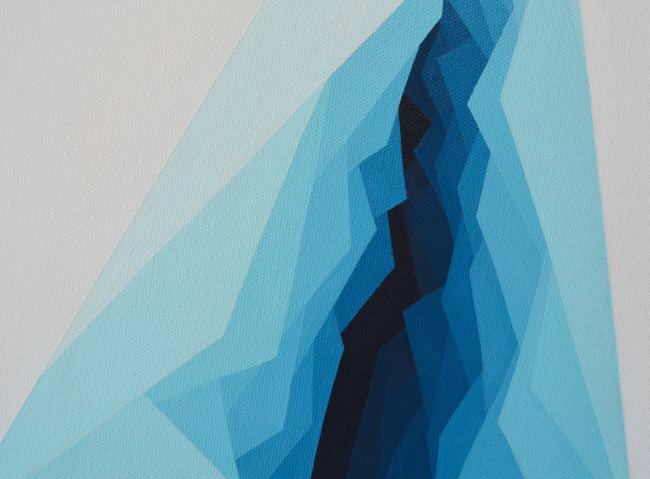
Kindred Post, a post office, gift shop and gathering space in downtown Juneau, has selected 10 art submissions to print on 1,000 postcards. The selections are from around the state, and from a diversity of artists.
“They Are Always With Us” by Rob Roys (Courtesy of Kindred Post)
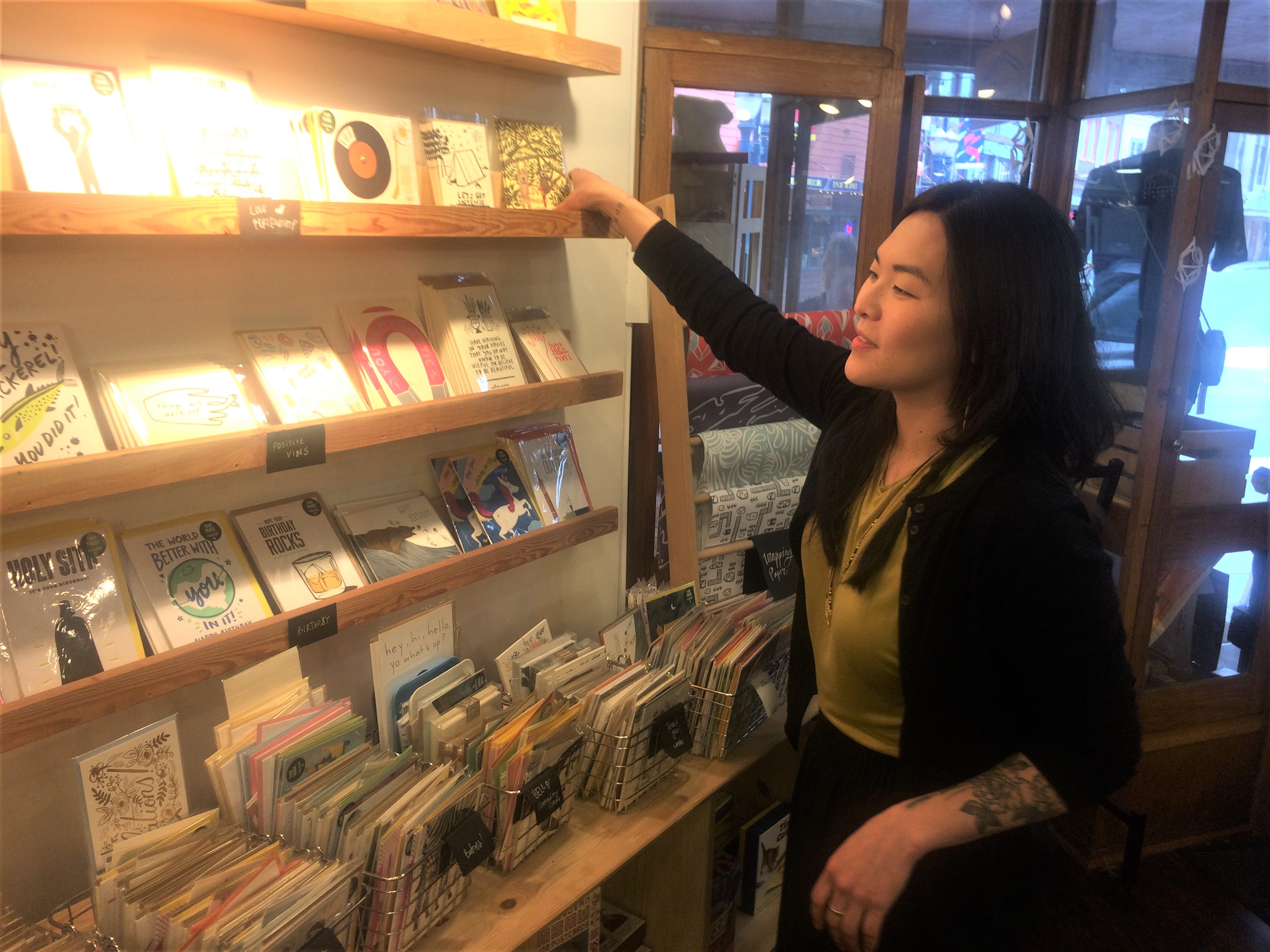
It does not take long to realize Kindred Post is a little different from the average post office. The store’s sidewalk sandwich board reads: stamps, boxes, shipping services, handmade and Alaskan made gifts and good vibes. An image of a woman wearing an American flag hijab that reads “We The People” is in the storefront, and just inside is a hoodie that reads “Social Justice Hustle.”
“So when we first started Kindred Post I’d had this dream to fill it with local art,” said artist and writer Christy Namee Eriksen has owned the business for 3 years.
Kindred Post is not your average post office. (Photo by Scott Burton)
Beyond post officey stuff, it’s known for selling artful jewelry, happening First Friday art gatherings and “Tiny Post Office” concerts. Still,
“People come here every day to buy postcard stamps and they’re always looking for postcards,” said Eriksen.
Eriksen had already tapped some of Juneau’s usual suspects for art, so a contest seemed in order. Two hundred and fifty submissions came in between July and August.
Among the 10 winners is Tom Chung, who teaches art at the University of Alaska Anchorage.
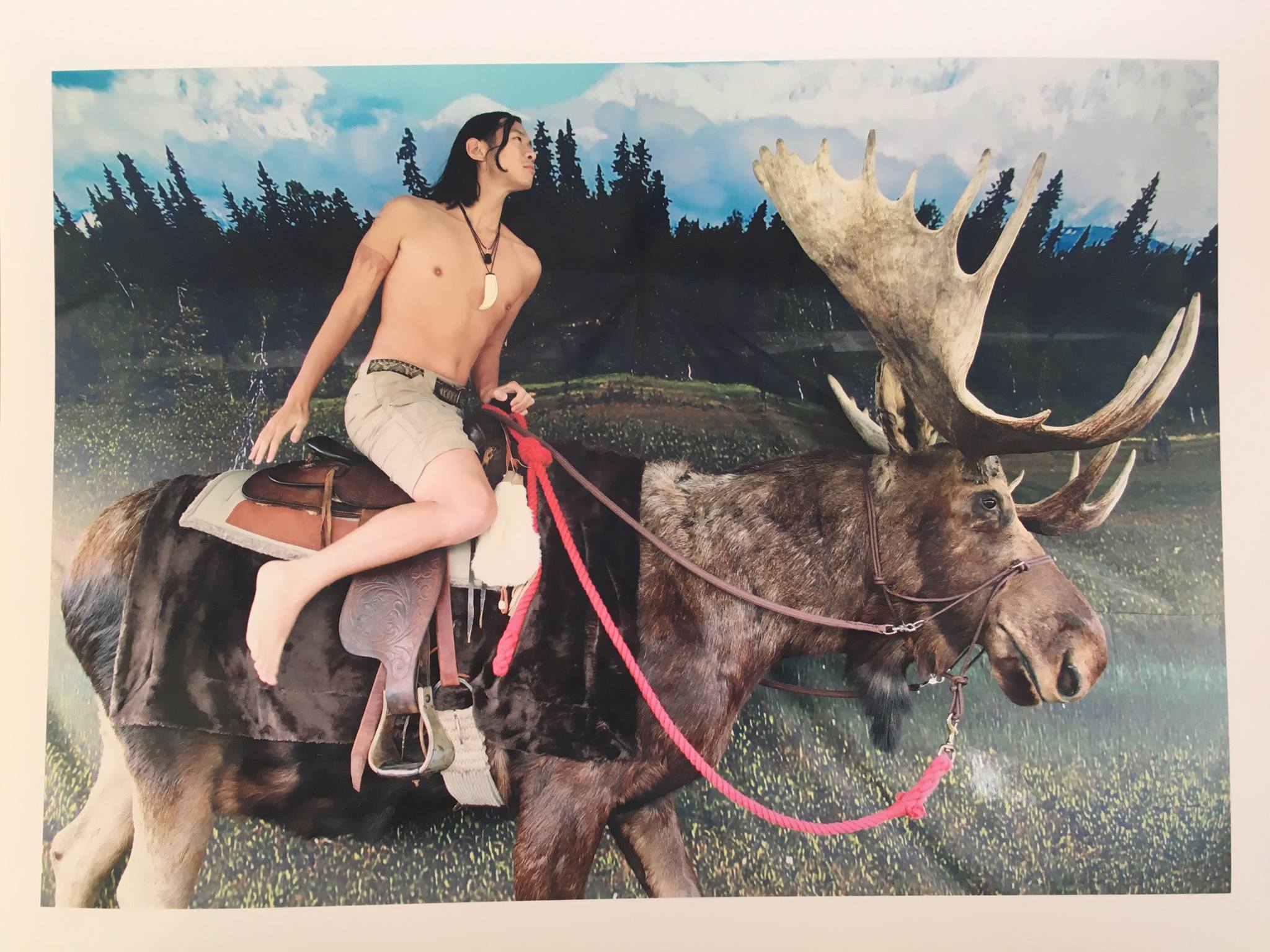
“The image is of myself riding shirtless on this moose in front of the backdrop of an Alaskan wilderness,” Chung said.
“Moose Rider” by Thomas Chung (Courtesy Kindred Post)
“I don’t see representations very often of Asian males, and so I use myself because it’s a little bit of an act of rebelling and I guess that I believe I live in a culture that says I am not desirable or not beautiful, and so I place myself in these sort of images of desirability or masculinity to kind of rebel against that,” said Chung.
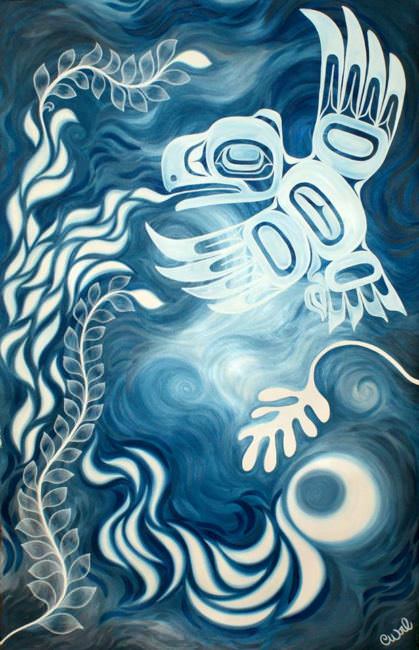
Crystal Worl is a Juneau-based mixed media artist and business owner that works in paint and fashion design. Her piece, “White Raven,” is also among the winners.
“I like to acknowledge my Tlingit side using formline, and then I also like to acknowledge my Athabascan side through putting beadwork, floral patterns in my paintings,” said Worl.
“White Raven” by Crystal Kaakeeyáa Worl (Courtesy Kindred Post)
“Splish Splash” by Hollis Kitchin (Courtesy Kindred Post)
“Flume” by MK MacNaughton (Courtesy Kindred Post)
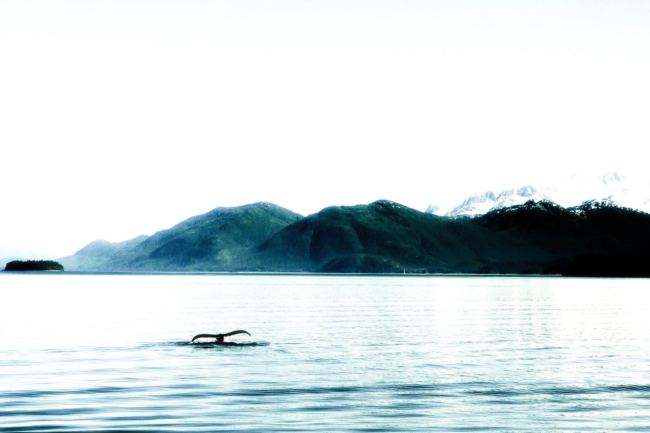
“Humpback Whale Tale” by Karena Perry (Courtesy Kindred Post)
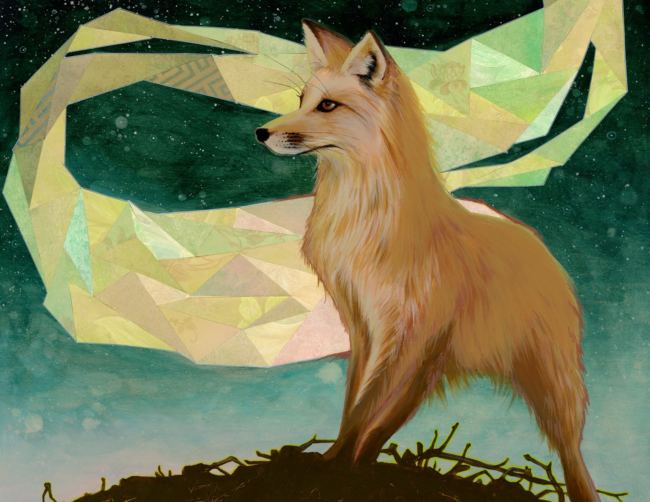
“Aurora Chaser” by Brianna Reagan (Courtesy Kindred Post)
“She Has Secrets” by Allison Estergard (Courtesy Kindred Post)
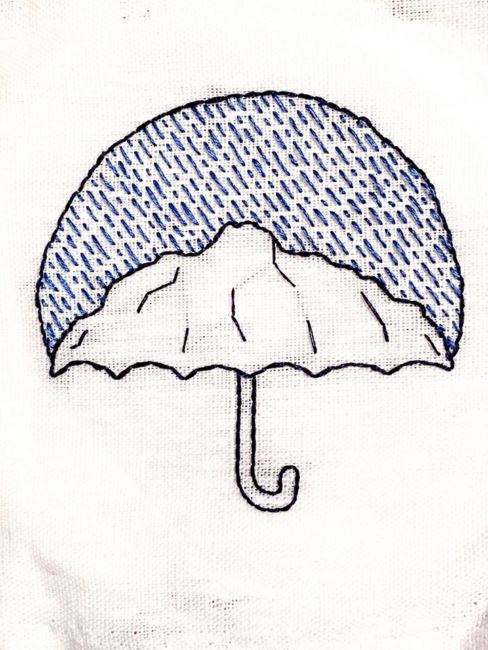
“But Locals Don’t Actually Use Umbrellas” by Veronica Rose Buness (Courtesy Kindred Post)
“This one has a seaweed pattern that looks like a growing stem. …. There’s a moon below Raven. You get the feeling that you’re looking up into the sky at Raven, and this is coming down and it feels also like you’re under water,” said Worl.
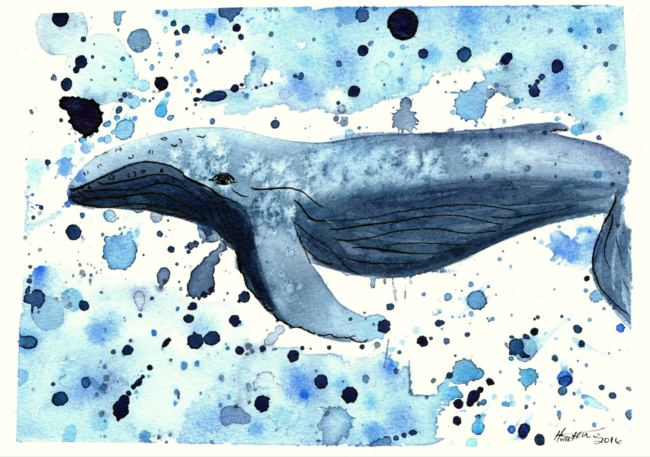
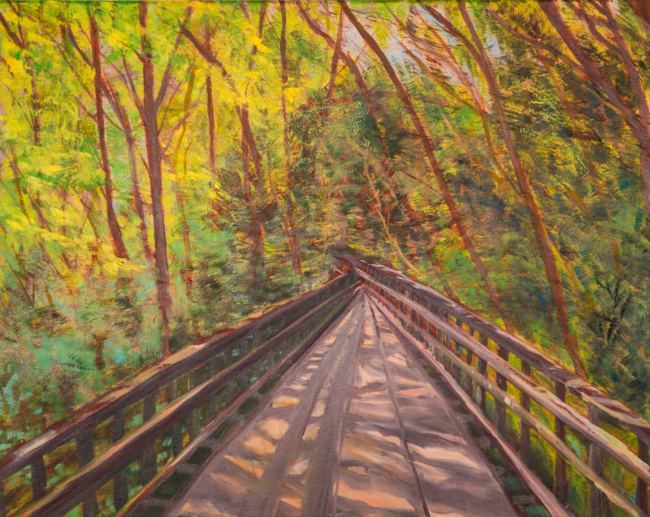
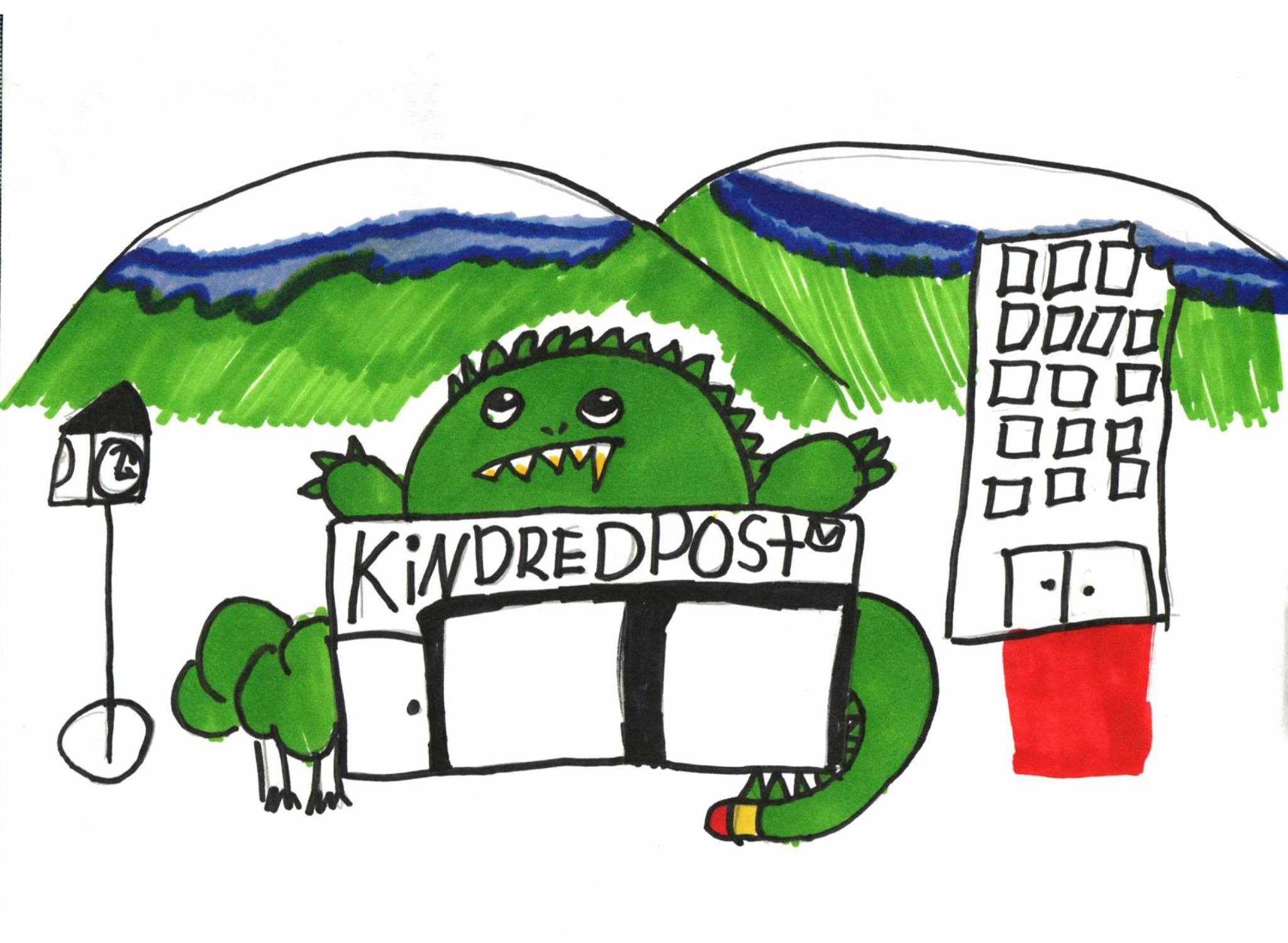
Additional winning images include a humpback whale in watercolor, a fox under the aurora, an image of a hand-embroidered umbrella. Some of the winning artists’ names are recognizable, some not — including Zoey Lam’s marker drawing of a large green dinosaur-like beast sort of hugging the Kindred Post store.
Having a diversity of artists is important to store owner Eriksen who studied social justice in college and co-founded a poetry slam in Juneau that is known for inclusiveness and empowering voice.
Kindred Post owner Christy Namee Eriksen. (Photo by Scott Burton/KTOO)
“I had a equity clause built into the competition. So we wanted to prioritize artists who have otherwise have had social marginalization, and maybe not have had as much access to artistic opportunities as others,” said Eriksen.
Eriksen, her staff and other community members judged.
“So we would give preference to artists who self-identified as either a woman, LGBTQ, a person of color, or an indigenous person, artists who are experiencing a developmental disability, or just a disability,” said Eriksen.
“I thought that was really great, I noticed that,” said Chung. “And we were allowed to write a little comment with our submission and I wrote I am a gay person of color that also lives with a disability. And it’s not just I guess to give a leg up to people that might need a little more encouraging, but also being inclusive to all sorts of diversity it expands the range of viewpoints that can be shared.”
I asked Eriksen why social justice and equity are important, and a part of her business.
“Our success is tied to the success of our neighborhood, of our city, of our community,” Eriksen said. “And so if you have that type of commitment to the place or the people that you belong to, then the question for me would be why would you not be committed to social justice? Why would you not want to raise up and work towards equality for all of its members?”
One thousand of the printed cards will be released at Kindred Post on Oct. 1.
Close
Update notification options
Subscribe to notifications
Subscribe
Get notifications about news related to the topics you care about. You can unsubscribe anytime.