Pianist William Ransom and cellist Zuill Bailey packed the State Office Building’s atrium today during Juneau Jazz and Classics’ free lunchtime concert.
Before the musicians played the tune in this video, they asked the kids in the audience to guess what kind of animal is was about.
Guesses from the audience included an owl, a pterodactyl, a pit bull, a big bird, a humming bird, and finally, a bumblebee.
Ransom and Bailey play again tonight with the Vega String Quartet and bassist Janet Clippard at the Juneau Arts and Culture Center at 7:30 p.m.
Sticking with the animal theme, the group of musicians will play Franz Schubert’s Trout Quintet.
The festival continues tomorrow night at 7 p.m. at the JACC with a collection of musicians who will play selections from Beethoven’s 5th Symphony.
Click here to see the festival’s schedule, which runs until May 20.
The Atlanta-based Vega String Quartet played at today’s Juneau Jazz and Classics free lunchtime concert.
The musicians played for about an hour in the State Office Building’s 8th floor atrium with everything from Beethoven to Haydn to Brahms and even some folk and fiddle tunes.
The string quartet will be joined by cellist Zuill Bailey this evening from 5:30 to 6:30 p.m. for another free concert at the Alaskan Brewing Company’s Depot downtown.
The Vega String Quartet is conducting a violin, viola, and cello workshop tomorrow at UAS starting at 7 p.m.
The next free, lunchtime brown bag lunch at the SOB is on Wednesday with cellist Zuill Bailey and pianist and Jazz and Classics artistic director William Ransom.
Click here for the full music festival’s schedule, which runs through May 20.
The Congress kicks off the 31st annual Juneau Jazz and Classics festival Friday at Elizabeth Peratrovich Hall. The band’s website characterizes its music as “a dynamic mix of riveting rock ‘n’ roll, old school soul, classic country, and searing psychedelia.”
But they’re just the beginning. The festival runs until May 20 at multiple venues including the Shrine of St. Therese, UAS, the JACC, Perseverance Theater, schools and a lot more.
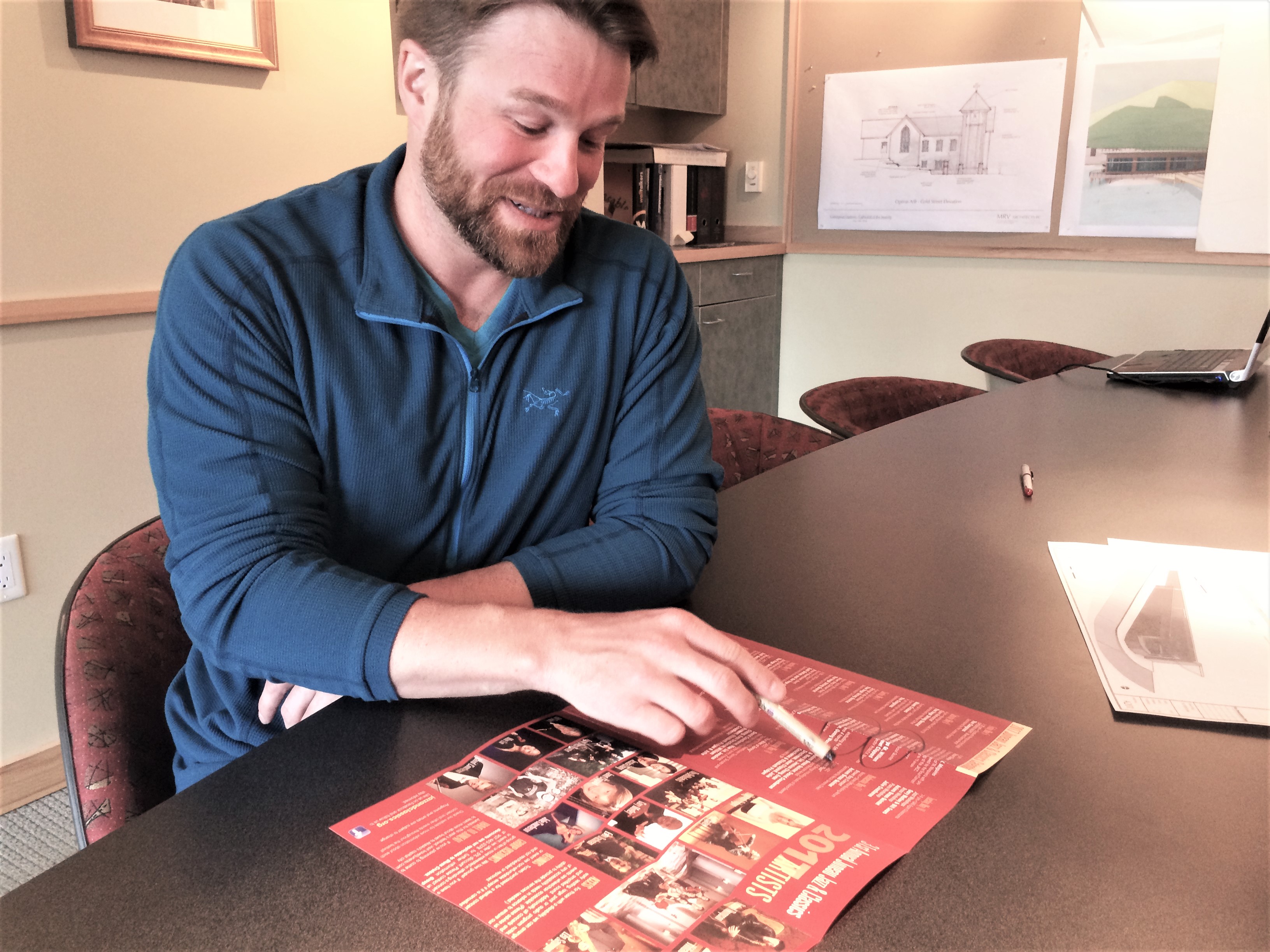
It’d be pretty hard to make it to all of the 20-something performances, so I visited with Juneau Jazz and Classics board member Zane Jones.
Juneau Jazz and Classics board member Zane Jones struggles to whittle it down to the must-see concerts. (Photo by Scott Burton/KTOO)
“To get that broad essence of Jazz and Classics is to choose three very different venues and musicians,” said Jones.
Jones works at MRV Architects, and has been on the Juneau Jazz and Classics board for 4 years. It was hard to get him to whittle it down, but when pressed:
“Top three: one of the blue venues which would be either the blues cruises, or the dance party at the ANB. I would do one of the quintets or Will Ransom — so one of the slow, nice classical beautiful ones. And then I would do the dance party at the JACC with the Defibulators.”
Jones is also a fan of the Jazz Jam at the Lucky Lady bar, and the lunchtime Brown Bag Concerts at the State Office Building. Both are among the festival’s free events.
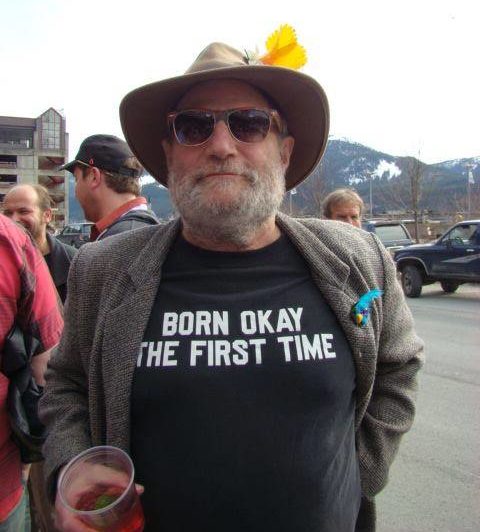
Joe Karson writes short fiction and a blog that often focuses on politics and religion. (Photo courtesy of Joe Karson)
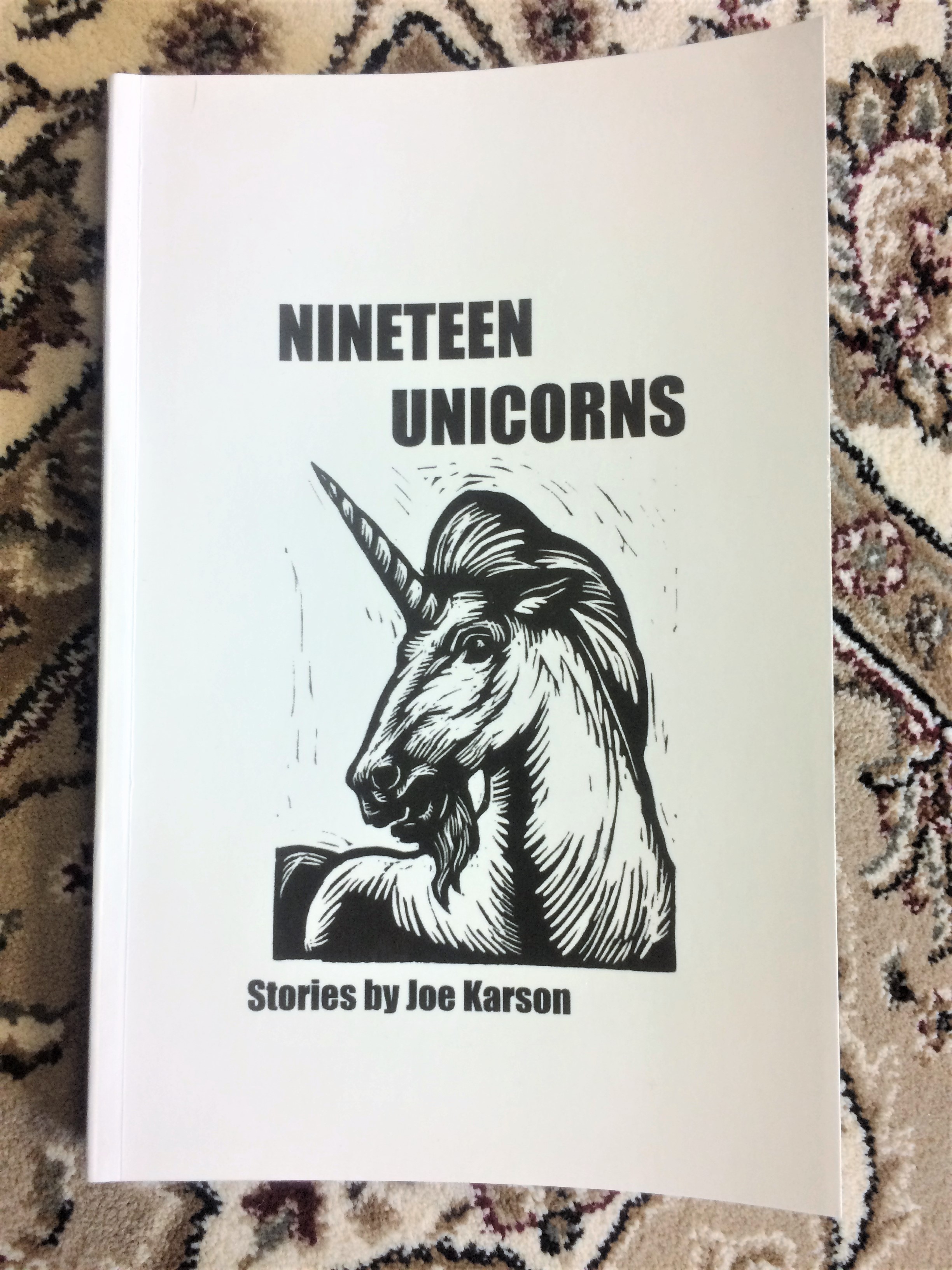
Juneau writer Joe Karson has released a new book titled “19 Unicorns.” It’s a collection of 17 short stories and two novellas. Karson spoke with me about the collection on KTOO’s A Juneau Afternoon.
To get a feel for the book, the writer shared a description of one of the book’s novellas.
“It’s called ‘Pulp 73,’” he said. “Drugs, sex, and Rock and Roll. George substitutes booze and jazz into the counterculture battle cry, but he’s just fine with sex part as he battles through the 70’s in his Bible Belt, Ohio home.”
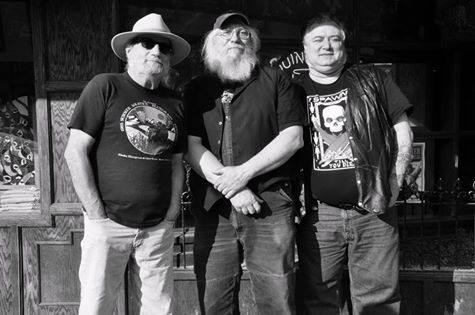
Joe Karson, left, also plays guitar and sings in The Downtown String Band. Also pictured are Shawn McCole, middle, and C. Scott Fry, right. (Photo courtesy of Joe Karson)
Like all of the collection’s work, the piece is fiction, but it’s about a struggling young writer.
“Can’t imagine who I based that upon,” he said with a laugh.
The rest of the book’s stories include titles like “Martini,” “Fish Tale,” “Roy Rogers Thirty Feet Tall,” “Gun,” “Conclave,” and one based in Juneau titled “Ixt.”
“I-x-t, which is a Tlingit word for a shaman, or I think some people have translated it into English as a prophet, but anyway it’s a spiritual leader in the Tlingit community. The story, which takes place in Juneau has a Tlingit myth that kind of runs through the whole story,” said Karson. “It has a lot of flavor of Southeast in it. As a matter of fact, I think there’s salmon right in the first paragraph and in the last paragraph of the novel. But it is an adventure story, a wild one. So it’s sort of, I don’t know, sex, violence and salmon.”
The book’s cover art and illustrations are by Karson’s longtime friend, artist Sam Hamrick of Seattle, Washington. (Photo by Scott Burton/KTOO)
Karson, who describes his age as “over 50,” is a retired woodworker who now works as a musician and substitute teacher, and writes a blog called The Karson Report that is largely nonfiction commentary on politics and religion. But his passion is with the short story.
“I write mostly short fiction, which is a bit of a challenge. Novelists very often talk about how they throw some characters out there and see what happens. But when you’re writing short fiction it’s a little more controlled that that I think,” said Karson.
“And I tell people that my stories are — to me they’re more like discoveries than inventions because they come to me with a beginning a middle and an end — I get the whole thing. Very often, I get the end first and I am just writing towards that,” said Karson.
Despite his love for short fiction, Karson says his next project is nonfiction, a memoir-like essay called “Manifesto.”
As part of First Friday events, Karson will be signing copies of “19 Unicorns” from 4:30 p.m. to 6:30 p.m. at Rainy Retreat Books.
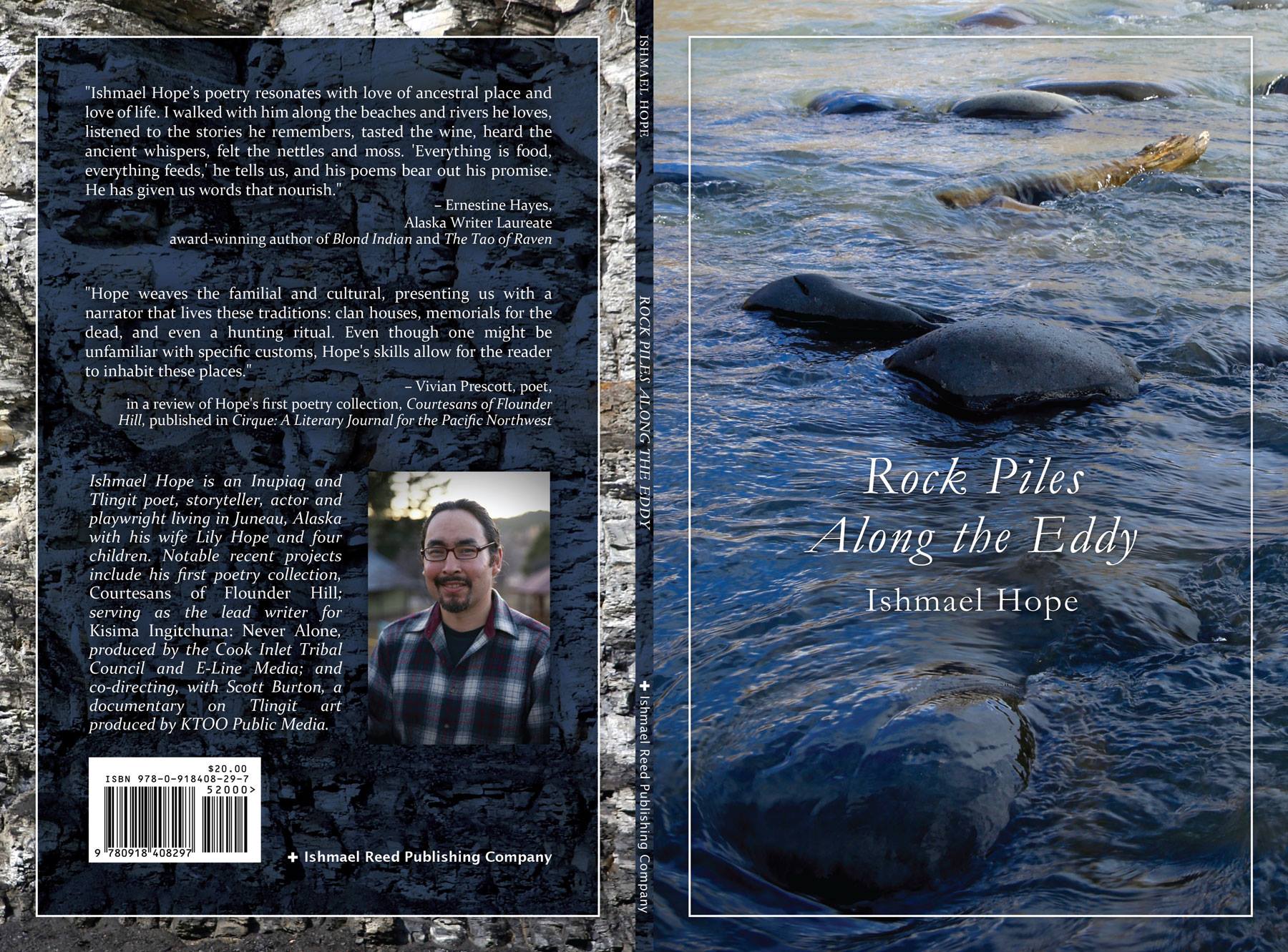
Ishmael Hope will read from his new book of poetry “Rock Piles Along the Eddy” Thursday at Kindred Post in downtown Juneau.
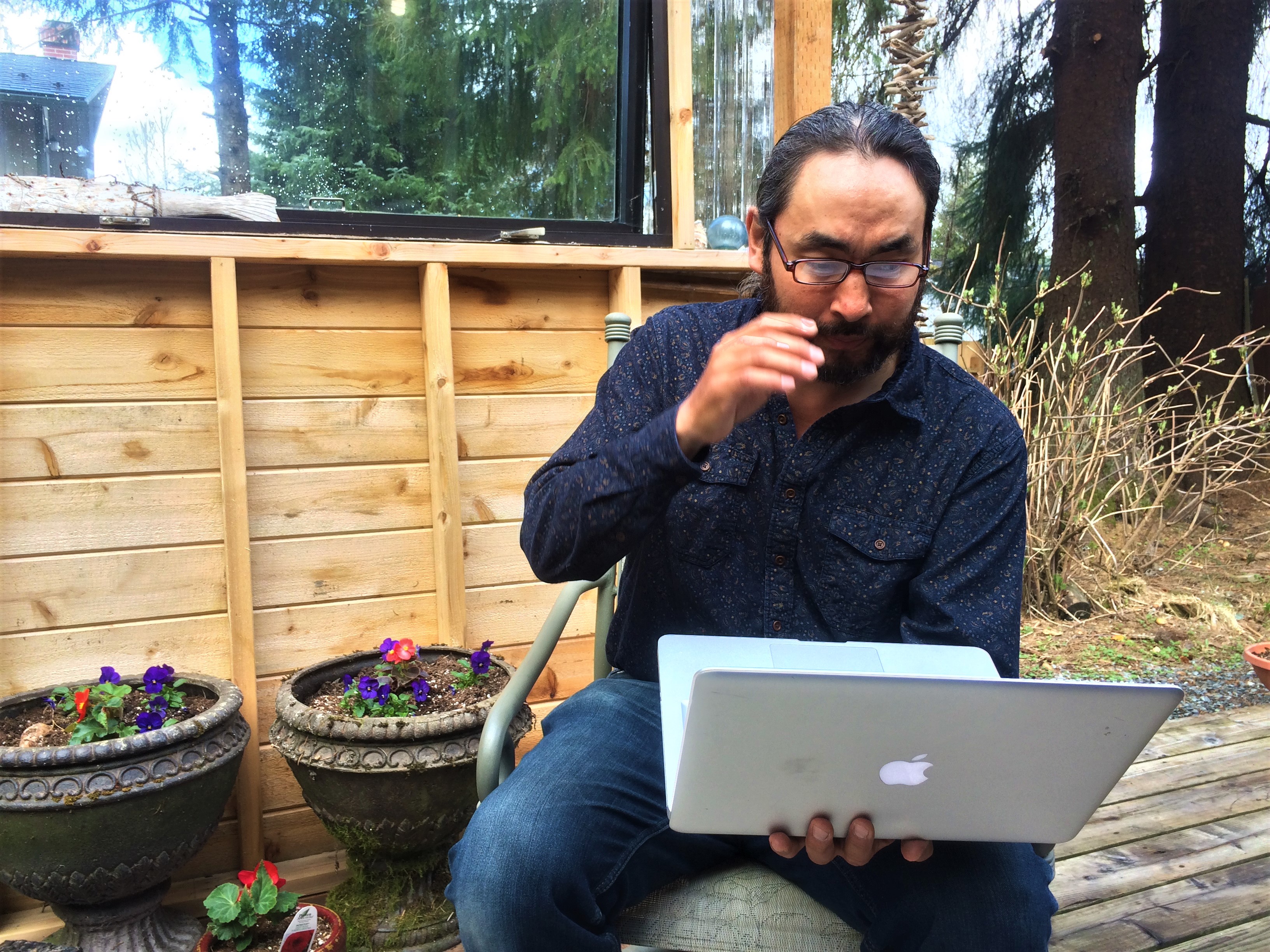
On a chilly blue-sky morning, Hope sits on the back porch of a valley home. It was a quiet place in house full of kids.
Ishmael Hope reads from a digital version of “Rock Piles Along the Eddy.” (Photo by Scott Burton/KTOO)
“Khaagwáask’ yéi xhat duwasáakw. My Tlingit name is Khaagwáask’. My Inupiaq name: Uvanga atinga Angaluuk. My name Inupiaq name is Angaluuk. And I am a poet and performer-storyteller, and I’m grateful to be here,” said Hope in introduction.
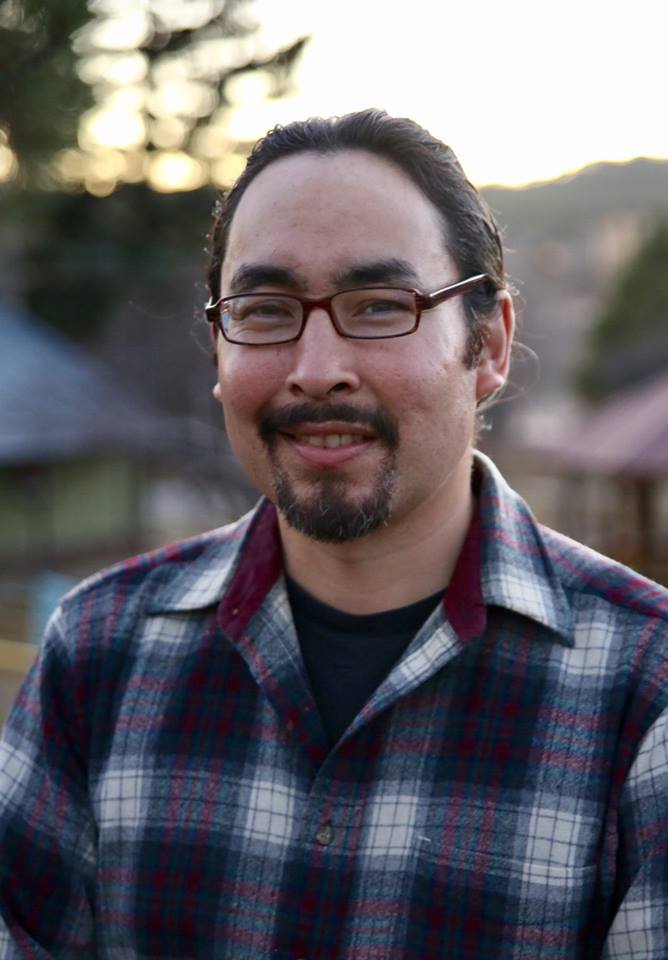
He wears his graying black hair in a ponytail, and small, reddish rectangular glasses frame his eyes above a full beard. To exemplify his work, Hope shared a piece called “Canoe Launching into the Gaslit Sea.”
Free time to speak with a reporter does not come easily to the artist. At 35 he’s the father of four, with—news flash—a fifth on the way with his wife, Tlingit weaver Lily Hope. Lily watched the children inside, but they needed to switch as soon as possible so she could weave—the deadline for her museum-commissioned Chilkat robe looms.
Hope will read from “Rock Piles Along the Eddy” at Kindred Post on Thursday at 7 p.m. (Photo by Ursala Hudson/Courtesy Ishmael Hope)
“A lot of what I was trying to do with this collection, ‘Rock Piles Along the Eddy,’ was explore Indigenous thought,” said Hope.
Hope is also working on a master of fine arts degree in creative writing from the Institute of American Indian Arts, is co-directing a documentary on Tlingit art here at KTOO, and is working on curriculum for Goldbelt Heritage on Tlingit language learning.
Hope says he’s looking forward to reading with Ernestine Hayes and Christy NaMee Eriksen. “They’re some of the finest writers in Alaska — they build community,” says Hope. (Photo by Ursala Hudson/Courtesy Ishmael Hope)
“What does it mean to be Indigenous?” continued Hope. “What does Indigenous thinking and being and feeling — how does that translate into the world? How do we express that? How do we emit that? How do we let that, I think, waft, in the work, in the language?”
“Rock Piles Along the Eddy,” which is a reference to a Tlingit tradition of creating salmon-friendly eddies with rock piles, is 70-pages long with 44 poems.
“This is really not fashionable writing,” said Hope with a hearty laugh. “It’s not the thing that’s going to get awards and be prestigious, and I don’t care. I really don’t. You know, I’m trying to write the work that connects to people, connects to the community whether they’re poetry fans or whether they’ve never picked up a poetry book.”
Hope will be joined by the Alaska State Writer Laureate, Ernestine Hayes, and writer and community activist Christy Namee Eriksen at Kindred Post at 7 p.m. tonight.
Listen to Ishmael Hope read
“Canoe Launching into the Gaslit Sea”
Now, as much as ever, and as always,
we need to band together, form
a lost tribe, scatter as one, burst
through rifle barrels guided
by the spider’s crosshairs. We need
to knit wool sweaters for our brother
sleeping under the freeway,
hand him our wallets and bathe
his feet in holy water. We need
to find our lost sister, last seen
hitchhiking Highway 16
or panhandling on the streets of Anchorage,
couchsurfing with relatives in Victoria,
or kicking out her boyfriend
after a week of partying
in a trailer park in Salem, Oregon.
Now, as much as ever, and as always,
we need to register together,
lock arms at the front lines, brand
ourselves with mutant DNA strands,
atomic whirls and serial numbers
adding ourselves to the blacklist.
We need to speak in code, languages
the enemy can’t break, slingshot
garlic cloves and tortilla crumbs,
wear armor of lily pads and sandstone
carved into the stately faces of bears
and the faraway look of whitetail deer.
We need to run uphill with rickshaws,
play frisbee with trash lids, hold up
portraits of soldiers who never
made it home, organize a peace-in
on the walls of the Grand Canyon.
We need to stage earnest satirical plays,
hold debate contests with farm animals
at midnight, fall asleep on hammocks
hanging from busy traffic lights.
Now, as much as ever, and as always,
we need to prank call our senators,
take selfies with the authorities
at fundraisers we weren’t invited to,
kneel in prayer at burial grounds
crumbling under dynamite.
We need to rub salve on the belly
of our hearts, meditate on fault lines
as the earth quakes, dance in robes
with fringe that spits medicine, make
love on the eve of the disaster.