Scott Burton, KTOO

New Perseverance satire wrestles with style, substance and identity

A satirical play with a megalomaniac title character who talks about himself in the third person opens this Friday at Perseverance Theatre.

While “The Elaborate Entrance of Chad Deity” takes place in a professional wrestling ring, the men in tiny tight outfits explore ethnic politics, celebrity and American culture.

A professional wrestling ring may not be where one expects to find fine art that deals with issues like these.

But, according to play director Shona Osterhout, they’re complementary.

Enrique Bravo rehearses as Macedonio “Mace” Guerra in Perseverance’s production of “The Elaborate Entrance of Chad Deity.” Note these are rehearsal photos without completed sets or costumes. (Photo by Cam Byrnes/Perseverance Theatre)

“Wrestling is, and I am going to air quote this and I’m not trying to spoil anything, it’s fake, right? It’s make believe. It’s theater,” Osterhaut said. “Then you have a play — a piece of theater — on top of a piece of theater. Then you have these layers of what I like to call masks, right? You get to peel all of these layers back and see actually what the real story is.”

In an interview with the Actors Theatre of Louisville, playwright Kristoffer Diaz described the main character, Mace, as a Puerto Rican pro-wrestler from the Bronx.

“Who is really good at the wrestling, part of professional wrestling, and he comes to find out that the wrestling part is a very small part of it,” Diaz said. The part of interacting with an audience, being charismatic — those are the big factors for somebody’s success.”

In Juneau, Enrique Bravo plays Mace.

His counterpart, superstar wrestler Chad Deity, is played by San Diego-based actor Vamel Sephus.

“Chad is the face of the league,” Sephus said. “He’s The Rock, your Hulk Hogan, your Stone Cold Steve Austin. Anyone of those guys who you think of as the champ — he is the champ.”

To exemplify the part, Sephus spoke in his character’s voice.

Chad Deity was hanging out with his boy, Derek Jeter, the other day,” Sephus said in character as Deity. “Chad Deity’s boy, Derek Jeter, turned to Chad Deity and said, ‘Chad Deity, you’re the champion and the ladies’ man and the media icon I’ve always wanted to be.’ And Chad Deity turned to his boy Derek Jeter and said, ‘Chad Deity knows Derek Jeter. Chad Deity knows.’”

Beyond examining a megalomaniac who talks about himself in the third person, playwright Diaz, who was raised in the Bronx and is of Puerto Rican decent, points out additional themes.

“It’s also about racial politics, ethnic politics, America, celebrity, opulence, money, all that kind of good stuff,” said Diaz in an interview with the Dallas Theater Center.

And the set at Perseverance Theatre?

“It’s a 65,000-seat stadium with a huge ring,” Sephus said.

“As an audience member you are invited to participate. We want it,” Osterhout added. “This is a play where you want to get involved because it’s just going to be more fun for you — it’s going to land fun for you. You’re coming to a wrestling match, and a play happens.”
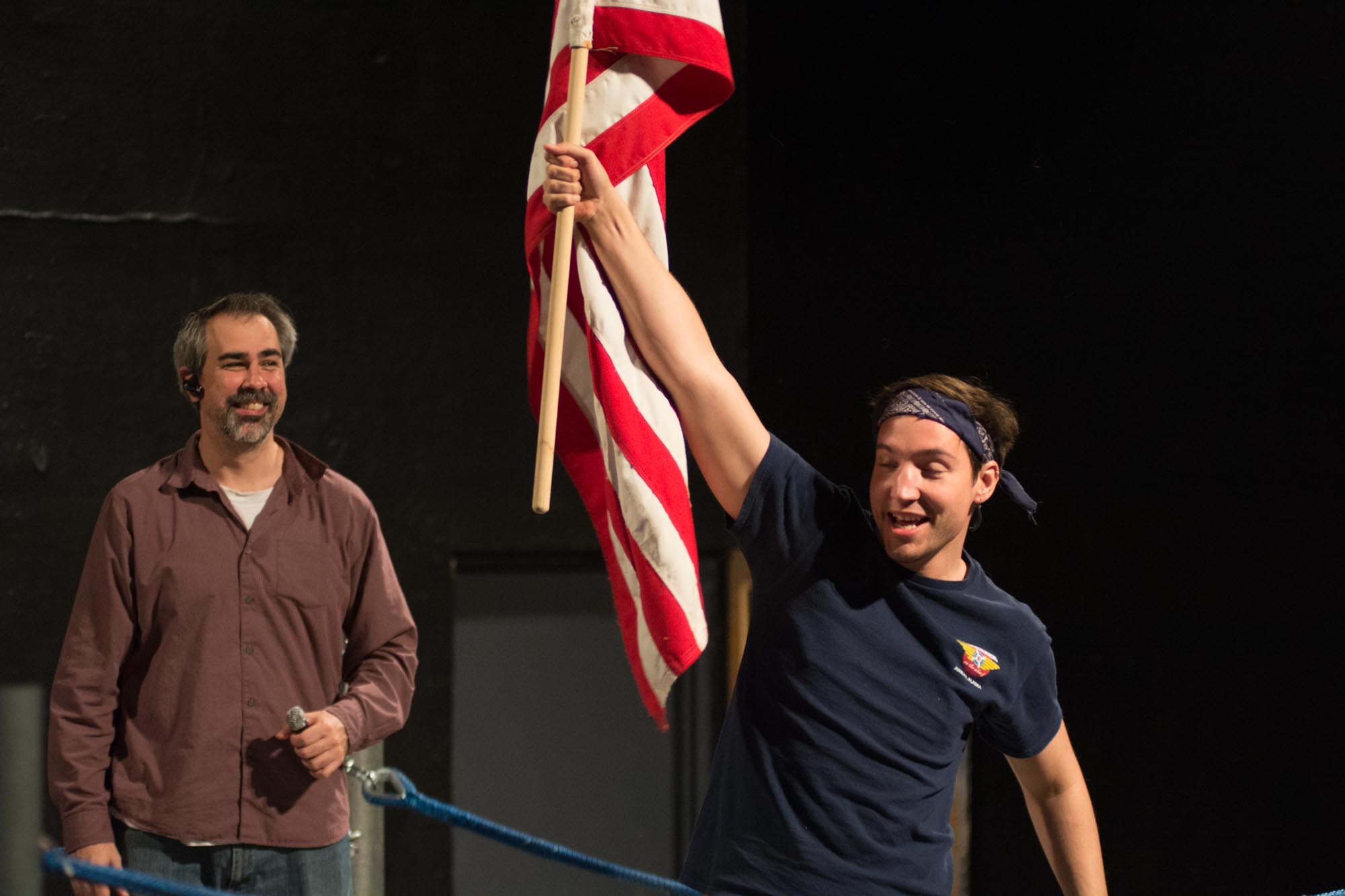
Tom Robenolt rehearses as Everett K. Olson, and Richard Jay Carter as “The Bad Guy.” These are rehearsal photos without completed sets or costumes. (Photo by Cam Byrnes/Perseverance Theatre)

“Scream, yell. Cheer on the champ, boo for the bad guy,” Sephus said.

“The Bad Guy” is played by Richard Jay Carter. Additional cast include Tom Robenolt at Everett K. Olson, and Jacob Athyal as Vigneshwar Paduar.

Perseverance Theatre’s production of “The Elaborate Entrance of Chad Deity” opens 7:30 p.m. Friday.

There are also pay-as-you-can previews 7:30 tonight and Thursday. The play runs through October 7.
Documentary ‘Lineage: Tlingit Art Across Generations’ premieres Tuesday


“Lineage: Tlingit Art Across Generations” premieres Tuesday night on 360 North. The 1-hour documentary film is a collaboration between KTOO Public Media, 360 North public television and Tlingit poet and storyteller Ishmael Hope.

The documentary explores the artistic lineage of many Tlingit culture bearers, including weavers, carvers, bead artists, musicians and more.

“What was important to me was a multi-generational revelation of how the spirit of Tlingit art gets fostered, how it continues, how it gets reincarnated,” said Hope, who I co-directed with.

One of our first shoots was with culture bearer and carver Paul Marks.

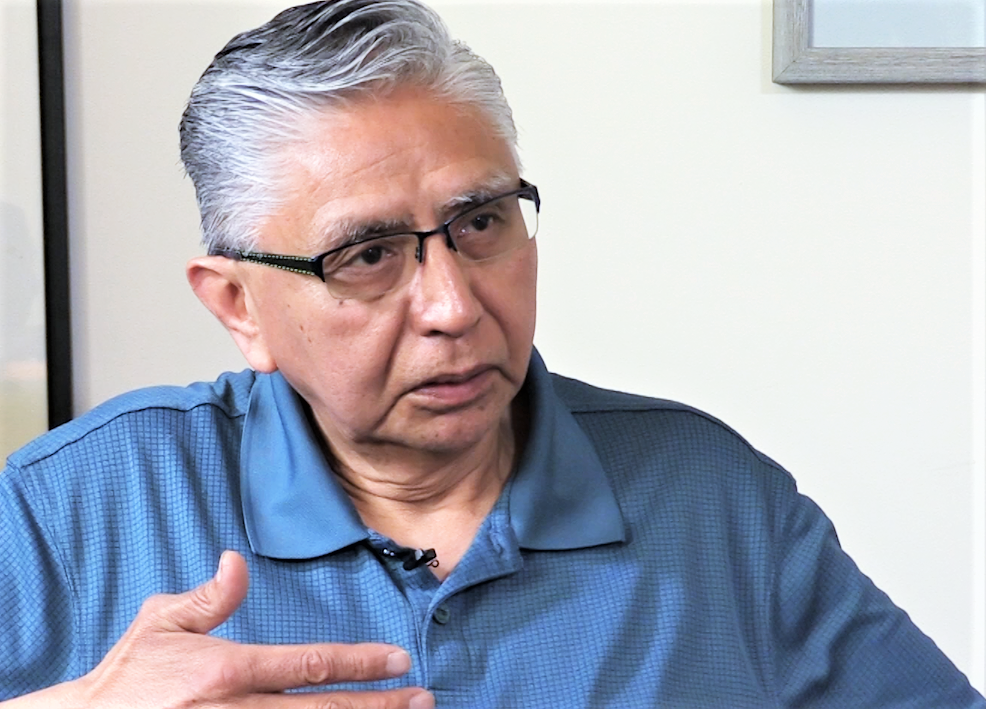
Paul Marks, Khinkaduneek of the Lukaaxh.ádi clan, is among the culture bearers in the film.
Paul Marks, Khinkaduneek of the Lukaaxh.ádi clan, is among the culture bearers in the film. (360 North video still)

“When we dance it does something to our spirit. It makes us feel good. And to wear our ancestral at.óow brings us strength and pride in our people, of our ancestors,” said Marks.

To see the art in action, Hope organized a Khu.eex’, or potlatch, in Sitka.

“What I love the most is when we are seeing the people in the regalia, in their at.óow, their Chilkat blankets, and the clan hats, those heavy important clan hats, their dancing in that. The culture is fully alive and everyone in that room feels it,” said Hope.

In Sitka, we filmed master weaver Teri Rofkar in her studio. Rofkar passed shortly after our visit and the scenes in the documentary are her last footage.

At one point in the documentary Rofkar points to a robe and a basket in her studio.

“The mountain goat and this spruce roots. You know, this was cutting edge science 6,000 years ago. And so for today, what are we doing? If I want Tlingit methodology, if I want our weaving to be relevant 6,000 years from now, how am I going to make that possible? It’s very obvious now that I’m the one passing through the weaving, not the weaving in me,” Rofkar said.

Fellow master weaver, Clarissa Rizal, also passed after our time with her. Beyond footage of her working with her daughter, Lily Hope, she left us with knowledge like this.

“This is a spiritual practice for women. When you raise up the spiritual practice of a woman, you raise up the level of harmonious existence,” Rizal said.

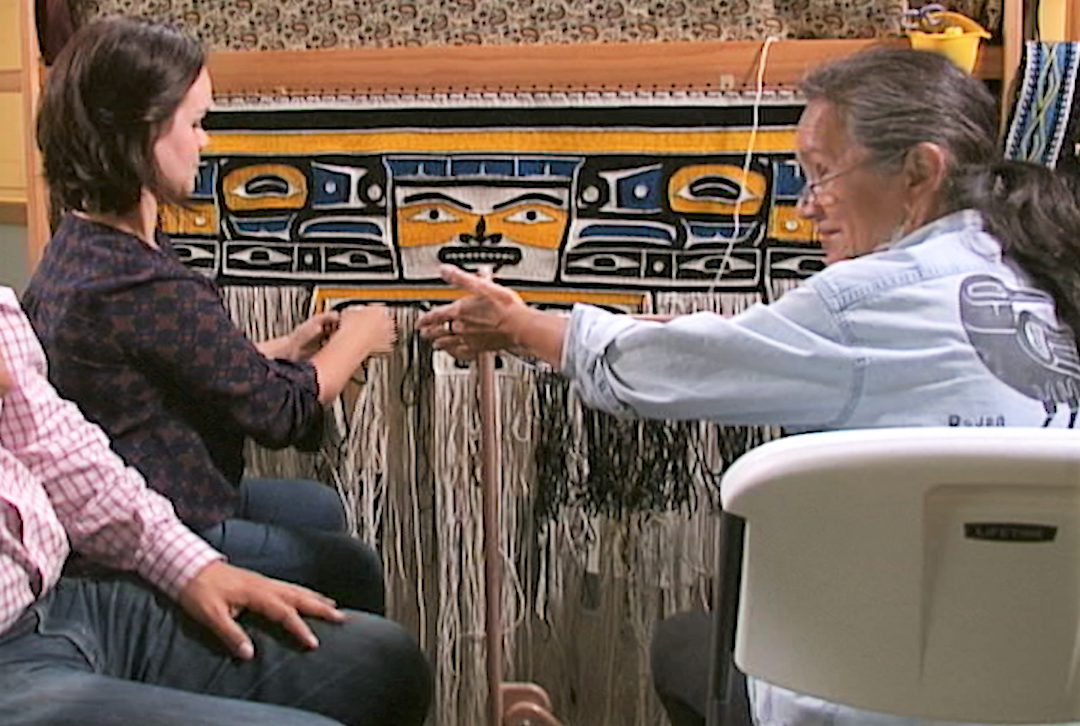
Master Chilkat weaver and multi-disciplinary artist Clarissa Rizal, Daalsak’u Tláa of the T’akhdeintaan clan, weaves with her daughter Lily Hope, Wooshkhindeinda.aat.
Master Chilkat weaver and multi-disciplinary artist Clarissa Rizal, Daalsak’u Tláa of the T’akhdeintaan clan, weaves with her daughter Lily Hope, Wooshkhindeinda.aat. Both women are in the artistic lineage of Jennie Thlunaut, Shaax’saani Keek’ of the Kaagwaantaan clan. (360 North video still)

We also spoke with multi-disciplinary artists, brothers Nick and Jerrod Galanin as they carved a canoe in Sitka. They’re the grandchildren of master carver George Benson.

Nick Galanin, Yéil Yatseen of the L’uknaxh.ádi clan, is a multi-disciplinary artist who is featured in the documentary.
Nick Galanin, Yéil Yatseen of the L’uknaxh.ádi clan, is a multi-disciplinary artist who is featured in the documentary. His music project, Silver Jackson, provided the sound track for the film. (360 North video still)

“Working on this canoe, by making artwork, and studying that, and diving into that, actively engaging it, has become the best way to feel some ownership towards it. And I guess, belonging to it,” Jerrod said.

Jerrod’s brother Nick, and his music project Silver Jackson, provided the documentary’s music. Songs like this one called “Perfect Mistake.”

[bandcamp width=300 height=42 album=2138434582 size=small bgcol=333333 linkcol=0f91ff track=3582331906]

If Hope regrets anything with the film, it’s that we didn’t cover more artists.

“This is a sampling and hopefully it has enough range to reveal some of this vision and these questions we were going for regarding the generations, regarding the spirit and character of the art,” Hope said.

“Lineage: Tlingit Art Across Generations” premieres at 8 p.m. Tuesday on 360 North. Visit 360North.org/Lineage for more information and to watch the documentary on demand. Funding for the documentary was provided by the Alaska Humanities Forum.

Correction: In an earlier version of this story, the photo caption for Paul Marks misidentified his clan. He is a member of the Lukaaxh.ádi, clan, not the L’uknaxh.ádi. 

Red Carpet Concert: Annie Bartholomew

Remember those Red Carpet Concert videos from folk fest we’ve been releasing over the last couple weeks? Well, it turns out there was one more video. After a cancellation, the production team had an extra slot to fill and our very own Annie Bartholomew happened to have her guitar with her. Here’s a bonus from the session, Annie Bartholomew with her song “Mister Thomas.”

Watch this and other Red Carpet Concerts with The Murphy Beds, Goldwing and more here at KTOO.org.

With new Chilkat robe, Juneau weaver hopes art form becomes globally recognized

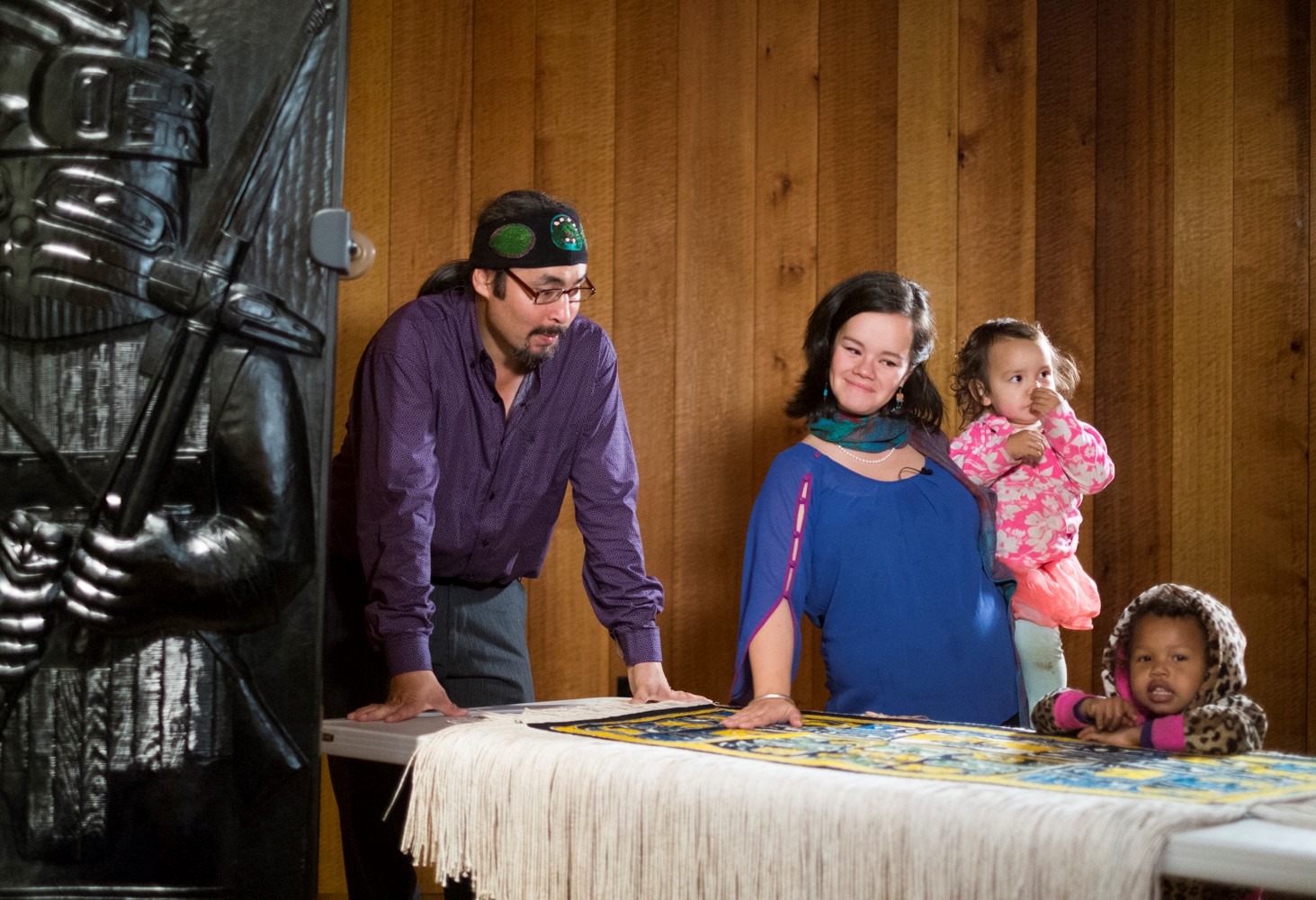
Ishmael, Lily, Ella and Mary Hope admire Lily’s completed robe. (Photo by Annie Bartholomew/KTOO)

Close to 50 people joined a ceremony Tuesday in the clan house at the Walter Soboleff Center to help celebrate the completion of Lily Hope’s Chilkat robe.

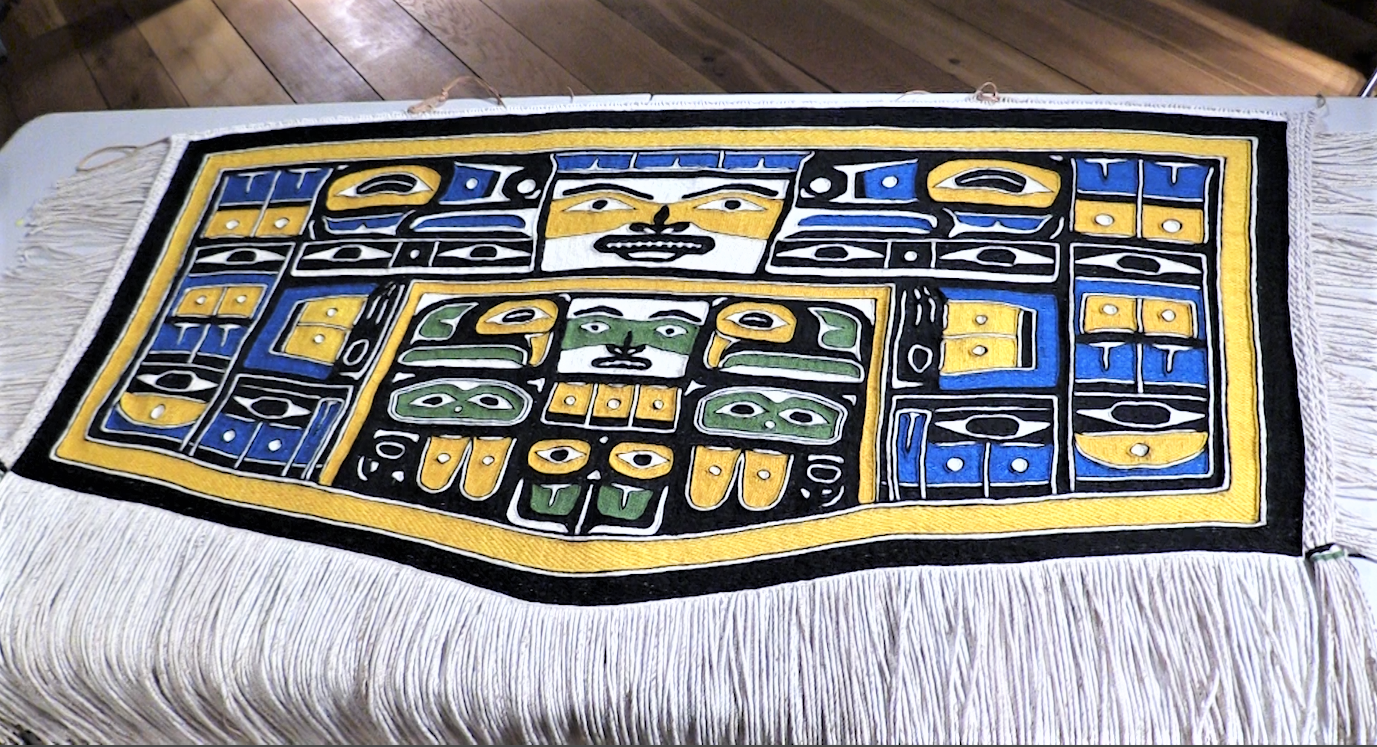
The robe was commissioned by the Portland Art Museum for an exhibit that honors Hope’s lineage of weavers including Cora Benson, Jennie Thlunaut, and Clarissa Rizal. Rizal is Hope’s mother who passed away in December.

As part of the ceremony, which included cutting the finished robe off the loom, Hope shared part of her inspiration for completing the commission.

Lily Hope’s Chilkat robe taken from video screenshot. (360 North)

“I want to help the Portland Art Museum, and other museums, and the nation and the globe to recognize Chilkat and Ravenstail weaving at least as much, if not more recognizable than Navajo weavings. So, I am just going to make that public today that we are going to bring it global so that when somebody sees these they go, ‘That is a Chilkat weaving from Southeast Alaska,’” said Hope.

A representative from the Portland Art Museum flew up to receive the robe.

Revisiting internment camp near Juneau promotes healing

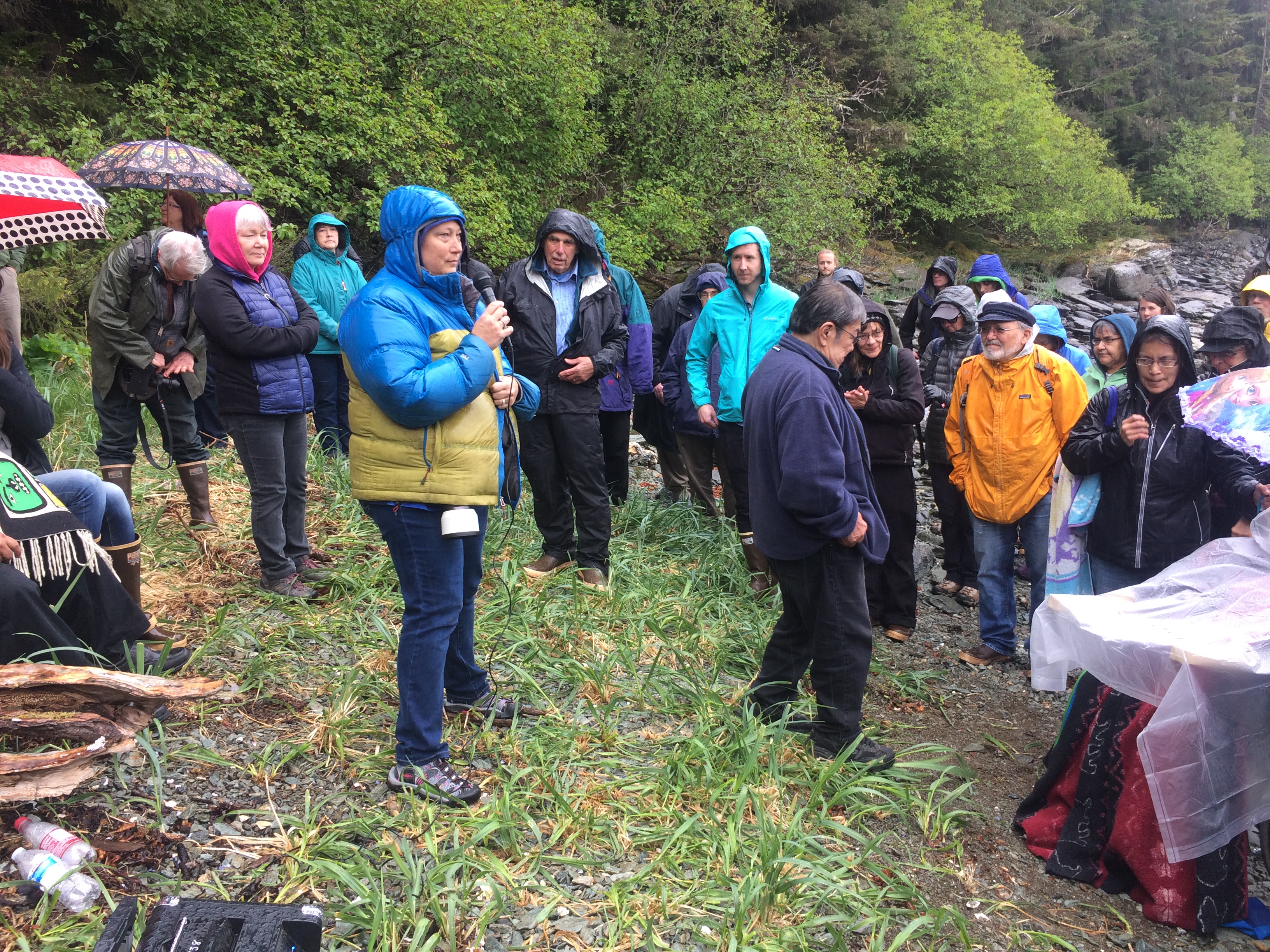
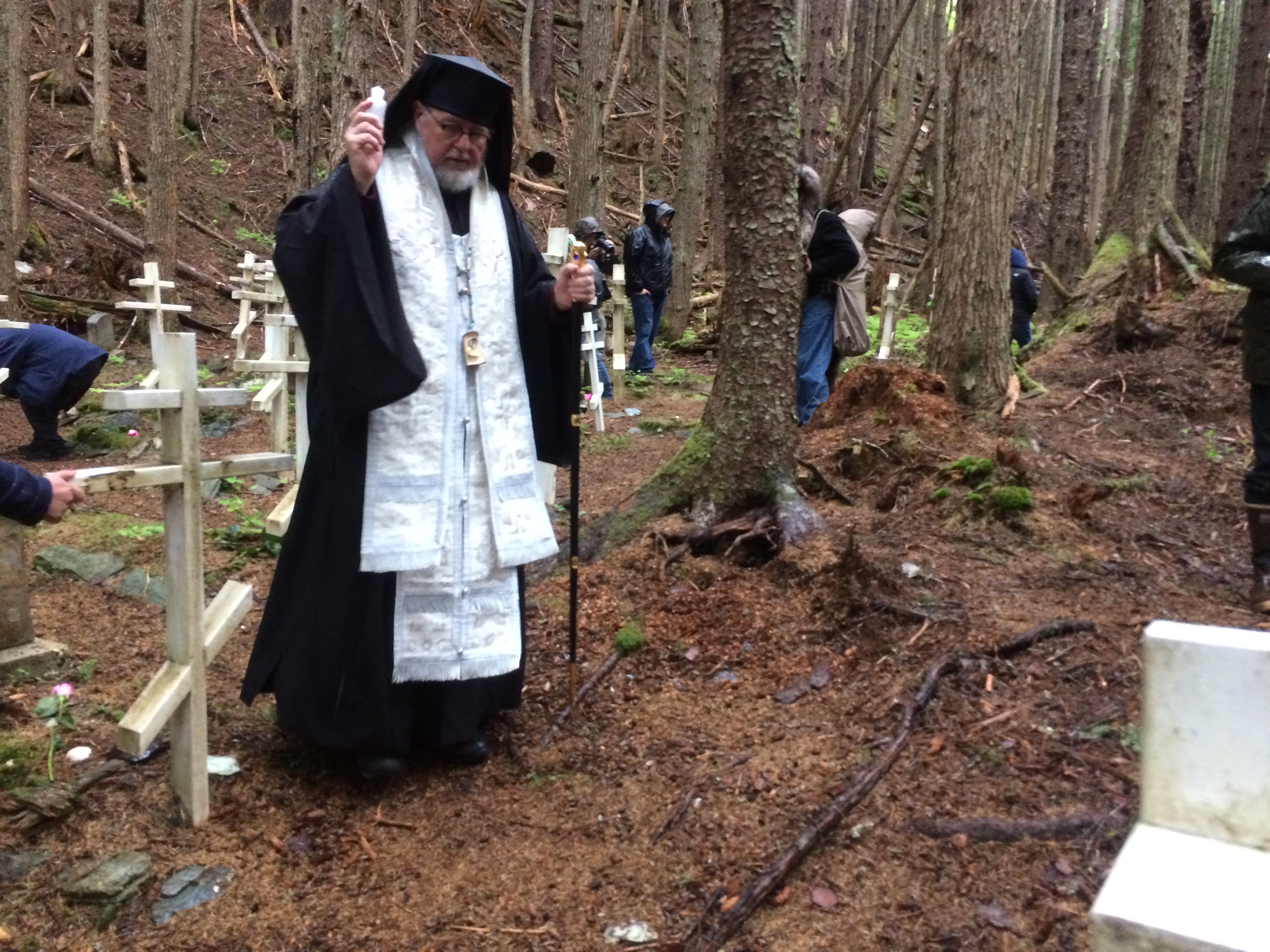
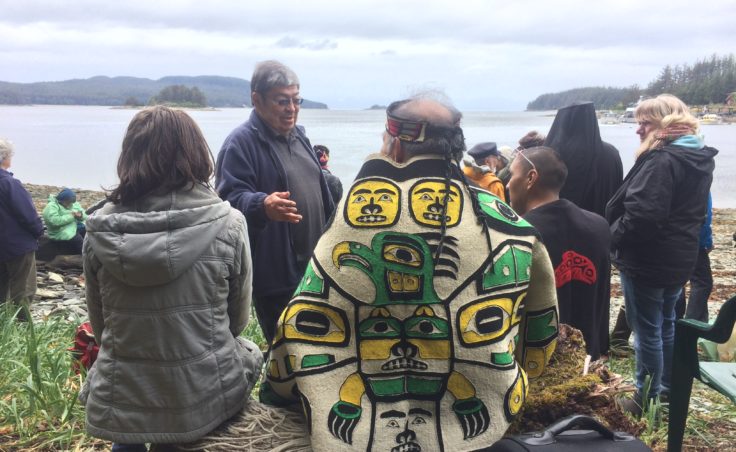
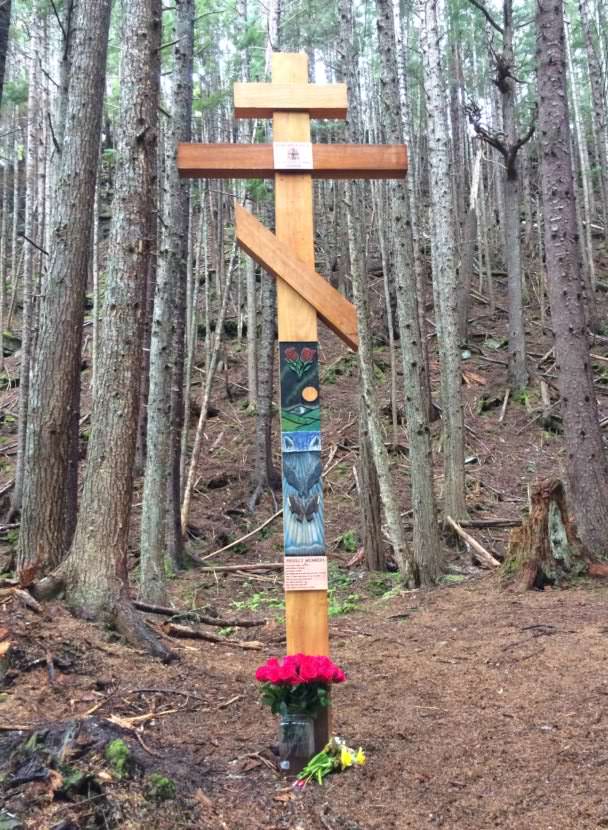
As the raven flies, Funter Bay is less than twenty miles from downtown Juneau. The bay is nooked into the northwest corner of Admiralty Island–if you’ve traveled by boat to Hoonah or Gustavus you’ve passed it.

But did you know that was where the U.S. Government interned hundreds of Aleuts, or Unangan people, to protect them from Japanese invasion during World War II?

The internees, from St. Paul and St. George in the Pribolof Islands, were moved about 1,300 miles against their will.

People died on the way and in Funter Bay over their two-year internment.

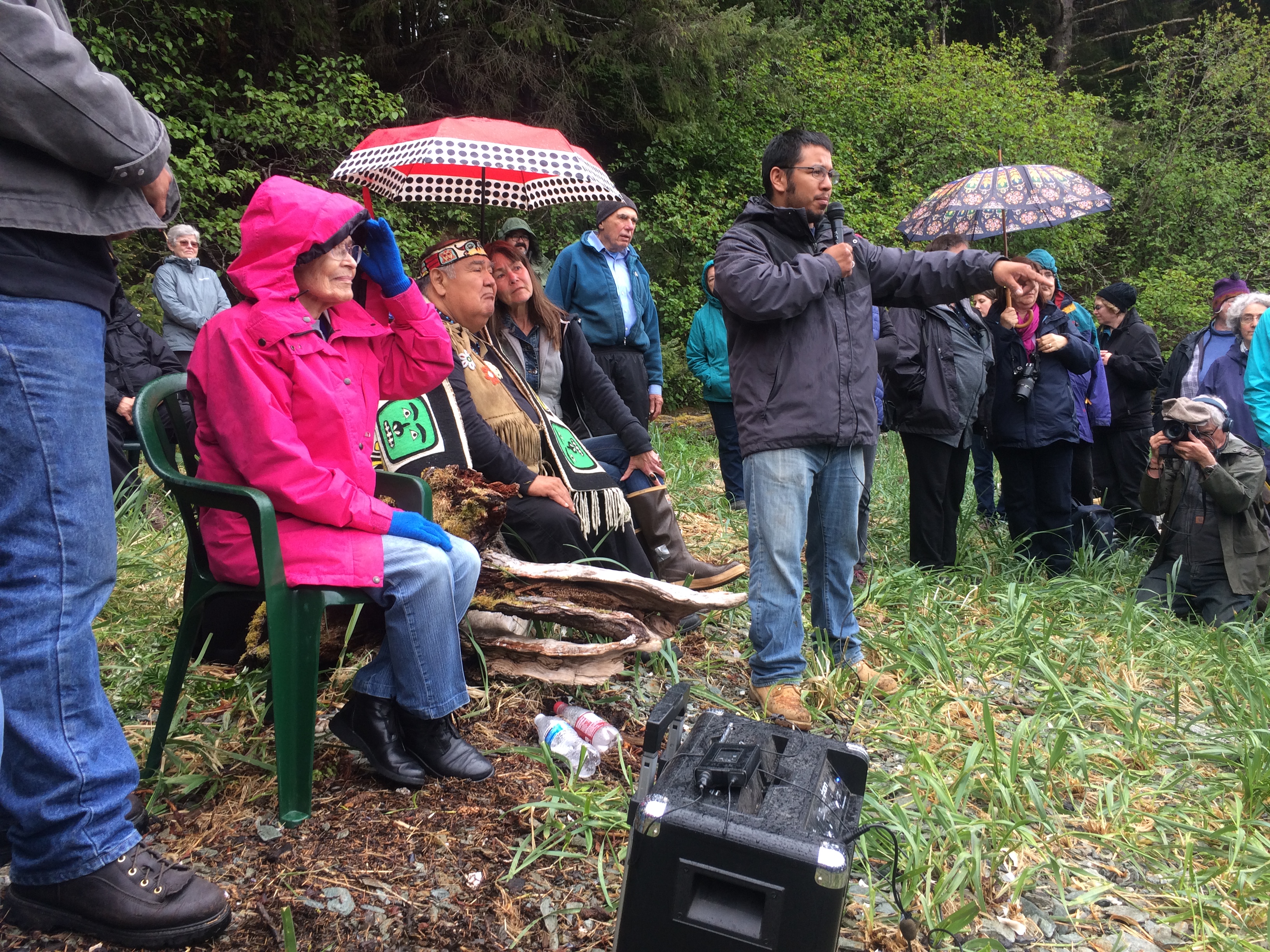
The nonprofit Friends of Admiralty Island organized a trip on Saturday that brought internees, and descendants of internees back to the camp to raise awareness and promote healing.

Over 100 people joined Saturday’s trip including KTOO’s Scott Burton who brings us this audio postcard.

The audio includes the voices of Tara Bourdukofsky, Ginger Bear, Karen Clark, Martin Stepeton, Bishop David, and Jill Merculief Schnabel.

Click here to read a story about the internment camp 50 miles south on Killisnoo Island near Angoon.

Brass music fills the State Office Building

This is the Axiom Brass Quintet from at today’s Juneau Jazz and Classics’ lunchtime concert at the State Office Building.

Between songs, members of the group talked to the audience, which included several school groups, about the histories and mechanics of their instruments—two trumpets, a tuba, a French horn, and a trombone.

The quintet plays again tonight at the Juneau Arts and Culture Center at 7 p.m. The group will be joined by several additional instruments, including piano, bass, cello, and violin.

Juneau Jazz and Classics continues Friday at 7:30 p.m. at the Juneau Arts and Culture Center. The concert is titled “The Rites of Spring” and will include compositions by Beethoven, Vivaldi and Stravinsky.

The two-week festival concludes on Saturday at Centennial Hall with Richard Thompson. Click here for a full schedule.

Site notifications
Update notification options
Subscribe to notifications