Scott Burton, KTOO

Ernestine Saankalaxt’ Hayes to be named 17th Alaska State Writer Laureate

The 17th Alaska State Writer Laureate will be officially announced tonight at the Governor’s Awards for the Arts and Humanities in Juneau.

In addition to the evening’s awards presentation and live arts performances, Juneau-based Ernestine Saankalaxt’ Hayes will be officially honored as the Alaska State Writer Laureate.

Hayes belongs to the Kaagwaantaan, or wolf clan, on the Eagle side of the Tlingit nation.

She may be best known because of her award-winning book “Blond Indian,” a memoir that chronicles the author’s early life between Alaska and California.

Listen to the story here:

The Alaska State Council on the Arts facilitates the selection of the Writer Laureate. The Governor’s Awards for the Arts and Humanities can be seen on 360 North beginning at 8 p.m.

Beyond publications and awards however, the state’s writer laureate must be nominated to the Alaska State Council on the Arts — in this case it was by Homer-based writer, poet and teacher Erin Hollowell.

“I would like to flatter myself that she recognized lyricism in my prose,” Hayes said.

Most know that prose refers to standard writing — or writing that is not poetry or drama for theater. But what is lyricism?

“It is prose that has elements of poetry,” Hayes said. “So that when we say, What is creative nonfiction? One common understanding is that it is nonfiction writing that has some of the characteristics and techniques of fiction. And, for me, lyrical prose is like that except that it has some of the characteristics and techniques that are commonly associated with poetry.”

Here is an excerpt of Hayes reading from “Blonde Indian.” Note how the writing, especially toward the end of the selection, could indeed be read from a poem.

“…and he’d never take another drink and he’d be a good husband to Mabel and a good father to Patricia and even a good son to Old Tom and a good friend to everybody and he would never let another swallow of saltwater fill his mouth–migod he should never have bought that last pint of vodka or even the beer–he couldn’t feel the tears on his skin or hear his last bubbling gasps as his face sank into the cold wet hidden inlet where the smell of the ocean, the feel of the spray, the sound of the gulls, the taste of the salt, the sight of mountain behind mountain behind island behind island, falling back and back in shadows and gray and dark green would never change.”

When Alaska’s laureate program started in the early 1960s it was only for poets.

In the mid-1990s the program broadened to include all genres of writing, and is now a two-year appointment.

Being the laureate means more than talented writing — it includes working with Alaskans to promote literature in the arts.

Another reason Hayes thinks she was selected was because of her recent participation in the Alaska Reads program. In February she visited 15 communities personally, and later, an additional 18 communities via teleconference.

“I did workshops and readings. I visited book stores, Highland Mountain (Correctional Facility), different sorts of schools, incarcerated people, senior centers, and Bean’s Café in Anchorage,” Hayes said. “I was thrilled and honored to meet so many Alaskans and hear their stories.”

That program, Alaska Reads, was an initiative created by the outgoing Writer Laureate Frank Soos. Hayes said she also has a concept for what she’d like to accomplish.

“Asking people of different generations to write and share parts of their stories and perform one another’s words,” Hayes said.

In the meantime, Hayes can often be found at the University of Alaska Southeast, where she teaches writing.
Watch and listen to KTOO’s 2016 concerts

In the spirit of year-end retrospectives, we put together a one-hour special highlighting the concerts we produced in 2016. Listen here:

Performers include (click on name to watch video where available): Sophia Street, Collette Costa and friends, Playboy Spaceman, HARM, Reeb Willms and Caleb Klauder, Harrison B, The Carper Family, Improbabilies, Forhorn, Whisky Class, The Hannah Yoter Band, Stephen Blanchet, Nicole Church, and Teri Tibbett and Friends.

Club Baby Seal provides new artistic outlet in Juneau

It’s awful out in Juneau on a Saturday night. After a bunch of snow, it’s raining, and moat-like ponds of water fill the streets, the sidewalks, everywhere.

Bad conditions however, have not affected attendance at a Club Baby Seal show, a new comedy troupe in Juneau.

The group of four comedians, two managers, a volunteer bartender and security guard are set up at the Gold Town Nickelodeon. It’s their second show of the night and it’s well attended — the first show sold out.

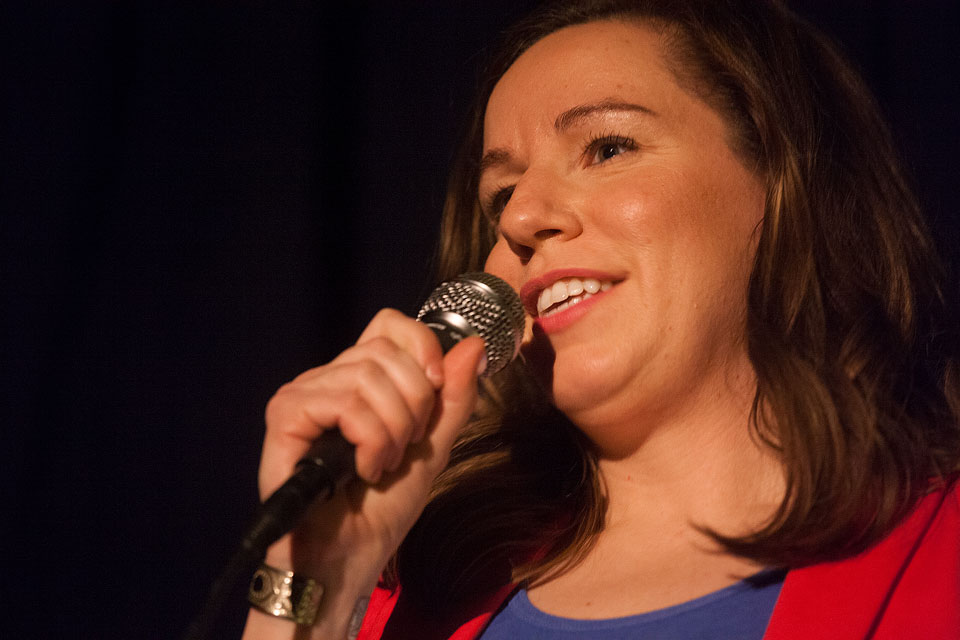
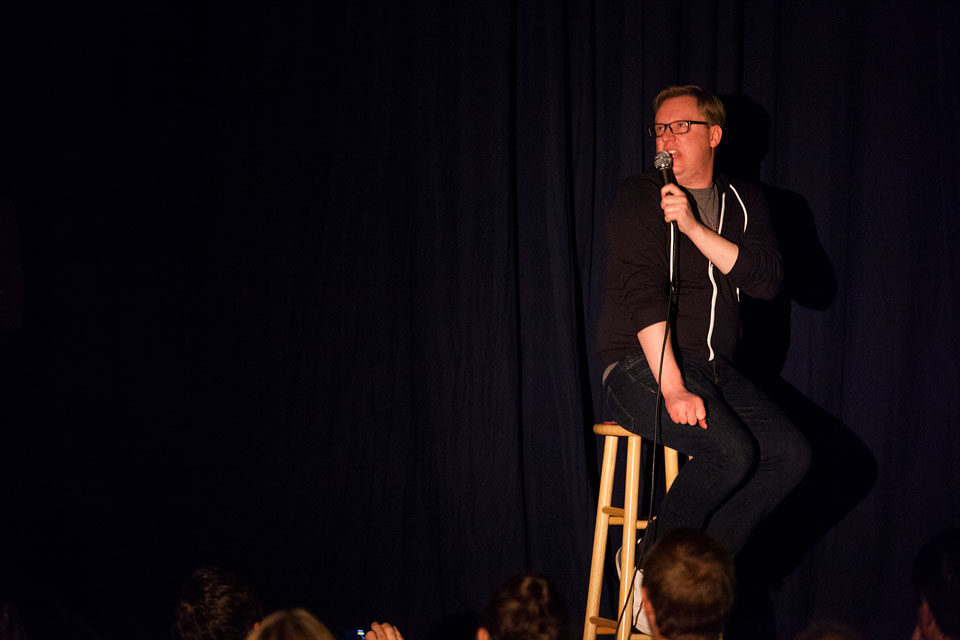
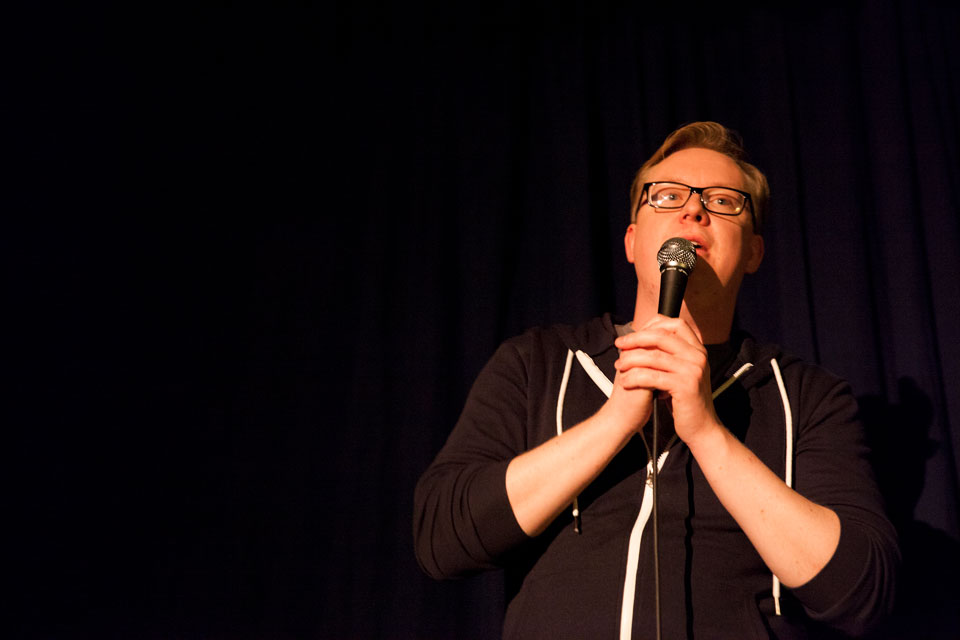
After a welcome from manager Grace Lee, emcee Corin Hughes-Skandijs warms up the crowd.

Part of his open includes a self-deprecating realization that he has the look of a movie extra.

Corin Hughes-Skandijs is CBS's emcee. (Photo by Rashah McChesney/KTOO)
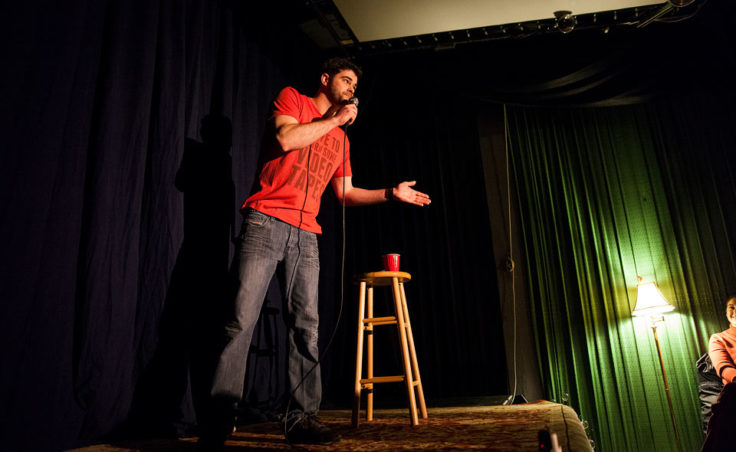
Corin Hughes-Skandijs emcees Club Baby Seal. (Photo by Rashah McChesney/KTOO)

“I’m the kind of guy that you would see stuck at the top of roller coaster, the hero has to come up and save me. I’m sitting there with like, a Mickey ears hat,” he said. The audience gives the bit a healthy laugh.

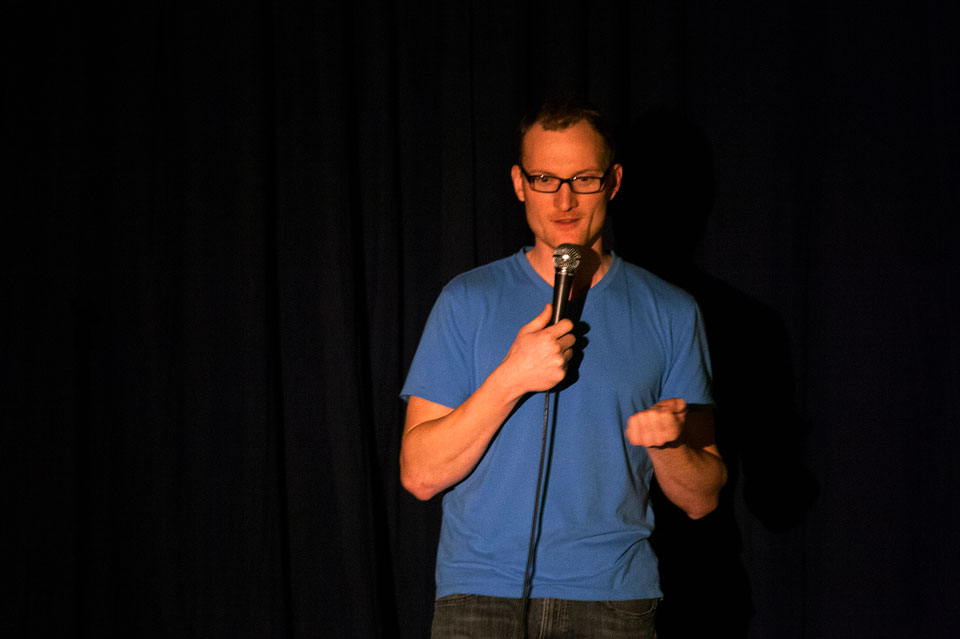
Next up is one of the group’s founders, Brady Ingledue. After taking a stand-up workshop, he started gathering long-time friends to write jokes and perform at home.

One of his jokes takes place in the bedroom.

“I do like to experiment in the sack, though. What I like to do is get, like, a girl. I’m coming in, I’ll get you all set up in the bedroom right there, doing your thing,” he says. “And then I’ll be over here kind of making a baking soda volcano. You know, getting the elements going, there’s test tubes.”

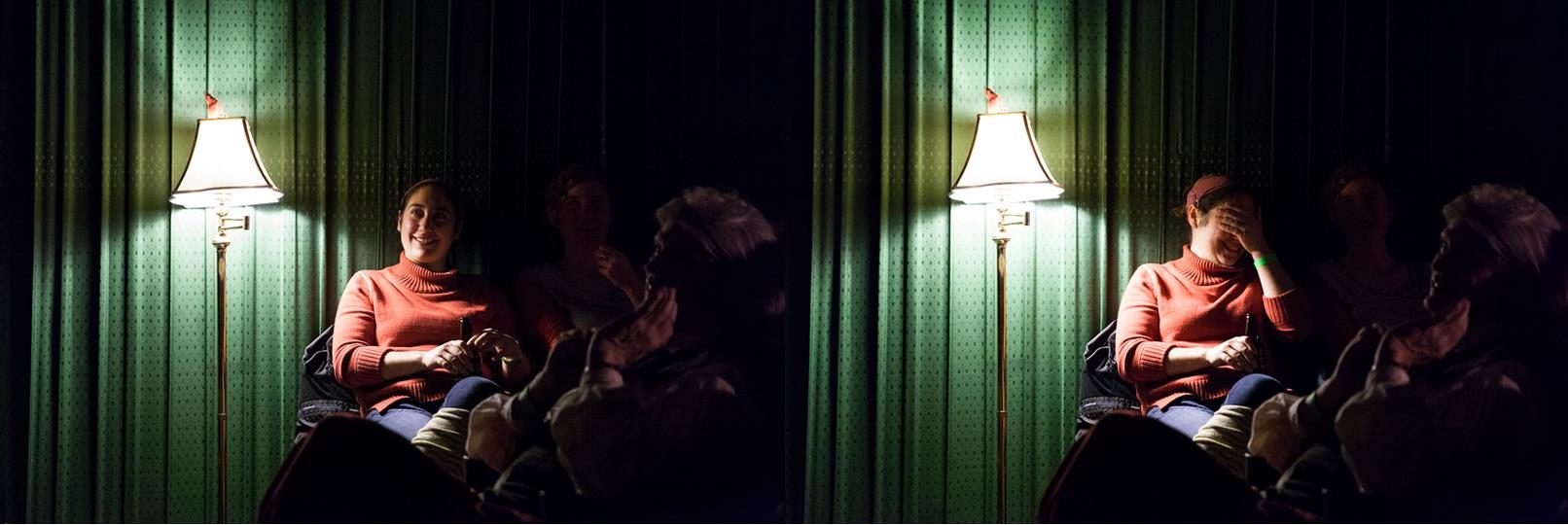
Audience members laugh during the stand up comedy show, Club Baby Seal, on Saturday, Dec. 18, 2016 in Juneau, Alaska. (Photo by Rashah McChesney/KTOO)
Audience members laugh during the stand-up comedy show, Club Baby Seal, on Saturday, Dec. 18, in Juneau. (Photo by Rashah McChesney/KTOO)

Alicia Hughes-Skandijs is the other group founder who wrote and practiced with Ingledue in the beginning. Her bit is about role-playing — but in a decidedly unsexy setting, the produce section of Fred Meyer.

“So I start in the organic section, and I just, like, grab it, like I know what I’m doing,” she says in a suggestive voice. “Ohh, this recipe calls for two kinds of kale. I know what’s going to happen with it.”

She snaps back to her regular voice.

“I do know what’s going to happen to the kale. The kale is going to get really, really slimy, like in my produce drawer.”

After the show she said, “It is the best feeling in the world when people are laughing because it feels like through their laughter they’re like, ‘Oh yeah I get it. Like, I’m with you on that point.’”

Alicia and Brady eventually met Nate Williams at a party. They started doing house shows in his living room in front of a brick-patterned curtain they ordered from Amazon.

Williams also is the one who suggested the name — Club Baby Seal — an irreverent play on words he conceived as a fifth-grader for the name of a snow fort he made.

“I don’t listen to self-help directly, but I listen to people who listen to self-help,” Williams said. “It’s too powerful straight from the source, like, uncut Tony Robbins is more than anyone can really handle. And I really don’t want to improve too rapidly.”

For those first house shows they brought on Alicia’s brother, actor Corin Hughes-Skandijs as emcee, and eventually actor and long-time friend Allison Holtkamp started performing too.

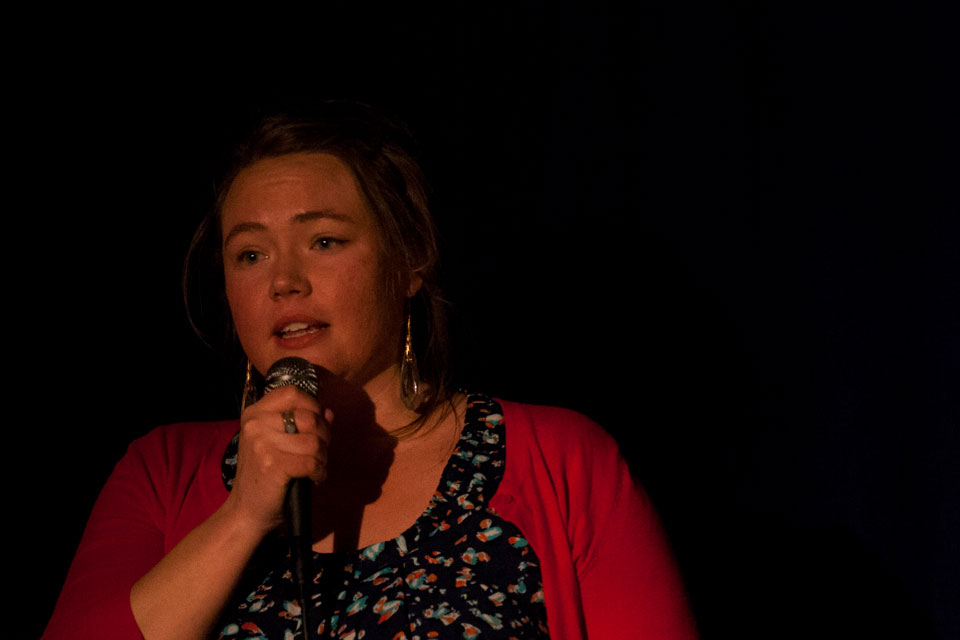
Holtkamp’s performance includes a bit about artificial insemination that brings hard laughs. She also works as an actor.

Allison Holtkamp (Photo by Rashah McChesney/KTOO)
Allison Holtkamp. (Photo by Rashah McChesney/KTOO)

“It is much more terrifying than acting because in acting you get to go on stage and you get to be someone else. With stand-up comedy you have to get up there and be yourself, and talk about things in your life that may be uncomfortable or … you know, sperm,” Holtkamp said with a laugh.

Unfortunately, Holtkamp’s sperm bit is not public-media safe, but whether it’s that, being an extra, role-playing, self-help or self-image, Alicia said material works “because there is something universal in there that everyone can relate to.”

And what does it feel like when it’s working and everyone is laughing?

“It’s like getting done with a 10-mile run and you get all of those endorphins in that one big laugh,” Holtkamp said.

Corin said, “It’d be like if your whole family was gathered in the living room when you came home from work and they all give you a standing ovation. And you were like, ‘What’s it for?’ ‘For you, and by the way, here is your favorite dinner that you’ve always wanted.’”

Williams said, “It’s like a hug from father or something. It’s a huge acceptance that what you say, what you think — yeah, it’s actually a really neat connection.”

The comedians are quick to thank their managers Hali Duran and Grace Lee, and they’re proud of providing a new artistic outlet in Juneau.

Club Baby Seal has shows scheduled in Petersburg in January, and they hope to make it to Anchorage and beyond in the spring.

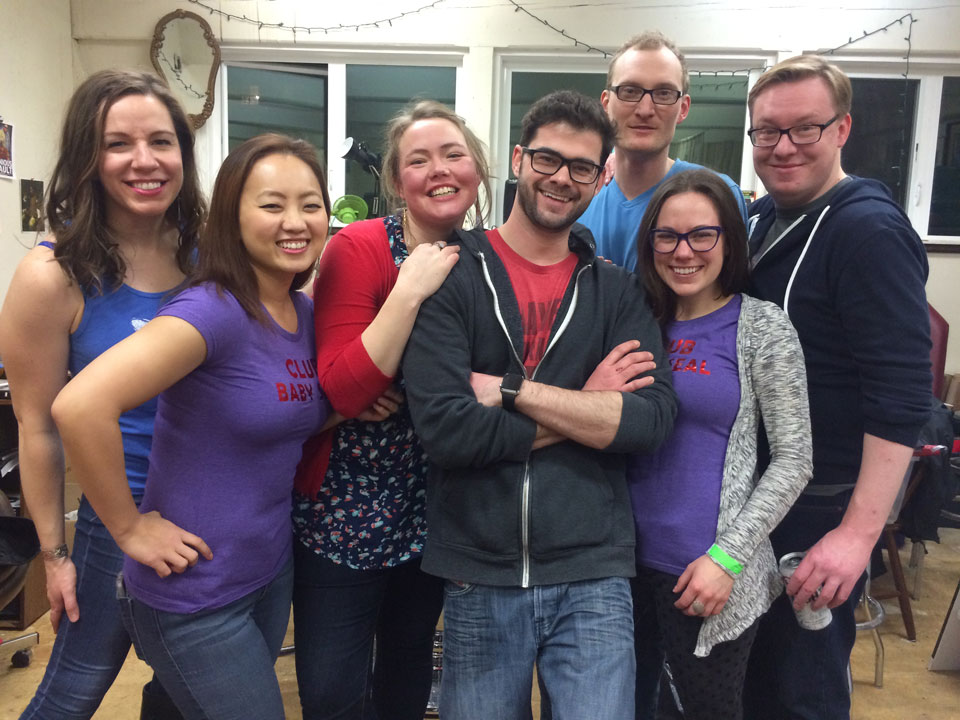
From left to right Club Baby Seal is: Allison Holtkamp, Grance Jang, Alicia Hughes-Skandijs, Brady Ingledue, Nate Williams, Hali Duran, and Corin Hughes-Skandijs. (Photo by Scott Burton)
From left to right, Club Baby Seal is: Allison Holtkamp, Grace Lee, Alicia Hughes-Skandijs, Brady Ingledue, Nate Williams, Hali Duran and Corin Hughes-Skandijs. (Photo by Scott Burton)

Correction: An earlier version of this story misidentified one of the club’s managers. Grace Lee is a manager of Club Baby Seal, not Grace Jang.  

Interviews about Alaska Native education recorded

The Quinto family is among the participants in the StoryCorps project at the Juneau Public Library. (Photo courtesy of the Juneau Public Library)
The Quinto family is among the participants in the StoryCorps project at the Juneau Public Library. (Photo courtesy Juneau Public Library)

The Juneau Public Library recently celebrated the addition of 30 audio interviews to their collection. The recordings were done in Juneau, Haines and Klukwan. Many focus on Alaska Native education.

The initial inspiration for the project stems from StoryCorps, a national oral history organization that’s received support from many local entities.

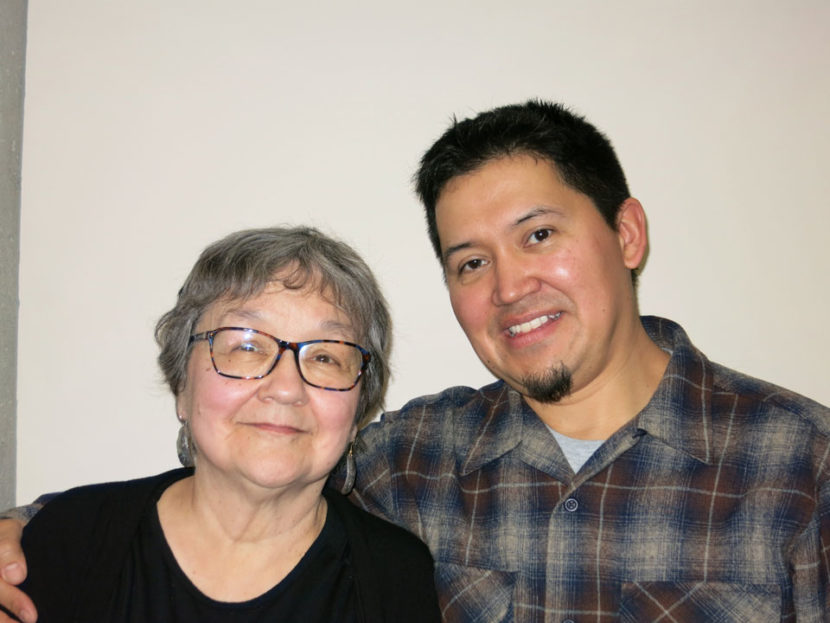
Among the recordings is this conversation between scholar Lance Twitchell and writer and educator Ernestine Hayes. Here are a few some excerpts from their 45-minute conversation.

Ernestine Hayes and Lance Twitchell.
Ernestine Hayes and Lance Twitchell. (Photo courtesy Juneau Public Library)

Twitchell: My name is Lance Twitchell, or Xh’unei, and my relationship to Ernestine Hayes is we are colleagues, we are partners in a fight against coloniality, and she would be my clan auntie and my clan daughter, is how I consider it, and I am very happy to be here.

Hayes: I’m Ernestine Hayes. I’m 71 years old. Today is Dec. 6, 2016. Here we are at the UAS Egan Library in Auk Kwan territory. And I’m here with my colleague Lance Twitchell, and we are, as he says, battling together.

Twitchell: Everybody who walks on this very soil is walking on a place where the Tlingit language was born, and if they’re walking in other places, where those other languages were born. A big part of trying to be — moving in a different direction that colonialism is saying, “Hey, that you’re not the only thing that’s around,” and, “Hey, you’re not the only important thing,” and also, “Things didn’t start with you.” And so, a big part is trying to educate this general populace so that they know, so that the indigenous is not a nameless, faceless thing that’s frozen in time, that has no capability of doing modern things.

Hayes: If we built a racist society, what would it look like? Who would be incarcerated? Who would be the dropouts? Who would have the highest suicide rates? Who would have the highest rate of parental termination? Who’s language would be disappearing? Who would be sick from addiction, and tuberculosis and diabetes? If we build a racist culture, that’s what it would look like, and that’s what this looks like.

Twitchell: I think about the arrogance of the colonial world and then how that translates now to this total reluctance to see the blatant racism that carries through so many, just system after system after system, and drives you nuts cause you’re like, trying to talk to somebody and you just realize how they don’t get it.

Hayes: I think some of us have to be warriors and I just have defined a line where I stand. And I’ll stand there as long as I can, and when I can no longer stand there, I will lay there. But I will not, you know, move back from that line.

Twitchell: Ernestine, you are one of the most important voices in my life, so I like having this conversation with you.

Hayes: Thank you.


This conversation, and more with people like the Quinto family, Hellen Feller and Carol Brady, and Cherri and Wayne Price will be available soon at the Juneau Public Library.

Respected Chilkat and Ravenstail weaver Clarissa Rizal dies at 60

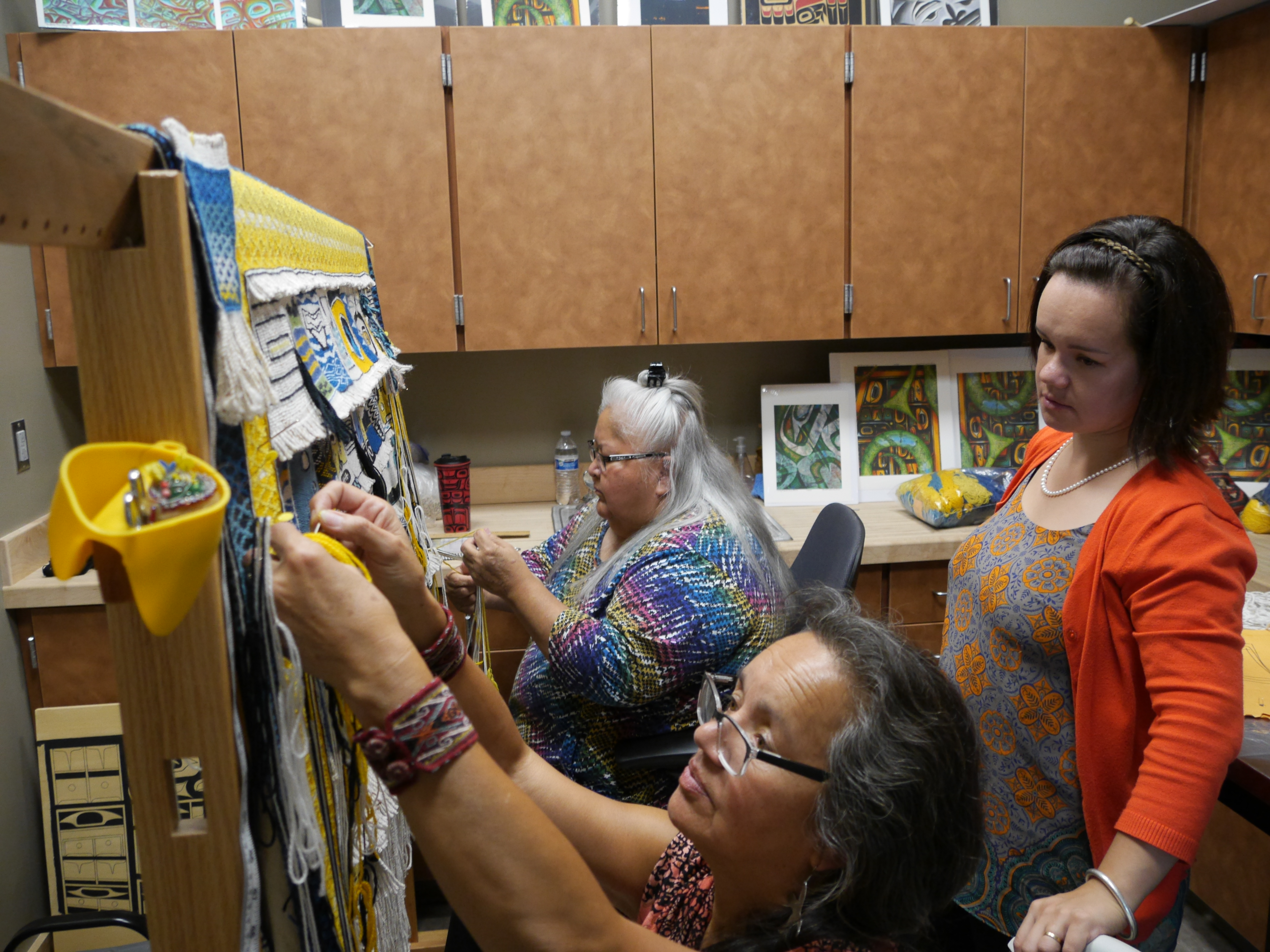
Della Cheney, left, and Clarissa Rizal work on braiding the side borders for the Weavers Across Waters Chilkat/Ravenstail community robe on Monday, August 22, 2016, at the Sealaska Heritage Institute, Juneau. One of three of Rizal's daughters, Lily Hope watches the weavers work on the robe, which will be part of the Huna Tribal House opening celebration. Hope is also an accomplished weaver, actress and storyteller. (Photo by Tripp J Crouse/KTOO)
Della Cheney, left, and Clarissa Rizal work on braiding the side borders for the Weavers Across Waters Chilkat/Ravenstail community robe on Aug. 22, 2016, at the Sealaska Heritage Institute in Juneau. Lily Hope, one of Rizal’s three daughters, watches the weavers work on the robe, which was part of the Huna Tribal House opening celebration. (Photo by Tripp J Crouse/KTOO)

“The world has lost another luminary.”

That’s how the Sealaska Heritage Institute began a message announcing the death of Clarissa Rizal at age 60, a renowned Chilkat and Ravenstail weaver. She was a Raven of the T’akdeintaan Clan, also known as the black-legged Kittywake Clan.

The institute’s announcement says Native people owe her a debt for teaching and reviving the sacred art.


Rizal was diagnosed with terminal liver and colon cancer in October and passed in the early hours this morning. Her sudden death comes as a shock to many.

In addition to weaving, Rizal was a multimedia artist who worked with paint, music, spoken word, printmaking and sculpture. Among her works in recent years was a collaboration with the Seattle-based band Khu.éex’. You can hear Rizal perform in “To Her Grandmother” by clicking below.

Among other awards, Rizal was a 2016 National Endowment for the Arts fellow. You can watch her presentation at the Fellowships Concert below.

She leaves behind children Kahlil and his wife Mikiko along with their daughter Violet; Lily Hope and husband Ishmael, and their children Elizabeth, Louis, Mary and Ella; Ursala Hudson and husband Chris Haas and their daughters Amelie and Simone. She is also survived by her siblings Richard, Tim, Irene and Deanna.

A celebration of life in Juneau will take place in the summer of 2017.

Juneau Afternoon-11-14-2016

Monday at 3 on A Juneau Afternoon, Scott Burton hosts:

We’ll learn about becoming a certified nurse through UAS’s CNA program;

Ben Huff and Marjorie Menzi will highlight an upcoming photography lecture and workshop at the SLAM;

Amanda Filori and Mia Wade will fill us in on an upcoming open mic for kids;

And we’ll get a preview of “Hold These Truths” by Perseverance Theatre’s Art Roach and director Leslie Ishii.

That, Writers Almanac, Bird Note, music and more, live at 3 on KTOO-NEWS, repeated at 4 on KRNN, and available on demand via ktoo.org

Site notifications
Update notification options
Subscribe to notifications