Yvonne Krumrey

Justice & Culture Reporter, KTOO

"Through my reporting and series Tongass Voices and Lingít Word of the Week, I tell stories about people who have shaped -- and continue to shape -- the landscape of this place we live."
Trial of former Juneau chiropractor accused of assaulting more than a dozen women begins

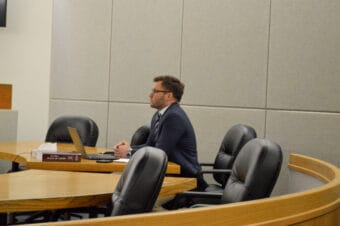
Former Juneau chiropractor Jeffrey Fultz sits during jury selection ahead of his sexual assault trial in Juneau on Wednesday, July 30, 2025. (Photo by Yvonne Krumrey/KTOO)

Content warning: This article includes mentions of sexual assault and abuse that may be uncomfortable for some readers. Resources are available at the bottom of this post.

After 10 days of jury selection, lawyers read opening statements Tuesday in the trial of a former Juneau chiropractor arrested four years ago on multiple sexual assault charges. Jeffrey Fultz is accused of assaulting more than a dozen women under the guise of medical care while he worked at Southeast Alaska Regional Health Consortium.

While the charges against Fultz have been public for years, this was the first chance to hear from his defense.

One of Fultz’s defense attorneys, Wally Tetlow, opened with arguments that Fultz provided legitimate care to the witnesses.

“The evidence in the case is going to show that during legitimate medical treatment, Dr. Fultz did make contact with sensitive areas of the body, but he did not make any contact with sensitive areas of the body without consent,” Tetlow said.

He said while the women accusing Fultz of assault may have been uncomfortable during their treatment, that does not mean he committed assault. 

He also argued the investigating officer Daniel Darbonne — a former Juneau Police officer who died in 2023 — told women they were assaulted without reviewing the medical records himself.

“They didn’t know at all whether it’s legitimate medical treatment or not, but it was,” he said. “But Darbonne tells them it’s not, and they believe him.”

The defense attorney ended with a plea to the jury. 

“At conclusion of the evidence in this case, we’re going to ask you to find Mr. Fultz not guilty on all of the charges,” he said.

The Fultz trial comes after years of delays, and will decide whether he perpetrated the crimes more than a dozen Juneau women accuse him of. He could face years in prison.

Judge Larry Woolford read instructions to the 16 jurors seated.

“This is a criminal trial, and the fundamental obligation of jurors in a criminal trial is to apply the presumption of innocence and the burden of proof beyond a reasonable doubt,” he said. “The defendant, although accused of a crime, begins trial with a clean slate with no evidence favoring conviction.”

State prosecutor Jessalyn Gillum opened the state’s case against Fultz by outlining what he’s accused of. 

“We are here because the defendant engaged in sexual contact with his patients under the guise of legitimate medical treatment,” she said. “He violated their trust and he violated their bodies. ” 

She read the list of witnesses and what they sought treatment for in chronological order, beginning with when they started treatment. 

“Upon these allegations becoming public, additional women stepped forward,” Gillum said.

Gillum outlined what witnesses will say: women who sought care for injuries in their hands and arms would find Fultz spending extensive time on their buttocks and breasts. In some instances, they claim he touched their vaginas. They said that Fultz didn’t leave the room when women undressed and that he ignored “no” and dismissed uncertainty from his patients. 

The jury will hear from expert witnesses and alleged victims in the coming days. The trial is expected to last for at least another two weeks.

The Indian Health Services established a hotline for callers to report suspected child abuse or sexual abuse by calling 1-855-SAFE-IHS (855-723-3447) or submitting a complaint online on the IHS.gov website. The hotline may be used to report any type of suspected child abuse within the IHS, or any type of sexual abuse regardless of the age of the victim. The person reporting by phone or online may remain anonymous.

Locally, people can call AWARE in Juneau at 907-586-1090.

Juneau Animal Rescue may have a spot for their new shelter

Cats look out a viewing window at Juneau Animal Rescue on Thursday, Jan. 18, 2024. (Clarise Larson/KTOO)

Juneau Animal Rescue may have a location for a new, updated shelter.

At Monday’s Assembly meeting, members gave the OK for the city manager to negotiate leasing a parcel of city property to the rescue for less than fair market value.

JAR Board Member Kevin Ritchie said the next step is to raise enough funds to design and build the new shelter once the lease is approved. Building costs are expected to be between $15 and 20 million. 

“To make a project go forward, to start raising money, you need to have a place to put the project,” he said. “You need to describe what it’s going to look like and how much it’s going to cost.”

JAR leadership has been fundraising for a new building for the last few years. They say the current shelter isn’t meeting the needs for sheltering animals in Juneau. 

The roof leaks and the floors have started to sink. A 2021 inspection showed the facility doesn’t meet national standards. Ritchie said the shelter often finds itself at or near capacity, especially in summer. 

“The big thing is that the current shelter was built back in 1984 and that was before there were national standards for the treatment of animals,” he said. “And frankly, it just wasn’t built to be a very good housing for animals.”

JAR says the new facility would ideally have a better ventilation system to help prevent the spread of diseases, and more space for cats, dogs, and smaller animals like rodents and reptiles.

The city land JAR may lease is in the Mendenhall Valley, and the shelter would share it with the Southeast Alaska Food Bank. Ritchie said the construction timeline depends on how quickly the organization can raise funds.

Juneau Animal Control shares how to prepare pets for emergencies

Animal Control Officer Thomas Young-Bayer holds jars full of cat litter as part of his emergency go-bag for his pets on July 2, 2025. (Photo by Mikko Wilson/KTOO)
Animal Control Officer Thomas Young-Bayer holds jars full of cat litter as part of his emergency go-bag for his pets on July 2, 2025. (Photo by Will Mader/KTOO)

Like much of Alaska, Juneau has its share of disasters and emergencies. Part of living here is planning ahead for scenarios that may require evacuating your home. Juneau Animal Rescue wants to inform residents about how best to prepare to evacuate their pets too. 

They have a list of things all pet owners should know and have on hand to make sure their pets are safe in an emergency or crisis. 

Thomas Young-Bayer is an animal control officer. He said it’s a good idea to gather the things our furry friends may need for a few days away from home. 

“One of the best ways to prepare yourself, your family and your pets for an expected emergency is to pack a go-bag,” he said.

He unpacked his own go-bag for his dog and cat. In it: a muzzle, jars of kibble, and a well-loved blanket.

“These are a couple of my dog’s favorite toys,” he said, holding the disembodied arm of a stuffed animal. “And you know, they might even just be a scrap of a toy, but if that dog loves that, if that’s what helps it feel safe and familiar and with a new situation and want to play and kind of get out of its fear and anxiety stage, then that’s what you should grab and have ready to go.”

The go-bag should be waterproof and have the pet’s medications, three days worth of food, water, and hygiene supplies. 

For the full list, watch this video breakdown of the pet go-bag:

And Young-Bayer said Juneau Animal Rescue can be that temporary landing place for pets in emergencies. 

“Whether they be fire, flood, landslide, or people who are suddenly unhoused for another unexpected reason, or even expected reasons, such as eviction,” he said.

If that moment ever arises, he said there are some things pet owners can do to make it easier for JAR to house pets, like making sure pets are spayed and neutered, and their vaccinations are up to date. Pet owners should give JAR all their pet’s information: medical history, vaccination and sterilization records, microchip numbers, and photos of the pets with their people. 

The organization keeps that in a file with the owner’s contact information, he said. That also helps if a pet gets loose in an emergency or is otherwise separated from its family. 

“Having them microchipped is very, very helpful for us to identify who a particular pet is that we might encounter and who that pet belongs to and where its home is,” Young-Bayer said.

JAR offers microchipping and their staff can scan a pet’s existing microchip to make sure the information is up to date.

But the best way to keep your pets safe in the event of a landslide or flood, he said, is to identify a friend or family member in Juneau who lives outside of the same hazard zone, is familiar with your pet, and can be prepared to care for the animal if you’re evacuated.

Young-Bayer also encouraged pet owners to be prepared for their pet to be anxious—dogs may be more reactive in a crisis, and cats may hide in hard to reach places. And he said, if there’s a known threat of an emergency, bring outdoor cats inside where they’ll be easier to evacuate. 

If Juneau residents have a pet emergency, they can reach animal control by calling JAR or through the Juneau Police Department after hours dispatch line at 907-586-0600.

Tongass Voices: Juneau’s mobile crisis responders on meeting patients where they’re at

Two women stand smiling by a car marked "Capital City Fire/Rescue." Meghan DeSloover and Sarah Zaglifa respond to mental health emergencies in Juneau as part of a new mobile crisis team. July 1, 2025. (Photo by Yvonne Krumrey/KTOO)
Meghan DeSloover and Sarah Zaglifa respond to mental health emergencies in Juneau as part of a new mobile crisis team. July 1, 2025. (Photo by Yvonne Krumrey/KTOO)

This is Tongass Voices, a series from KTOO sharing weekly perspectives from the homelands of the Áak’w Kwáan and beyond.

A new mobile crisis team has been operating in Juneau since November. Each team is comprised of a clinician from Bartlett Regional Hospital and an EMT from Capital City Fire/Rescue.

Meghan DeSloover and Sarah Zaglifa reflected on their role in filling some of the gaps in behavioral health care in Juneau. The first responders broke down how their unit helps get patients care on their own terms. 

The following transcript has been lightly edited for clarity.

Sarah Zaglifa: So this is what goes in the crisis bag. We have a resource binder with everything you can imagine, treatment applications, resource lists, different assessment tools. Is in there, clean socks for someone who’s walking around in wet socks. That’s never a healthy thing, so I always keep a stash. I’m Sarah Zaglifa, and I’m a licensed clinical social worker on the mobile crisis team.

Meghan DeSloover: My name is Megan de Slover, and I am a community health specialist with Capital City Fire/Rescue and an EMT, and I work on the mobile crisis team.

I’ve been working with the fire department since 2018 just naturally, being a part of the mobile integrated health team, I have become a part of the mobile crisis team. We’ve done a number of trainings to prepare us for this, and so that’s how I’m here.

Sarah Zaglifa: So I got involved in mobile crisis way back in the 90s, believe it or not, I got my master’s degree way back then. I was living in San Francisco and part of the domestic violence task force there, and really immersed into crisis work at that point, and was married to the military. We relocated. Were stationed in Alaska, decided to settle here and wanted to commit to the community. I was working at Bartlett in the emergency department for four years. Then I worked in behavioral health and a little bit in oncology, and then when this program started getting up and running, I really wanted to get back to my crisis roots, because it’s the best job. Love it. 

Meghan DeSloover: I learned that we have a huge need in this community for assistance, and that there isn’t always money and there aren’t always avenues, and there aren’t always people to fill those roles. So I’ve just, I’ve been really thankful to be a part of this, because I feel like our role has been very helpful.

Sarah Zaglifa: I feel really inspired by Bartlett and other community partners like CCFR being very invested in the safety net of the community, and being part of the fiber of that safety net is really important. 

I think the best part about this position and where I’ve learned the most is how important it is to meet the patient – literally and figuratively – where they’re at. Your assessment is so much more rich and respectful when you’re on their turf and you are their guest versus the natural change in dynamics when you’re in an emergency department or in more clinical setting, 

I feel really proud of how our team as co-responders can just sit with someone and just be with them and whatever It is they’re in with no agenda, with no pressure.

Meghan DeSloover: We don’t fix everything for everybody. Certainly that’s not even the goal, because it would be impossible. But just people feeling like, oh, I have someone else to reach out to. 

Sarah Zaglifa: I feel like crisis is an invisible illness. Behavioral health is an invisible illness. It’s not outward. So a lot of people, I think, can easily hide some of these things and not identify it as a crisis. And we come judgment-free to just see where we can go with what we have. 

There’s plenty of times we go on a call thinking it’s about one thing, finding out the root is actually something very different, and we can work on that root. Or maybe the person’s not ready to open up to complete strangers, and so we can offer other types of support, and then maybe follow up with them. Or now, now they know us, and when they call, we’re not starting from square one. 

Juneau chiropractor accused of assault scheduled to start trial Tuesday

Courtroom A at the Dimond Courthouse in Juneau on Dec. 11, 2024. (Photo by Yvonne Krumrey/KTOO).

Editor’s note: This story originally reported the trial would begin Monday, July 14 due to a clerical error on the court system calendar. It actually begins Tuesday, July 15. 

A new trial date has been set for the Juneau chiropractor arrested four years ago on multiple sexual assault charges. Jeffrey Fultz is accused of assaulting more than a dozen women under the guise of medical care. His trial is scheduled to start next Tuesday.

This is Fultz’ third trial date. It comes after nearly 50 hearings and numerous postponements. But at a pre-trial hearing Tuesday, the state prosecutor, judge and Fultz’s defense attorney all said they plan to avoid further delays. 

A final pretrial hearing is scheduled for Friday. 

Police arrested Fultz in 2021 based on seven initial accusations that he had assaulted patients while he was a chiropractor for Southeast Alaska Regional Health Consortium. Fultz now faces 15 felony sexual assault charges and one misdemeanor harassment charge. 

Fultz has been living in Colorado since posting bail four years ago. He has made one in-person appearance in Juneau court since.

One of Fultz’s accusers, a woman the courts are identifying as C.E.L., said that she is relieved and grateful this case may finally go to trial. 

“So many of us have lived in this limbo, and we’ve been unable to fully heal, because the system that promises accountability has kept stalling,” she said.

Several factors contributed to the delay. The investigating Juneau police officer died. The first judge assigned to the case retired. Fultz’s first attorney was deemed “mentally unable” to continue with the case. 

Fultz hired his current attorney, James Christie, in January of last year.

Fultz’s case was first scheduled to begin trial in February of this year but was delayed as the court continued to process and release outstanding records. Then, it was scheduled for a trial date in April but was delayed yet again when a member of the defense team experienced serious health issues.

Some of the charges Fultz faces date back to 2014. 

“Once we get into trial, what we’ll see is that some of the victims, the harm happened to them 11 years ago,” C.E.L. said. “Like, that’s when Obama was in office.”

The Anchorage Daily News and ProPublica reported early this year that felony cases in Alaska often face years of delays requested by defense attorneys and approved by judges.

Due to new limitations established by the Alaska Supreme Court, cases filed before 2023 now have a limit of 270 days before they must go to trial starting in May. 

The order says the defense and prosecution are each allotted 90 days of delay requests, and a further 90 days is included for “other periods of delay for good cause.”

C.E.L. said long delays can take a toll on alleged victims of assault.

“This idea that ‘justice delayed is justice denied’ is absolutely true, and that every delay reinforces the idea that harm against victims isn’t urgent, isn’t serious,” C.E.L. said. 

The trial is scheduled for a five-week time period, starting next Tuesday and lasting into August. Judge Larry Woolford will be presiding. 

The public may attend proceedings in person in Courtroom A at Juneau’s Dimond Courthouse, or by phone.  

In early 2021, the Indian Health Services established a hotline for callers to report suspected sexual abuse by calling 1-855-SAFE-IHS (855-723-3447) or submitting a complaint online on the IHS.gov website. The hotline may be used to report any type of suspected child abuse within the IHS, or any type of sexual abuse regardless of the age of the victim. The person reporting by phone or online may remain anonymous.

People who suspect they may be the victims of sexual abuse in Juneau can also call AWARE at (907) 586-1090.

Defense attorney says man accused of local woman’s murder has no plans to return to Juneau

A smiling woman sits at a table holding a spoon in a bowl of something you can't see
Photo courtesy of the family of Faith Rogers

Earlier this week, a man arrested for the 2022 murder of a Juneau woman was released from prison in Wasilla.

In early June, a judge dismissed charges against Anthony Michael Migliaccio based on a lack of evidence. On Monday, Juneau’s District Attorney Whitney Bostick decided not to refile charges.

“At this time, the State no longer believes it can prove the case beyond a reasonable doubt,” Bostick said as part of her statement. “While this decision may be painful, it reflects our legal and ethical responsibility under the law.”

The Department of Law said the decision was based on new information, but declined to say what that new information was or elaborate beyond the initial statement.

Migliaccio was arrested two months after Faith Rogers was found dead on a popular Juneau hiking trail in September 2022. Migliaccio was indicted on charges of murder and manslaughter.

Since his release Monday, some Juneau residents have questioned this outcome. They have been posting their frustrations and fears online. A Reddit post contains a video allegedly posted by Migliaccio talking about planning to get away with murder. And on Facebook, commenters say they aren’t sure if it’s safe to walk trails alone in Juneau.

Betsy Holley from the Department of Corrections says Migliaccio declined transport back to Juneau, and was released to a pre-trial facility in Palmer with no supervision.

Migliaccio maintains his innocence and his attorney, Nico Ambrose, says his client has no plans to return to Juneau.

Ambrose issued a statement Thursday saying police arrested the wrong person. Ambrose argues that public pressure to make an arrest led to this outcome.

“I think the record bears out that the pressure to close the case led the police to cut corners and rush their investigation with the result that they charged the wrong person,” his statement reads.

Ambrose said he doesn’t know why the state stopped pursuing the case, but he offered a few speculations in the emailed statement. He points to a lack of physical evidence.

Police found no blood or DNA from Rogers on Migliaccio when they contacted him hours after her death. He was allegedly wearing the same clothes described by witnesses who saw him near the scene of the crime.

Ambrose said police also lost possible evidence obtained via a search warrant for Rogers’ phone backups, though police say the department re-obtained the evidence. Ambrose also said the police didn’t investigate a conflict she was having with family members.

In an email Thursday, Juneau Deputy Police Chief Krag Campbell defended the department. He said JPD’s investigation showed that Migliaccio was the sole suspect in the case after speaking with multiple people associated with Rogers and the investigation into her death.

“The investigation showed enough evidence to form probable cause that Migliaccio was the suspect in the murder of Faith Rogers,” he said. “And it was determined that he posed an active threat to the community.”

Campbell said JPD stands by the investigation it conducted in 2022.

He said Migliaccio remains the primary suspect in Rogers’ murder and the case currently has no active leads, though JPD will investigate any new information.

Site notifications
Update notification options
Subscribe to notifications