
Yvonne Krumrey

Justice & Culture Reporter, KTOO

"Through my reporting and series Tongass Voices and Lingít Word of the Week, I tell stories about people who have shaped -- and continue to shape -- the landscape of this place we live."

Juneau Animal Control is searching for an elusive German Shepherd

A German Shepherd named Jackie who has been on the run in the Mendenhall Valley since February was recently spotted by a local photographer. (Courtesy of gillfoto)

After a German Shepherd named Jackie evaded euthanasia in Los Angeles, she’s now evading animal control officers in Juneau.

Listen:

Since Jackie’s escape on Valentine’s Day, Thom Young-Bayer has been strategizing with animal control officers how best to recapture her. 

Part of their plan involves a large cage with a weighted plate on the bottom that closes the entrance if anything steps on it. There’s a dish with dog food, cat food and beef dumplings on the plate and cheeseburgers zip-tied to the back of the cage. The trap wouldn’t hurt Jackie, as Young-Bayer demonstrated recently by crawling inside. The searchers check it twice a day.

For a while after they set up the trap in the Mendenhall Valley near Dredge Lake, nothing happened – except for a squirrel that made off with some coffee cake. 

“And then one night, all the bait disappeared,” Young-Bayer said. “And the trap was set off, so we decided to put a trail camera out.” 

Since, they’ve seen Jackie come to the trap on the camera footage, carefully reaching over the mechanism to get the food, and backing out of the cage.

She keeps returning, so Young-Bayer is hopeful. But there’s a time limit: the bears will wake up soon. 

“That’s the last thing we want is to trap a bear cub,” he said. “That would be really bad.” 
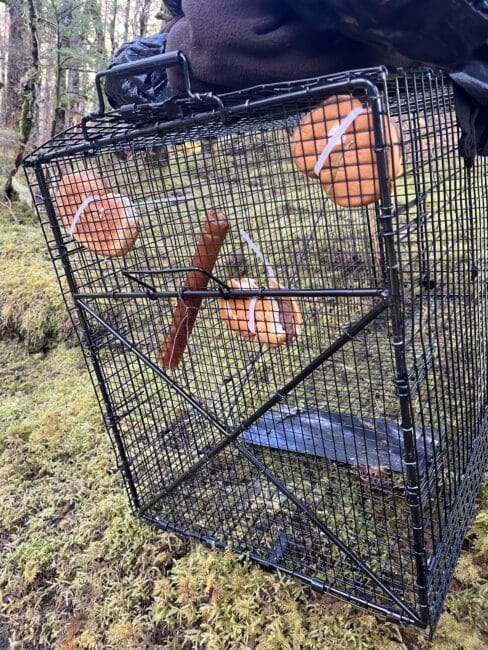
A trap baited with cheeseburgers sits waiting for Jackie. (Photo by Yvonne Krumrey/KTOO)

They won’t be able to leave bait out in the woods much longer. 

Jackie came up to Juneau from Los Angeles in January with two other dogs. They were slated for euthanasia to make room as devastating wildfires pushed more animals into shelters in the region. Thom’s wife Skylar Young-Bayer wasn’t going to let that happen. She convinced Juneau Animal Rescue to take three dogs from California. 

“And they’re like, ‘Sure, you know, we could probably do three or four, but someone needs to go down there and get them,’” she said. “And I’m like, ‘well, I’ll do it.’” 

Skylar brought Jackie and two other dogs up from shelters she said have a euthanasia rate of 30 to 40%. She works with these shelters to alert adoptees and foster networks when a dog is added to a list of potential euthanasias. The Young-Bayers adopted two of their own dogs from these high-kill shelter areas. 

Local families adopted all three dogs within a month, but Jackie slipped her collar on a walk the first day she was at her new home.

“And this is the thing: we all really underestimated Jackie,” Young-Bayer said. The cunning canine continues to evade capture. 

But despite her wiliness, Jackie doesn’t seem to be dangerous, Young-Bayer said. 

“She’s very scared and shy and sweet,” she said. “She’ll give you kisses. She doesn’t bite.”

And Jackie is resourceful. 

Each day, animal control hears reports of a couple of sightings of Jackie, but she’s always moved on by the time they get there, minutes later. An animal control officer nearly lured her by hand with a cheeseburger, but a passing jogger accidentally scared her off. 

So now, the Young-Bayers, alongside animal control officers, have been checking traps they set in the woods in the for her.

Jackie the German Shepherd in an undated photo. (Courtesy of Juneau Animal Rescue)

Rick Driscoll is the director of Juneau Animal Rescue, which also houses Juneau’s animal control officers. He said Jackie is shy and evasive, so people shouldn’t go out searching for her. 

“She’s not going to just walk up to you and let you put a collar or a leash on her,” Driscoll said. “So it’s best if they just report it to us.” 

He said if anyone sees Jackie during the day, they should call JAR. 

Driscoll said he’s worried about her. 

“She’s the biggest thing that’s on my mind, as the executive director of JAR,” he said.

He’s afraid she could be hit by a car, eat something poisonous, or just lose too much weight and become weak.

The couple that adopted Jackie misses her too. Eulaysia Rayne Bostrack said she felt a personal connection to the sweet dog she picked up. 

“I am from LA, I know about the fires and the life of the stray dogs down there,” she said. “I’ve seen it all, so I know what she’s been through.”

The community is showing it cares too. Bostrack said the night after Jackie slipped her collar, about 40 people helped search until the early hours of the morning. Bostrack has seen her dog twice since she went missing. 

“And both times, I kind of broke down because we didn’t get too much time with her,” she said.

Bostrack is hopeful that, with Juneau’s support, she can bring Jackie back home again — and keep her there, with added reinforcements. 

“I’m going to try and look into getting a three strap harness,” she said.

Juneau turns out to support queer and trans people in the wake of Trump policies

Daaljíni Mary Cruise, who helped organize the Unity for the Queer Community event, addresses those gathered on March 9, 2025. (Photo by Yvonne Krumrey/KTOO).

Members of Juneau’s LGBTQ+ community and the people who support them gathered in droves over the weekend to protest the Trump administration’s policies and language surrounding queer and trans people.

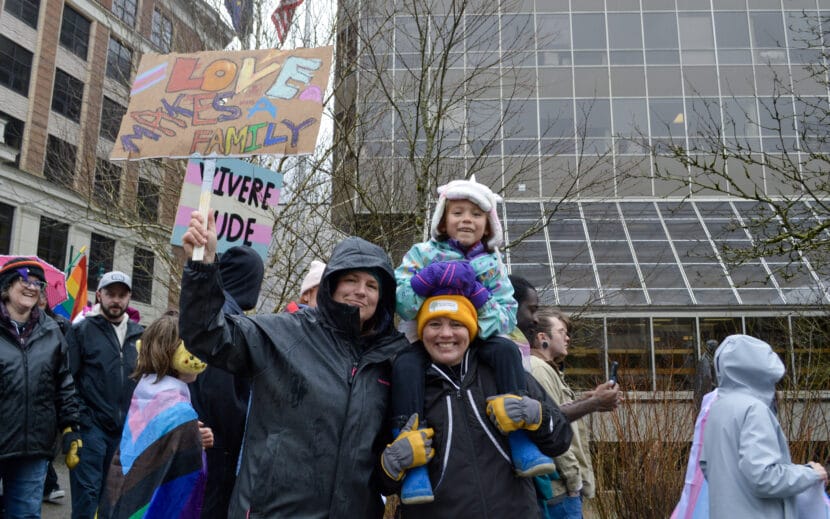
Over 200 people gathered at the Alaska State Capitol steps on Sunday to show their support for Juneau’s LGBTQ+ community with pride flags draped over shoulders and signs that said things like “Gender affirming health care is life-saving.” 

Organizer Daaljíni Mary Cruise said the event was planned to show Juneau’s young people that their voices matter, that they matter. 

“That’s the way we all need to be with our children,” she said. “We need to teach them it is okay to speak up against injustice.” 

Cruise said living as an out queer person, teaching Lingít and raising her kids to be accepting has felt like her way to support her community. But recently that’s changed. 

“That’s not enough anymore,” she said. “And it’s at this point where I feel like we have to stand up and we have to fight. We are going to have to fight hard, just like our ancestors who came before us.”  

She’s talking about policies and rhetoric pushed by President Donald Trump that endanger LGBTQ+ people across the country. Within 10 days of his return to the White House, Trump banned gender-affirming health care for youth, against recommendations by the American Academy of Pediatrics.

The administration’s moves have left queer and trans people in fear. 

But as the demonstrators prepared to march through downtown to Elizabeth Peratrovich Hall, Cruise said she wanted this event to be fun, too – to shine a light on the community.

“I just want to bring joy to some of the darkest days of our lives right now,” she said. 

Sa.áax’w Margaret Katzeek, who works in mental health support, says coming together in times like this is necessary. 

“We heal in community. This is where the healing comes from – showing up for each other,” Katzeek said.

Wendi Siebold, her partner Ray Romberg, and their child marching at a demonstration to support Juneau’s queer and trans community on March 9, 2025. (Photo by Yvonne Krumrey/KTOO)

Wendi Siebold marched with her partner and daughter. She said they especially wanted to show up for Juneau’s transgender community, which she says is being “directly targeted” by Trump’s policies.

“I feel like Juneau as a whole understands the importance for protections for everyone,” she said.

The march through downtown was followed by drag performances. At Elizabeth Peratrovich Hall, booths full of resources and pride flags awaited the demonstrators.

Kids like Silje Haven Marr waited in line to have their faces painted with glitter. 

“We’re all people and like, if we’re different, like, it’s not a big thing to be different,” Haven Marr said. “And this is an event to show people that it’s normal to be you, and it’s normal to be gay and stuff.” 

The Has Du Eetíx’ X’aakeidíx̱ Haa Sitee dance group performs for the Unity for the Queer Community event at Elizabeth Peratovich Hall in Juneau on March 9, 2025. (Photo by Yvonne Krumrey/KTOO).

Elizabeth Giudice, with the Southeast Alaska LGBTQ+ Alliance or SEAGLA, was standing on the other side of the line of booths. They said that anti-trans and anti-queer policy proposals aren’t new, but the political climate feels different now.

“Now that things are sort of in the forefront, people are afraid, because it seems like things are actually actionable,” Giudice said. 

But they said events like this one show that Juneau’s queer community won’t go into hiding. 

“When we get together, we see just how far we’ve come, just how close we can all be, and how out and how proud we can all be, and know that we don’t have to be as afraid as we have been,” they said. “And that’s progress.” 

A mostly youth dance group called Has Du Eetíx’ X’aakeidíx̱ Haa Sitee took the stage to perform songs, including one that Cruise wrote for this event. 

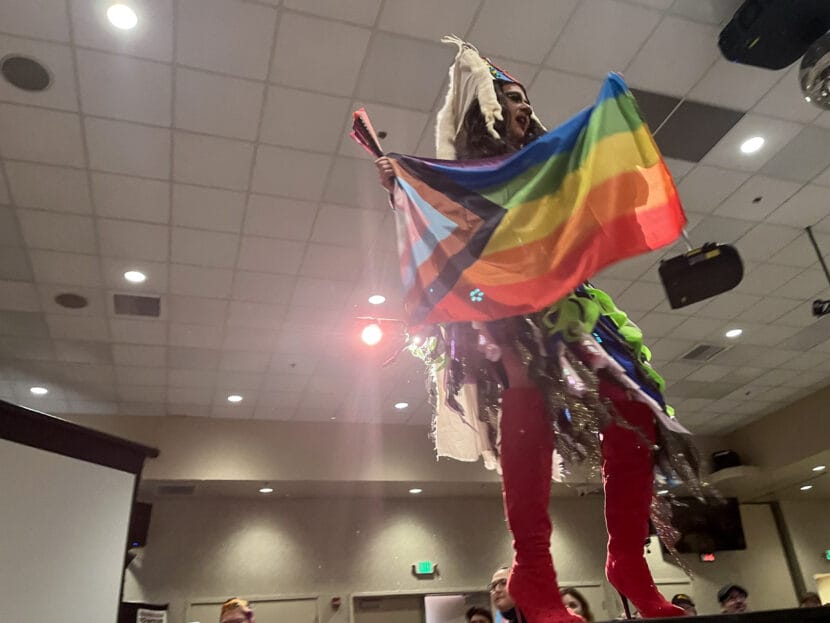
Lingít drag performer Lituya Hart Monroe joined dancers in an ermine pelt headdress, holding a pride flag.

The song is called “Ḵusax̱án Ḵusax̱ánx̱ Sitee” – love is love. 

“Through love, we will succeed,” the group sang in Lingít. “We have existed forever.” 

Lituya Hart Monroe dances to “Ḵusax̱án Ḵusax̱ánx̱ Sitee,” or Love is Love, written by Daaljíni Mary Cruise for the Unity for Queer Community event the on March 9, 2025. (Photo by Yvonne Krumrey/KTOO)

Lingít Word of the Week: Kaklahéen — Slush or Sleet

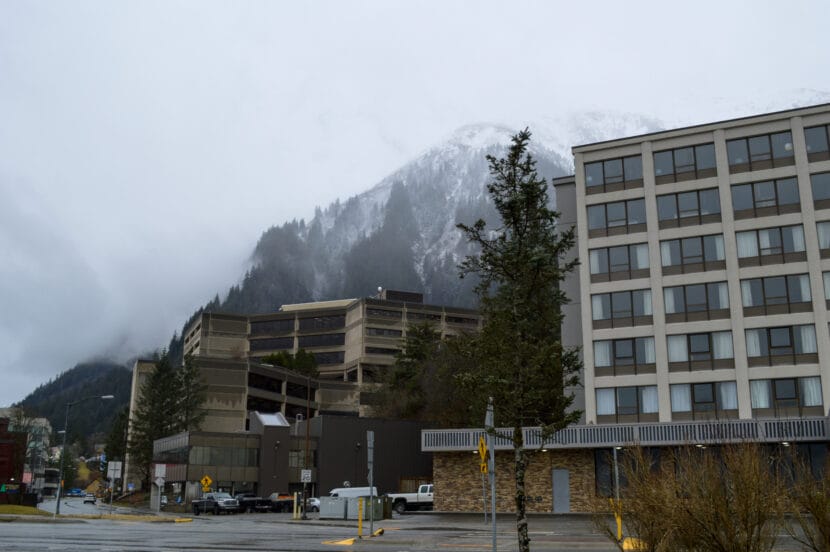
Downtown Juneau in the sleet on March 10, 2025. (Photo by Yvonne Krumrey/KTOO)

This is Lingít Word of the Week. Each week, we feature a Lingít word voiced by master speakers. Lingít has been spoken throughout present-day Southeast Alaska and parts of Canada for over 10,000 years.

Gunalchéesh to X̱’unei Lance Twitchell, Goldbelt Heritage Foundation and the University of Alaska Southeast for sharing the recorded audio for this series.

This week’s word is kaklahéen, meaning slush or sleet. Listen to the audio below to learn how to say kaklahéen.

The following transcript is meant to help illustrate the words and sentences. 

Keihéenák’w John Martin: Kaklahéen. 

That means slush or sleet.

Here are some sentences:

Keihéenák’w John Martin: Táakw.eetí áyá kaklahéen haa ḵaa daak wusitán.

In the spring sleet falls on us.

Keiyishí Bessie Cooley: Kaklahéen wé dleit.

The snow is slush.

Ḵaakal.áat Florence Marks Sheakley: Táakw eenxʼ áyá kaklahéen sitee yá dleit.

In the winter the snow is slushy.

Kaxwaan Éesh George Davis: Kaklahéen has du káa daak wusitán. 

It sleeted on them all. 

You can hear each installment of Lingít Word of the Week on the radio throughout the week. 

Additional language resources:

Find biographies for the master speakers included in this lesson here.

Learn more about why we use Lingít instead of Tlingit here.

Watch a video introducing Lingít sounds here.


Juneau nonprofit aims to hire fired Forest Service staff to maintain local trails, if it can raise the money  

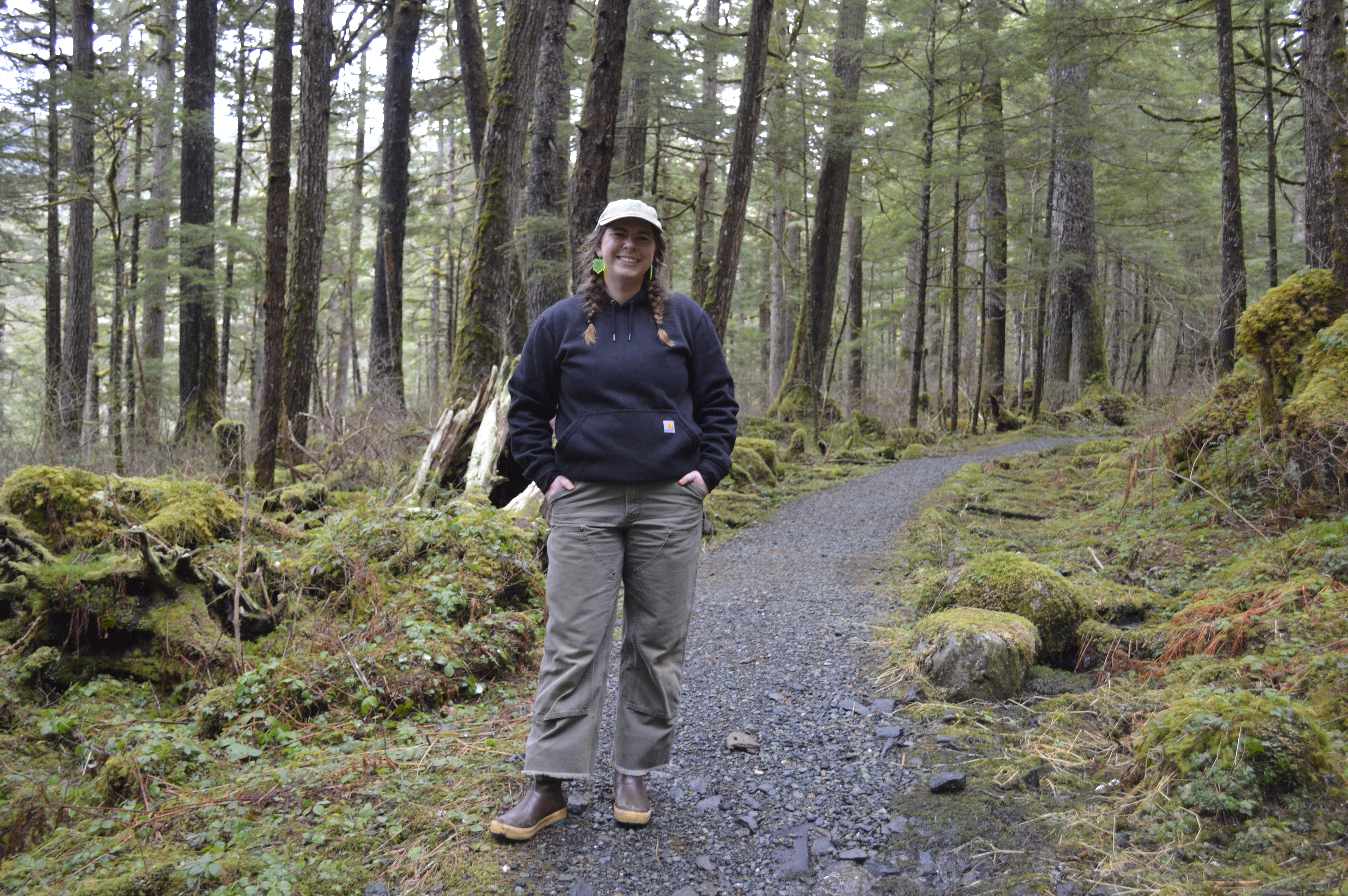
Trail Mix Inc. Director Meghan Tabacek stands on a recently-improved portion of Peterson Lake Trail in Juneau on Feb. 27, 2025. (Photo by Yvonne Krumrey/KTOO).

Juneau’s Peterson Lake trail is known for being a bit wet. It winds through muskeg to a lake, where a U.S. Forest Service cabin hosts overnight visitors. 

“The trail over time has just gotten soggier and soggier,” Trail Mix, Inc. Director Meghan Tabacek said. 

Trail Mix is Juneau’s trail maintenance nonprofit. While making her way down the part of the trail that her crews have been tending to, Tabacek pointed to some of the changes they’ve made. 

“The great thing about this job is there’s always no shortage of trails that need love,” she said.

The trail can be slow going on a rainy day — or most days in Juneau — with deep pools of rain and mud in between tree roots. There are sections of wood planks that have eroded and rotted in the 10 years since they were installed. Trail Mix has been replacing those with gravel. 

Peterson Lake Trail is one of many that Trail Mix’s trail crews have spent countless hours improving for Juneau residents. Now, the work may be on pause due to federal funding and job cuts. 

But Juneau’s trail maintenance nonprofit wants to hire fired U.S. Forest Service staff to make a new trail crew — if it can raise enough money to pay them.

The plan would allow skilled trail workers to continue their work this summer, after half of the Forest Service trail crews were fired last month by the Trump administration.

In the past, the organization partnered with Forest Service trail crews and had two of its own crews funded by the federal government dedicated to working on Tongass National Forest trails. 

In the recent federal firings, Juneau’s Forest Service crews were halved. And Trail Mix isn’t planning on being reimbursed for its work on Forest Service trails. 

Tabacek wants to keep those fired employees’ trail work skills in Juneau, and she said Trail Mix can be a landing place for those who lost their jobs. 

Still, she said, those jobs should be reinstated. 

“This is not an ideal situation for us, for anyone,” she said. “We understand and we know that the best place for federal workers is to continue being with the Forest Service.” 

Tabacek said, as she understands it, the Forest Service is planning to keep all remaining trail crews on cabin maintenance, leaving Trail Mix to maintain Juneau’s 250 miles of trail.  

But the organization’s remaining funding sources are funding city trails, not national forest ones. 

So Trail Mix is campaigning to fundraise $170,000 dollars — enough to hire five trail crew staff for the season. As of Thursday, community members have donated just under $12,000. Tabacek said she knows they have a long way to go, but she’s optimistic.

Nearly 90% of Juneau residents use the trails throughout the year, according to a 2016 City and Borough of Juneau survey

Juneau’s nine Forest Service cabins also see heavy use. After last month’s Forest Service firings, Quinton Woolman-Morgan’s crew is down to one person.

Quinton Woolman Morgan was fired from his U.S. Forest Service job in February, in a wave of federal firings. (Photo courtesy of Quinton Woolman Morgan).

“And you can’t do it by yourself,” he said. “The projects are just far too big.”

He maintained Juneau’s cabins for three seasons. He was fired last month, in a wave that suddenly left dozens of Juneau-based federal workers without a job. 

Woolman-Morgan said the job involves a lot of pumping out the bathrooms, among other maintenance.

“If a bunk bed is not fixed, or a staircase isn’t fixed, it’s kind of an unsafe thing,” Woolman-Morgan said. “And we’re always out there replacing windows, painting. Everything gets really weathered.”

The Forest Service hasn’t released a plan for how the work that was done by fired staff will be maintained. 

Out on the Christopher Trail near Gold Creek, Gooshdeihéen Ricardo Worl surveys the work he and his Trail Mix crew did last summer. He said the Tongass is an especially challenging place to build trails. 

“Southeast Alaska is both a beautiful and a really unforgiving and challenging place to build and maintain trail,” he said.

He’s an avid trail user in Juneau who’s worked on trails with Trail Mix for the past two summers.

Gooshdeihéen Ricardo Worl at the base of a closed bridge on the old Christopher Trail in Juneau on Feb. 28, 2025. Worl’s Trail Mix crew spent last summer building a new trail that will replace the bridge. (Photo by Yvonne Krumrey/KTOO)

But Worl said that hard work isn’t always noticeable to the people who regularly use the trails. 

“You know it’s done right when people don’t notice it,” he said. “When you can go about your daily life like, ‘Oh, let’s go into a cabin this weekend,’ and not have to second guess it.”

Worl grew up in Juneau — hiking, biking and skiing local trails  — and he said they are an integral part of Juneau’s community and culture. 

And trail work, he said, is essential. He hopes residents will step up to support it.

Pretrial delays leave everyone in Alaska’s court system waiting

Courtroom A at the Dimond Courthouse in Juneau on Dec. 11, 2024. (Photo by Yvonne Krumrey/KTOO).

In a Juneau courtroom in January, a man calling in from Lemon Creek Correctional Center begged to go to trial. Phillip Drummer was charged with a domestic violence assault in December of 2023. The prosecutor was ready for trial, too. Drummer’s “right to a speedy trial” timeframe was closing. 

But his defense attorney, Rex Butler, didn’t have any space in his schedule because of all his other cases. 

Juneau District Attorney Whitney Bostick, who is prosecuting the case, said if Drummer wasn’t willing to wait six weeks for his attorney, he could represent himself.

“Ms. Bostick raised the possibility, Mr. Drummer, of you proceeding pro se, without an attorney, in this matter,” presiding Judge Larry Woolford told the defendant.

Drummer didn’t like that idea. 

“Your honor, this is totally not fair to me. I don’t understand why the court won’t make sure that I’m adequately represented,” he said. “Here I am pretty much being forced to have to either represent myself or wait another two months in jail.” 

At the end of the hearing, Judge Woolford decided it would be best to wait. 

“I think the only thing that makes sense is to set this for a date-certain trial to start March 3,” Woolford said. 

Pretrial delays leave victims and defendants in limbo

This hearing was a snapshot of how pretrial delays have affected Alaska courts: victims, witnesses and defendants are often waiting years for a resolution, and their lives are put on hold in the meantime. 

It also leaves untried defendants – people accused of crimes but presumed innocent until found otherwise by the court – sitting in jail.

Anchorage Daily News and ProPublica reported in January that these delays amount to extreme wait times for felony trials. The average wait to resolve felonies has almost tripled in Alaska in the past decade, from just over one year on average to close to three years.

The Sixth Amendment to the U.S. Constitution says “In all criminal prosecutions, the accused shall enjoy the right to a speedy and public trial, by an impartial jury.”

It has two time limits: that an indictment, when a grand jury formally accuses the defendant of the crime, or an arraignment, when the defendant is told of what they are being charged with, must happen within a month of arrest, and that a trial must start within 120 days of the indictment or arraignment.

But the Constitution also allows for exceptions. 

Roughly half the people sitting in Alaska prisons are awaiting trial. It’s been that way for several years now – especially after the pandemic halted most jury trials for two years. 

Thatʼs about 2,000 individuals who are legally innocent. And according to the Alaska Department of Corrections, incarceration costs the state $200 per person per day. It costs the state roughly $400,000 per day to incarcerate people who have yet to be convicted. 

In February, more than half of the inmates in Juneau’s Lemon Creek Correctional Center hadn’t been sentenced yet. 

Alaska courts’ response to ‘extraordinary’ delays 

In her State of the Judiciary address last month, Alaska Chief Justice Susan Carney acknowledged the extremely delayed cases highlighted in recent media coverage. 

“The delays in those cases are extraordinary,” she said.

She said C and B level felonies — the kind Drummer has been charged with — typically resolve within 10 months. Since his initial arraignment, Drummer has waited about 14 months. 

Carney said Alaska’s court system is  working to limit pretrial delays. 

“Presiding judges in each judicial district have issued orders limiting the number of continuances in a case and limiting the number the entire time that a case can be delayed absent truly extraordinary circumstances,” she said. 

Overburdened defense attorneys … or intentional delays?

Meanwhile, Drummer’s Anchorage-based lawyer, Rex Butler, has over 300 active cases across the state. He says his caseload is so high because he takes on cases that the state’s Public Defender Agency can’t represent due to conflicts of interest, like Drummer’s. 

Butler sometimes gets cases that have been in the court system for a few years already. 

“We pick up the case file, and now the file is on fire,” he said. 

Even though the case is new to Butler, the court is eager to see it resolved.

He said that sexual assault and domestic violence cases have become a lot more complex in his 40 years as a defense attorney. 

Felony cases take a lot longer to prepare for, with the risk of conviction carrying greater consequences, and they don’t move through the trial system nearly as quickly.

That causes them to pile up on attorneys’ desks. 

“The practice of criminal law has gotten much more complicated, involved and it’s tedious,” Butler said. “It’s always been very emotional.”

Butler says fewer and fewer lawyers want to take on cases that involve alleged heinous crimes, like murder and sexual assault. 

According to Juneau’s District Attorney Whitney Bostick, delays make it harder for prosecutors to prove to a jury “beyond a reasonable doubt” that a defendant committed a crime.

“In general, the state’s ability to prove a case becomes more difficult the longer the case is delayed,” she said.

She said witnesses get frustrated with delays, or their memories fade. Sometimes, witnesses die before a case reaches trial.

Some cases now take more time to both defend and prosecute, Bostick said, as technological advancements mean many cases have more evidence than they did even 10 years ago.

The ADN/ProPublica investigation found that, in some instances, pretrial delays are a tactic on the part of a defense team to stall a case so witnesses’ memories fade.

And, Bostick said, these delays take a toll on the victims. 

“They’ve gone through the unthinkable, and every time there’s a hearing, whether it be a bail hearing or a continuation of the case,” she said. “It brings that trauma that they experienced back front and center.”

Sometimes, victims don’t want to continue with the case after years of delay, she said. They lose hope. 

Phillip Drummer – the defendant who was begging to go to trial –  has multiple previous assault and DV charges starting in the late 1990s. In this case, though, he hasn’t been found guilty. 

And he’s still in jail in the meantime, even though he’s not serving a sentence.

For now, Drummer’s case continues in court limbo. His eleventh pre-trial conference is scheduled for March 28.

Correction: an earlier version of this story incorrectly reported the amount of time a trial must start under Rule 45 in Alaska. 

Juneau’s Forest Service trails may be without maintenance this year

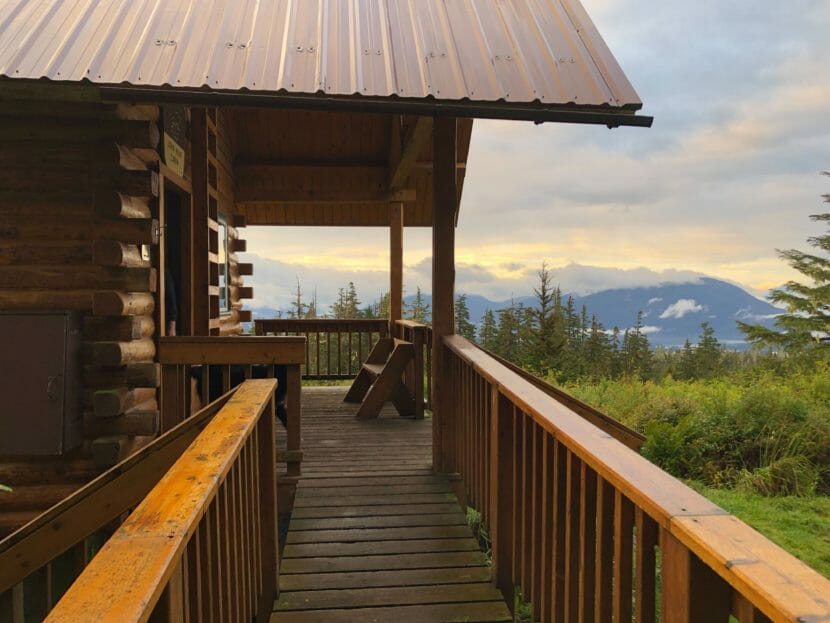
John Muir Cabin near Auke Bay on Sept. 16, 2022. (Photo by Yvonne Krumrey/KTOO)

Juneau’s trail maintenance nonprofit won’t be maintaining Forest Service trails this season, unless it can crowd-source funding for a new trail crew. 

That includes maintenance on access trails to heavily-used cabins at Peterson Lake, Dan Moller and Windfall Lake. 

Leaders of Trail Mix, Inc. made the decision to reallocate their Forest Service crews to other work, because they say they may lose the federal funding that pays them.

Half of the organization’s summer trail crews are funded by Forest Service grants. With instability at the federal level, Executive Director Meghan Tabacek said she doesn’t want to risk not being able to pay those workers. 

“I don’t ever want to be in a situation where we can’t pay our employees,” she said. “That’s just not how we do business here.”

Trail Mix usually gets about $420,000 annually in federal funding. Usually, the Forest Service pays Trail Mix during or after the season.

Tabacek says the funding comes from two sources: the Great American Outdoors Act, a 2020 act that funds improvements to recreation areas on federal land, and Alaska Forest Service fees from the Mendenhall Glacier Visitor Center and cabin use that get deposited back into trail work.

The city has long partnered with Trail Mix for trail upkeep. George Schaaf leads the City and Borough of Juneau’s Parks and Recreation department and said they are one of Juneau’s greatest assets. 

“The trails make Juneau, Juneau,” he said. “It’s a huge reason I think a lot of us chose to come here, chose to stay and a lot of why people who grew up here also stay or come back.”

And, he said, the federal funding cuts could mean Juneau has to spend a lot more money in the future to maintain certain trails.

“If you keep up on the periodic maintenance, your cost over the lifetime is going to be a lot lower,” he said. “But if you don’t maintain what you have, you’re going to end up spending a lot of money all at once to try to get it back.”

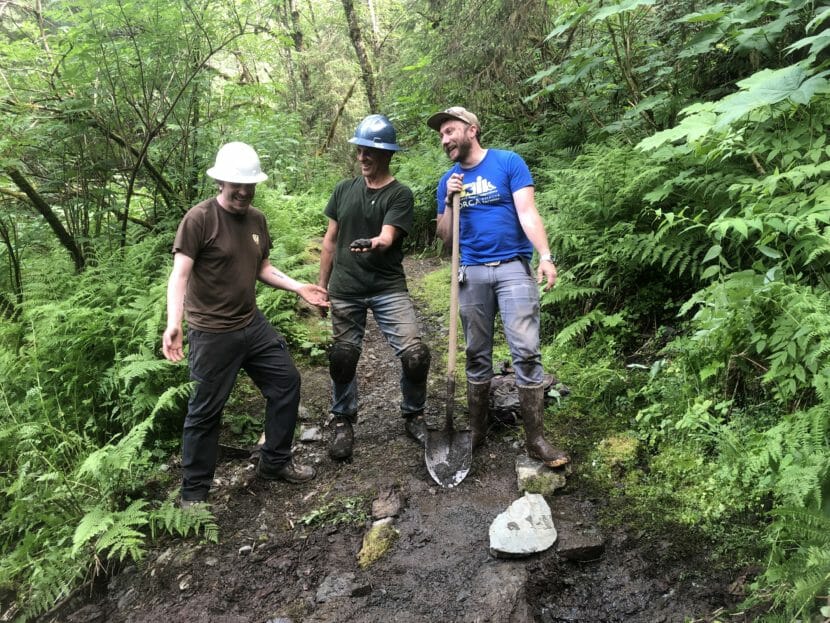
Trail Mix, Inc. staff member Laib Allensworth and volunteers Dave Haas and Dan Parks working on Lemon Creek Trail. June 4 2022. Photo by Yvonne Krumrey/KTOO

Trail Mix’s Tabacek said the federal funding agreements haven’t been canceled yet. But she fears they could be because federal funding across the U.S. has been slashed, leaving many nonprofits without previously-guaranteed money to operate.  

“We’re just incredibly nervous to have the federal government as a business partner right now,” Tabacek said. “Agreements and grants that people thought were set in stone are being lost, left and right.”

Trail Mix has already hired its crews. Tabacek said Trail Mix now has to find other ways to pay for about half of its staff, and hopes to secure funding from the city. But she said those funding sources would pay only for work on city trails, not Forest Service trails.

That’s why the nonprofit is raising funds to hire a new crew made up of fired Forest Service staff. That crew could be tasked with maintaining Forest Service trails – roughly 40% of Juneau’s trails, she said. 

“It’s the people who use trails that are going to feel this, you know,” Tabacek said. “And obviously our staff are feeling it, and the staff of the Juneau Ranger District are feeling it as well. But this really has eliminated a lot of ways we work on Forest Service trails and to maintain these trails that we love.”

The fundraiser’s goal is $170,000, and Tabacek said the organization has about a month to raise that amount before trail work begins. And she said this year is a good year to volunteer. 

Site notifications
Update notification options
Subscribe to notifications