"Through my reporting and series Tongass Voices and Lingít Word of the Week, I tell stories about people who have shaped -- and continue to shape -- the landscape of this place we live."
STA staff and volunteers distribute herring eggs on branches after the 2020 subsistence harvest. (Photo by Berett Wilber/KCAW)
This is Lingít Word of the Week. Each week, we feature a Lingít word voiced by master speakers. Lingít has been spoken throughout present-day Southeast Alaska and parts of Canada for over 10,000 years.
Gunalchéesh to X̱’unei Lance Twitchell, Goldbelt Heritage Foundation and the University of Alaska Southeast for sharing the recorded audio for this series.
This week’s word is g̱áax’w, or herring eggs. Listen to the audio below to learn how to say g̱áax’w.
The following transcript is meant to help illustrate the words and sentences.
Ḵaakal.áat Florence Marks Sheakley: G̱áax’w.
That means herring eggs.
Here are some sentences:
Ḵaakal.áat Florence Marks Sheakley: Ḵaa jéexʼ kei naldzée yaa yá g̱áaxʼw.
It is getting difficult for people to get herring eggs.
Keihéenák’w John Martin: Tsaa eex̱i tín áwé dux̱áa nooch g̱áaxʼw.
Four A’s testing outreach (Photo Courtesy of Alaskan AIDS Assistance Association, also known as Four A’s)
The Trump administration announced Thursday it would shrink U.S. Department of Health and Human Services staff by almost a quarter, and has suggested that it will dissolve the Centers for Disease Control and Prevention division that focuses on HIV prevention.
Amid the uncertainty, Alaska organizations aren’t sure if the federal funding they rely on will still exist. One of those organizations is the Alaskan AIDS Assistance Association, or Four A’s.
Its director, Robin Lutz, said losing federal funding could make the AIDS epidemic get much worse in Alaska — and more deadly.
“We have the opportunity to end the epidemic,” Lutz said. “We will not be able to do that if this administration continues to act in the way it has.”
In her nearly 30 years working with HIV-positive people, Lutz has seen major improvements to awareness, prevention and treatment of HIV and AIDS. But she says losing federal grant funding means the state would lose progress in fighting the disease.
The nonprofit helps Alaskans who are HIV-positive with housing and access to life-saving medication. It also helps people get tested to know if they are HIV-positive, which helps curb the spread. Roughly 700 people are living with HIV in the state. Threats to Medicaid could further endanger Alaska’s HIV-positive population.
The Trump administration plans to cut the federal health department by nearly 25 percent. Local organizations say there has been little to no information about the impact these changes will have on federal grants.
“Over a third of people living with HIV in the state don’t have the resources they need and deserve to manage their health without support, and it’s basically economic support,” she said.
And Lutz said Alaska is a uniquely difficult place to access HIV testing and prevention medications. Accessing preventative care is already a challenge for Alaskans, due to misinformation and stigmatization of HIV.
Ed Schoenfeld and Betsy Longenbaugh research old true crime stories in Southeast Alaska together at the Alaska State Archives on March 7, 2025. (Photo by Yvonne Krumrey/KTOO)
This is Tongass Voices, a series from KTOO sharing weekly perspectives from the homelands of the Áak’w Kwáan and beyond.
A retired couple in Juneau has picked up an interesting hobby — researching true crime stories in Southeast Alaska’s history. Betsy Longenbaugh and Ed Schoenfeld host walking tours and talks, and Longenbaugh has turned the research into two books, with another in progress.
Her first work of fiction, Death in the Underworld, is based on a crime committed in Douglas in 1916. And they have two upcoming presentations — called Death with Dessert — in April and May.
Betsy Longenbaugh: Our daughter, when we talked about Alaska’s first serial killer, made a cheesecake with a cereal crust. So she’s very deliberate about choosing, choosing the desserts and tailoring them to our presentation.
Ed Schoenfeld: We had a story about dismemberment and dismemberment, and she created a dismembered lemon meringue pie.
Betsy Longenbaugh: I’m Betsy Longenbaugh.
Ed Schoenfeld: I’m Ed Schoenfeld.
Betsy Longenbaugh: Well, both of us retired. We’ve been retired now for somewhere between six and seven years, and our passion after we retired, very unexpectedly, became looking into historic murders in not just Juneau, but some of the other communities in Southeast Alaska.
Ed Schoenfeld: And we call our effort True Crime Alaska, because everybody needs to be branded, right? And we research historic true crime. And it’s not just to do blood and guts, you know, like so much of the true crime reporting is these days, but we really like to talk about what’s going on in the community, and it really gives you a window into a community at a different point of time. I mean, Juneau in 1904 or, you know, Tenakee in the 1930s.
Betsy Longenbaugh: 1906, to be precise.
Ed Schoenfeld: And beyond that, it also just gives us a chance to talk about not only the particular cases, but how the justice system worked, how the community responded to times of crisis, which, in a small town, a murder generally, is a crisis.
And also to examine how the judicial system, the police, etc, responded to crimes against women and people of color, because obviously there was a lot of discrimination in those days.
Betsy Longenbaugh: But also how the media covered it. I mean, one of the things that have been interesting and frustrating is when we do our research, we know that there are Alaska Native women and men being killed. There’s very little coverage about them in the newspapers. There might be an account that it happened. But often it’s not much more than a name or two and maybe a charge.
In my second non fiction book, I just wrote a piece about a murder that happened in Petersburg, it was a horrible murder. It was a woman and child, and you would think it would have been a very sensational story that got a lot of coverage, but they were Chinese and their killer was Japanese, and they were all cannery workers. So there was actually very little coverage about the crime itself, even in Petersburg, where it happened.
Because we rely so heavily on newspapers as a resource for research, it’s upsetting and a little frustrating when the newspaper turns a blind eye to really these terrible things that are happening and we can’t get a handle on it.
We’re basically dealing with stories that don’t involve it, involve any live witnesses in all. But one case, the new book is going to have a story that happened in Sitka in the late 1950s and I actually was able to talk to two witnesses to that case, simply because I grew up in Sitka. So I was able to sort of track down these old timers, one of a former nurse who just turned 100 and was sharp as a tack and really helpful in the story.
So not having people who were there, having to rely on all third hand resources, so not having live witnesses, and then trying to figure out bits and pieces of clues. I had a story that I just wrote about a killing down in Ketchikan, and I thought I had a pretty good handle on it, until I contacted my source in Alcatraz. I have a guy I worked with named Gregory Schmidt, who works for the archives down in San Francisco, and he sends me these amazing resources from Alcatraz.
And when he sent that, I realized that most likely this man had not actually done the crime, based on what happened during his parole hearings and his behavior in prison, where he spent most of the rest of his life.
Finding those little bits and pieces, and sometimes big bits and pieces, is really the fun part. Again, it’s the puzzle, right? It’s figuring out.
Ed Schoenfeld: And sometimes we just have a feeling that there’s something missing that maybe we can find if we dig deeper. And it’s the same as when you’re reporting, you think you have the story, but you’ve done enough of this to think there’s something else going on here we should know about.
And sometimes we, pretty much, you know, decide not, not to include something in a book or presentation, because we’re just not sure. Usually we’re able to figure it out one way or the other.
Betsy Longenbaugh: We’ve been very clear about drawing the line at statehood, because when we initially did this work, not the writing, but the walking tours, we included some cases that Ed had covered as a reporter and that I was familiar with. And it became too traumatic, not just for us, but for the people who were hearing the stories.
I remember walking to her where we were talking about a contemporary murder was not, I don’t know, 25-30 years ago, but one of the people on the tour had taught the defendant in grade school. And another tour, we’d had somebody who’d served on the jury.
And I’m from a little town, you know? I’m from Sitka and I know how these things haunt communities. They really haunt communities. And we didn’t want to be participating in that haunting.
We wanted to be able to talk about stories where, as I like to put it, everybody would be dead anyway. Because it takes away that immediacy and the trauma, and I think the trauma and sadness of the murder, which are always just really heartbreaking, is balanced by telling more about their story and Ed likes to think of it as bringing names to the fore that have been long forgotten. The first book is Forgotten Murders. And it’s not just forgotten murders, in my mind, it’s forgotten victims.
Ed Schoenfeld: And the other way we kind of balance out this horrible stuff is we talk a lot about the history of the community and just of trends.
Betsy Longenbaugh: It’s actually the first fiction I’ve ever written. It’s based on a historic case that happened in Douglas in the early 1900s but I found that case very difficult to look into. It’s a very upsetting case in so many ways, and so when I fictionalized it, I found it, I was able to come up with a much more satisfying end.
And also explore some of the pieces of that story that we discovered when we were doing research on the original piece, which is that the victim was part of a sex trade operation that operated in Buenos Aires between the 1870s and World War Two. It was very well known, and their books about it, and this woman happened to have been part of that and was killed by her procurer, and who they were unable to convict.
So in my story, there’s a lot more twists and turns, but it’s sort of based generally around this historic crime.
Ed Schoenfeld: And there’s as much research that went into this, I think, just plus the imagination, and Betsy is a wonderful writer. But you know, if we wanted to find out, well, how much beer cost, because there’s bar scenes, not sure if we use that, but.
Betsy Longenbaugh: Well, I found out a lot about too about how federal marshals worked and coroner’s juries, which I’d been learning more about, but to write about those in a fictional piece was just different. So I really, really, really enjoyed writing it. It was just really super fun, because I was able to, I think, create some strong female characters.
So this the story, as it turns out, sort of centers around these very strong women who are trying to protect themselves from a ruthless killer who’s already killed one of their friends, and sort of how they protect themselves and the world of Juneau at the time of 1916.
You can find information about their talks and books at truecrimealaska.com.
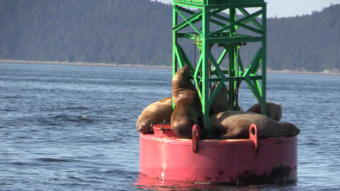
Harbor seals rest on ice near South Sawyer Glacier in 2007. (Photo courtesy NOAA’s Alaska Fisheries Science Center)
This is Lingít Word of the Week. Each week, we feature a Lingít word voiced by master speakers. Lingít has been spoken throughout present-day Southeast Alaska and parts of Canada for over 10,000 years.
Gunalchéesh to X̱’unei Lance Twitchell, Goldbelt Heritage Foundation and the University of Alaska Southeast for sharing the recorded audio for this series.
This week’s word is tsaa, or seal. Listen to the audio below to learn how to say tsaa.
The following transcript is meant to help illustrate the words and sentences.
A rock painted like an octopus by Heather Stemmerman (Photo by David Purdy/KTOO)
This is Lingít Word of the Week. Each week, we feature a Lingít word voiced by master speakers. Lingít has been spoken throughout present-day Southeast Alaska and parts of Canada for over 10,000 years.
Gunalchéesh to X̱’unei Lance Twitchell, Goldbelt Heritage Foundation and the University of Alaska Southeast for sharing the recorded audio for this series.
This week’s word is náaḵw, or octopus. Listen to the audio below to learn how to say náaḵw.
The following transcript is meant to help illustrate the words and sentences.
Kooshdáakʼu Bill Fawcett: Náaḵw.
That means octopus.
Here are some sentences:
Kooshdáakʼu Bill Fawcett: Daa sáwé aan yeedanáḵw? Há náaḵw áyá.
What are you baiting with? Oh, it’s octopus.
Keihéenák’w John Martin: Náaḵw tsu haa atx̱áayix̱ sitee.
Octopus is also our food.
Keiyishí Bessie Cooley: A tlʼeiḵ káx̱ yaa kdag̱wátʼch, náaḵw.
The octopus is crawling along on its tentacles.
Ḵaakal.áat Florence Marks Sheakley: Náaḵw dutáax’in.
People used to bite octopus.
Kaxwaan Éesh George Davis: Náaḵw du ḵoowú tóodáx̱ daak wujiḵáḵ.
The octopus crawled out of it’s den.
You can hear each installment of Lingít Word of the Week on the radio throughout the week.
The family of Tracy Lynn Day, a Lingít woman who has been missing since 2019, at a Missing and Murdered Indigenous Peoples vigil on March 13, 2025. (Photo by Yvonne Krumrey/KTOO).
Juneau community members gathered for a candlelight vigil for Missing and Murdered Indigenous People on Thursday.
It was a space for healing after the remains of a missing Indigenous teenager were found in Arizona last month. That loss touched an emotion that crosses state boundaries — the loss that Indigenous communities everywhere feel about their relatives who were victimized by violence.
“We will never stop saying their names,” said Xeetli.éesh Lyle James, Lingít advocate and leader.
A fire crackled as dozens of people gathered under a lunar eclipse at the Kaasei Healing Kootéeyaa, a totem pole that represents healing from gender-based violence. James read the names of Indigenous women and children who have been murdered, or disappeared.
“The most recent: repeat after me, Emily Pike. Say her name,” James said.
Emily Pike was 14 years old when she went missing from her group home in Arizona in January. Her dismembered remains were found a month later.
This tragic story isn’t an uncommon one. Indigenous women and girls in the United States are three times more likely to be murdered than white women and girls. For that reason, the news touched members of the Juneau community, who gathered to honor, remember and heal.
Advocates and community members gather to mourn recent and ongoing cases of Missing and Murdered Indigenous Peoples at a vigil on March 13, 2025. (Photo by Yvonne Krumrey/KTOO).
“We’ve always known this: that when we speak their names, they’re standing with us,” James said.
Kaelyn Schneider is Day’s daughter. She said the kootéeyaa is a space for the families of missing and murdered Indigenous people who don’t have answers.
“There are so many family members that, like my mom’s case, we don’t have a grave site,” she said. “We have nowhere to mourn our loved one, you know. So I think this is really special.”
She said hearing her mother’s name lets her know that people in Juneau haven’t forgotten about her.
James introduced a song called “I x̱’ádudlitseen” – it means “you are precious.”
“All of you standing here this evening are precious,” he said. “All our loved ones that we lost too early, they are precious.”
Attendees holding drums got ready for the song, and he taught the words before it started, so the group could sing loudly together. He invited all to dance.
“And when you dance, stomp it into the ground, because we are tired of all our relatives disappearing and no explanation, no justice for our loved ones,” James said. “We are their voices. You are their voices. You are their strength.”
The kootéeyaa was carved by Master Carver Wayne Price. It was raised in 2022 at Twin Lakes to be a symbol of healing from domestic violence and child abuse.
“It’s a totem that probably shouldn’t ever have to be built,” Price said Thursday.
Corlé LaForce puts a cedar chip in the fire at a Missing and Murdered Indigenous Peoples vigil on March 13, 2025. (Photo by Yvonne Krumrey/KTOO).
Later, people burned cedar chips in a small fire. Price carved the chips out of a dugout canoe. Organizers said each one represents a victim of violence. He said the fire was meant to heal the community — and he said he thinks it will.
“You know, that’s why we’re here, because we believe it’s going to work,” Price said.
Close
Update notification options
Subscribe to notifications
Subscribe
Get notifications about news related to the topics you care about. You can unsubscribe anytime.