Yvonne Krumrey

Justice & Culture Reporter, KTOO

"Through my reporting and series Tongass Voices and Lingít Word of the Week, I tell stories about people who have shaped -- and continue to shape -- the landscape of this place we live."

Tongass Voices: Author Tessa Hulls on feeding her family’s ghosts

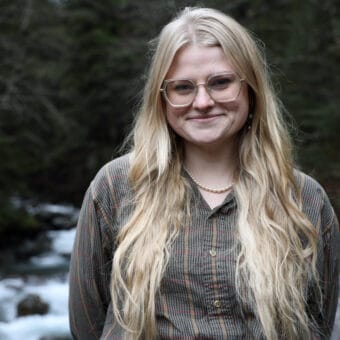
Artist and author Tessa Hulls published the graphic memoir Feeding Ghosts last year. It chronicles her family’s history with political oppression and mental illness. (Photo courtesy of Tessa Hulls)

This is Tongass Voices, a series from KTOO sharing weekly perspectives from the homelands of the Áak’w Kwáan and beyond.

Tessa Hulls has worked a lot of jobs, biked a lot of miles, and lived a few different lives in and outside of Alaska. A part of her was running from something.

But she spent the last decade turning to face it by writing a graphic memoir about her family’s history. The memoir is called Feeding Ghosts, and it’s won three national awards.

The following transcript has been lightly edited for clarity.

Tessa Hulls: I have always been somebody who wrote. You know, I was one of those kids where, from the age I could shove a crayon up my nose, it was clear I was going to be a writer and an artist. And there’s not any route I could have taken that would have allowed me to escape that. 

My name is Tessa Hulls. I am an artist, writer and adventurer who drew and wrote the graphic memoir Feeding Ghosts. 

And yeah, my grandmother, Sun Yi, she was a journalist in Shanghai during the communist takeover, and she ended up on the wrong side of political history, so she was labeled a dissident and was arrested and put through Maoist era thought reform. And for her, writing was the way in which she tried to assert her own reality, even as she watched the government take over and deny everything that was happening.

And it was something that was both her liberation, but also ultimately what broke her mind, because after she and my mom fled China as political refugees, they went to Hong Kong, and my grandma wrote a memoir about eight years of living under the communist regime, and then, unfortunately, had a mental breakdown, and she never really regained her sanity, and she spent the rest of her life trying to rewrite the story that had been taken from her.

Yeah, well, I think when I first started the book, I was really determined to not talk about any feelings. It was just going to be about history. I was not going to be a character in it. And once I was able to commission a translation of my grandmother’s memoir, because it was written in Chinese and never translated into English. So when I opened it and finally read her book, it was kind of the first time that I ever heard her voice, because even though I grew up with her and my nuclear family, we had a language barrier, and she was also heavily medicated on antipsychotics. 

So when I started reading this book that she had written as a political refugee in her 20s, I just immediately went “Oh no,” because I knew suddenly the scope of what I was trying to do had become infinitely more complicated, and the book was going to have to contend with the question of, ‘what is truth?’ when you’re working with both an unreliable mind and a government that is dismantling reality all around you. 

I didn’t feel like I had a choice. My family ghosts literally told me I had to do this. 

So I would spend full summers working in Alaska, and then would freelance as an artist and writer in Seattle in fall and winter, and then spend two months alone on a solo bikepacking trip.

And I was doing it in a way that felt really authentic to what I needed, but I also was well aware that I was running from something. 

And so I was on one of these bike trips kind of realizing that this chapter of my life where I was just hoarding my own wonder had come to an end and that I needed to step into a different kind of responsibility. 

 And so I was biking alone up a mountain and so I said, “Okay, if this chapter is done, what comes next?” And the landscape opened up and spoke to me and said, “Someone has to feed the ghosts.” And my book is called Feeding Ghosts, because that was the beginning of this nine year process of really stepping into something that was my family duty. 

And as I got towards the end of the story, you kind of get contemplative about,” Well, what did I learn, really, along the way?” And I think the process of drawing and writing this book was really me learning how to render both my mother and my grandmother in two complex, three dimensional characters. And in order to do that, I had to draw them from every angle.

And I wrote about my grandmother saying that it’s much easier to call someone crazy than it is to contend with how deeply they’ve been injured by the past. 

And I think a lot of the things that we put the umbrella category of trauma on are really just instead coming from a refusal to look at the depth of rupture, and therefore the amount of work it would require for there to be genuine repair.

So the places where there weren’t clear answers, I forced that uncertainty on my reader and said, look, it’s kind of a choose your own adventure here, because there’s no way to actually discern what actually happened, and here are the competing narratives. And I leave it up to you to decide what path to take through it.

You can find Feeding Ghosts at Alaska Robotics, where Hulls will launch the paperback version with a party on May 6 at 5:30 p.m. 

Trial again delayed in sexual assault case against former Juneau chiropractor

Courtroom A at the Dimond Courthouse in Juneau on Dec. 11, 2024. (Photo by Yvonne Krumrey/KTOO).

The trial for a former Juneau chiropractor accused of assaulting more than a dozen patients has once again been delayed. It was scheduled to start this week, but was pushed back at a pre-trial conference because a member of the defense team is having severe health issues. The court plans to hear the case later this year. 

Police arrested Jeffrey Fultz four years ago on three charges of sexual assault. More women have come forward since. A total of 14 women, a majority of whom are Alaska Native, have now accused Fultz of assault.

The charges are based on accusations that he assaulted patients who sought chiropractic care while he worked for Southeast Alaska Regional Health Consortium. 

Some of the charges date back more than a decade. 

The case has seen years of delays in the pre-trial process. Now the court is attempting to set a trial date for the third time. The delays have left the alleged victims in limbo, waiting for justice.

At a pre-trial conference last week, Fultz’s defense attorney, Anchorage-based James Christie, reported that his co-counsel, Wally Tetlow, is experiencing life-threatening health problems and has been advised not to travel for at least one month. Christie argued that Tetlow’s in-person participation is vital.

“So I think, I think we’re in a position where there’s, there’s really, unfortunately, we have to identify a new window for a trial date,” Christie said.

State Prosecutor Jessalyn Gillum told the judge that her team opposes the delay. 

“Given the age of the case, the number of victims, and the fact that the victims have been very clear on wanting their day in court, the state is in no other – has no other choice but to oppose this request,” she said.

Gillum acknowledged Tetlow’s health concerns, but pointed to the fact that Tetlow is not the attorney named in the case for Fultz’s defense — Christie is. She argued that his inability to participate in person shouldn’t derail the trial schedule. 

This is not the first time that the health of the defense has delayed the trial. Fultz’s previous attorney had health problems that caused delays for the majority of a year.

Several other factors have also contributed to the long wait for a trail. The investigating Juneau police officer died, then the first judge assigned to the case retired, and later Fultz’s first attorney was deemed “mentally unable” to continue with the case. 

Victims have repeatedly said in hearings that each time they have to call in to advocate for the case to go to trial, it’s traumatizing.

Fultz has been out on bail, living in Colorado with some pre-trial monitoring since 2021. He appeared in court in person once last year. 

Judge Larry Woolford, who is presiding over the case, said he was reluctant to reschedule, after the dozens of witnesses had set aside time for what is expected to be a long and complex trial. 

“I mean, certainly the parties are aware that it has been the court’s intention that this matter would be ready to go on April 21,” he said. “And we have been, I think it’s fair to say, marching steadily, if imperfectly, toward that for some time now.”

But he said Tetlow’s emergency health issues are within the bounds of what constitutes an appropriate reason for further delays. 

“This is obviously not something anybody could have predicted nor prevented,” Woolford said. 

Woolford cited recent orders from the Alaska Supreme Court to limit delays in older court cases, and said this situation abides by those new rules as well. Under that order, the defense and prosecution can request delays for up to 90 days each, and a court can consider delays for up to 90 days for “good cause.” 

Multiple witnesses who called into a hearing last week said this delay will impact the prosecution.

“I just want to remind the court that there are 14 victims that have cleared the next five weeks to make this happen,” one alleged victim said. Victims who called in did not identify themselves by name. 

Another cited the disruptions this is causing her own life. 

“I’m a therapist, and have to cancel my clients,” she said. “And it, you know, that’s a big deal too.”

Woolford said in the hearing the court is willing to extend the case into the summer, and no further. 

“The windows that I’ve outlined strike me as a reasonable compromise between the unfortunate situation in which your team finds itself, and the, I think, compelling need to get this matter to trial,” he said.

But both the prosecution and defense expressed that their teams and witnesses may not be available for much of the summer. 

A hearing to determine a future trial schedule is set for April 28. 

Lingít Word of the Week: Laax̱ — Red Cedar

Haida artist and carver Nang K’adangáas Eric Hamar poses with a red cedar canoe hand-carved in the Native Village of Kasaan’s carving shed on Prince of Wales Island on May 9, 2024. (Jack Darrell/KRBD)

This is Lingít Word of the Week. Each week, we feature a Lingít word voiced by master speakers. Lingít has been spoken throughout present-day Southeast Alaska and parts of Canada for over 10,000 years.

Gunalchéesh to X̱’unei Lance Twitchell, Goldbelt Heritage Foundation and the University of Alaska Southeast for sharing the recorded audio for this series.

This week’s word is laax̱, or red cedar. Listen to the audio below to learn how to say laax̱.

The following transcript is meant to help illustrate the words and sentences. 

Keihéenák’w John Martin: Laax̱. 

That means red cedar.

Here are some sentences:

Keihéenák’w John Martin: Kootéeyaa aan dulyeix̱ yaa laax̱.

They make totem poles with red cedar.

Keiyishí Bessie Cooley: Laax̱ haawú litsʼáa.

Red cedar branches smell good.

Kooshdáakʼu Bill Fawcett: Deikeenaa aasí laax̱, ḵúnáx áwé xʼalitseen hé naakéexʼ.

It is a Haida tree, red cedar, it is really valuable here in the north

Ḵaakal.áat Florence Marks Sheakley: Ldakát át aan yéi daadunéi yá laax̱.

People work on red cedar for everything.

Kaxwaan Éesh George Davis: Laax̱ dax̱ dulyéix̱.

People use red cedar.

You can hear each installment of Lingít Word of the Week on the radio throughout the week. 

Additional language resources:

Find biographies for the master speakers included in this lesson here.

Learn more about why we use Lingít instead of Tlingit here.

Watch a video introducing Lingít sounds here.

Tlingit and Haida tribal assembly votes to limit number of delegates from outside Southeast Alaska

The Central Council of the Tlingit and Haida Indian Tribes of Alaska’s 90th tribal assembly meets in Juneau on April 18, 2025. (Photo by Yvonne Krumrey/KTOO)

Southeast Alaska’s largest tribal government approved a rule change Friday that greatly reduces the number of representatives from communities outside the region.

Delegates from places like Seattle and Anchorage say the amendment limits the voices from some of the largest communities of tribal members, but delegates from Southeast say this gives rural tribal members more of a voice. 

Friday was the last day of the Central Council of the Tlingit and Haida Indian Tribes of Alaska’s 90th tribal assembly in Juneau. The majority of delegates approved an amendment that reduces the maximum number of delegates from urban communities like Anchorage, Seattle and San Francisco to four delegates each. 

One of Sitka’s delegates, Gerald Hope, said a larger proportion of representation from tribal villages would show support to those communities. 

“The village communities are hurting really badly. How can we stand with them?” Hope said. “One of the things in this kind of form of government is to give them a modest increase in voice.”

The five-hour debate brought up questions of representation and belonging, and what leads people to leave their home communities. 

“Those of us who live in urban areas are there for things that are out of our control,” said Anchorage Delegate Tasha Hotch, who said she left Southeast because of domestic violence. 

“I’ve tried to move back to Juneau, I’ve tried to move back to Klukwan,” she said.

Other delegates who live in Anchorage and Seattle said that lack of opportunity and financial stability led them to leave their villages as well, but this shouldn’t limit their voice as tribal members. 

According to representatives from Tlingit and Haida, the amendment is part of a broader plan to review the structure of government to better reflect the tribe’s citizenry. 

It would also reduce Juneau’s delegation — and any within Southeast Alaska — to 20 people. Even with the reduction, Juneau will be allotted the most delegates in the assembly. 

Before the amendment passed, Seattle was tied with Juneau with 25 delegates that represent the community’s interests to the broader tribal government. Communities elected one delegate per 200 tribal citizens. But this resolution raises that threshold to 275 citizens. 

Seattle has the most enrolled tribal members of any community, with more than 9,000. Juneau has more than 7,000.

The resolution doesn’t propose any changes to tribal services in communities like Anchorage and Seattle, where Tlingit and Haida has offices, but the delegates that came from those communities said representation itself matters too.

Karen Elliott-Lauth, from Seattle, asked for more time to compromise on the resolution. 

“So I’m just asking you guys to table this,” she said. “Let’s get together and make solutions instead of being so divided, that’s all I ask.”

Wrangell Delegate Mike Hoyt grew up in Seattle, so he empathized with what tribal members from urban areas are feeling about the loss of their delegates. But he says it’s vital that voices in the villages are heard too. 

“I think what people are feeling, and the concerns that you guys have in terms of silencing of voices or having maybe a lack of that balance, is what the villages currently are feeling,” Hoyt said. 

Despite the emotional testimony, speakers expressed respect for the other delegates present.

The amendment passed 63 to 52, and it takes effect immediately.

Lingít Word of the Week: Yaana.eit — Wild Celery

Wild celery
Yéilk’ Vivian Mork points to a wild celery plant’s new leaves, which along with the stalks, are edible. She says the plant usually tastes best when new, young growth develops in the early spring. She recommends picking wild celery – sometimes known as cow parsnip – during cloudy, cool days to avoid an allergic skin reaction to the photosensitive chemical furanocoumarins that are part of the plant’s sap or found on the hairs. (Photo by Matt Miller/KTOO)

This is Lingít Word of the Week. Each week, we feature a Lingít word voiced by master speakers. Lingít has been spoken throughout present-day Southeast Alaska and parts of Canada for over 10,000 years.

Gunalchéesh to X̱’unei Lance Twitchell, Goldbelt Heritage Foundation and the University of Alaska Southeast for sharing the recorded audio for this series.

This week’s word is yaana.eit, or wild celery. Listen to the audio below to learn how to say yaana.eit.

The following transcript is meant to help illustrate the words and sentences. 

Kooshdáakʼu Bill Fawcett: yaana.eit. 

That means wild celery.

Here are some sentences:

Kooshdáakʼu Bill Fawcett: Ḵúnáx̱ áwé yak’éi wé yaana.eit.

Wild celery is very good.

Keiyishí Bessie Cooley: Yaana.eit náakw yáx̱ yéi du.oowún.

People used to use wild celery like medicine.

Ḵaakal.áat Florence Marks Sheakley: Yées yaa kana.éini áyá yakʼéi yá yaana.eit.

This is good, young wild celery is growing here.

Kaxwaan Éesh George Davis: Yaana.eit wutuwax̱áa.

We ate wild celery.

You can hear each installment of Lingít Word of the Week on the radio throughout the week. 

Additional language resources:

Find biographies for the master speakers included in this lesson here.

Learn more about why we use Lingít instead of Tlingit here.

Watch a video introducing Lingít sounds here.

Mendenhall Glacier Visitor Center plans for limited staffing for first cruise ship on Monday

Mendenhall Glacier Visitor Center on Friday, Dec. 15, 2023. (Clarise Larson/KTOO)

The U.S. Forest Service says it has a plan in place to staff the Mendenhall Glacier Visitor Center this tourism season. That comes almost two months after dozens of staff were fired amid federal downsizing. 

In a press release Thursday, the Forest Service shared their staffing plan for the Mendenhall Glacier Recreation Area. Five staff will be ready to greet the first cruise visitors of 2025 on Monday and the area will continue opening intermittently throughout the month.

By May 4, the visitor center will be open and staffed from 10 a.m. to 5 p.m. on weekdays and Sundays.

Since February, the Trump administration has cut thousands of federal jobs across the nation, including all but one staff member at the visitor center in Juneau. In a typical summer, there are about a dozen on site. 

Some of the fired staff have been rehired. But there is a chance they may lose their jobs again or accept a deferred leave offer as the federal government continues its quest to downsize.

U.S. Forest Service spokesperson Paul Robbins said the visitor center will be staffed most days cruise ships come to Juneau, with the exception of April 26. 

The release says the Forest Service presence at the glacier will be made up of staff from the Forest Service’s offices in Juneau, and those staff will be supported by employees with partner organizations like the Central Council of the Tlingit and Haida Indian Tribes of Alaska and Discovery Southeast, who already have a presence at the glacier. 

In addition to Forest Service employees, the tribe’s cultural ambassador program will have eight staff at the glacier Monday through Friday. 

Between these three organizations, the release says staff will be able to manage crowds, provide for visitor safety, maintain trails and facilities and manage bear encounters. 

The Juneau Assembly is considering a proposal to set aside $200,000 to help those partner organizations hire more staff for the visitor Center. 

While the visitor center will only be open on certain days, the recreation area will be open as usual, from 6 a.m. to midnight each day. The portable bathrooms outside the visitor center will be open at all times, and the bathrooms by the visitor center parking lot will be open from 8 a.m. to 7 p.m. each day.

Site notifications
Update notification options
Subscribe to notifications