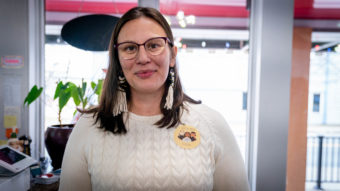
Yvonne Krumrey

Justice & Culture Reporter, KTOO

"Through my reporting and series Tongass Voices and Lingít Word of the Week, I tell stories about people who have shaped -- and continue to shape -- the landscape of this place we live."

Lingít Word of the Week: Atx̱aan Hídi — Smokehouse

Gene Carlson checks red salmon strips in his smokehouse. July 16, 2021. (Izzy Ross/KDLG)

This is Lingít Word of the Week. Each week, we feature a Lingít word voiced by master speakers. Lingít has been spoken throughout present-day Southeast Alaska and parts of Canada for over 10,000 years.

Gunalchéesh to X̱’unei Lance Twitchell, Goldbelt Heritage Foundation and the University of Alaska Southeast for sharing the recorded audio for this series.

This week’s word is atx̱aan hídi, or smokehouse. Listen to the audio below to learn how to say atx̱aan hídi.

The following transcript is meant to help illustrate the words and sentences. 

Kaxwaan Éesh George Davis: Atx̱aan hídi. 

That means smokehouse.

Here are some sentences:

Kaxwaan Éesh George Davis: Atx̱aan hídi áx̱ ashayaawatée du xaadí. 

He hung his fish in the smokehouse.

Keihéenák’w John Martin: Lingít x̱áat has ax̱ʼán nooch atx̱aan hídi ax̱ has aléiyix̱.

People always make dry fish in the smokehouse by putting it up high.

Keiyishí Bessie Cooley: Atx̱aan hídi yeix̱ ashaayawatee wé tʼá.

They hung up the king salmon in the smoke house

Kooshdáakʼu Bill Fawcett: Ḵúnáx̱ áwé ya’kéi wé x̱áat atgaxtoox̱’aan atx̱aan hídi.

It’s very good, the fish that was smoked in a smokehouse. 

Ḵaakal.áat Florence Marks Sheakley: Atx̱aan hídixʼ yakʼéi wé sʼeiḵ.

The smoke used in smokehouses is good.

You can hear each installment of Lingít Word of the Week on the radio throughout the week. 

Additional language resources:

Find biographies for the master speakers included in this lesson here.

Learn more about why we use Lingít instead of Tlingit here.

Watch a video introducing Lingít sounds here.

Federal cuts could limit Alaska library services and hours at Juneau branches

Shelves at the Juneau Public Library Downtown Branch on May 5, 2025. (Photo by Yvonne Krumrey/KTOO)

Libraries in Alaska may no longer be able to request books from out of state, or mail books and other media to Alaskans who don’t live near a library. 

Trump administration cuts to federal staff that distributes funding for libraries means has left funding for the state’s Interlibrary Loan services and the Alaska Library Extension program are uncertain after the end of June.

Juneau Public Libraries Director Catherine Melville said these programs mean people who live in small communities without libraries can still access library books.

“Alaska Library Extension fulfills the State of Alaska’s mission to make sure that everybody, no matter where you live in Alaska, you receive some form of library service,” she said. 

In March, President Donald Trump issued an executive order that heavily reduced the Institute of Museum and Library Services, the federal agency that funds museum and library programs across the country.

Since then, IMLS staff have been placed on leave. A federal judge has granted an injunction to pause Trump’s dismantling of IMLS, but Melville says there’s still uncertainty that Juneau’s libraries will receive the funding they were awarded. 

Three Juneau library staff positions that facilitate these programs would be cut in the absence of other funding, and losing those positions would mean a reduction in library hours. 

“We have no communication saying the money is coming, or even communication saying the money is not coming,” Melville said. “And because this program employs staff and operates year round, it’s not it’s not something that we can just pause or wait. I have to either be paying my staff or not.”

The library is asking the City and Borough of Juneau for $130,000 to compensate for how the potential funding losses would affect local library users. The federal uncertainty doesn’t prevent Alaska libraries from sending books to other libraries the state’s library consortium, but any requests for materials outside of that may be affected. Melville said she suspects cuts to IMLS will have broader impacts in Alaska in the long term.

Correction: This article has been corrected to reflect that Trump administration cut the staff that distributes federal funding to libraries, rather than the funding itself.

Juneau Arts and Humanities Council director resigns after organization cuts DEI language from its website

Phil Huebschen at their office on May 6, 2025. (Photo by Yvonne Krumrey/KTOO)

The executive director of the Juneau Arts and Humanities Council will resign following the board’s decision to cut diversity, equity and inclusion language from its website.  

The organization announced Monday that Phil Huebschen is leaving the nonprofit after two years.

“I found myself unable to authentically engage in implementing the decision of the board,” Huebschen told KTOO.

The board says its February decision to cut DEI language from the website is temporary, in the hopes that it would help the JAHC continue to receive federal grants. It comes in response to the Trump administration’s threat to cut funding to organizations that use DEI language in their programming. 

The board plans to rearticulate and restore the language at a later date. 

Several local arts and culture organizations have been impacted by canceled federal grant funding unrelated to DEI language. 

Huebschen said they understand the board’s decision. 

“Both options it was faced with were poor options, frankly,” Huebschen said. “One of them was to potentially lose critical funding for programs that are very strategically important for the JAHC, and the other was to just completely comply with federal directives, which is very much against our mission, our vision, our values, all of it.” 

The JAHC board released a statement Wednesday that explained its reason for removing the language, and said the decision wasn’t unanimous.  

“The very purpose of these directives from a federal level is to create lateral conflict,” the statement reads. “We understand experiencing anger surrounding these decisions, but do not want this to pit the JAHC against the communities we serve.”

Huebschen said that the federal grant funding in question makes up about 15% of the JAHC’s budget, and it’s not money that can be easily replaced. 

“I’ve heard people comparing the JAHC to Harvard – the JAHC does not have a $53.2 billion endowment,” they said. “We do not have a pillow of funding, flexible operational funding that can fill in that gap. So if that money were to go away, those programs disappear. And we cannot fund them.”

As of Wednesday, Huebschen said they don’t know if the nonprofit will get the grants anyway. Their last day as executive director will be May 14.

On Missing and Murdered Indigenous People Awareness Day, loved ones remember Tracy Day

Tracy Day’s daughter Kaelyn Schneider hugs MMIP advocate Jamiann S’eiltin Hasselquist at the Kaasei Healing Kootéeyaa on May 5, 2025. (Photo by Yvonne Krumrey/KTOO)

Monday was Missing and Murdered Indigenous People Awareness Day. In Juneau, at events like this one — held in recognition of the epidemic of violence against Indigenous people — one name comes up consistently.

“I’m here because of Tracy Day,” said Kanaagoot’ Mike Kinville. He helped take care of Tracy Day when she was still a teenager. Decades later, she went missing at the age of 43. It’s been six years, and her family is still looking for her.

Monday night, advocates for missing and murdered Indigenous people gathered at Kaasei Healing Kootéeyaa, a totem pole created to be a space of healing from gender-based violence.

Mike Kinville and Jamiann S’eiltin Hasselquist look on as loved ones of missing and murdered Indigenous people burn wood chips in a ceremony on May 5, 2025. (Photo by Yvonne Krumrey/KTOO)

Those gathered wrote names of loved ones that have been the victims of violence on wood pieces carved out of a dugout canoe and burned them in the fire. 

“It is so hard for me when I see all these faces and all these names and all these families, the amount of pain that radiates out from that, you know, the hurt, the not knowing,” Kinville said. “It’s just — it’s almost crushing.”

Kaelyn Schneider is Tracy Day’s daughter. She has been raising awareness about her mother’s case via social media for years. She said that she feels disconnected from Lingít culture because her mother’s time teaching her was cut short. 

“I need people to understand that when Indigenous people go missing, it’s so much deeper than anyone realizes,” she said. “Not only are these our family members who we love and miss every single day, but these are the people who pass on sacred knowledge to the next generation of our family.”

Schneider said she’s grateful for the people who come together at gatherings like these to share their traditional knowledge with her family. She says they help the families of people lost to violence grapple with their unanswered questions as a community, and fill some of the space left behind.

Those gathered at the Kaasei Healing Kootéeyaa in Juneau on Missing and Murdered Indigenous Peoples Day raise a fist at the end of a song. May 5, 2025. (Photo by Yvonne Krumrey/KTOO)

Juneau-based artist and author wins Pulitzer Prize for graphic memoir

Artist and author Tessa Hulls published the graphic memoir Feeding Ghosts last year. It chronicles her family’s history with political oppression and mental illness. (Photo courtesy of Tessa Hulls)

A Juneau-based author’s graphic memoir won a Pulitzer Prize on Monday for autobiography and memoir. 

Tessa Hulls spent close to 10 years writing — and drawing — what would become “Feeding Ghosts.” KTOO interviewed Hulls last month about the memoir. 

“I didn’t feel like I had a choice,” she said. “My family ghosts literally told me I had to do this.”

The story is detailed, and meta. It isn’t a quick read. Every page takes time to digest.

It’s the story of her grandmother’s life, and how she lived through the Maoist revolution in Shanghai and chronicled her experience in a book after she fled Hong Kong.

“And for her, writing was the way in which she tried to assert her own reality, even as she watched the government take over and deny everything that was happening,” Hulls said.

Soon after publishing her memoir, Hulls’ grandmother began to lose her sense of reality, and the story follows her daughter — Hulls’ mother — and eventually Hulls herself, as they travel to China and Hong Kong, piecing together their family history.

“So the places where there weren’t clear answers, I forced that uncertainty on my reader and said, ‘look, it’s kind of a choose your own adventure here,’ because there’s no way to actually discern what actually happened, and here are the competing narratives,” she said. “And I leave it up to you to decide what path to take through it.”

Hulls has lived in and out of Alaska for years. She would alternate seasonal work for the state with jobs in restaurant kitchens, and take a couple of months for an extended bike trip in between. 

That pattern stopped about a decade ago, when Hulls felt a deep calling to start the project that would eventually become her memoir. Now, in the wake of this project, she’s living in Juneau and working at the Alaska State Capitol.

Hulls is launching the softcover version of “Feeding Ghosts” Tuesday at 5:30 p.m. at Alaska Robotics Gallery.

Lingít Word of the Week: Xíxch’ — Frog

A person's hand holds a frog
A hand holds a wood frog fresh out of winter hibernation. (Photo by Toben Shelby/Alaska Public Media)

This is Lingít Word of the Week. Each week, we feature a Lingít word voiced by master speakers. Lingít has been spoken throughout present-day Southeast Alaska and parts of Canada for over 10,000 years.

Gunalchéesh to X̱’unei Lance Twitchell, Goldbelt Heritage Foundation and the University of Alaska Southeast for sharing the recorded audio for this series.

This week’s word is xíxch’, or frog. Listen to the audio below to learn how to say xíxch’.

The following transcript is meant to help illustrate the words and sentences. 

Kooshdáakʼu Bill Fawcett: Xíxch’. 

That means frog.

Here are some sentences:

Kooshdáakʼu Bill Fawcett: Ḵunax̱ áwé shayadihéin wé xíxch’.

There are very many frogs.

Keiyishí Bessie Cooley: Xíxchʼ yóode yaa nashkʼén.

There is a frog jumping over there.

Ḵaakal.áat Florence Marks Sheakley: Kiks.ádix̱ sitee yá xíxchʼ has du at.óowu áyá.

The frog is the Kiks.ádiʼs at.óow.

You can hear each installment of Lingít Word of the Week on the radio throughout the week. 

Additional language resources:

Find biographies for the master speakers included in this lesson here.

Learn more about why we use Lingít instead of Tlingit here.

Watch a video introducing Lingít sounds here.

Site notifications
Update notification options
Subscribe to notifications