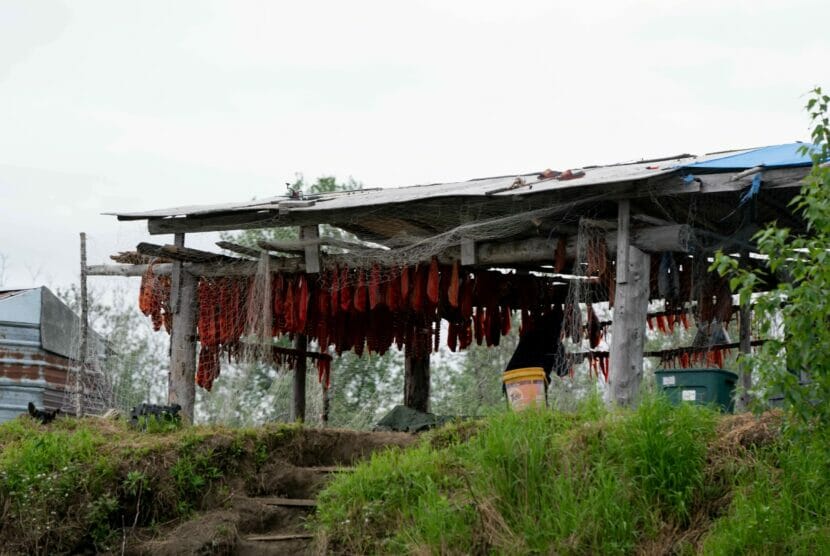
A fish camp near Akiachak, Alaska. June 23, 2023. (MaryCait Dolan/KYUK)
This is Lingít Word of the Week. Each week, we feature a Lingít word voiced by master speakers. Lingít has been spoken throughout present-day Southeast Alaska and parts of Canada for over 10,000 years.
Gunalchéesh to X̱’unei Lance Twitchell, Goldbelt Heritage Foundation and the University of Alaska Southeast for sharing the recorded audio for this series.
This week’s word is yanshuká, or camp. Listen to the audio below to learn how to say yanshuká.
The following transcript is meant to help illustrate the words and sentences.
Keihéenák’w John Martin: Yanshuká.
That means camp.
Here are some sentences:
Keihéenák’w John Martin: Astʼeix̱, astʼeix̱ áwé yanshuká dei ḵuyaanagweich.
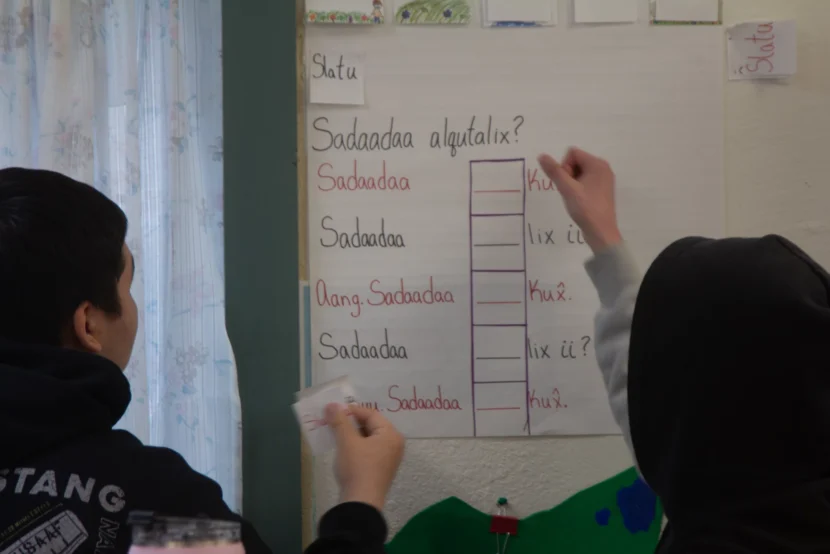
Classes like this one are rare. Unangam Tunuu is taught in only a handful of classes in the public school system, and outside these sessions, the language is seldom spoken. The struggle on St. Paul mirrors trends across Alaska. A 2024 report from the Alaska Native Language Preservation and Advisory Council, a legislative council that advises the governor’s office, found that all of the state’s Indigenous languages are critically endangered, with some spoken by fewer than a dozen people. (Theo Greenly/KUCB)
In a classroom on St. Paul Island, Aquilina Lestenkof stands before a group of students, guiding them through an Unangam Tunuu language exercise. Her voice is steady and encouraging as she repeats a phrase, which the children repeat back. Some stumble over the syllables, but Lestenkof smiles.
“We focus on speaking, and it doesn’t matter if you mumble, fumble, fail fast, go ahead. Speak it,” she says. “Because putting it out there into this wonderful Unangax̂ universe is keeping it alive.”
Lestenkof runs the community’s language center on St. Paul, a remote island in the Bering Sea, where educators and elders are fighting to preserve Unangam Tunuu, the traditional language of the Unangax̂ people. Despite their efforts, the language faces a steep decline, with few fluent speakers left and even fewer opportunities to use it outside the classroom.
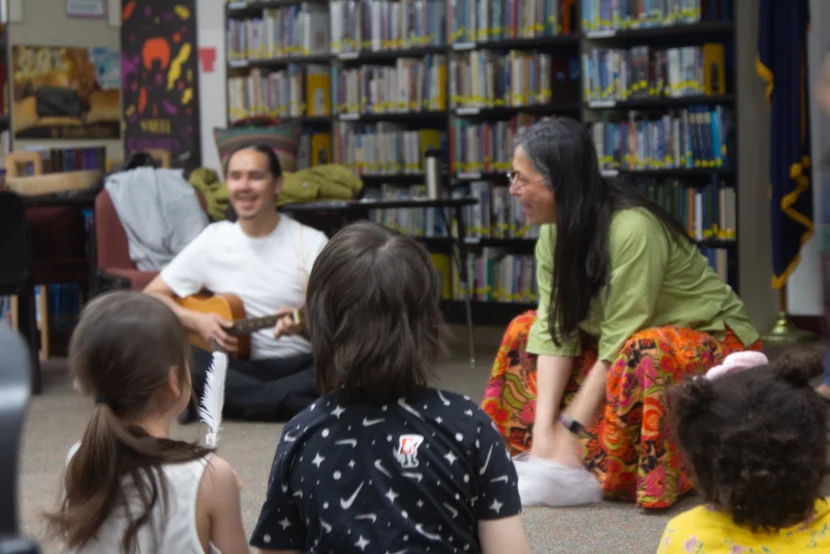
“We focus on speaking, and it doesn’t matter if you mumble, fumble, fail fast, go ahead. Speak it,” says Lestenkof, right. “Because putting it out there into this wonderful Unangax̂ universe is keeping it alive.” (Theo Greenly/KUCB)
Classes like this one are rare. Unangam Tunuu is taught in only a handful of classes in the public school system, and outside these sessions, the language is seldom spoken. The struggle on St. Paul mirrors trends across Alaska. A 2024 report from the Alaska Native Language Preservation and Advisory Council, a legislative council that advises the governor’s office, found that all of the state’s Indigenous languages are critically endangered, with some spoken by fewer than a dozen people.
Following the fur seal
The challenges facing Unangam Tunuu are rooted in a history of colonization. While Unangax̂ people historically traveled to St. Paul to hunt, they did not live on the remote Pribilof Islands. That changed when Russian settlers forced many Unangax̂ to relocate there as laborers during the fur trade.
The United States continued the practice after purchasing Alaska in 1867, designating the Pribilof Islanders as “wards of the state.” It wasn’t until 1983 that the U.S. government withdrew from the Pribilofs,allowing the community to regain independence.
Today, St. Paul celebrates its freedom withAleut Independence Day, held each year on Oct. 28. The event brings the community together at the school gym, where residents cook, sing, and honor their heritage.
Zinaida Melovidov, known as Grandma Zee, is one of the few remaining fluent speakers in St. Paul. At this year’s celebration, she prepared “million dollar soup,” a dish made with corned beef that reflects the government’s compensation to the people of St. Paul.
“We call corned beef ‘million dollar’ because that was what the government gave to the people,” she said.
For Melovidov, the celebration is bittersweet. She remembers the injustices her people endured under colonial rule.
“It was sad,” she said. “Oh, I was so angry they treat our people like that.”
The loss of fluent speakers, many of whom are elders, has only deepened her frustration.
“All the people are gone that can speak, have a conversation, talk together. And these little kids, these younger ones, they don’t understand,” she said.
Melovidov says the only person left with whom she can really hold a conversation in Unangam Tunuu is her uncle, Gregory Fratis Sr., the oldest person on St. Paul at 83 years old.
Looking forward, glancing back
The state report emphasizes the importance of intergenerational learning, where elders pass their knowledge to younger generations. Events like Aleut Independence Day are aimed at fostering those connections.
With bellies full of fry bread and million dollar soup, attendees gathered in the gymnasium for closing ceremonies. Lestenkof addressed attendees over the school’s PA system.
“This is what we’re gonna do,” she said. “We’re going to say Malgaqan samtalix, and we’re going to walk a wonderful clockwise circle.”
“Malgaqan Samtalix” is an Unangax̂ song rooted in the idea of accepting the past.
“What has happened before has happened, and we must respect that,” said George Pletnikoff Jr., a young Unangam Tunuu instructor from Saint Paul who teaches alongside Lestenkof.
“We’re all here right now,” he added.
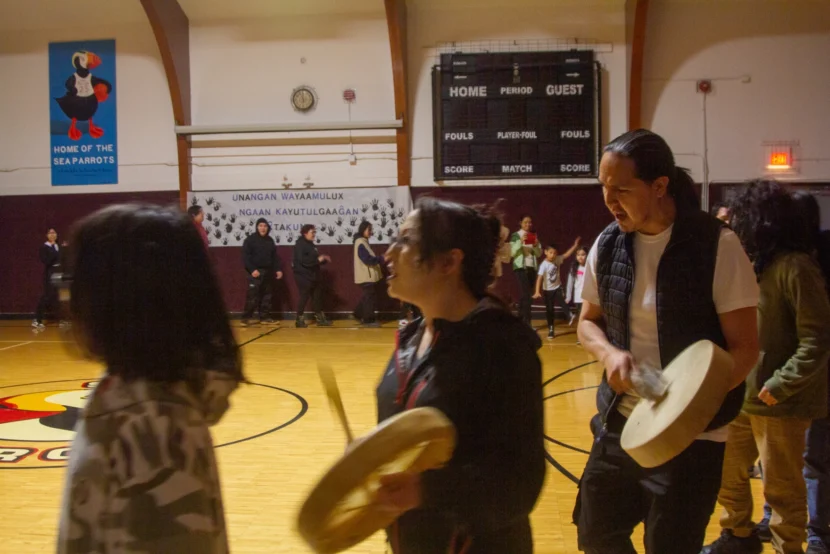
“Malgaqan Samtalix” is an Unangax̂ song rooted in the idea of accepting the past. “What has happened before has happened, and we must respect that,” said George Pletnikoff Jr., a young Unangam Tunuu instructor from Saint Paul. (Theo Greenly/KUCB)
While Alaska has made strides in incorporating Native languages into public education, programs remain limited. Most Indigenous students in Alaska’s public schools still lack access to Native language instruction.
Studies show thatintegrating cultural elements into language education can boost learners’ motivation and sense of ownership, a goal Lestenkof says is central to events like Aleut Independence Day.
“Something like today’s celebration, it’s strength building, and keeping our techniques and tools, and having the kids understand that it’s all in our hands,” she said.
The community forms a ring around the inside of the gymnasium, placing their hands on the shoulders of the person in front of them. Pletnikoff starts banging a drum, and the attendees chant, “Malgaqan Samtalix.” Everyone chants in unison and walks in a circle.
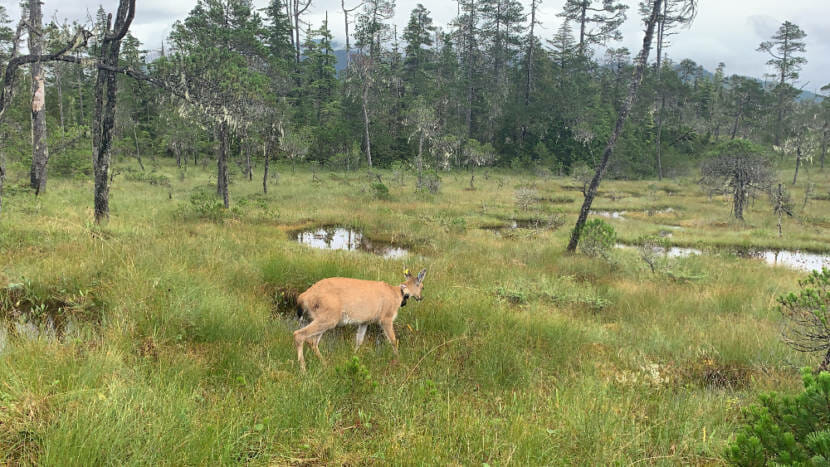
A fitted with a tracking collar walks through muskeg on Mitkof Island in 2020. (Photo courtesy of Dan Eacker/ADF&G)
This is Lingít Word of the Week. Each week, we feature a Lingít word voiced by master speakers. Lingít has been spoken throughout present-day Southeast Alaska and parts of Canada for over 10,000 years.
Gunalchéesh to X̱’unei Lance Twitchell, Goldbelt Heritage Foundation and the University of Alaska Southeast for sharing the recorded audio for this series.
This week’s word is g̱uwakaan, or deer. Listen to the audio below to learn how to say g̱uwakaan.
The following transcript is meant to help illustrate the words and sentences.
Kooshdáakʼu Bill Fawcett: g̱uwakaan.
That means deer.
Here are some sentences:
Kooshdáakʼu Bill Fawcett: A loowú kg̱wagóot g̱uwakaan. Shákdé yei kḵwasatéen.
A deer is going to walk out on the point. Perhaps I will see it.
Keihéenák’w John Martin: G̱uwakaan dleeyi ax̱ x̱’éi yak’éi.
Deer meat tastes good.
Keiyishí Bessie Cooley: Ḵuwakaan máa yateeyí yéixʼ yei tusatínch, neilxʼ.
Sometimes we see deer at our home.
Ḵaakal.áat Florence Marks Sheakley: At ḵuwaháa ag̱aa du.únt yé yá g̱uwakaan.
The time has come for people to go deer hunting.
Kaxwaan Éesh George Davis: Shaa yadaadé kei wdlitlʼétʼ g̱uwakaan ag̱a.óonit
They climbed up towards the upper part of the mountain to shoot a deer.
You can hear each installment of Lingít Word of the Week on the radio throughout the week.
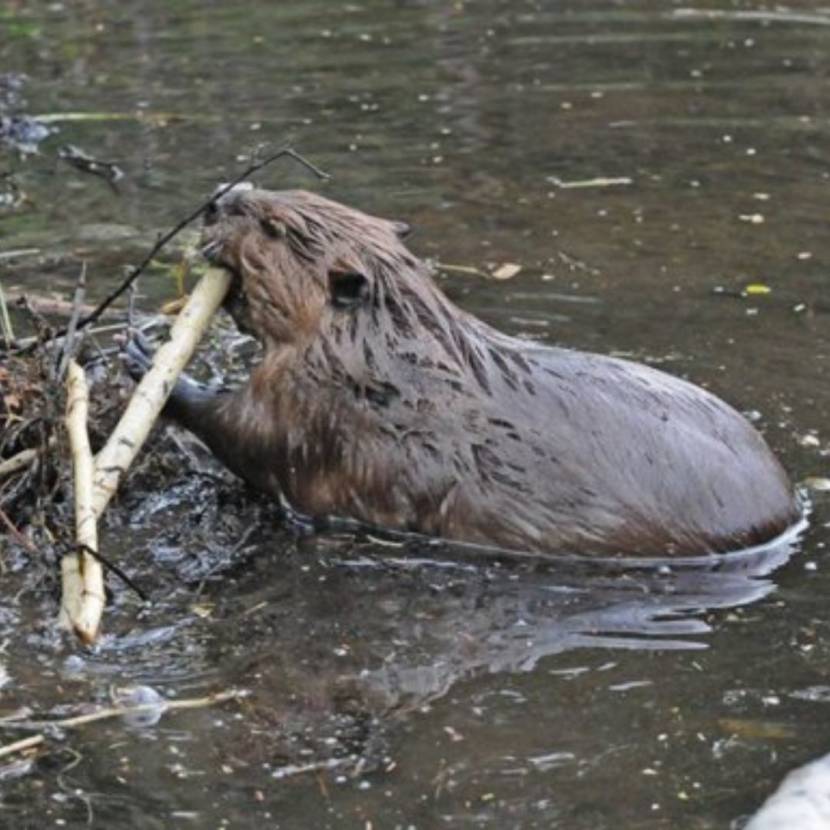
Beavers build dams to create ponds, where they build underwater lodges. The deep water offers protection from predators. (Photo courtesy of SEALT)
This is Lingít Word of the Week. Each week, we feature a Lingít word voiced by master speakers. Lingít has been spoken throughout present-day Southeast Alaska and parts of Canada for over 10,000 years.
Gunalchéesh to X̱’unei Lance Twitchell, Goldbelt Heritage Foundation and the University of Alaska Southeast for sharing the recorded audio for this series.
This week’s word is s’igeidí, or beaver. Listen to the audio below to learn how to say s’igeidí.
The following transcript is meant to help illustrate the words and sentences.
Kaxwaan Éesh George Davis: S’igeidí.
That means beaver.
Here are some sentences:
Kaxwaan Éesh George Davis: S’igeidích wusiḵít.
The beaver dams it.
Keihéenák’w John Martin: Héen x̱oo kat aaní yéi yá s’igeidí has du aaní yéi yatee.
Among the surface of the water, this is the beaverʼs place.
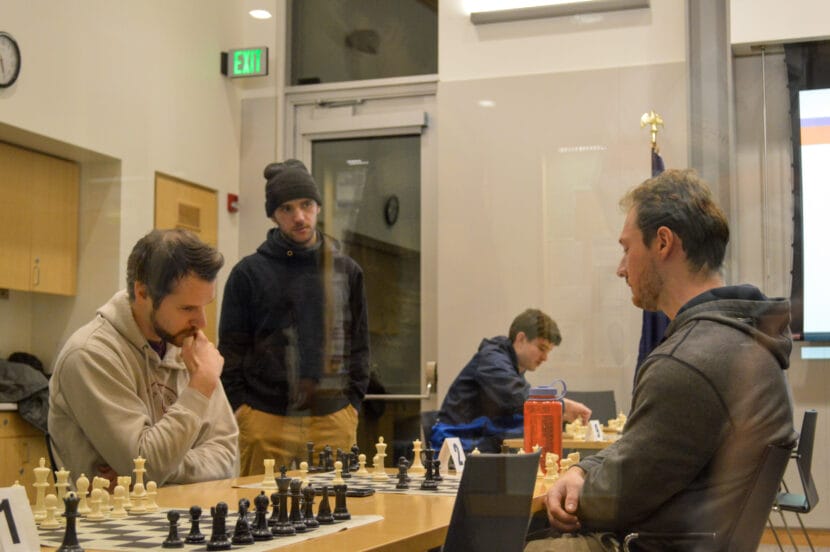
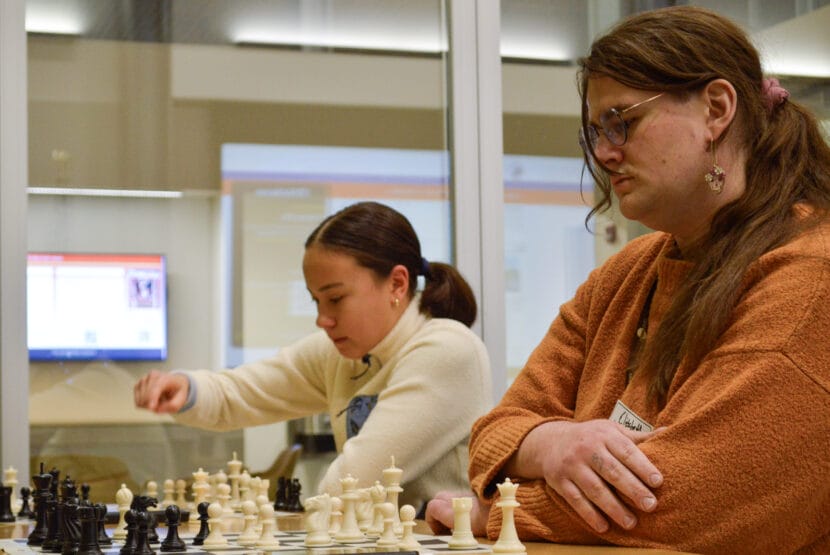
Maen Wolf (center) watches Matt Schiffner (right) contemplate his next move at an Alaska Chess Club tournament on Dec. 19. 2024. (Photo by Yvonne Krumrey/KTOO)
The Alaska Chess Club hosted its seventh tournament this week in Juneau. The club was started this year by players who wanted more opportunities for in-person competition.
Listen:
There were two chessboards per table set up in the Mendenhall Valley Public Library conference room on Thursday. Twenty people sat face-to-face at the tables, chatting about chess.
“I see a lot of new faces here today, which means you’ve all been breaking the first rule of Chess Club,” Maen Wolf, who ran the tournament, told the players before kicking things off.
Once the two-sided timers started, the room was silent, except for the sound of pieces landing on the chessboard.
Each player had up to 10 minutes total, limiting games to 20 minutes. Some games were over in six, others ran the timer down to a second on each side.
Wolf started the club this spring because he wanted to expand in-person playing beyond just him and some friends at a bar.
“I was like, ‘Okay, there should be something official here,’” he said.
Most of the players honed their games on Chess.com. But Kevin Gullufsen said in-person games are different and better.
“Most of us play on our phones a lot, but it’s a totally different thing, playing over the board, like OTB,” he said, whispering. On the other side of a glass wall, a serious game was in action.
“Also playing against a live person, there’s a whole kind of psychological aspect to it that’s a lot more fun, and it’s kind of the more real version of chess,” he said.
Players who finished their games earlier started to trickle into the hallway, and conversations about what went well and what could have been better filled the silence.
Kaia Mangaccat came to this tournament ready with a plan. And she said it went well.
“I did an opening, and it worked, and that got me off to a really good start,” she said.
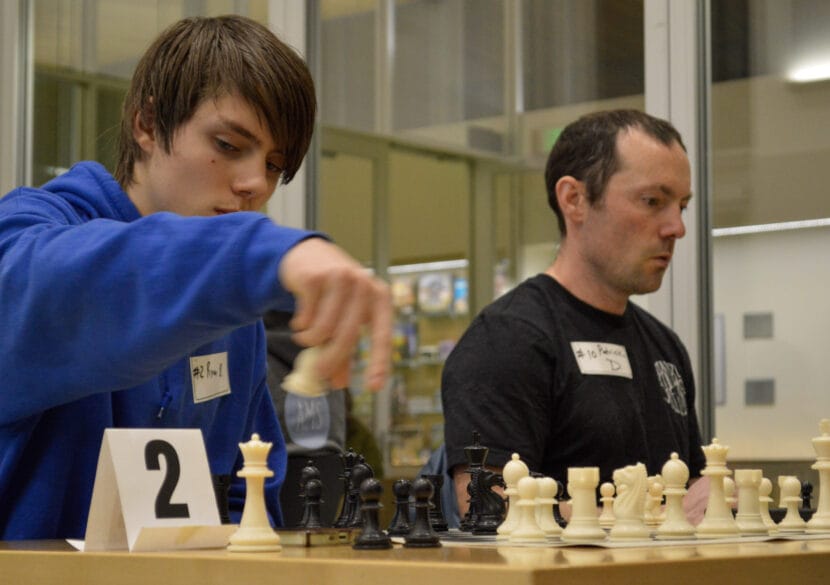
Ryan Beery (left) makes a quick move at an Alaska Chess Club tournament on Dec. 19. 2024. (Photo by Yvonne Krumrey/KTOO).
Fourteen-year-old Ryan Beery was also proud of his first game.
“I felt pretty good,” he said. “I think I got maybe two brilliant moves.”
Matt Schiffner’s third game came down to the wire. Players who finished already watched through the glass. He said afterwards that he cinched the victory in the last few moves.
“When there were just a few pieces left, and he just put his rook on the square that my knight covered, and I was able to capture it. You know, at first I almost missed it,” he said. “I was about to play a different move, and then out of the corner of my eye, I saw it. And as soon as I saw that, it just clicked, and felt very satisfying.”
Schiffner won the tournament, undefeated through seven games.
Kaia Mangaccat (left) and Elizabeth Giudice at a chess tournament on Dec. 19. 2024. (Photo by Yvonne Krumrey/KTOO).
But no matter how well the players scored, they were eager to play and learn from each other. At least, that’s what Elizabeth Giudice said.
“It’s not whether you win or lose, it’s the pieces you move along the way,” she said.
And just in case seven games wasn’t enough, Wolf said people could play one more game after the tournament if they want to. The top three winners lingered, but everyone else headed for the door.
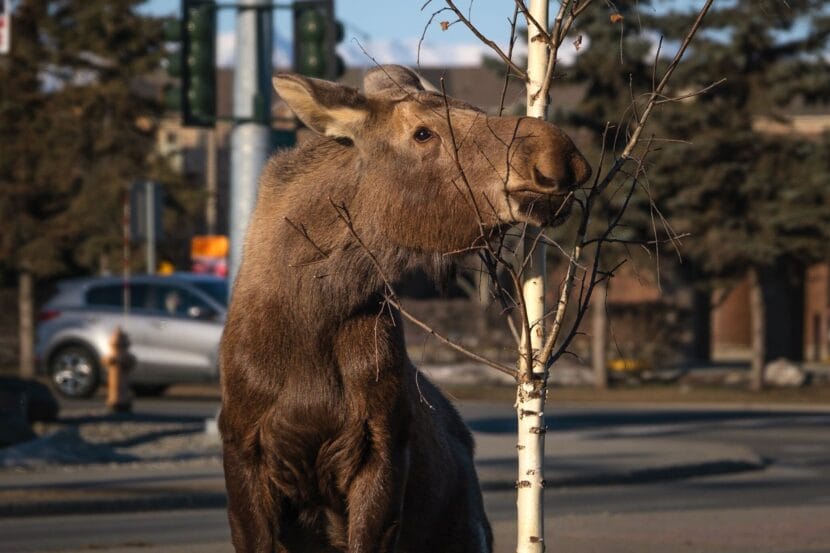
A moose grazes in Anchorage on April 19, 2023. (Photo by Brian Venua/KMXT)
This is Lingít Word of the Week. Each week, we feature a Lingít word voiced by master speakers. Lingít has been spoken throughout present-day Southeast Alaska and parts of Canada for over 10,000 years.
Gunalchéesh to X̱’unei Lance Twitchell, Goldbelt Heritage Foundation and the University of Alaska Southeast for sharing the recorded audio for this series.
This week’s word is dzísk’w, or moose. Listen to the audio below to learn how to say dzísk’w.
The following transcript is meant to help illustrate the words and sentences.
Ḵaakal.áat Florence Marks Sheakley: dzísk’w.
That means moose.
Here are some sentences:
Ḵaakal.áat Florence Marks Sheakley: Tlél haa x̱ánxʼ shawoodahéin dziskʼw.
There arenʼt a lot of moose around us here.
Keihéenák’w John Martin: Yá goodáan yáx̱ áyá kooligéi yá dzískʼw.