Arts & Culture

Tongass Voices: Tamara Wilson on her museum installation and the slinkies that live there

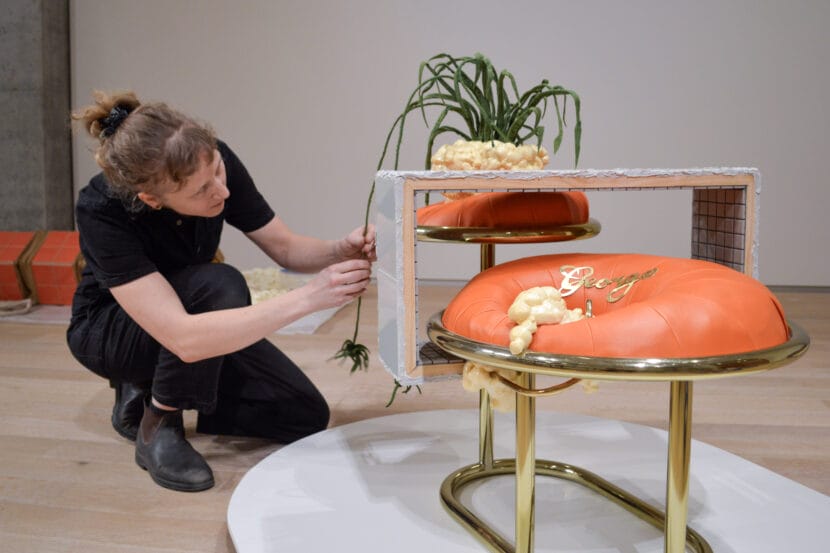
Tamara Wilson sets up her exhibit “Slinkies and the Window Frame” at the Alaska State Museum on Feb. 3, 2025. (Photo by Yvonne Krumrey/KTOO).

This is Tongass Voices, a series from KTOO sharing weekly perspectives from the homelands of the Áak’w Kwáan and beyond.

Tamara Wilson recently unpacked a living room at the Alaska State Museum. She made it out of felt — among other materials — for her upcoming show, “Slinkies and the Window Frame.” 

For the exhibit, Wilson built accordion-like creatures covered in orange ceramic tiles. They will be unfurled throughout the gallery space with nameplate necklaces that say things like “George.” Those are the Slinkies.

The show opens Friday at 4:30 p.m. at the Alaska State Museum and runs through April 12.

Listen:

This transcript has been lightly edited for clarity.

Tamara Wilson: They’re totally useless, right? Like the only thing that they do is bring joy, which I think is kind of wonderful. It’s a little presumptuous of me to say that the work will bring joy, but if it does, that’s great. But it really has no other function outside of just being present for the viewer to enjoy.

I’m Tamara Wilson, and I’m an installation [designer] and painter from Fairbanks, Alaska.

A lot of my sort of formal background in arts was mostly painting. And then as it kind of developed over time, the paintings sort of started taking over the space, creating the space. So then I started thinking less about the paintings themselves, and more about people viewing the paintings, or people being inside the space.

And so then that kind of naturally turned into wanting to create, almost like a three dimensional painting for people to be in. So the installations came about because the paintings just weren’t enough.

So this is the back side of the slinky that will get put on this armature and then hung on the wall so you can see the accordions kind of. It’s like stretched out, and then when they’re shipped, they’re all condensed. So then that’s when they’re in, like resting slink. And then when they’re in the gallery, they’re pulled out, so that they’re in more of their organic, moving form.
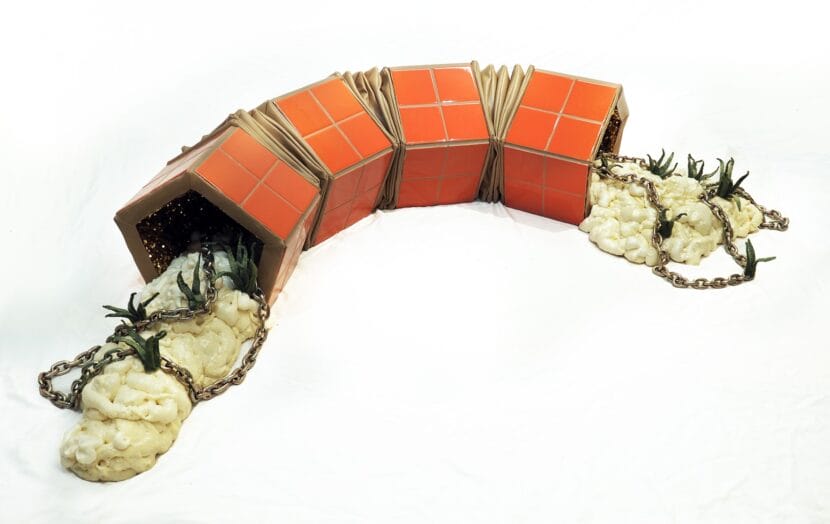
One of Tamara Wilson’s slinkies named for “Slinkies and the Window Frame.” Courtesy of the Alaska State Museum.

So this piece that you’re seeing from the back side, it’s called U-turn. And the like name plates say “You turn round and round.” And so it’s the necklace of the slinky, clearly, because every slinky needs a necklace, apparently. And then coming out of the end of it is that expanding foam that’s against the wall with more chain. It’s kind of like its gut spilling out.

So yeah, I mean, read into it what you might, but the nameplates kind of allude to why its contents are being spilled onto the floor.

So this right here is a frame, like a kind of classic oak frame, and it’s going to go in this wall here. And so the people experiencing the installation that’s going to be on the other side of the wall will be framed in this when they’re inside it. So you will view them from the more traditional side of the gallery as if they were in the painting.

It’s very much a living space. The installation itself, that’s kind of adjacent to the more traditional gallery space, is set up like a living quarters. It has a bed, it has a television, a heat source — the radiator — a lot of house plants. And then on this side of the wall, on this side of the frame, are these like slinky pieces, and they are more like creatures, forms that might occupy that living room space.

There is something that’s kind of intriguing about looking into somebody else’s space. And I guess that initially the inspiration for doing this framed installation — that the viewer can actually walk through the frame — originally was just like who are in these colossal portraits that you see in museums? Often like royalty or I don’t know people that I don’t relate to or know or know much about.

And so the viewer being able to be in that frame themselves kind of elevates the viewer to be the portrait, in a way.
Lingít Word of the Week: Dleit— Snow

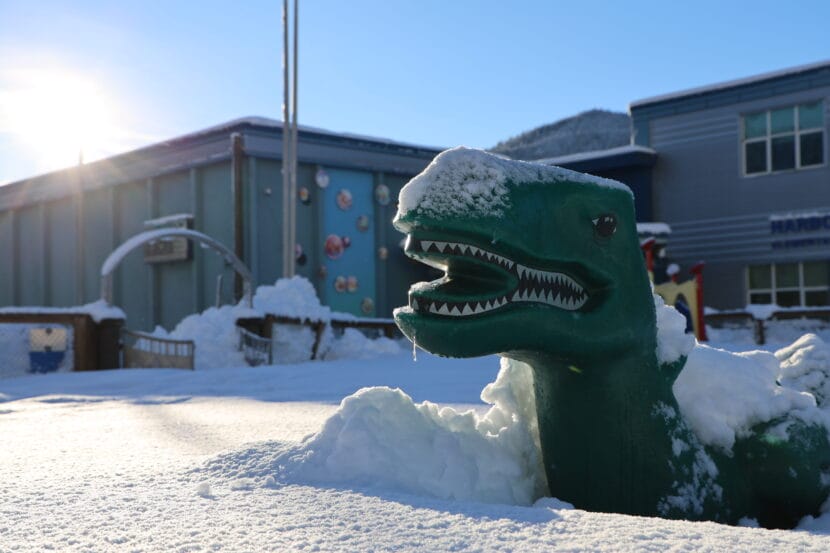
Snow covers playground equipment outside Harborview Elementary School on Tuesday, Jan. 16, 2024. (Clarise Larson/KTOO)

This is Lingít Word of the Week. Each week, we feature a Lingít word voiced by master speakers. Lingít has been spoken throughout present-day Southeast Alaska and parts of Canada for over 10,000 years.

Gunalchéesh to X̱’unei Lance Twitchell, Goldbelt Heritage Foundation and the University of Alaska Southeast for sharing the recorded audio for this series.

This week’s word is dleit, or snow. Listen to the audio below to learn how to say dleit.

The following transcript is meant to help illustrate the words and sentences. 

Kooshdáakʼu Bill Fawcett: Dleit. 

That means snow.

Here are some sentences:

Kooshdáakʼu Bill Fawcett: Ḵúnáx̱ áwé daak wusitaan wé dleit.

It’s really snowing. 

Keiyishí Bessie Cooley: Dleit shaa shakée yéi yatee.

There is snow on the mountaintop.

Ḵaakal.áat Florence Marks Sheakley: Dleit daak wusitán.

It is snowing. 

Kaxwaan Éesh George Davis: Dleit g̱aadlaan.

The snow is deep.

You can hear each installment of Lingít Word of the Week on the radio throughout the week. 


Additional language resources:

Find biographies for the master speakers included in this lesson here.

Learn more about why we use Lingít instead of Tlingit here.

Watch a video introducing Lingít sounds here.

Rhiannon Giddens, Dirk Powell announced as headliners for 50th Alaska Folk Festival

Rhiannon Giddens and Silk Road Ensemble perform at TED2016 – Dream, February 15-19, 2016, Vancouver Convention Center, Vancouver, Canada. (Creative Commons photo by Bret Hartman/TED)

Alaska Folk Festival leadership announced this afternoon on social media that the guest artists for the 50th festival will be Rhiannon Giddens and Dirk Powell.

Both artists have won multiple Grammys. And they’ve both come to Juneau’s Folk Fest before: Giddens in 2007 as a member of the Carolina Chocolate Drops and Powell as an attendee several decades ago.

The two have worked together for years, and played together just last week at a festival in Ireland. 

Giddens was named a MacArthur Genius Fellow in 2017, and won a 2023 Pulitzer Prize for the opera “Omar,” which she cocomposed and performed. It’s based on a memoir written by an enslaved Muslim man in 1831. 

Giddens has been a member of notable ensembles, like the New Basement Tapes, and has released five solo albums. 

According to her website, Giddens is debuting her own music festival in Durham, North Carolina, two weeks after Folk Fest. 

Powell has toured with folk legend Joan Baez, and recorded albums with artists like Eric Clapton and Loretta Lynn.

The 50th Alaska Folk Festival is April 7 to 13 at Centennial Hall in Juneau. 

What’s in a name? Following presidential order, Athabascan reflections on the meaning of Denali

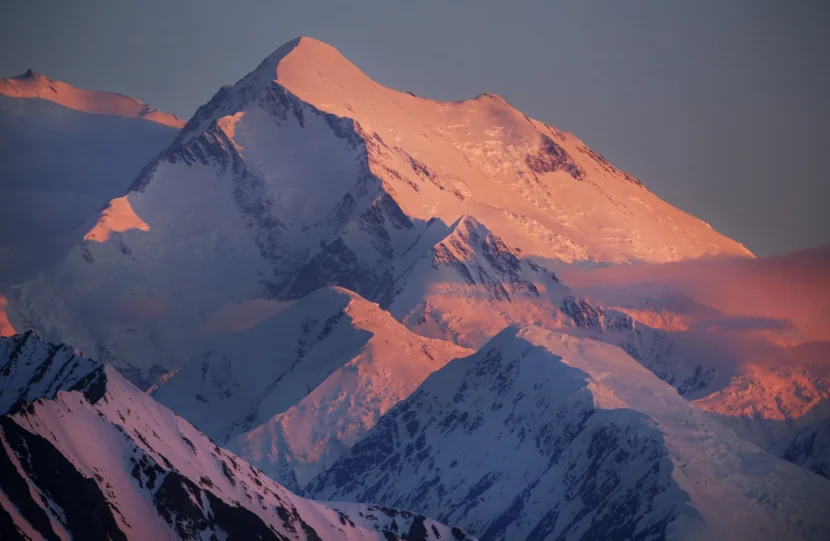
Denali during sunset at midnight seen from backcountry Unit 13 on June 14, 2019. (Photo by Emily Mesner/National Park Service)

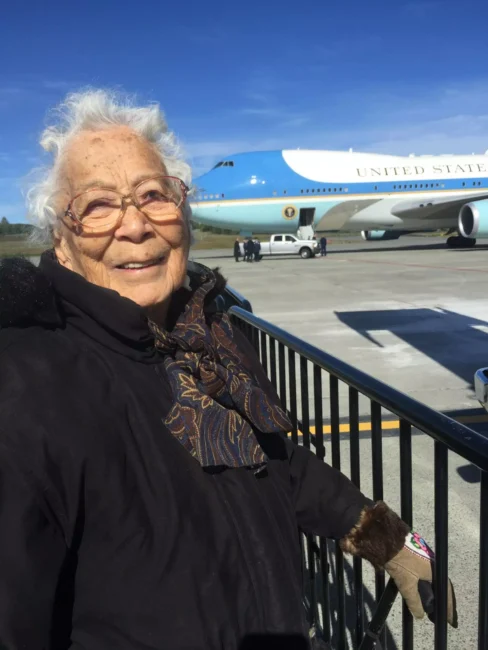
Poldine Carlo, an Athabascan elder from Nulato, was in her late nineties when she performed her Denali song in 2017 at a conference in Holy Cross on the Yukon River. In a raspy, aging voice, she did her best to belt out the song. The refrain, which she sang in her Koyukon dialect, was “Say Denali. Say Denali.”

This photo of the late Poldine Carlo was taken on August 31, 2015 at Joint Base Elmendorf -Richardson in Anchorage, while she was waited to meet President Barack Obama. She greeted him with her Denali song, to celebrate his administration’s efforts to change Mount McKinley back to its original Koyukon Athabascan name, Denali. (Photo by Sylvia Lange)

Angela Gonzales remembers hearing the song when Carlo sang it for President Barack Obama during his visit to Alaska in 2015, the summer his administration changed the name of the nation’s tallest mountain from McKinley back to Denali.

“It just felt so good,” she says. “And it was healing.”

That year, Gonzales wrote about the joy she felt over the return of the ancient name in her blog, Athabascan Woman.

“It felt like Alaska Natives were given back something taken away from us,” she wrote. “People may think colonization is just something that you read about in textbooks. It is a very real thing when you see names like Mount McKinley take over our place.”

Then, earlier this month, President Donald Trump issued an executive order to once again rename the mountain as Mount McKinley.

“We will restore the name of a great president, William McKinley to Mount McKinley, where it should be and where it belongs,” he said at his inauguration.

Gonzales says she felt hurt and angry after Trump’s order, if not defiant.

“What I call it is not going to change. And a law or an executive order is not going to change my relationship to it,” she said. “But to see it go back – it’s disappointing. Because I feel like we’re going back in a direction that we don’t want to go.”

For Gonzales, the name Denali looms large in her own family history. Her maiden name is Yatlin, which means “runner” and refers to her family’s long history of running on foot to trade goods with other peoples.

“We were people who traded everywhere,” she said. “We have artifacts that are from other locations.”

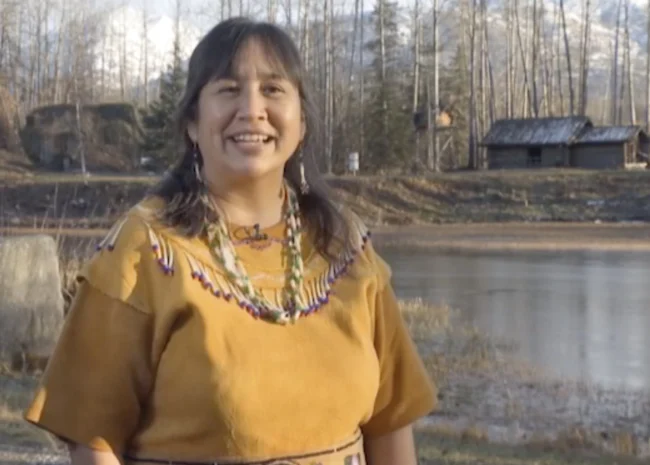
Angela Yatlin Gonzales, wearing a traditional Koyukon Athabascan dress made out of moose hide. Gonzales publishes the Athabascan Woman blog. (Will Mader/KTOO)

Gonzales says, even today, the name Denali stirs so many emotions, mainly the feeling of living in a great land with “untold stories from our ancestors,” stories that speak to their relationship to the mountain, even how it determines the weather around the whole region.

She says there are also stories about the vast network of trails that weaved around a group of mountains.

There is Mount Foraker, which was originally Sultana, Denali’s woman, or wife. And there is Mount Hunter, which was Begguya, their child. Like Denali, Mount Foraker — Alaska’s second-tallest peak — was renamed after an Ohio politician, Sen. Joseph Foraker.

Elders like Wilson Justin are familiar with these mountains. He grew up in Nabesna, east of Denali, which was an important landmark for hunters who sometimes had to travel far and wide to find food. He says the original names for this family of mountains explains why they are regarded as relatives in his Ahtna Athabascan culture.

From his childhood, he remembers stories about how the trail system went all the way up to Siberia and Canada and all the way down the coast to California.

“It represents something that was a part of our medicine people’s trails from as far back as we know,” Justin said.

He says there really isn’t a word for “mountain” in his Ahtna dialect, Each one was called by a given name, and they were thought of as spiritual points of light — maybe because of how the ice and snow on their peaks sparkled in the sun.

“You didn’t want to refer to those places in kind of a low way, a dismissive way,” Justin said.

He says elders spoke of them with reverence.

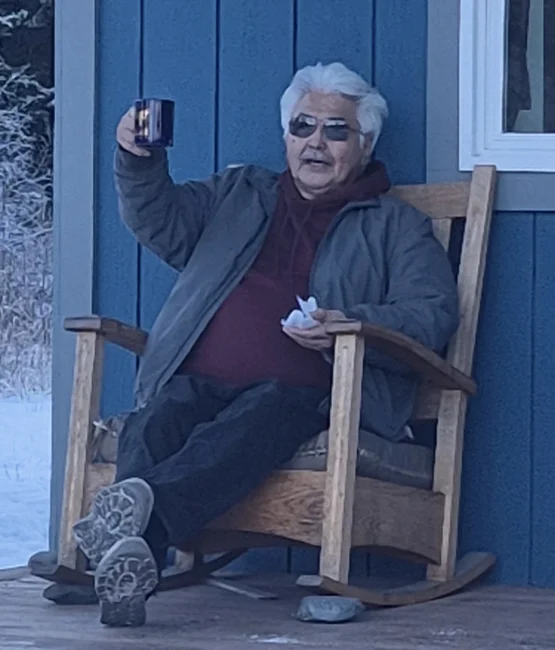
Wilson Justin visiting daughter in Valdez. (Photo by Anita Carltikoff of Nondalton)

“Northern Lights are like, in the old stories — not the newer stories, but the really old stories of Ahtna — are messengers,” Justin said. “And in places like Denali, being a place that messengers would like to stop and touch.”

Wilson says he was taught never to act if he were entitled to the sky. For his people, Denali exists beyond space and time and is a way to connect to the universe.

“When you’re in that place, that location, the mountain will speak to the sky for you,” he said. “A really fascinating way of Indigenous people to be able to express continuity, to connect to your past and future generations.”

Attempts to dismantle that continuity are already underway. The U.S. Interior Department has begun to take steps to designate Denali as Mount McKinley, and Google is changing the name on its maps.

Justin says it may be hard for Trump to understand the heart-and-mind connection his people have with Denali, but he says that no matter what comes of the president’s orders, it won’t change how he feels.

“To me, it’s never going to be anything else,” he said. “Taking Denali down is his way of saying we don’t count.”

Tongass Voices: Marian Call and Lisa Puananimōhala’ikalani Denny on bringing together Juneau’s music-makers

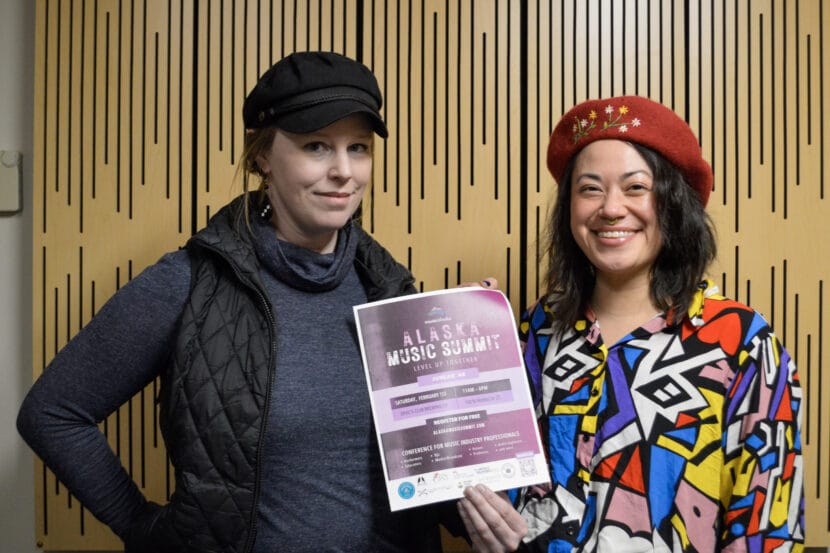
Marian Call and Lisa Puananimōhala’ikalani Denny are organizing the Juneau meeting of the Alaska Music Summit. Pictured in the KTOO studio on Jan. 24, 2025. (Photo by Yvonne Krumrey/KTOO)

This is Tongass Voices, a series from KTOO sharing weekly perspectives from the homelands of the Áak’w Kwáan and beyond.

Marian Call and Lisa Puananimōhala’ikalani Denny are organizing this week’s Alaska Music Summit in Juneau. It’s a chance for anyone who is a part of making music in the region to come together and swap ideas.

The Juneau summit is Saturday from 11 a.m. to 4 p.m. at Devil’s Club Brewing. Participants can register at alaskamusicsummit.com.

Listen:

This transcript has been lightly edited for clarity.

Marian Call: I’m Marian Call. I’m the Program Director of Music Alaska. 

Lisa Puananimōhala’ikalani Denny: I’m Lisa Puananimōhala’ikalani Denny. I am the project outreach coordinator for Music Alaska for the Juneau Music Summit. I also did a little volunteer coordination for our summit up in Anchorage.

The summit is a gathering of music-minded people across the state of Alaska. There are three of them: Fairbanks, Anchorage and Juneau. And it’s like a convention for people in every facet of the music industry to come together, to network, to share our perspectives and to connect with each other and level up together. 

Marian Call: The music summit was started about some years ago, but this is the seventh one, and we’re really excited to see every year, more and more people who are in different parts of music-making. Like people who do booking or people who are DJs, or people who make beats, or people who write new operas, or people who are teaching preschoolers, right? 

All these people serve different roles, but sometimes don’t have the chance to really talk to each other, even though all our fates are very connected. So the music summit makes space for this to happen, and it also gives us a chance to intentionally try to make our music ecosystem better, because it certainly nothing happens if we don’t try together to make it better. And when we do try to make it better, amazing things happen. 

We’ll also be talking about money, about what musicians earn, what they’re paid, how to make the money work. How to make it work well for the venue too. How to have a successful event when you’re trying to make sure that people are being compensated what they’re worth. 

Lisa Puananimōhala’ikalani Denny: We’ve reserved one small segment for to hear from the perspective of the bartenders, who are tend to be viewed as on the fringes of the scene, but they play such a crucial role in a lot of music events, especially like in downtown Juneau, where they’re helping run a lot of that show. 

Marian Call: I think that’ll be great. I think nobody ever asked the bartenders ‘Hey, which shows work?’, but I think they have specialized knowledge about that. 

Possibly the most important part is when we simply free the room up to everyone. Just talk to each other, right? Talk to someone you don’t know, talk to someone you haven’t talked to in a long time. So at lunch and afterwards and the next day at office hours, that’s really when it happens. 

We’re trying to kind of build bonds between the most distant corners of the music community, like if you’re as far apart as you can be in the music community, if you’re playing heavy metal

versus performing like 11th century chant. Or if you’re like teaching preschoolers versus performing with seniors in a community choir. 

No matter how far apart we are, all of our fates are tied together, and this is our opportunity, once a year, to try and make sure that people see that connection and value it. 

Lisa Puananimōhala’ikalani Denny: I am an independent musician in Alaska, and I wasn’t that before I came here. And Juneau is such a fun community to be an artist, a performer, a musician in, because we are so supportive. We’re so all about it. You want to try something? Do it. We’re going to support and applaud you. 

Lingít Word of the Week: G̱ooch — Wolf

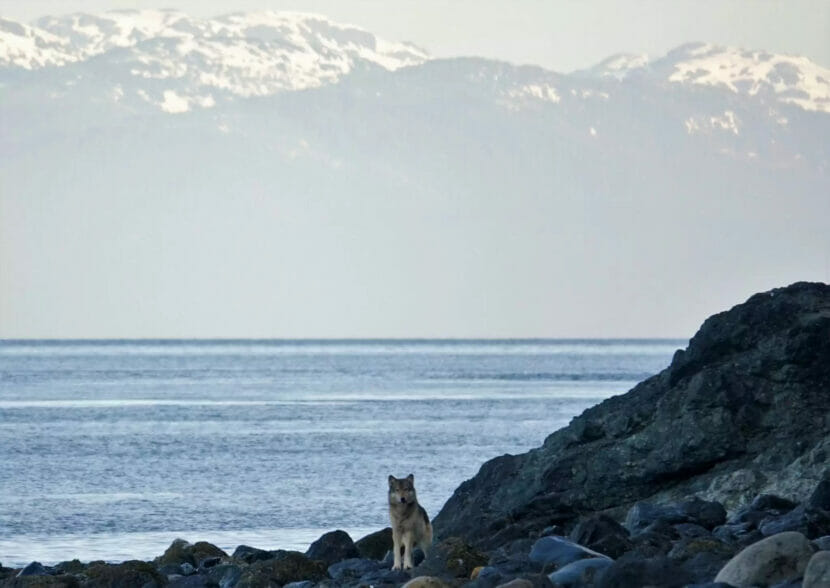
A wolf on Pleasant Island near Gustavus, Alaska peers at the camera. (Photo by Bjorn Dihle)

This is Lingít Word of the Week. Each week, we feature a Lingít word voiced by master speakers. Lingít has been spoken throughout present-day Southeast Alaska and parts of Canada for over 10,000 years.

Gunalchéesh to X̱’unei Lance Twitchell, Goldbelt Heritage Foundation and the University of Alaska Southeast for sharing the recorded audio for this series.

This week’s word is g̱ooch, or wolf. Listen to the audio below to learn how to say g̱ooch.

The following transcript is meant to help illustrate the words and sentences. 

Kaxwaan Éesh George Davis: G̱ooch. 

That means wolf.

Here are some sentences:

Kaxwaan Éesh George Davis: G̱ooch kei akaawag̱áx.

The wolf is howling.

Keihéenák’w John Martin: Kaagwaantaan, g̱ooch áwé has du yahaayí átx̱ alyiex̱.

The Kaagwaantaan use the image of the wolves. 

Keiyishí Bessie Cooley: G̱ooch ax̱ éesh du kʼoodásʼi kaadé wuduwaḵáa.

A wolf was sewn on my fatherʼs shirt.

Ḵaakal.áat Florence Marks Sheakley: Kaagwaantaan Yanyeidí has du at.óowu áyá g̱ooch.

The wolf is the at.óow of the Kaagwaantaan and the Yanyeidí.

Additional language resources:

Find biographies for the master speakers included in this lesson here.

Learn more about why we use Lingít instead of Tlingit here.

Watch a video introducing Lingít sounds here.

Site notifications
Update notification options
Subscribe to notifications