Arts & Culture

Juneau MMIP advocates mourn together in wake of murdered Indigenous teen in Arizona

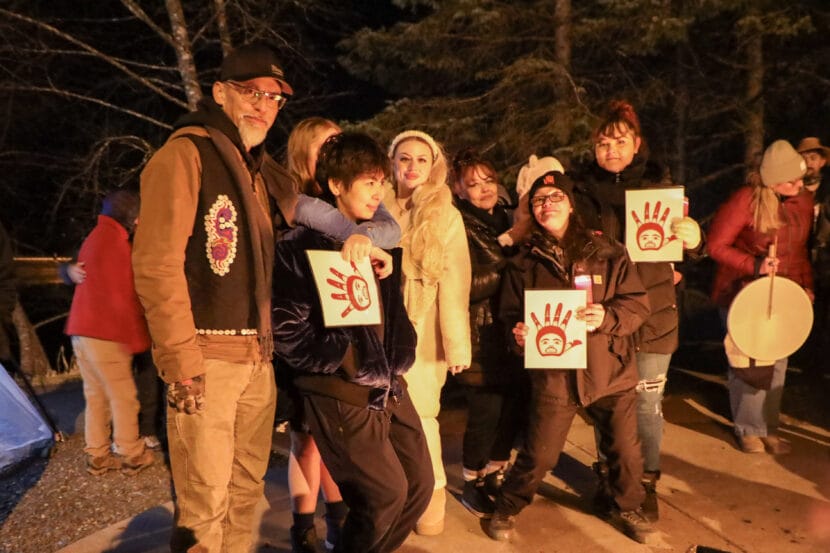
The family of Tracy Lynn Day, a Lingít woman who has been missing since 2019, at a Missing and Murdered Indigenous Peoples vigil on March 13, 2025. (Photo by Yvonne Krumrey/KTOO).

Juneau community members gathered for a candlelight vigil for Missing and Murdered Indigenous People on Thursday.

It was a space for healing after the remains of a missing Indigenous teenager were found in Arizona last month. That loss touched an emotion that crosses state boundaries — the loss that Indigenous communities everywhere feel about their relatives who were victimized by violence.

“We will never stop saying their names,” said Xeetli.éesh Lyle James, Lingít advocate and leader.

A fire crackled as dozens of people gathered under a lunar eclipse at the Kaasei Healing Kootéeyaa, a totem pole that represents healing from gender-based violence. James read the names of Indigenous women and children who have been murdered, or disappeared.

“The most recent: repeat after me, Emily Pike. Say her name,” James said.

Emily Pike was 14 years old when she went missing from her group home in Arizona in January. Her dismembered remains were found a month later.

This tragic story isn’t an uncommon one. Indigenous women and girls in the United States are three times more likely to be murdered than white women and girls. For that reason, the news touched members of the Juneau community, who gathered to honor, remember and heal.
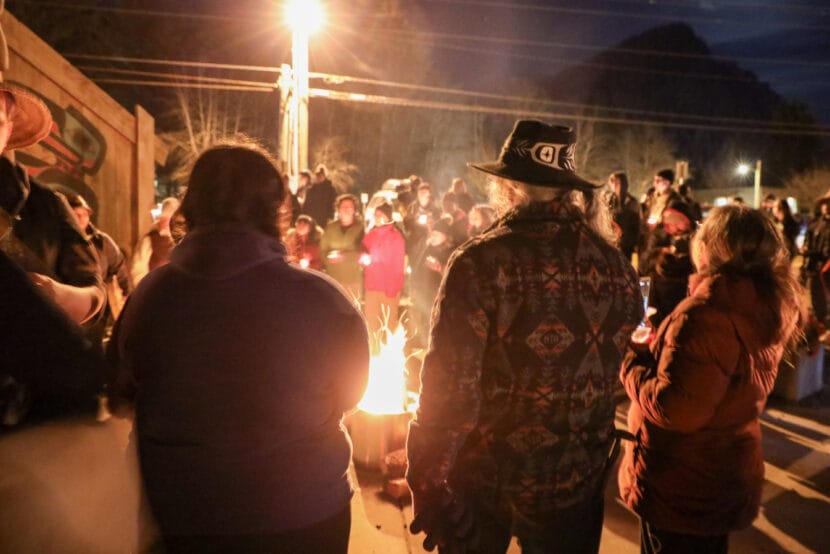
Advocates and community members gather to mourn recent and ongoing cases of Missing and Murdered Indigenous Peoples at a vigil on March 13, 2025. (Photo by Yvonne Krumrey/KTOO).

“We’ve always known this: that when we speak their names, they’re standing with us,” James said.

James also named Ashley Johnson-Barr, a 10-year-old girl who was kidnapped and murdered in Kotzebue in 2018, and Tracy Day, a Lingít woman who went missing in Juneau in 2019.

Kaelyn Schneider is Day’s daughter. She said the kootéeyaa is a space for the families of missing and murdered Indigenous people who don’t have answers.

“There are so many family members that, like my mom’s case, we don’t have a grave site,” she said. “We have nowhere to mourn our loved one, you know. So I think this is really special.”

She said hearing her mother’s name lets her know that people in Juneau haven’t forgotten about her.

James introduced a song called “I x̱’ádudlitseen” – it means “you are precious.”

“All of you standing here this evening are precious,” he said. “All our loved ones that we lost too early, they are precious.”

Attendees holding drums got ready for the song, and he taught the words before it started, so the group could sing loudly together. He invited all to dance.

“And when you dance, stomp it into the ground, because we are tired of all our relatives disappearing and no explanation, no justice for our loved ones,” James said. “We are their voices. You are their voices. You are their strength.”

The kootéeyaa was carved by Master Carver Wayne Price. It was raised in 2022 at Twin Lakes to be a symbol of healing from domestic violence and child abuse.

“It’s a totem that probably shouldn’t ever have to be built,” Price said Thursday.
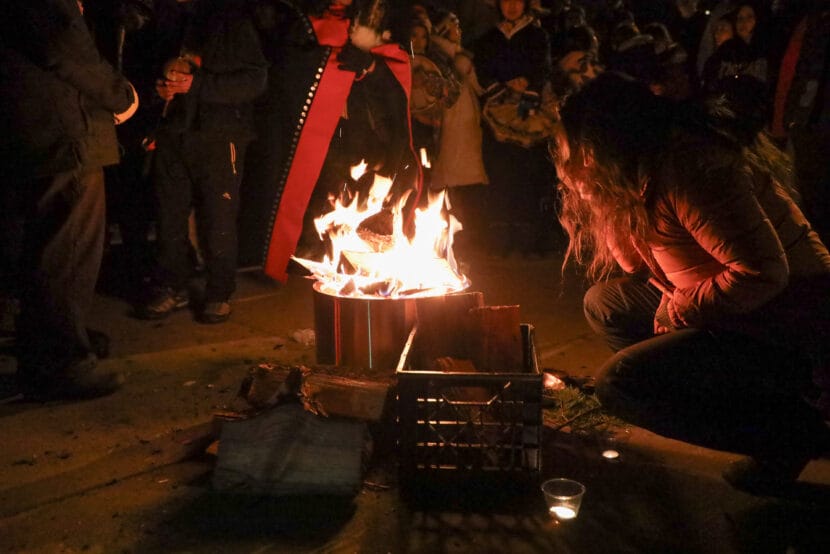
Corlé LaForce puts a cedar chip in the fire at a Missing and Murdered Indigenous Peoples vigil on March 13, 2025. (Photo by Yvonne Krumrey/KTOO).

Later, people burned cedar chips in a small fire. Price carved the chips out of a dugout canoe. Organizers said each one represents a victim of violence. He said the fire was meant to heal the community — and he said he thinks it will.

“You know, that’s why we’re here, because we believe it’s going to work,” Price said.
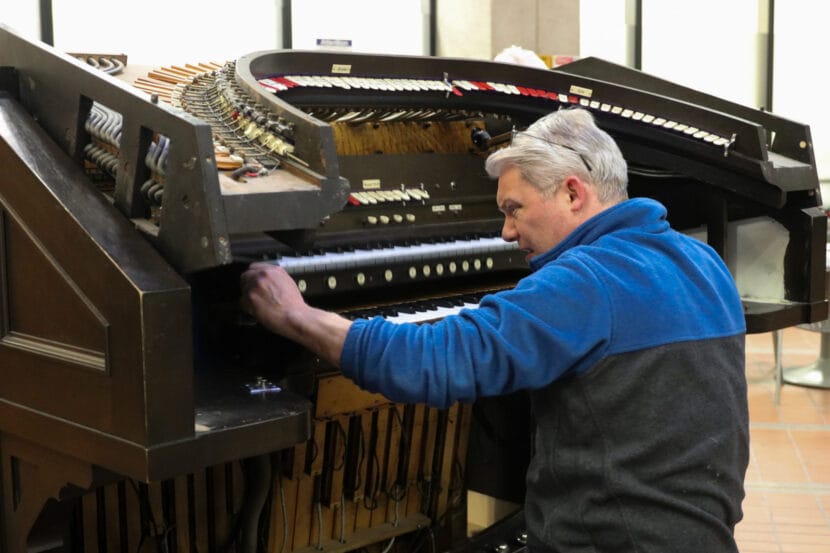
Tongass Voices: Portland-based organ experts on the future of Juneau’s nearly century-old theater organ

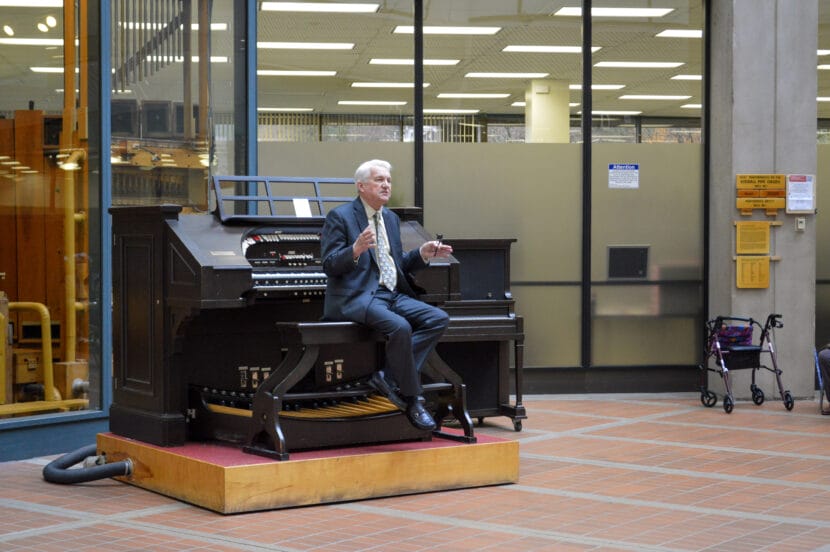
Chris Nordwall examines the Kimball theater organ at the state office building in Juneau on Thursday, March 6, 2025. (photo by Jamie Diep/KTOO)

This is Tongass Voices, a series from KTOO sharing weekly perspectives from the homelands of the Áak’w Kwáan and beyond.

Juneau’s State Office Building is home to the state’s only publicly available theater organ, and its fate is in question. The Kimball organ has been around for nearly 100 years, and it’s been part of the Alaska State Museum’s collection since the 1970s.

But now, the organ is approaching the end of its usable life. Rebuilding it would cost upwards of $250,000 and require shipping it to Portland, Oregon for a year.

Father and son Jonas and Chris Nordwall came to Juneau from Portland to take a look at the inner workings of the organ. In this episode of Tongass Voices, they talk about what’s needed to keep it going.

The following transcript has been lightly edited for clarity.

Chris Nordwall: I have a feeling those are all feather touch, right there. That one I already took down, go to the next note. Down. No, no, slowly. How quickly is it contacting?

Jonas Nordwall: Feather touch.

Chris Nordwall: All right.

My name is Chris Nordwall, and I am co-owner of Rose City Organ Builders in Portland, Oregon.

We came up to Juneau to tune the organ at the State Office Building, repair what we could in short order, and get it ready for what was the Friday afternoon lunch concert, and also then have the sit down discussion in the Q&A forum that was just held to find out what the fate of the instrument will be.

Jonas Nordwall: I’m Jonas Nordwall. I’m from Portland, Oregon, and currently I’m technically retired, but I’m at First United Methodist Church as the artistic music director, and I’ve been there 54 years.

I was approached by my son, who is a co-owner of Rose City Organ Builders, about coming up here to have a meeting with people at the museum about their Kimball pipe organ, and its possible future.

It was an opportunity to come up and see what’s going on and what the thoughts of the community are, because that’s the important thing. It’s not what the outsiders want to recommend. It’s what’s going to be the best results for your local community.

Jonas Nordwall speaks during an organ concert at the state office building in Juneau on Friday, March 7, 2025. (Photo by Yvonne Krumrey/KTOO)

Chris Nordwall: This is a challenge, because you’re coming in and trying to diagnose something that isn’t original per se. Parts of it are, parts of it have been updated. I mean, that’s always the feel good thing at the end of the day, if you’ve actually nailed something down that you know has been an ongoing thing.

You’ll do what you have to do to get that note to function the way it should. It may not be the prettiest repair, but if it works for the performance, that’s what you’re going for. And I think that’s, what this thing has seen over the last 30 years. It’s had, the immediate needed maintenance to get it through the next day. And it’s kind of hit the brick wall. 

So the other thing you have to be really careful about is you can’t start going too deep with this, because it’s like a Pandora’s box. You might be able to repair that you might cause 10 other problems in the process. 

Every project that we’ve undertaken always has its own challenges, and there’s a lot of gnashing of teeth, there’s blood, sweat and tears, but the final product, when you hear it make music for the first time, is always thrilling, and when you see people enjoying it again as they remember hearing it and whatnot. It’s, it gives you a lot of momentum to keep going in an otherwise very small, niche market.

I hope it’s still around. I hope that it’s something that we’ll see a resurgence. Everything has to die off. Hopefully it won’t completely die off, but I hope to see that it’ll sort of have its rebirth in the not too distant future.

Lingít Word of the Week: Kaklahéen — Slush or Sleet

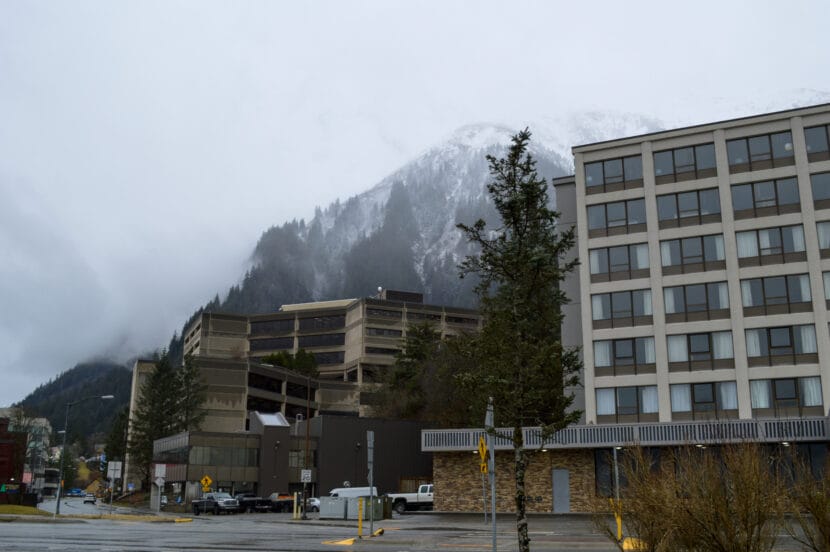
Downtown Juneau in the sleet on March 10, 2025. (Photo by Yvonne Krumrey/KTOO)

This is Lingít Word of the Week. Each week, we feature a Lingít word voiced by master speakers. Lingít has been spoken throughout present-day Southeast Alaska and parts of Canada for over 10,000 years.

Gunalchéesh to X̱’unei Lance Twitchell, Goldbelt Heritage Foundation and the University of Alaska Southeast for sharing the recorded audio for this series.

This week’s word is kaklahéen, meaning slush or sleet. Listen to the audio below to learn how to say kaklahéen.

The following transcript is meant to help illustrate the words and sentences. 

Keihéenák’w John Martin: Kaklahéen. 

That means slush or sleet.

Here are some sentences:

Keihéenák’w John Martin: Táakw.eetí áyá kaklahéen haa ḵaa daak wusitán.

In the spring sleet falls on us.

Keiyishí Bessie Cooley: Kaklahéen wé dleit.

The snow is slush.

Ḵaakal.áat Florence Marks Sheakley: Táakw eenxʼ áyá kaklahéen sitee yá dleit.

In the winter the snow is slushy.

Kaxwaan Éesh George Davis: Kaklahéen has du káa daak wusitán. 

It sleeted on them all. 

You can hear each installment of Lingít Word of the Week on the radio throughout the week. 

Additional language resources:

Find biographies for the master speakers included in this lesson here.

Learn more about why we use Lingít instead of Tlingit here.

Watch a video introducing Lingít sounds here.


Lingít Word of the Week: Kootéeyaa — Totem Pole

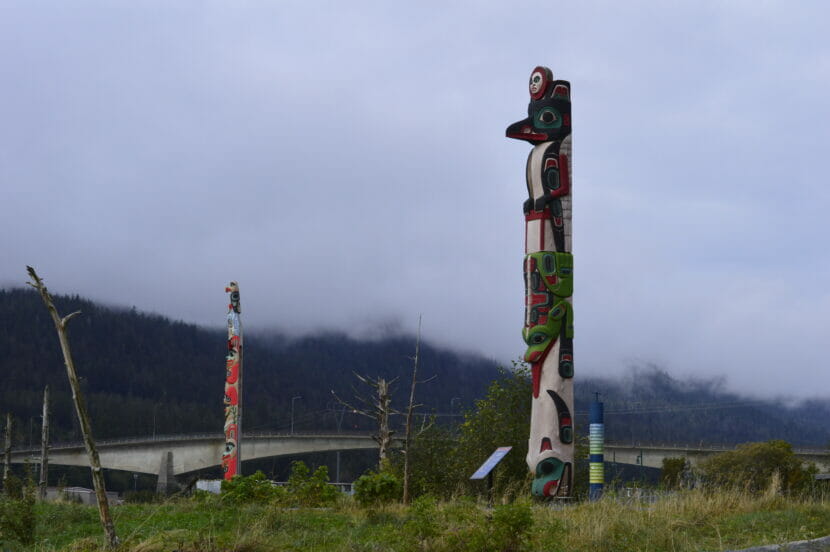
Two kootéeyaa, or totem poles, on Juneau’s waterfront on Oct. 4, 2023. (Photo by Yvonne Krumrey/KTOO)

This is Lingít Word of the Week. Each week, we feature a Lingít word voiced by master speakers. Lingít has been spoken throughout present-day Southeast Alaska and parts of Canada for over 10,000 years.

Gunalchéesh to X̱’unei Lance Twitchell, Goldbelt Heritage Foundation and the University of Alaska Southeast for sharing the recorded audio for this series.

This week’s word is kootéeyaa, or totem pole. Listen to the audio below to learn how to say kootéeyaa.

The following transcript is meant to help illustrate the words and sentences. 

Kaxwaan Éesh George Davis: kootéeyaa. 

That means totem pole.

Here are some sentences:

Kaxwaan Éesh George Davis: Kootéeyaa akaaach’ák’w.

He carved a totem pole.

Keihéenák’w John Martin: Yóo ḵawdudziteey i duwasáakw kootéeyaa.

The thing being carved is called kootéeyaa. 

Keiyishí Bessie Cooley: Kootéeyaa yóoxʼ kaduchʼáakʼw.

A totem pole is being carved way over there.

Kooshdáakʼu Bill Fawcett: Daa sáwé yéi daa.eené? Kootéeyaa áx̱ kaxajaaḵw.

What are you doing? I’m designing a totem pole. 

Ḵaakal.áat Florence Marks Sheakley: Ax̱ éek’ kootéeyaa yéi adaanéiyin.

My brother used to work on totem poles.

You can hear each installment of Lingít Word of the Week on the radio throughout the week. 

Additional language resources:

Find biographies for the master speakers included in this lesson here.

Learn more about why we use Lingít instead of Tlingit here.

Watch a video introducing Lingít sounds here.

Tongass Voices: Frank Henry Kaash Katasse on navigating the irony of theater

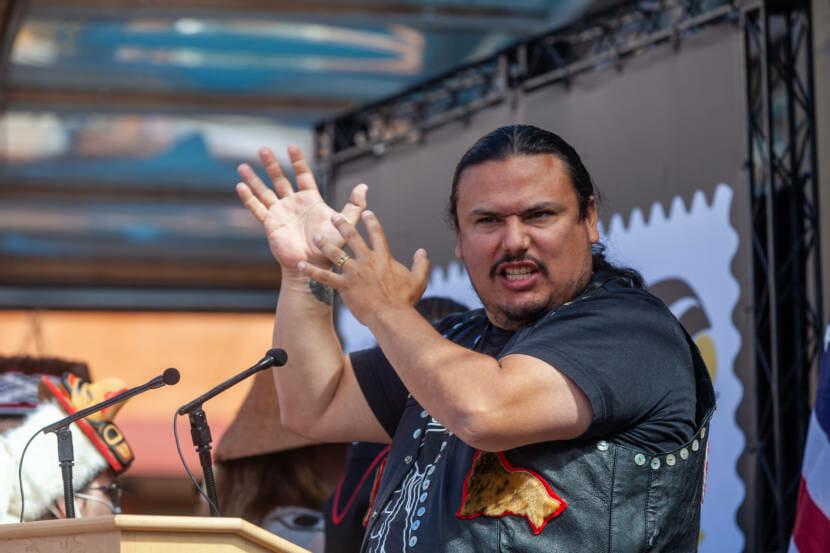
Frank Henry Kaash Katasse tells a story of Raven bringing the sun, stars and moon to humanity during a ceremony celebrating the release of Rico Lanáat’ Worl’s new postage stamp “Raven Story,” on Friday, July 30, 2021 in Juneau, Alaska. (Photo by Rashah McChesney/KTOO)

This is Tongass Voices, a series from KTOO sharing weekly perspectives from the homelands of the Áak’w Kwáan and beyond.

Frank Henry Kaash Katasse is an Indigenous actor and playwright who incorporates Lingít language into plays performed on Juneau’s stages and airwaves. Now, he’s directing a play written by another Indigenous playwright, about white people putting on a Thanksgiving play. 

He says the play is full of humor and irony, but at its core, it gets at the question of who creates theater and who is in the audience watching. 

“The Thanksgiving Play” opens on Friday, with a pay-as-you-can preview on Wednesday. 

Listen:

Frank Henry Kaash Katasse: Kaash áyá ax̱ saayí. Dleit Ḵaa x̱’éináx̱ Frank Henry Kaash Katasse. Hi, I’m Frank Katasse. Frank Henry Kaash Katasse. I’m directing the play, “The Thanksgiving Play” at Perseverance Theater. 

It’s written by Larissa FastHorse. This play, this “Thanksgiving Play,” has been kind of like a darling across the country. It was, you know, it’s a very top produced play across the country, had a Broadway run within the last few years. 

And it’s funny. It’s a really, really funny play. The play is about, basically, it’s about four white people trying to put on a traditional Thanksgiving play without any Native people in it, and the struggles of trying not to offend anybody. And it’s all very farcical and it’s really, like, line-by-line, it’s a really, really funny play. 

There is a certain amount of irony within this play, especially that it’s, you know, it’s a written by a Native person about white people trying to do a Native play without any Native people. But, and that can be — that’s a tricky thing to navigate. And one great thing about Perseverance is that, you know, bringing in a supporting cast of Indigenous perspectives and BIPOC perspectives and so not just me, you know, helming as the director, but you know, we have cultural consultants that are going to come in.

And Perseverance Theater spends a great amount of resources and energy educating and discussing whose land that we’re on and how It’s important to tell these stories in Lingít Aaní, so this play, you know, it seems like to make fun and poke at some of those ideas, but Perseverance Theatre, I think, takes it very seriously. 

And I think it helps having, you know, a Native director like to understand some of the subtleties within the comedy. I’m like, “Did they understand this joke, like when they did this in Plano, Texas, or whatever, by a completely white cast and production team? Did they understand some of these jokes?”

These are really, really funny and, and we’ve got to try to highlight some of that Indigenous humor that’s built into the script. And there’s a certain amount of irony there. I think it is trying to hold up a mirror to society, and I think it’s my job to make sure it does that thing. 

I think Juneau will like it. I explain it to people just like I explained it here. It’s four white people trying to put on a Thanksgiving play, and they’re like, “that’s a funny premise.” And you’re like, “yeah, it is.” And they’re trying not to offend anybody. And of course, it’s always offensive. 

I think people are going to be surprised on how funny this play is.

Lingít Word of the Week: Ḵutx̱.ayanaháa — Star

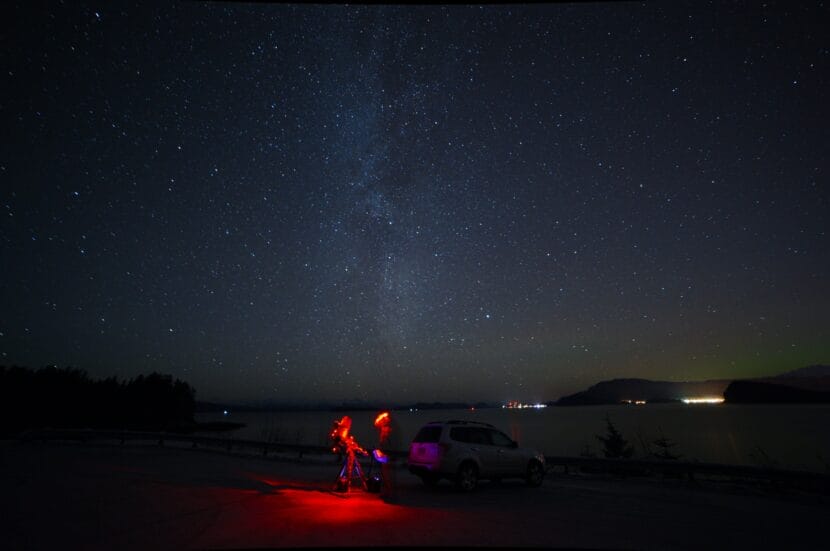
Dave Hanson photographs the Juneau night sky. (Photo provided by Dave Hanson)

This is Lingít Word of the Week. Each week, we feature a Lingít word voiced by master speakers. Lingít has been spoken throughout present-day Southeast Alaska and parts of Canada for over 10,000 years.

Gunalchéesh to X̱’unei Lance Twitchell, Goldbelt Heritage Foundation and the University of Alaska Southeast for sharing the recorded audio for this series.

This week’s word is ḵutx̱.ayanaháa, or star. Listen to the audio below to learn how to say ḵutx̱.ayanaháa.

The following transcript is meant to help illustrate the words and sentences. 

Ḵaakal.áat Florence Marks Sheakley: Ḵutx̱.ayanaháa. 

That means star.

Here are some sentences:

Ḵaakal.áat Florence Marks Sheakley: Ḵutx̱.ayanaháa tuteen nooch kéi ḵunas.áatʼi

We always see stars when the weather is cold.

Keiyishí Bessie Cooley: Ḵutx̱.ayanaháa máa yatee yéixʼ ḵutg̱anaháa yóo dáx̱ duwasáakw lingít x̱ʼeináx̱.

Stars are sometimes called “ḵutg̱anaháa” in Lingít.

You can hear each installment of Lingít Word of the Week on the radio throughout the week. 

Additional language resources:

Find biographies for the master speakers included in this lesson here.

Learn more about why we use Lingít instead of Tlingit here.

Watch a video introducing Lingít sounds here.

Site notifications
Update notification options
Subscribe to notifications